9 perspectives, each in the voice of that country's press.
Canberra is particularly focused on the judicial scope of the UN report, presented as potentially fueling future prosecutions in international courts, rather than a moral verdict pitting Washington against Tehran.
4 sources
Brasília first takes note of the legal qualification in the UN report: the United Nations claims to have "reasonable grounds" to believe that the US strikes on Minab and Lamerd constitute war crimes, a conclusion that the Brazilian press details strike by strike before reporting the crossed denials of Washington and Tehran.
4 sources
Ottawa is first examining the legal qualification of the UN report, which classifies the two American strikes in February as war crimes and the Iranian repression as crimes against humanity.
2 sources
Paris identifies two complementary reports that each build a nominative case file: that of the UN mission on American strikes and Iranian repression, and that of Amnesty International which names 87 officials of the Iranian power for the 2022 repression.
3 sources
Tehran takes away from the UN report confirmation of American war crimes in Minab and Lamerd, more so than the finding regarding its own repression.
2 sources

Lisbon retains particularly the legal qualification of the UN report: war crime for the American strike on the Minab school, crime against humanity for the Iranian repression, without dwelling on the concrete consequences in Geneva.
2 sources
London is measuring the diplomatic consequences of the UN report, between the military dilemma of Trump and the granting of Iranian visas in the midst of war.
2 sources
The United States government rejects the conclusions of the UN report outright, with the White House attributing responsibility for the war crimes to Iran, while an internal assessment suggests a targeting error rather than an intentional strike.
5 sources
Pretoria is gauging the scope of this report in light of its own commitment to international accountability: the US refusal to recognize the authority of the Human Rights Council is holding South African attention, just like the crimes against humanity uncovered on the Iranian side.
2 sources
Common ground and differences in coverage across the media analysed.
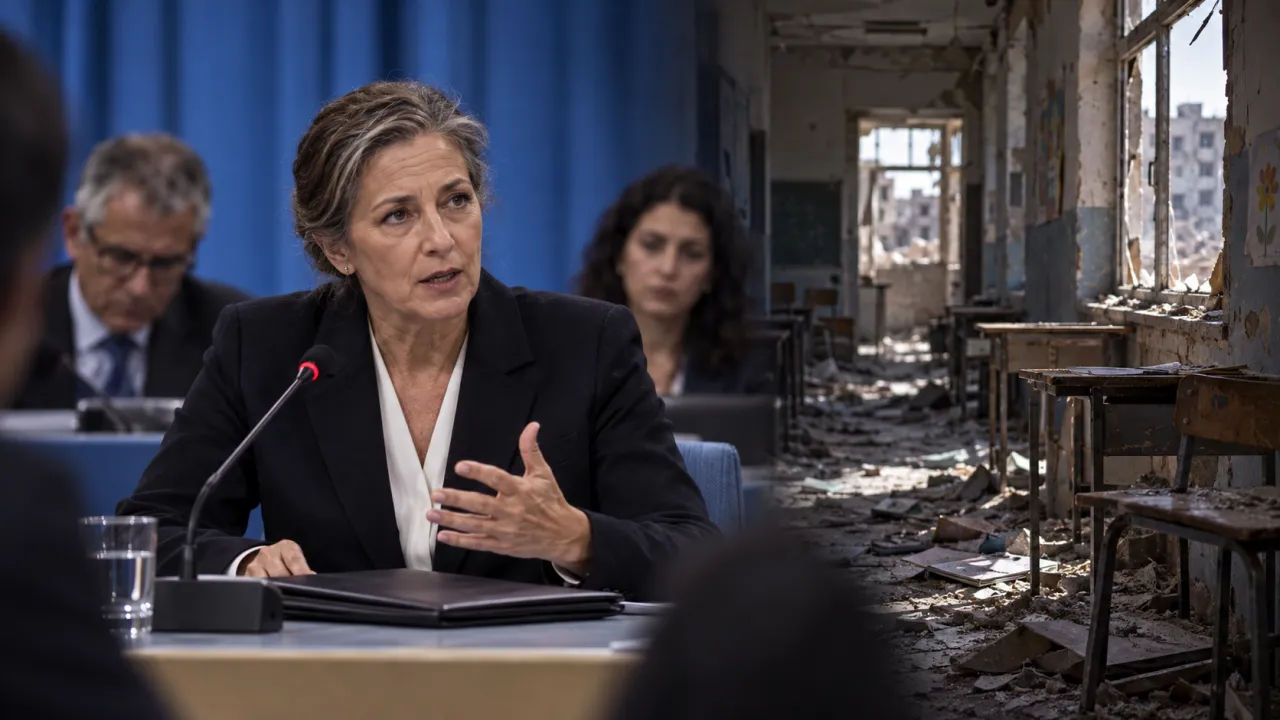
The International Independent Fact-Finding Mission on Iran, mandated by the UN, says it has 'reasonable grounds' to believe that US forces committed a war crime when they struck the Shajareh Tayyebeh primary school in Minab on February 28, where more than 150 people, including around 100 schoolchildren, were killed according to Iranian authorities.
The same report concludes that Iranian authorities committed crimes against humanity in suppressing the anti-government protests that began in late December.
The report also covers a second US strike, targeting a sports complex and a residential neighborhood in the city of Lamerd.
While the UN mission believes that the failure to update US targeting databases goes beyond simple negligence, an internal assessment cited by the US press suggests a likely unintentional strike, linked to the use of outdated intelligence.
Coverage aligned with this reading
Coverage that diverges
Coverage emphasizes, depending on the country, the potential judicial scope of the report (prosecutions, international courts) or its immediate diplomatic fallout (visas granted to Tehran, military dilemma mentioned by Trump).
Coverage aligned with this reading
Coverage that diverges
This grouping describes the publications analysed, not the position of these countries’ populations or of their governments.
DOMINANT ANGLE
Canberra is particularly focused on the judicial scope of the UN report, presented as potentially fueling future prosecutions in international courts, rather than a moral verdict pitting Washington against Tehran.
KEY POINTS
ANALYSIS
Canberra, September 18, 2026. The Australian press is reporting without hesitation the conclusions of the International Independent Fact-Finding Mission on Iran, mandated by the UN Human Rights Council in Geneva and chaired by Bangladeshi jurist Sara Hossain. According to ABC News, the body established in 2022 says it has "reasonable grounds" to believe that US forces committed a war crime by striking the Shajareh Tayyebeh primary school in Minab on February 28, at the very beginning of the war between the US, Israel, and Iran. More than 150 people, including around 120 schoolchildren according to Iranian authorities, were killed; Iranian state media reports 168 deaths, mostly children. PerthNow estimates that at least 178 civilians, including women and children, were victims of the two US strikes in February, including a second strike on a sports complex, also qualified as an indiscriminate attack.
The Sydney Morning Herald and The Age, which are reporting the same dispatch, detail the investigators' reasoning: Washington allegedly relied on intelligence placing a high-ranking Iranian commander at the site without sufficiently verifying the information before launching the strike, and did not update its targeting data on the presence of the school, which is located near a naval installation of the Revolutionary Guards. PerthNow emphasizes that the report "could potentially be used in efforts to seek justice before international courts" - the angle most taken up by the Australian press, more so than the moral verdict on Washington or Tehran.
The same report concludes that Iranian authorities committed crimes against humanity in suppressing the protests that began in late December, before the war. ABC News recalls that the Trump administration neither acknowledged responsibility nor published the results of the Pentagon's investigation into the bombing of the school. The Iranian and US permanent missions in Geneva did not immediately respond; neither did the US State Department. Washington has always claimed to conduct its operations "in accordance with the law of armed conflict", while Tehran rejects accusations of systematic violations.
DOMINANT ANGLE
Brasília first takes note of the legal qualification in the UN report: the United Nations claims to have "reasonable grounds" to believe that the US strikes on Minab and Lamerd constitute war crimes, a conclusion that the Brazilian press details strike by strike before reporting the crossed denials of Washington and Tehran.
KEY POINTS
ANALYSIS
Brasília, Friday, September 18, 2026. The Brazilian press is detailing the conclusions of the International Independent Fact-Finding Mission on Iran, mandated by the UN, which stated on Thursday that it has "reasonable grounds" to believe that the United States committed war crimes during two strikes on February 28 against Iran. The report, intended for the Human Rights Council in Geneva, first targets the Tomahawk missile bombing of the Shajareh Tayyebeh primary school in Minab, southern Iran: according to the tolls reported by Veja and G1, the strike killed over 150 people, including nearly 120 children. The investigators consider the school a "clearly identifiable" civilian target and found no evidence of military use of the site; the report, cited by Veja, states that Washington relied on intelligence indicating the presence of a high-ranking Iranian commander without properly verifying it before striking "the school building knowing that there was a substantial risk" of hitting civilians.
The second strike, in Lamerd, hit a sports center and a neighboring residential area near a school with a PrSM fragmentation missile, dispersing "tungsten clouds" and killing or injuring 22 civilians, according to G1. The same report concludes that Iranian authorities committed crimes against humanity by suppressing, in the country's 31 provinces, the protests launched in late December against the rising cost of living, using "repressive laws", "lethal force", and the death penalty as a tool of intimidation, according to the Jornal de Brasília.
DOMINANT ANGLE
Ottawa is first examining the legal qualification of the UN report, which classifies the two American strikes in February as war crimes and the Iranian repression as crimes against humanity.
KEY POINTS
ANALYSIS
Ottawa, September 18, 2026. Canadian newsrooms are repeating, almost word for word, the UN dispatch released on Thursday: the International Independent Fact-Finding Mission on Iran, mandated by the UN, says it has "reasonable grounds" to believe that the United States is responsible for two military strikes carried out in February against an Iranian school and sports facility, and that these strikes constitute war crimes. The same report, intended for the Human Rights Council in Geneva, concludes that Iranian authorities have committed crimes against humanity in suppressing anti-government protests that began in late December, even before Washington and Israel launched their airstrikes against Iran on February 28.
CBC News and the Globe and Mail detail the strike on the Shajareh Tayyebeh primary school in Minab: over 150 people killed, including about 120 schoolchildren, according to Iranian authorities. UN experts describe this attack as indiscriminate, causing civilian deaths and damage to civilian infrastructure, which constitutes a war crime under international law.
The report emphasizes a specific point: the US military did not update its targeting databases concerning this school, which is located near a naval complex of the Revolutionary Guards, nor confirm that it was a military target. For the mission, this goes beyond simple negligence.
DOMINANT ANGLE
Paris identifies two complementary reports that each build a nominative case file: that of the UN mission on American strikes and Iranian repression, and that of Amnesty International which names 87 officials of the Iranian power for the 2022 repression.
KEY POINTS
ANALYSIS
Paris, Friday, September 18, 2026. The French press has taken note of the latest report from the International Independent Fact-Finding Mission on Iran, intended for the Human Rights Council, which portrays a population caught in a vice. BFMTV quotes UN investigators describing Iranian civilians as "trapped between serious human rights violations and crimes against humanity committed by their own government, and the deadly conflict pitting the country against the United States and Israel", a conflict triggered on February 28 by Israeli-American strikes. According to the mission, the repression of last winter's protests, which began in late December against a backdrop of anger over the cost of living before culminating on January 8 and 9, "marks a significant escalation compared to the past": increased use of the death penalty, communication cuts, and repressive laws.
This report adds to the distinct but convergent one recently published by Amnesty International in the French columns. Four years after the death in detention of Mahsa Amini, the NGO documents over 1,000 pages of "crimes against humanity" - murders, tortures, rapes, forced disappearances - committed during the repression of the 2022 "Woman, Life, Freedom" movement, and names 87 Iranian officials, including the current head of the Revolutionary Guards, Ahmad Vahidi. "The Iranian authorities have committed crimes against humanity to crush the 2022 Woman, Life, Freedom uprising", asserts Amnesty's Secretary General, Agnès Callamard, as part of, she says, "a state policy of resorting to deadly force to reduce any dissent to nothing". Six of the named officials have since been killed in the American-Israeli strikes that opened the war at the end of February.
DOMINANT ANGLE
Tehran takes away from the UN report confirmation of American war crimes in Minab and Lamerd, more so than the finding regarding its own repression.
KEY POINTS
ANALYSIS
Tehran, Friday, September 18, 2026. The report published Thursday by the International Independent Fact-Finding Mission on Iran, mandated by the UN Human Rights Council in Geneva, offers the Islamic Republic an unexpected piece of evidence: confirmation, by an international body, that the United States probably committed war crimes last February. The Mehr agency reports that the mission found "reasonable grounds to believe that the United States committed the war crime of launching indiscriminate attacks resulting in the loss of human life or injury to civilians, or damage to civilian property," targeting the February 28 strike on the Shajareh Tayyebeh primary school in Minab, where Iranian authorities counted over 150 dead, including around 120 schoolchildren, as well as a second strike on a sports complex and residential neighborhood in Lamerd, where munitions scattered tungsten pellets. According to the mission, the failure to update American targeting bases regarding the school, located near a naval installation of the Revolutionary Guards, goes beyond simple negligence. The same report, in its other part, concludes that Iranian authorities committed crimes against humanity in suppressing the protests launched at the end of December: documented killings in all 31 provinces, at least 221 children killed, tens of thousands of arbitrary detentions, and an internet blackout imposed on January 8, which remained in effect for over five months. This second finding, documented by Iran International, is not included in the Mehr agency's account, which only addresses the part of the report implicating Washington. Tehran, which rejects accusations of systematic violations, highlights the American part of the report as validation of its version of the February strikes, while Washington rejects the entire document, its officials having always claimed to respect the law of armed conflict.
DOMINANT ANGLE
Lisbon retains particularly the legal qualification of the UN report: war crime for the American strike on the Minab school, crime against humanity for the Iranian repression, without dwelling on the concrete consequences in Geneva.
KEY POINTS
ANALYSIS
Lisbon, September 18, 2026. The Portuguese press reported on Thursday the conclusions of the report by the International Independent Fact-Finding Mission on Iran, mandated by the UN Human Rights Council. According to SAPO Notícias, the mission claims to have "motivos razoáveis" (reasonable grounds) to believe that the United States committed war crimes during two military strikes in February against a school and a sports complex. The document, to be presented on Monday to the Human Rights Council in Geneva, particularly highlights the attack on February 28 against the Shajareh Tayyebeh primary school in Minab: American forces launched Tomahawk missiles against a clearly identifiable school, as well as another missile with a tungsten warhead. The mission describes this strike as "indiscriminée" (indiscriminate). SAPO recalls that in Minab, over 150 people were killed, according to Iranian authorities. SAPO also notes that these February 28 strikes are part of a series of American and Israeli attacks against Iran, and that the second case examined by the mission, in Lamerd, targeted a sports complex and a residential neighborhood.
The Observador, in its "A Guerra Traduzida" bulletin, cites Reuters to place the report in a broader context: the mission examined both American military conduct and the Iranian government's response to the unrest that began in late December. On the latter point, the UN investigation concludes that Iranian authorities committed crimes against humanity in the deadly repression of anti-government protests. Both media outlets note that Washington had, even before publication, claimed that its military operations respected the law of armed conflict, while Tehran continues to systematically reject accusations of human rights violations.
DOMINANT ANGLE
London is measuring the diplomatic consequences of the UN report, between the military dilemma of Trump and the granting of Iranian visas in the midst of war.
KEY POINTS
ANALYSIS
London, 18 September 2026. The report by the International Independent Fact-Finding Mission on Iran, mandated by the UN, is making headlines in the British press mainly due to its shockwave in Washington. The text, intended for the Human Rights Council in Geneva, establishes "reasonable grounds" to believe that the United States committed war crimes during two strikes in February: one on the Shajareh Tayyebeh primary school in Minab, where at least 156 civilians died according to investigators — including 120 children, a toll that Iranian state media puts at 168 — and another on a sports complex and residential area in Lamerd, which killed or injured 22 civilians. According to the mission, US forces relied on intelligence placing a commander of the Revolutionary Guards at the school, without verifying or confirming that the site remained a legitimate target. Washington had already denied striking Lamerd and said it was investigating Minab; a State Department official now claims that the US gives no credibility to the report's conclusions. The same document concludes that there were crimes against humanity on the Iranian side, for the repression of January's protests, with killings in all 31 provinces "on a staggering and unprecedented scale". Tehran has not commented on this new report, simply recalling that it rejects any accusation of systematic violations.
What the British press is mainly taking away from this is the impact on the conduct of the war itself. Asked by Axios, Donald Trump mentioned a "big decision" to come: "Do I want to go in and annihilate them [the Iranian regime] or not? It's a big decision. Anything can happen with me." Another sign of this climate: Washington has granted visas to the Iranian president and his foreign minister to attend the UN General Assembly in New York next week — despite the war still being at an impasse. For London's newsrooms, the Geneva report therefore settles nothing: it is part of an ongoing diplomatic balance of power between Washington, Tehran, and the UN, where the judicial issue weighs less, for now, than the American president's political calculation.
DOMINANT ANGLE
The United States government rejects the conclusions of the UN report outright, with the White House attributing responsibility for the war crimes to Iran, while an internal assessment suggests a targeting error rather than an intentional strike.
KEY POINTS
ANALYSIS
Washington, Friday, September 18, 2026. The Pentagon and the White House rejected outright on Thursday, September 17, 2026, the conclusions of the International Independent Fact-Finding Mission on Iran, mandated by the UN Human Rights Council in Geneva. The report claims to have "reasonable grounds" to believe that American forces committed the war crime of launching indiscriminate attacks during two strikes in February: the Shajareh Tayyebeh primary school in Minab, where over 150 people were killed according to the cited count, and a sports complex and residential neighborhood in Lamerd, where 22 civilians died.
A State Department official dismissed the credibility of the text, accusing the Human Rights Council of "pushing anti-American and anti-Semitic rhetoric" and "appeasing repressive regimes," according to CNBC. White House spokesperson Anna Kelly, quoted by the Associated Press, was even more direct: "The only party in this conflict that has committed war crimes is the Iranian regime." Washington had already left the Human Rights Council by presidential decree from Donald Trump in February 2025; the mission said it had sought American cooperation without receiving a response.
DOMINANT ANGLE
Pretoria is gauging the scope of this report in light of its own commitment to international accountability: the US refusal to recognize the authority of the Human Rights Council is holding South African attention, just like the crimes against humanity uncovered on the Iranian side.
KEY POINTS
ANALYSIS
Pretoria, September 18, 2026. The International Independent Fact-Finding Mission on Iran, mandated by the United Nations, has concluded that there are "reasonable grounds to believe" that American forces committed war crimes during two strikes in February in Iran, report Daily Maverick and SABC News, which are relaying the conclusions transmitted to the Human Rights Council in Geneva.
The first strike targeted the Shajareh Tayyebeh primary school in Minab, in the south of the country: more than 150 people were killed there, according to Iranian authorities. The second strike hit a sports complex and a residential neighborhood in Lamerd. For UN investigators, the fact that Washington did not update its targeting bases concerning the school, which is located near a naval installation of the Revolutionary Guards, goes beyond simple negligence.
The same report also finds that Iranian authorities committed crimes against humanity in the repression of anti-government protests that began at the end of December: killings, massive arbitrary detentions, and prolonged internet shutdowns. Neither Washington nor Tehran is spared.
The American reaction occupies a central place in South Africa's handling of the file. White House spokesperson Anna Kelly judged that the Human Rights Council "has accomplished nothing for human rights", affirming that only Iran had committed war crimes in this conflict. The Pentagon says its investigation is "ongoing" and has "nothing to announce for the moment". The Geneva mission recalls that it is an investigative body, not a judicial one: its findings can feed into prosecutions before national jurisdictions or the International Criminal Court.
Explore every perspective on this subject across 9 countries.
Compare viewpoints and see where they diverge.
published on
countries
sources
articles
The UN mission based its findings on unverified intelligence that placed an Iranian commander at the Minab school, while a parallel report by Amnesty International, released on Wednesday, September 16, names 87 officials responsible for the 2022 Iranian crackdown, and in Washington, Donald Trump mentions a "big decision" to come regarding Iran, according to Axios.
The report, transmitted to the Human Rights Council, has not yet led to any known judicial proceedings in Geneva.
According to ABC News and the Sydney Morning Herald, UN investigators estimate that Washington relied on intelligence placing a high-ranking Iranian commander at the school site before striking, without re-verifying this information or updating its targeting databases on the existence of the school building, located near a naval installation of the Revolutionary Guards.
For the mission, this lack of update goes beyond simple negligence. In Lamerd, according to the G1, the strike was carried out with a fragmentation PrSM missile that dispersed "tungsten clouds" over a sports complex and a residential neighborhood near a school.
In May, before the House of Representatives, Admiral Brad Cooper, from Central Command, had stated that the Minab attack "corresponded" to a US strike, according to the US press. In June, Donald Trump himself acknowledged that "nobody did this intentionally" and that "mistakes were made", according to Axios.
« The only party in this conflict that has committed war crimes is the Iranian regime. »
CENTCOM, on the other hand, continues to deny any responsibility in the strike on the Lamerd sports complex. The State Department, for its part, has dismissed any credibility of the UN report, accusing the Human Rights Council of "pushing anti-American and anti-Semitic rhetoric" and "appeasing repressive regimes", according to CNBC.
Four years after the death in detention of Mahsa Amini, Amnesty International documents, over more than 1,000 pages, murders, tortures, rapes and forced disappearances committed during the repression of the "Woman, Life, Freedom" movement of 2022, qualified as crimes against humanity, according to France 24 and RFI.
« Iranian authorities have committed crimes against humanity to crush the 2022 Woman, Life, Freedom uprising »
The report names 87 Iranian officials, including the current head of the Revolutionary Guards Ahmad Vahidi. Six of them have since been killed in American-Israeli strikes that opened the war at the end of February, according to BFMTV.
The report is to be presented on Monday to the Human Rights Council in Geneva, according to several outlets, including Daily Maverick and SAPO Notícias. Jornal de Brasília reports that investigators are asking Council member states to pressure for an end to the war, to prosecute those responsible, and to grant asylum to civilians fleeing Iran.
« Do I want to go and annihilate them or not? It's a big decision. Anything can happen with me. »
Daily Maverick notes that the mission is not itself a judicial body: its findings can inform prosecutions in national courts or the International Criminal Court. The report comes as Washington has granted visas to the Iranian president and his foreign minister to attend the UN General Assembly in New York next week, according to The Independent.
Established in 2022, it is chaired by Bangladeshi jurist Sara Hossain.
47 member states; Iran, Israel, and the United States are not part of it.
A preliminary report mentions a probable but unintentional strike, related to outdated intelligence.
Published on Wednesday, it names 87 Iranian officials including the head of the Revolutionary Guards Ahmad Vahidi.
The Jornal de Brasília also reports that the investigators are asking the 47 member countries of the Human Rights Council - which does not include Iran, Israel, and the United States - to pressure for an end to the war, to prosecute those responsible, and to grant asylum to civilians fleeing the country. On the American side, the Pentagon refused to comment on a report "conducted by an external organization", according to UOL, while White House spokesperson Anna Kelly retorted that the Council "has done nothing for human rights" and that Iran is the only party to the conflict to have committed war crimes. The Iranian permanent mission in Geneva did not respond to requests from the Reuters agency, while Tehran continues to reject accusations of systematic violations.
The two Canadian titles report that the Iranian and American permanent missions in Geneva did not immediately respond to requests from Reuters. They recall the consistent positions of the two capitals: Washington asserts that its military operations respect the law of armed conflict, Tehran rejects accusations of systematic human rights violations on its part.
None of the two articles consulted mention an official Canadian reaction. The coverage is limited to relaying the conclusions of the UN mission and the legal qualifications it retains - war crime for the American strikes, crime against humanity for the Iranian repression - without the federal government being quoted or questioned on this matter.
The convergence of these two texts - one on the crimes attributed to Iranian repression, the other on those that the UN mission attributes to Washington, including the controversial strike on a school in the south of the country - puts the French press in front of the same editorial reflex: documenting, naming the chains of command, with a view to international justice that neither Tehran nor Washington recognizes for the time being.
Neither SAPO nor the Observador provides details on the concrete actions the Human Rights Council could take in response to this report, nor the exact figures of Iranian repression mentioned in the UN dossier. The Portuguese coverage remains focused on the legal qualification itself: war crime for the school attack, crime against humanity for the repression, presented as the two sides of the same report submitted to Geneva.
The American press nonetheless notes a nuance that Washington has not publicly claimed. CBS News reports that a preliminary internal assessment judged American forces "probably" responsible for the Minab strike, without intending to target the school, possibly due to outdated intelligence that still classified the area as part of an Iranian military installation. In June, Trump himself stated that "nobody did this intentionally" and that "mistakes are made," according to Axios. In May, Admiral Brad Cooper, from Central Command, told the House that the Minab attack "corresponded" to an American strike.
CENTCOM continues to deny any responsibility for the strike on the Lamerd sports complex. Neither the White House nor the Pentagon has acknowledged responsibility or published the conclusions of a Pentagon investigation into the school attack, which was opened on the first day of the war. The case also revives a documented fracture among Republicans over the conduct of the conflict, while the president continues to assure that Tehran wants an agreement to end it.
For the South African press, this contrast between the American rejection of UN mechanisms and Pretoria's historical adherence to human rights multilateralism gives the report a scope that goes beyond the Iran-United States conflict: it questions the solidity of the bodies that South Africa regularly invokes in its own approaches, from the International Criminal Court to the International Court of Justice. The report is to be presented to the Human Rights Council on Monday, where Washington and Tehran will again be under the scrutiny of member states.






