Venezuela: María Corina Machado returns from exile amid uncertainty over a presidential election
published on
countries
sources
articles
More divergent than 33% of recent comparable stories (reference: 98 recent stories measured with the same method).
The return of María Corina Machado can be understood through three questions that the covers of the corpus address unevenly: where she entered, what Washington did or did not do, and under what conditions an election could take place.
No presidential election date has been set: Delcy Rodríguez talks about elections without a calendar, while the opposition demands a date and the release of political prisoners.
An entry via Colombia, according to ABC
No source in the corpus directly documents the route. Folha, Tagesschau, HuffPost España, and MTV Uutiset note that neither Machado nor her entourage has specified how she entered the country or where she is.
Infobae and Primicias quote a publication from the Spanish daily ABC: the crossing allegedly took place at the Colombian border during the weekend of October 24 and 25, after international efforts. Primicias mentions a ninth attempt since June. Infobae counts eight failed operations between June and September. Clarín estimates the car journey to be 847 kilometres from the Táchira border.
Channel News Asia, according to two sources, describes a private flight from Panama to Colombia, followed by a land border crossing. The Independent reports the same itinerary, also based on two sources. The Buenos Aires Times cites two exiles who told AFP that she passed through Colombia, without confirmation from Colombian authorities.
The number of attempts varies depending on the source. Le Temps, Handelsblatt, Aftonbladet, and Subrayado write "at least seven", citing Machado's party. ABC, as relayed by Infobae and Primicias, reports eight failed attempts followed by a ninth try.
From Barquisimeto to Caracas
According to HuffPost España, Machado appeared during mass at the Divina Pastora sanctuary in Santa Rosa. Runrun.es notes that this mass surprised Vente Venezuela militants. She then traveled to Caracas by road, with stops in Yaracuy, Carabobo, and Aragua, according to El Pitazo and El Universo, which cites EFE.
« Venezuela is giving a lesson to the entire world »
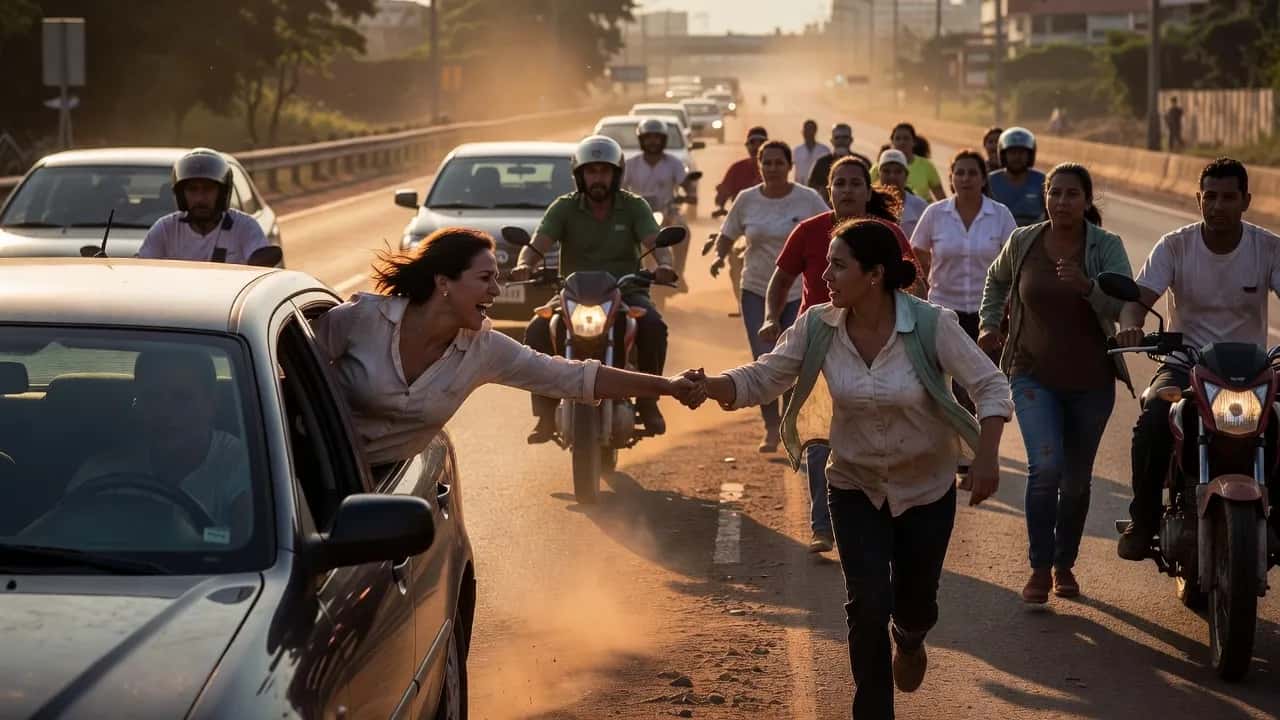
El Universo describes an armored vehicle and thousands of people along the route. El Pitazo notes the absence of security forces members and chants of "Elecciones Ya". The arrival times in Caracas differ: El Pitazo writes around 22 hours, RPP after 21 hours.
La Libre Belgique, which relies on AFP journalists, places her in Guacara before her arrival in the capital in the evening. Clarín adds stops in Valencia and Maracay.
What Washington has done or not
Several outlets report different versions of the US role prior to the return. MTV Uutiset, Channel News Asia, The Independent, and La República recall that, according to Reuters in June, US officials had asked Machado to postpone her trip. The Guardian writes that the administration was, according to unconfirmed information, opposed to this return.
« there is little doubt that her passage depended on approval from the United States »
The BBC notes that information suggests a US role in the delay, which Washington denies. MercoPress indicates that Donald Trump denied this and that Marco Rubio claims she could return "like any Venezuelan citizen". Primicias, according to ABC, mentions a White House decision not to oppose her return after all.
On the calendar, France 24, YLE, Channel News Asia, and Business Day recall that in September, Donald Trump deemed it premature to consider democratic elections. NPR writes that Washington responds that the country must first stabilize. Aftonbladet mentions economic stability first, and El Observador a three-phase US plan: stabilization, recovery, transition.
The Reuters dispatch published by Business Day also mentions a signing ceremony the previous month, supervised by Delcy Rodríguez and US Energy Secretary Chris Wright, where international energy groups committed to expanding their projects.
The dialogue from which Machado is absent
MercoPress reports that Delcy Rodríguez's government has been negotiating with Dinorah Figuera since August on a roadmap: renewal of the Supreme Court and the National Electoral Council, followed by regional elections before the presidential election. Machado has rejected this sequence. BioBioChile adds that a third round of dialogue concluded the previous week, welcomed by the United States, and that Machado was not invited but says she will not hinder it.
On the Venezuelan side, the local press writes that the dialogue table has just opened a discussion on political guarantees and the revision of four laws used to disqualify opponents, including Machado. La Libre Belgique reports that Delcy Rodríguez assured that elections will take place, without a date. Gestión quotes her phrase: they will take place when Venezuela "is prepared".
CBS News recalls that Caracas considers Machado a fugitive, accused of having called for military intervention. Adnkronos lists accusations of treason, terrorism, conspiracy, and homicide. According to El Financiero, which reprints Bloomberg, the government has already allowed exiles to return, including Machado's relatives; an official from the Ministry of Information did not respond to their request for comment.
The BBC notes that it is unknown what Machado plans to do, but she has said she wants to run again if an election is organized. In this corpus of 23 countries, the meta-analysis ranks 14 presses in a reading centered on Washington's role and six in a reading centered on the electoral calendar and mobilization. This count measures what each coverage highlights, not the opinion of their readers.
Marco Rubio sees it as the "direct result" of the reconciliation talks; Donald Trump says he knows nothing about the return.
According to her party, Machado had tried to enter at least seven times; ABC mentions an entry via Colombia.
He hailed "a very important day for Venezuelans" and announced that he would also be returning soon.
Key figures
- 61 %percent of favorable opinions towards Machado according to an AtlasIntel poll for Bloomberg News1 source · El Financiero
- 52 % versus 19 %voting intentions for Machado versus Delcy Rodríguez, according to the same poll1 source · El Financiero
Other figures compared across countries
Failed return attempts before October 25
Basis of comparison: Number of failed attempts by Machado to return, according to his party or ABC, between June and October
Four outlets report "at least seven" attempts according to Machado's party; Argentina (eight failed operations, according to ABC) and Ecuador (ninth attempt since June) provide a higher count, also from the same Spanish media.
Values by country (10)
- Switzerland · at least seven timesLe Temps
- Germany · At least seven timesHandelsblatt
- Sweden · at least seven timesAftonbladet
- Uruguay · seven attempts to return according to her partySubrayado
- Argentina · eight failed operations between June and SeptemberInfobae
- Ecuador · ninth test since JunePrimicias
- Belgium · not reported in this corpus
- Brazil · not reported in this corpus
- Canada · not reported in this corpus
- Mexico · not reported in this corpus
What the comparison reveals
Common ground and differences in coverage across the media analysed.
What the media report in common
María Corina Machado announced her return to Venezuela on Sunday, October 25, through a message on X, after nearly a year in exile.
Delcy Rodríguez has been interim head of Venezuela since Nicolás Maduro was ousted by a US operation in January, and no presidential election date has been set.
Where media coverage diverges
Who made the return possible
Marco Rubio attributes the conditions for the return to the reconciliation talks supported by Washington. Other headlines report, according to Reuters and ABC, that US officials had asked Machado to postpone her return, or that the administration was reluctant about it.
Presidential election schedule
Machado, her allies, and the protesters are demanding an election date. US officials, as reported by NPR, Aftonbladet, and YLE, respond that the country must first stabilize or deem the elections premature.
Coverage that diverges
This grouping describes the publications analysed, not the position of these countries’ populations or of their governments.
How each country frames the event
- diplomatic
- ArgentinaBelgiumBrazilCanadaSwitzerlandChileColombiaEcuadorFinlandFranceRomaniaSingaporeUnited KingdomUnited StatesUruguaySouth Africa
- domestic politics
- SpainGermanyItalyMexicoPeruSwedenVenezuela
2 different framings across 23 countries · 16 of 23 countries share the same framing
Pair by pair: same frame or different frames
Each square pairs two countries. Filled: both countries' coverage uses the same frame. Empty: their frames differ. The map describes framings without evaluating them.
Pairs with the same frame: 141 of 253
- same frame
- different frames
Blind spots
What the coverage of each country leaves aside, while others put it forward.
 Mexico
- election calendar demanded by the opposition
- release of political prisoners
Geopolitical context
María Corina Machado's return comes amid a Venezuelan transition opened by the US military operation in January, which sidelined Nicolás Maduro. Delcy Rodríguez is serving as interim leader with the apparent backing of Washington, which is holding reconciliation talks with a sector of the opposition that Machado has not been invited to. The issue of the presidential election date, the release of political prisoners, and the role of the United States is shaping the coverage across neighboring countries, European, and Asian presses.
Understand the context
- OCT 22, 2026Thousands of people are protesting to demand a quick presidential election
- OCT 25, 2026Machado announces her return on X and joins Caracas in a caravan
How each country reads it
Preview: 3 of 23 media perspectives. Syntheses of the media analysed — not direct quotations. Method & limitations
 Spain
Madrid sees this return as a challenge to the interim government, following seven failed attempts and with no electoral calendar on the horizon.
3 sources · View sources
 Argentina
Buenos Aires sees the return of María Corina Machado as the result of a diplomatic operation led by Washington, with Colombia as a conduit and internal tensions within the Trump administration.
5 sources · View sources
 Belgium
Brussels weighs in on Washington's role: María Corina Machado's return is presented as a challenge to Delcy Rodríguez, in a transition that the United States is driving without her.
2 sources · View sources
The full text, country by country
Spain
DOMINANT ANGLE
Madrid sees this return as a challenge to the interim government, following seven failed attempts and with no electoral calendar on the horizon.
KEY POINTS
- Machado announced his return on Sunday, October 25, with "Estoy aquí. Con ustedes" after nearly ten months in exile and at least seven failed attempts in three months (El País English, HuffPost España).
- She appeared during mass at the Divina Pastora sanctuary, in Barquisimeto (Lara State), about 360 km from Caracas (ElDiario.es, HuffPost España).
- Edmundo González confirmed the arrival: "Hoy es un día muy importante para los venezolanos", and said he will return very soon as well (ElDiario.es, El País English).
ANALYSIS
Madrid, October 26, 2026. The Spanish press is treating María Corina Machado's return as the major Venezuelan political event of the weekend. On Sunday, October 25, the Nobel Peace Prize laureate announced on social media: "Estoy aquí. Con ustedes" ("I am here. With you"). HuffPost España reports that she appeared during mass at the Divina Pastora sanctuary in Santa Rosa, in the state of Lara, where she was greeted by supporters who hugged her and filmed the scene with their phones. ElDiario.es specifies that the sanctuary is located in Barquisimeto, about 360 kilometers west of Caracas, and relays images broadcast by her party, Vente Venezuela.
The three media outlets emphasize the difficulty of her return. Machado's team had reported at least seven failed attempts in three months, by boat, commercial or private plane, or by land, from Virginia, Panama, and Curaçao. El País English writes that, due to the lack of public explanation, "there is little doubt that her passage depended on approval from the United States". According to HuffPost España, it is still unknown by which route she entered the country or what her first destination was.
The reminder of her departure fuels the narrative: Machado had secretly left Venezuela on December 9, 2025, disguised and by boat to Curaçao, according to the reconstruction by the Wall Street Journal cited by HuffPost España. Her daughter, Ana Corina Sosa, had received the Nobel Prize in Oslo on her behalf.
Edmundo González, presented by ElDiario.es as the opposition candidate in 2024, who claims to have won that election, confirmed her arrival: "Today is a very important day for Venezuelans". He added that "our sovereign voice returns with her to lead and guide this process" and that he would also return "very soon". HuffPost España reports that Donald Trump expressed the wish for her to be safe.
The electoral issue structures the Spanish reading. HuffPost España dedicates a section to "a transition without an electoral calendar": Machado returns to a country led by an interim president, Delcy Rodríguez, who has set no election date. El País English speaks of a "direct challenge" to the government. ElDiario.es, more critical, describes Machado as "ultra-right" and recalls that González was recognized as the president in office by about fifteen countries.
Argentina
DOMINANT ANGLE
Buenos Aires sees the return of María Corina Machado as the result of a diplomatic operation led by Washington, with Colombia as a conduit and internal tensions within the Trump administration.
KEY POINTS
- Machado announced his return on X ("Estoy aquí. Con ustedes") after about ten months in exile and at least seven failed attempts, according to Clarín and MercoPress.
- According to ABC cited by Infobae, Colombia served as a transit point over the weekend of October 24 and 25, after eight failed operations between June and September.
- The government of Delcy Rodríguez has been negotiating with Dinorah Figuera since August on a roadmap providing for regional elections before the presidential election, a sequence that Machado rejects (MercoPress).
ANALYSIS
Buenos Aires, October 26, 2026. María Corina Machado announced her arrival at 11:30 am on X ("Estoy aquí. Con ustedes"), then prayed at the Divina Pastora sanctuary in Barquisimeto, before heading to Caracas by car, 847 kilometers from the Táchira border, with stops in Valencia, Guacara, and Maracay. Crowds awaited her at each stage, according to the daily. After seven failed attempts, a "diplomatic operation" would have produced the "miracle" of an uneventful entry, as reported by Clarín.
The itinerary is at the heart of the accounts. Infobae, citing the Spanish newspaper ABC, indicates that Colombia would have been a key piece in the operation during the weekend of October 24 and 25: a second attempt from this country and the ninth since June, with eight operations having failed between June and September. The same article mentions tensions within the Trump administration, concerned about not appearing responsible for a blockade. The Buenos Aires Times reports that two exiles told AFP that she entered through Colombia, without confirmation from Colombian authorities.
The political reading is just as present. Ámbito speaks of a "political challenge for Chavism" and notes that the return takes place while negotiations have left her camp "on the sidelines". MercoPress details this context: the interim president Delcy Rodríguez's government has been negotiating with Dinorah Figuera, president of the Assembly elected in 2015, a roadmap providing for the renewal of the Supreme Court and the National Electoral Council, followed by regional elections before the presidential election, a sequence that Machado has rejected.
The Argentine government is aware that Washington is at the forefront of the scene. Ámbito relays Marco Rubio, who attributes the return to American mediation. MercoPress recalls that several media outlets have stated that American officials had blocked certain attempts, which Donald Trump has denied, with Rubio ensuring that she could return "like any Venezuelan citizen". Edmundo González hailed "an important day for Venezuelans" and announced his own return "very soon".
The Buenos Aires Times puts the scene into perspective in a transformed country: Nicolás Maduro, captured during the American military operation in January, is being held in the United States, and the 59-year-old leader returns to challenge an interim government supported by Washington. Ámbito finally notes that the Uruguayan Colorado Party has joined the call for "free and transparent elections", a regional echo of a demand for an electoral calendar that remains unanswered.
Belgium
DOMINANT ANGLE
Brussels weighs in on Washington's role: María Corina Machado's return is presented as a challenge to Delcy Rodríguez, in a transition that the United States is driving without her.
KEY POINTS
- Machado returned to Venezuela on Sunday, October 25, after nearly a year in exile and arrived in Caracas in the evening (La Libre Belgique, according to AFP).
- Delcy Rodríguez ensured that elections would be held, without specifying a date, and is leading negotiations backed by Washington, from which Machado is excluded.
- Rubio considers the return a "direct result" of the US reconciliation process, while Trump says he knows nothing about it.
ANALYSIS
Brussels, 26 October 2026. The Belgian press is covering the return of María Corina Machado to Venezuela, on Sunday, 25 October, after nearly a year in exile. La Libre Belgique, citing AFP journalists, describes an opponent acclaimed by her supporters in Guacara, in the north of the country, before heading to Caracas in the evening, after a journey of several hundred kilometres. "Venezuela is giving a lesson to the whole world," she said.
For the daily, this return increases the pressure on the interim government to hold elections. It appears as a challenge for interim President Delcy Rodríguez, who is leading negotiations with part of the opposition, supported by Washington, on a democratic transition, from which Machado has been excluded. Rodríguez, who governs "under strong pressure from Washington", assured that elections would take place, without specifying a date. The crowd chanted: "We want elections, no more dialogue, elections now".
VRT NWS emphasizes the trajectory of the opponent. Nobel Peace Prize winner in 2025, Machado was to be the main rival of Nicolás Maduro in 2024, but she was excluded from the election, accused of corruption, and had long lived in hiding. The Flemish channel recalls that she offered her Nobel Prize to Donald Trump, a gesture that, according to her, brought her little benefit: after the abduction of Maduro and his wife by American special forces, Trump chose to work with Rodríguez and put Machado "completely aside". Washington has since exerted significant influence over the interim government.
American reactions, reported by La Libre, show this gap. When asked, Trump said he was not aware: "I don't know anything about it, but I think she's a very nice woman. She gave me her Nobel Prize, so how could I say otherwise?" Marco Rubio, on the other hand, sees it as the "direct result" of the "reconciliation" process under Washington's aegis.
The Belgian perspective is therefore one of a transition whose outcome depends less on the polls, for now, than on American arbitration. Both media outlets highlight the lack of an electoral calendar and the distance between the opponent and the White House, without taking a stance on the outcome.
 Brazil
DOMINANT ANGLE
Brasília is particularly wary of Washington's oversight of the Venezuelan transition: Machado's return is seen through the reconciliation negotiations supported by the United States.
KEY POINTS
- Machado returned to Venezuela on Sunday, October 25, after nearly a year outside the country, announcing: "Estou aqui. Com vocês" (Folha, G1).
- Marco Rubio claims the safe return conditions are a direct result of US-backed reconciliation negotiations (Folha).
- G1 reports that Delcy Rodríguez's government, successor to Maduro after the US military operation, is accused of being a continuation of Chavism.
ANALYSIS
Brasília, October 26, 2026. The Brazilian press reports on María Corina Machado's return to Venezuela on Sunday, October 25, emphasizing the diplomatic framework in which it takes place. According to Folha, the opposition leader, Nobel Peace Prize winner in 2025, "is trying to regain political prominence" amidst negotiations on the transition led by the interim government of Delcy Rodríguez "under the tutelage of the United States".
The two media outlets reproduce Machado's message on social networks, "Estou aqui. Com vocês" ("I am here. With you"), and the reaction of Edmundo González, opposition candidate in 2024, who wrote that "our leader, my dear María Corina, is in Venezuelan territory". Folha specifies that she visited a church in the state of Lara and that her party, Vente Venezuela, published images of her surrounded by supporters and attending a mass. González says he wants to join her soon in the country.
Folha recalls that Machado had left Venezuela in December 2025 to receive the Nobel Prize, after more than a year in hiding to avoid arrest; her daughter had received the distinction in Oslo. She then settled in Panama. G1 adds that this return follows several failed attempts in recent weeks and that her departure from the country was made possible by a secret operation led by the Trump administration.
The American aspect is central. Secretary of State Marco Rubio claims, according to Folha, that the conditions for her safe return are "the direct result" of the reconciliation negotiations supported by the United States. Neither of the two articles details how Machado entered the country: "we still do not know" how she managed to do so, notes Folha.
On the political level, G1 highlights the uncertainty: it is unknown what role she will play. The government of interim President Delcy Rodríguez, who succeeded Nicolás Maduro after the US military operation that overthrew him, is "accused of being a continuation of Chavism". The provided articles do not mention an electoral calendar, the release of political prisoners, or Donald Trump's reaction.
 Canada
DOMINANT ANGLE
Ottawa is weighing María Corina Machado's return in light of Washington's role: the Canadian press mainly sees growing doubts about Venezuela's democratic future, with no election scheduled.
KEY POINTS
- Machado reappeared in Venezuela on Sunday, October 25, for the first time since December, after 11 months of exile according to CBC.
- She returns to face an interim president who has exceeded the authorized term, with no election scheduled, after Maduro's ousting by the US military in January.
- When asked, Donald Trump said he knew nothing about her return but found Machado "very nice": "She gave me her Nobel Prize."
ANALYSIS
Ottawa, October 26, 2026. Canada's two major media outlets covering the event, the Globe and Mail and CBC News, share the same opening: opposition leader and Nobel laureate María Corina Machado reappeared in Venezuela on Sunday, October 25, for the first time since December, "at a time when doubts about the country's democratic future, and the role of the United States, are growing." CBC specifies that she had fled the country for 11 months after being briefly detained following a protest.
The Canadian narrative places this return in the sequence that began in January: the US military ousted President Nicolás Maduro and replaced him with interim president Delcy Rodríguez, who, according to both texts, has exceeded the time for which she was authorized to serve without any elections being scheduled. A subheading in the Globe describes a Venezuela "led by a Maduro ally backed by the Trump administration," and another recalls that Ms. Rodríguez promises elections and a transition to "full democracy."
Machado announced her arrival on social media: "I'm here. With you." Reporters describe her entry into a church in the state of Lara, west of Caracas, under the applause of a few dozen people, including a woman who speaks of "a miracle" and a man who shouts "Long live freedom!" She then took the road to Caracas with stops, thousands of people joining the convoy or waiting for her along the way. A man, in tears, runs alongside her car: "The future of my children is in your hands."
Edmundo González, another opposition figure, writes on X that he will be by her side "very soon" and hails "a very important day for Venezuelans," her "sovereign voice" returning with her to "lead and guide this process."
The US reaction is reported as is. When asked on Sunday, Donald Trump responded: "I don't know, but I think she's a very nice woman. She gave me her Nobel Prize. How could I say anything else?" before saying he hopes she is safe. Both media outlets leave this statement without comment, while inserting it into a text whose underlying theme remains electoral uncertainty and the dependence of the process on Washington.
 Switzerland
DOMINANT ANGLE
Bern-Zurich, through the voice of the Times and SRF, weighs this return in light of Washington: a Nobel return while Donald Trump praises cooperation with Delcy Rodríguez.
KEY POINTS
- María Corina Machado, 60, announced her return on Sunday, October 25, on X: "I'm here. With you.", after nearly a year in exile, including at least seven failed attempts to return, according to her party (Le Temps).
- Donald Trump, when asked, said he knew nothing about the return and described Machado as "a very pleasant woman", adding that she had given him her Nobel Prize (Le Temps, SRF).
- According to SRF, Delcy Rodríguez has been in charge of Venezuela since Nicolás Maduro was captured by the US army in January, and the return comes shortly after a controversial US oil deal.
ANALYSIS
Berne, October 26, 2026. The Swiss government is following the return of María Corina Machado, announced on Sunday, October 25. The Venezuelan opposition leader and Nobel Peace Prize winner wrote on the X network: "I am here. With you." According to Swiss sources, she had left the country in December 2025 to receive her award, after nearly a year in hiding, and had attempted to return at least seven times, in vain. At 60 years old, she was exiled in Panama, and her return marks the end of an absence marked by several demonstrations demanding her return.
The Swiss press recalls that she left the country after a year in hiding, amidst a wave of arrests.
The Lausanne daily details the first stage: the Santa Rosa church in Barquisimeto, some 400 km west of Caracas, where she came to thank the Virgin. Images broadcast by her team show supporters, some in tears, shouting: "Here is your people, María!" The SRF notes that Machado did not provide any details about her place of residence and that she was already largely in the shadows before her departure.
The German-speaking channel quotes Edmundo González, who says: "Today is a very important day": with her, he says, "our sovereign voice returns to lead this process and put it on the right track".
However, the essential part of the Swiss perspective passes through Washington. When asked by journalists, Donald Trump replied: "I don't know anything about this, but I think she's a very nice woman. She gave me her Nobel Prize, so how could I say otherwise?" He added that he hopes she is safe and that "we're doing very well in Venezuela". The SRF recalls that Trump regularly praises his good relationship with Delcy Rodríguez.
The context is set straightforwardly: Nicolás Maduro was captured in January by the US army in Caracas, and former Vice President Rodríguez has been leading the oil-rich country since then. The SRF emphasizes that the return comes a few weeks after a controversial American oil deal, which places the scene in a game of interests where the Nobel laureate appears as one actor among others, rather than as an arbiter of the political calendar.
 Chile
DOMINANT ANGLE
Santiago is deciphering María Corina Machado's return through the prism of Washington: the Chilean press is mainly relaying Marco Rubio's thesis, which attributes this return to the reconciliation dialogue supported by the United States.
KEY POINTS
- Marco Rubio claims Machado's return is the "direct result" of US-backed reconciliation talks, which have freed hundreds of political prisoners.
- Machado, who spent ten months in exile, was not invited to the third round of dialogue between the chavista regime and a sector of the opposition, but said she would not hinder it.
- Iván Duque hails a "sign of hope", calls for an election date, and holds Delcy Rodríguez's government responsible for Machado's security.
ANALYSIS
Santiago, October 26, 2026. Chilean media are covering María Corina Machado's return to Venezuela on Sunday, October 25, mainly through the statements it has sparked, particularly those from Washington. BioBioChile and La Tercera each dedicated an article to US Secretary of State Marco Rubio's stance on the matter.
According to La Tercera, Rubio stated on X that "the conditions that allow for Mme Machado's safe return to Venezuela are the direct result of the reconciliation conversations supported by the United States." He added that these discussions have already led to the release of "hundreds of political prisoners" and the return from exile of hundreds of opposition figures. He described them as "the best opportunity Venezuela has had in thirty years" to achieve a free election and lasting democracy peacefully. Washington also said it expects the freedoms of all political sectors to be respected.
BioBioChile put this message into context: the country is governed by Delcy Rodríguez, the interim president of chavista allegiance, under strong American pressure since Nicolás Maduro's capture during a US military operation in January. Maduro was transferred to a New York prison on narcotics trafficking charges. The media outlet recalled that a third round of dialogue between the chavista government and a sector of the opposition concluded the previous week, which was welcomed by the United States. Machado, who had been out of the country for ten months, was not summoned to the dialogue, but assured that she would not hinder it.
The second angle is regional. BioBioChile reported on the reaction of former Colombian President Iván Duque, who views this return as "a sign of hope for the recovery of democracy." He hopes that the date for "free, transparent, and internationally supported elections" will be announced soon. Duque also demanded the release of political prisoners, deemed that Machado's life must be protected, and held Delcy Rodríguez's government responsible for anything that might happen to her. He finally called on the United States to demand this guarantee.
Chilean coverage thus remains focused on the role of the United States and the issue of the electoral calendar, without giving a voice to Venezuelan actors from the current government.
 Colombia
DOMINANT ANGLE
Bogotá is deciphering Machado's return through the prism of Washington: between Trump's words, the credit Rubio is taking, and Duque's call, the Colombian press is placing the United States at the center of the Venezuelan transition.
KEY POINTS
- Marco Rubio stated on October 25 that Machado's return is the "direct result" of US-backed reconciliation talks, with hundreds of political prisoners released.
- Trump said: "Espero que esté a salvo. Es una mujer muy agradable. Pero nos está yendo realmente bien en Venezuela".
- Machado was not invited to the talks between the government and a sector of the opposition, but assured she would not hinder them.
ANALYSIS
Bogotá, October 26, 2026. The Colombian press is covering María Corina Machado's return as much as an episode of US tutelage over Venezuela as a Venezuelan event. Portafolio notes that Machado reappeared on Sunday, October 25, in a church in the state of Lara, "en medio del tutelaje de facto" that Washington exercises over the country, and quotes Donald Trump upon leaving the White House: "Espero que esté a salvo. Es una mujer muy agradable. Pero nos está yendo realmente bien en Venezuela." The US President gave no details about her return.
Semana highlights Marco Rubio's message on X: the conditions for Machado's secure return are "el resultado directo" of the reconciliation talks supported by the United States, which would have allowed the release of hundreds of political prisoners and the return of hundreds of exiled opponents. Rubio sees this as "la mejor oportunidad que ha tenido Venezuela en 30 años" to obtain free elections. The same article recalls that Machado, who remained in exile for ten months, was not summoned to these discussions, while ensuring that she would not hinder them.
El Colombiano and La República tell the story of her arrival: the announcement "Estoy aquí. Con ustedes" on X, Edmundo González's message ("Hoy es un día muy importante para los venezolanos"), and the crowd at the Divina Pastora sanctuary in Barquisimeto. El Colombiano recalls the failure of her attempt in September from Panama, then situates this return amidst negotiations between Jorge Rodríguez, president of the National Assembly and brother of interim president Delcy Rodríguez, and Dinorah Figuera. La República specifies that her supporters were waiting for her and that Washington had asked her in June to postpone her trip.
The most outspoken Colombian voice is that of former President Iván Duque, relayed by Semana: this return is "un símbolo de optimismo" and signals that "el regreso de la democracia está más cerca." He hopes for an upcoming election date with international support, holds Delcy Rodríguez's power responsible for any harm suffered by Machado, and asks the United States to demand the release of the remaining political prisoners.
The electoral calendar, however, remains without an answer in these articles: Delcy Rodríguez, interim president since Nicolás Maduro's capture by a US military operation in January, has set no date.
 Germany
DOMINANT ANGLE
Berlin is first taking note of María Corina Machado's return as a test for the Venezuelan electoral calendar, which the German press links to the protests for elections and the story of an opponent long prevented from returning.
KEY POINTS
- Machado announced her return on X with "Ich bin hier. Bei euch" after about ten months in exile (Tagesschau).
- She had attempted to return at least seven times in recent months, by plane, boat, and land, without success (Handelsblatt).
- Marco Rubio attributes this return to "reconciliation talks" supported by the United States; about 2,000 people have called for elections in Caracas (Tagesschau).
ANALYSIS
Berlin, October 26, 2026. For the Tagesschau, Nobel Peace Prize winner María Corina Machado has returned to Venezuela about ten months after her clandestine departure. "Ich bin hier. Bei euch" ("I am here. With you"), she wrote on X. Her ally and former presidential candidate Edmundo González Urrutia confirmed her arrival: "Today is a very important day for Venezuelans," he said, adding that with her return comes "our sovereign voice" to lead the process. The Handelsblatt reports that Venezuelan media have shown a public appearance by Machado in a church in Barquisimeto, a city in the center of the country, and that González Urrutia also wants to return soon.
The German press emphasizes the journey that preceded her return. The Handelsblatt recalls that she had tried to return at least seven times in recent months, by private plane, regular flight, boat, or land route: flights canceled at the last minute, faulty boats, other failed attempts without explanation. She had left her hiding place in early December 2025 to receive the Nobel Prize in Oslo, after living in hiding for a year and a half due to security forces, and then stayed mainly in the United States and Panama. The Tagesschau adds that she had fled by a perilous boat journey, during which she reportedly broke a vertebra, according to her spokesperson, that she arrived too late for the ceremony, and that her daughter received the prize in her place.
The electoral aspect appears in the intermediate title of the Tagesschau: on Thursday, thousands of people had demanded her return to Venezuela; in Caracas, about 2,000 protesters also called for elections on signs, and others marched in the state of Táchira, on the Colombian border. The context refers to the disputed presidential election of 2024, since which Machado had been living in hiding.
On the diplomatic level, the Tagesschau reports the reading of US Secretary of State Marco Rubio: it was "reconciliation talks" supported by the United States that paved the way for her return. Both texts emphasize that neither Machado nor González Urrutia has given immediate details about her location or the circumstances of her return, which leaves open the conditions of her security and the continuation of the political process.
 Ecuador
DOMINANT ANGLE
Quito sees Machado's return through the prism of Washington: between the American merit claimed by Rubio and the tensions revealed by ABC, the Venezuelan transition is read as a diplomatic file.
KEY POINTS
- Machado entered through the Colombian border on her ninth attempt since June, according to ABC as reported by Primicias.
- Marco Rubio judges the conditions of the return as the "direct result" of the US-backed reconciliation talks.
- A caravan took Machado from Lara to Caracas through Yaracuy, Carabobo, and Aragua, according to EFE as cited by El Universo.
ANALYSIS
Quito, October 26, 2026. Primicias, El Universo, and El Comercio are covering María Corina Machado's return as an episode of the Venezuelan transition controlled from Washington. On Sunday, October 25, the 2025 Nobel Peace Prize winner announced: "Estoy aquí. Con ustedes." She had left the country in December 2025 to receive her award in Oslo, after nearly a year in hiding.
Primicias, citing an exclusive from Spanish daily ABC, reports that she entered through the Colombian border on her ninth attempt since June, after international efforts and the White House's decision not to oppose her return. El Comercio notes that neither her location nor the circumstances of her entry were made public, and mentions at least seven attempts in three months, by air and sea.
She appeared at the Divina Pastora sanctuary in Santa Rosa, Barquisimeto (Lara State), greeted by hundreds of Vente Venezuela supporters. El Universo, citing EFE, describes a caravan crossing Yaracuy, Carabobo, and Aragua to Caracas, with Machado traveling in an armored vehicle amidst the acclaim of thousands of people. A 60-year-old teacher from Maracay, Mariana Rodríguez, sees this as "the door to freedom" and believes the government will have to negotiate "agreements for new elections".
The American aspect plays a central role. Marco Rubio claims that the conditions of her return are "the direct result" of reconciliation talks supported by the United States. Donald Trump, questioned in Washington, responded: "I don't know anything about it, but I think she's a very nice woman. She gave me her Nobel Prize," referring to the medal awarded on January 15; he hopes she is "safe" and believes the United States is doing "very well" in Venezuela. Primicias mentions, according to ABC, tensions with Washington.
Edmundo González Urrutia welcomed "a very important day for Venezuelans" and hopes to meet Machado soon. The articles recall the capture of Nicolás Maduro by American forces on January 3, 2026, and the interim government of Delcy Rodríguez. El Comercio specifies that Machado had called for mobilization and demanded a date for the presidential election this week.
 Finland
DOMINANT ANGLE
Helsinki is particularly focused on the American angle of Machado's return: through Reuters, YLE and MTV, the question is whether this return will tighten the links between the opponent and the Trump administration, which supports Delcy Rodríguez.
KEY POINTS
- Machado wrote Sunday "I'm here. With you." after nearly a year outside Venezuela, according to YLE and MTV Uutiset.
- YLE reports that Trump supports interim president Delcy Rodríguez and judged in September that it was too early for elections.
- According to MTV Uutiset, Reuters had reported in June that US officials had asked Machado to postpone her return.
ANALYSIS
Helsinki, October 26, 2026. The Finnish press is reporting on María Corina Machado's return with sobriety, relying on Reuters' dispatches. According to YLE, the Venezuelan opposition leader and Nobel Peace Prize laureate has returned to the country after nearly a year abroad. Edmundo González announced the news on social media: "Venezuela! I am very happy to announce that our leader, dear María Corina, is on Venezuelan territory." Machado wrote on Sunday: "I am here. With you."
YLE describes her arrival on Sunday afternoon, local time, at a church in the state of Lara, west of Caracas. Dozens of people applauded her, shook her hand, and kissed her, with phones raised to film. MTV Uutiset specifies that she gave no details about her current location or how she returned, and that González, based in Spain, said he would join her soon.
The common thread in the articles is the relationship with Washington. YLE writes that this return "could strain" ties with the Trump administration. Machado had sought to make the United States her ally before the operation in which American forces captured Nicolás Maduro in January. Donald Trump, for his part, has repeatedly supported interim president Delcy Rodríguez, Maduro's former vice president, and boasts about oil deals and American businesses in Venezuela. YLE recalls that he judged in September that it was too early to consider democratic elections. According to Reuters, Trump was unaware of her return.
MTV Uutiset adds a contextual element: in June, Reuters reported that Machado's desire to return had created friction in Washington, with American officials asking her to postpone her trip. She had then said she wanted to do everything to return and help the survivors of the earthquakes that killed at least 6,500 people.
Both media outlets recall that she had left the country clandestinely at the end of 2025 to receive her Nobel Prize, after spending over a year mostly in hiding, as the Maduro government prevented her from leaving. Machado claims that only a "serious democratic government" can offer the stability that investors are seeking. The articles do not detail the electoral calendar or political prisoners.
 France
DOMINANT ANGLE
Paris takes note of María Corina Machado's return to the position of Washington: between a Donald Trump who claims to know nothing and a Marco Rubio who claims the process, the French press weighs the American shadow over the transition.
KEY POINTS
- María Corina Machado announced her return on Sunday, October 25, on X: "I'm here. With you", after nearly a year in exile and at least seven failed attempts according to Vente Venezuela.
- Marco Rubio views this return as a "direct result" of the reconciliation process under Washington's auspices, while Donald Trump says he knows nothing about it (Le Monde, BFMTV).
- Thousands of people demonstrated on Thursday, October 22, to demand a swift presidential election and the return of the opposition leader (RFI).
ANALYSIS
Paris, October 26, 2026. The French press reports on María Corina Machado's return to Venezuela, announced on Sunday, October 25, in a message on X: "I'm here. With you." Le Monde, RFI, BFMTV, Sud Ouest, and France 24 all report the same details: nearly a year of exile, mostly in Panama, at least seven failed attempts to return according to her party Vente Venezuela, and a departure in December 2025 to receive the Nobel Peace Prize, after almost a year of hiding.
Le Monde provides details of the day. According to the opponent's spokespersons, she went to the church of Santa Rosa, in Barquisimeto, about 400 km west of Caracas, where her supporters shouted: "Here is your people, Maria!" Her ally Edmundo González Urrutia hailed "a very important day for Venezuelans." RFI recalls that thousands of people had gathered on Thursday, October 22, to demand a presidential election as soon as possible and the return of the leader, and that Delcy Rodríguez is governing by interim under strong pressure from Washington.
The core of the French perspective focuses on the United States. Le Monde quotes Donald Trump: "I don't know anything about this, but I think she's a very nice woman. She gave me her Nobel Prize, so how could I say anything else?" BFMTV reports the reaction of Marco Rubio, who sees this return as the "direct result" of the "reconciliation" process under Washington's aegis, and who considers it "the best chance Venezuela has had in 30 years" to move towards free elections.
France 24 is the most analytical. The channel estimates that this return "risks straining relations with the Trump administration," which has repeatedly expressed its support for Delcy Rodríguez, former deputy to Nicolás Maduro, and has welcomed the oil agreements concluded with American companies. It recalls that Donald Trump had deemed it premature to consider democratic elections in September. Its English version speaks of growing doubts about the country's democratic future and the American role, and notes that the US-backed transition talks had begun without the Nobel laureate.
Sud Ouest adds another aspect, the party's demand to annul the opponent's conviction after a former judge testified that she had signed under duress. The articles barely touch on the fate of political prisoners, and the events of January, the destitution of Nicolás Maduro by the United States, are only mentioned in passing. The central question remains that of an election date, which no one has set.
 Italy
DOMINANT ANGLE
Rome is first focusing on the return of the Nobel laureate and the unanswered question: on what date will Delcy Rodríguez organize a presidential election?
KEY POINTS
- Machado announced her return on X with "Sono qui. Con voi" after more than ten months in exile, according to Adnkronos and Libero Quotidiano.
- Delcy Rodríguez is running the country on an interim basis with the support of the Trump administration and no date has been set for new elections (Libero Quotidiano).
- According to La Repubblica, Marco Rubio claims the conditions for her return were created by the United States, while Trump says he hopes she will be safe.
ANALYSIS
Rome, October 26, 2026. The Italian press opens with the phrase published by María Corina Machado on X: "Sono qui. Con voi" ("I am here. With you"). Adnkronos and Libero Quotidiano recall that the Venezuelan opposition leader, Nobel Peace Prize winner, had been living outside the country since December, after leaving for Oslo where she received the distinction. Libero describes a video broadcast by her party, Vente Venezuela, where she greets her supporters, smiling, in a church in Barquisimeto.
The articles put this return into a disrupted political landscape. Adnkronos specifies that Nicolás Maduro, captured on January 3 by the United States, is being held at the Metropolitan Detention Center in Brooklyn. Libero writes that the country is now led by interim president Delcy Rodríguez, "historic ally of Maduro", supported by the Trump administration, and that "at the moment, no date is set for new elections". The opposition continues to demand that a date be set for the presidential election.
Adnkronos details the opponent's journey: banned from leaving the country since April 2014, prevented from running in the 2015 legislative elections and then in the 2024 presidential election, despite her victory in the opposition primaries with 90% of three million votes. She had then supported Edmundo González Urrutia, forced into exile. The newspaper also recalls that two attempts to return, in June and September, had been prevented, and that she remains targeted in Venezuela by accusations of treason, terrorism, conspiracy, and homicide. González confirmed the return and, according to Libero, promised to join her "very soon".
The American aspect appears mainly in the title of La Repubblica, which quotes Donald Trump ("Spero sia al sicuro", "I hope she is safe") and Marco Rubio, for whom "the conditions for her return were created by the USA". The text of Repubblica available in the corpus is limited to this headline.
Overall, the Italian coverage is factual and centered on the figure of Machado. It raises the question of the electoral calendar, without collecting a reaction from Delcy Rodríguez or detailing what the Venezuelan population expects.
Mexico
DOMINANT ANGLE
Mexico City sees Machado's return as the clearest test of Delcy Rodríguez's political opening, with Washington in the background.
KEY POINTS
- Machado announced on X "Estoy aquí, con ustedes" on Sunday, October 25, after ten months outside Venezuela (Reforma, El Financiero).
- AtlasIntel poll for Bloomberg News cited by El Financiero: 61% favorable opinions of Machado, who would win 52% to 19% against Delcy Rodríguez.
- Marco Rubio considers the return a "resultado directo" of the "reconciliación" process supported by the United States (Reforma, El Norte).
ANALYSIS
Mexico, October 26, 2026. The Mexican press is treating María Corina Machado's return as a test of the Venezuelan transition. On Sunday, October 25, the opposition leader and Nobel Peace Prize winner announced on X: "Estoy aquí, con ustedes." According to El Financiero, which reprinted a Bloomberg dispatch, she returned "sorpresivamente" to Caracas, without specifying how she entered the country or where she was.
Reforma reports that her first public appearance was at the Santa Rosa church in the state of Lara, where she thanked the Divina Pastora for her return after ten months abroad. It was former candidate Edmundo González who confirmed her arrival on his X account. The newspaper mentions "casi un año" of absence, while the agency mentions "diez meses."
El Financiero emphasizes the dilemma of interim president Delcy Rodríguez. Her government has already allowed the return of exiled politicians, activists, and journalists, including those close to Machado. Allowing her to organize and campaign freely would be the most significant expansion of this opening. Arresting her or limiting her activities, on the other hand, would increase pressure on Washington to react. A Venezuelan Ministry of Information official did not immediately respond to a request for comment.
The newspaper also recalls that Machado thanked Donald Trump and Marco Rubio, highlighting her ties to Washington, even if her return threatens to complicate the American strategy after Nicolás Maduro's arrest. It cites an AtlasIntel poll for Bloomberg News: 61% of favorable opinions for Machado, and 52% against 19% for Rodríguez in a hypothetical presidential election.
On the American side, Reforma and El Norte, which published the same AFP dispatch, reported Marco Rubio's statement. According to him, Machado's return is the "resultado directo" of the "reconciliación" process led in a dialogue table supported by the United States. The Mexican coverage remains factual and focused on the balance of power between the opposition leader and the interim president, without editorials on the legitimacy of the American intervention in January.
 Peru
DOMINANT ANGLE
Lima highlights the street's demand for elections: the Peruvian press frames Machado's return as a showdown over the electoral calendar with interim President Delcy Rodríguez.
KEY POINTS
- Machado returned to Venezuela on Sunday, October 25, after leaving the country in December 2025 to receive the Nobel Prize in Oslo, and arrived in Caracas after 21 hours in a caravan.
- Marco Rubio claims on X that the conditions of her return are the "direct result" of US-backed reconciliation talks, which allegedly led to the release of hundreds of political prisoners.
- Supporters are demanding "¡Elecciones ya!" ; Delcy Rodríguez says elections will take place when Venezuela is "prepared", with no date announced.
ANALYSIS
Lima, October 26, 2026. The Peruvian press is dedicating its coverage to the return of María Corina Machado, on Sunday, October 25, after more than ten months in exile. El Comercio recalls that the opposition leader, Nobel Peace Prize winner in 2025, returned "after several frustrated attempts" and that thousands of supporters welcomed her with cries of "liberty", demanding a presidential election for next year. RPP, which relies on the EFE agency, mentions seven failed attempts according to Machado's communication team.
The account follows the chronology of the day. Machado appears in the morning at a mass in Santa Rosa, in the state of Lara, after announcing on X: "Estoy aquí. Con ustedes" ("I am here. With you"). She then leads a caravan through Yaracuy, Carabobo, and Aragua, on board armored vehicles, before reaching Caracas after 9 pm, surrounded by motorcycles and supporters massed along the highway. Gestión emphasizes that the mode of entry into the country was not specified.
The testimonies collected by RPP set the tone: Vente Venezuela militants chant "¡Elecciones ya!" and a 60-year-old teacher sees "the door to freedom". Edmundo González Urrutia, opposition candidate in the July 28, 2024, presidential election, which he claims to have won, welcomes "a very important day for Venezuelans".
The second axis is American. Diario Correo and RPP report Marco Rubio's message on X: the conditions for Machado's safe return are "the direct result" of the reconciliation discussions supported by the United States, which would have allowed the release of hundreds of political prisoners and the return of hundreds of exiles. He sees "the best opportunity Venezuela has had in thirty years" to obtain free elections and lasting democracy. Correo specifies that these figures are not accompanied by any nominal list.
Donald Trump, questioned before this message, said he knew nothing about the return, judging Machado "a very pleasant woman" who handed him her Nobel Prize. Gestión finally refers to a statement by Delcy Rodríguez, according to which elections will take place when Venezuela "is prepared", without a fixed date. The Peruvian press thus leaves the central question pending: when will the Venezuelans vote?
 Romania
DOMINANT ANGLE
Bucharest is gauging this return in relation to Washington: the Romanian press mainly sees a tension with the Trump administration, which supports interim president Delcy Rodríguez.
KEY POINTS
- Machado returned to Venezuela on Sunday, October 25, after nearly a year in exile, announcing: "I'm here. With all of you" (Digi24, G4Media).
- Trump said he knew nothing about her return, called Machado a "very nice woman", and suggested that Washington would always support Delcy Rodríguez (Digi24).
- Maduro, ousted in January by a US military operation, is being held in New York ahead of a trial for drug trafficking (G4Media).
ANALYSIS
Bucharest, October 26, 2026. The Romanian press reports that the leader of the Venezuelan opposition and Nobel Peace Prize winner María Corina Machado returned to Venezuela on Sunday, October 25, after nearly a year in exile. Digi24, citing Reuters, notes that she announced it on social media: "Sunt aici. Alături de voi toți" ("I am here. With all of you"). Her press team published images of her appearance in front of a church, on the Plaza del Pueblo de Santa Rosa, in the state of Lara, in the northwest of the country.
G4Media, which relies on the BBC, quotes Edmundo González, former opposition candidate for the presidency: "Venezuela! I am very happy to announce that our leader, my dear María Corina, is on Venezuelan territory". The site recalls that Nicolás Maduro, ousted from power in January by a US military operation, was arrested and transferred to New York, where he is to be tried for drug trafficking and other offenses.
The dominant prism is American. According to Digi24, the issue of her return has "tensioned the relationship with the Trump administration", which Machado had tried to cultivate as an ally even before Maduro's ousting. Donald Trump has repeatedly expressed his support for interim president Delcy Rodríguez, Maduro's former deputy, and welcomed oil agreements and American business projects. In September, he judged it too early to consider democratic elections.
On Sunday, from the White House, Trump claimed to know nothing about her return. He described Machado as "a very kind woman" and suggested that the United States would continue to support Rodríguez. G4Media, citing Reuters, suggests that this return risks amplifying tensions between the Caracas authorities and the American administration.
The two articles are brief and based on international dispatches. They mention Washington's refusal to set an election date, but leave little room for the opposition's demands for an electoral calendar or the release of political prisoners; Digi24 only refers to a related article where Machado calls for a presidential election next year.
 Sweden
DOMINANT ANGLE
Stockholm is primarily focused on the showdown over the presidential election date: the opposition is demanding a schedule, while Washington is citing economic stability first.
KEY POINTS
- Machado announced on X on Sunday: "Jag är här. Med er" (I'm here. With you), after a year in exile (Svenska Dagbladet, according to AFP).
- According to her party, Machado has tried to return at least seven times since leaving for Oslo at the end of 2025 (Aftonbladet).
- Machado and her allies are demanding a presidential election date; US officials respond that economic stability must come first (Aftonbladet).
ANALYSIS
Stockholm, October 26, 2026. The Swedish press is treating María Corina Machado's return as a news brief with strong symbolic charge, relayed as early as Sunday, October 25. Svenska Dagbladet includes it in its continuous news feed: the Nobel Peace Prize laureate "has returned to Venezuela after a year in exile," according to AFP, and it is the opposition leader herself who announces it on the X platform: "I'm here. With you." The dispatch is brief and is found alongside the Serbian legislative elections and the Brazilian vote, which places the event in a series of democratic appointments of the day.
Aftonbladet develops this further. The newspaper reports that former candidate Edmundo González Urrutia relayed the message and wrote that the two would see each other "very soon": "our leader, my dear María Corina, is on Venezuelan soil." Later in the day, Machado entered a church in Barquisimeto, west of Caracas. The faithful applauded, shook her hand, filmed the scene with their phones; a woman, in tears, spoke of "a miracle." A man shouted: "Long live freedom."
The daily recalls the context of the exile. Machado left the country to receive the Nobel Prize in Oslo at the end of 2025, and since then, Venezuela has not allowed her to return; according to her party, she has tried to return at least seven times. She was chosen in October as the leader of the united opposition groups, which has increased pressure on Caracas. Aftonbladet also mentions, without detailing, the gesture by which she handed her Nobel Prize to Donald Trump, which "elicited strong reactions around the world."
The central point in this story is the electoral calendar. Machado and her allies are demanding a presidential election date, while American officials have emphasized that economic stability must come first. Aftonbladet recalls that in January 2026, the United States captured and ousted Nicolás Maduro, and left his former vice president, Delcy Rodríguez, in place.
Finally, the Swedish press quotes Secretary of State Marco Rubio, for whom Machado's "safe return" is "a direct result of the reconciliation talks supported by the United States." The two articles leave open the question of when, and under what conditions, Venezuelans will vote.
 Singapore
DOMINANT ANGLE
Singapore views Machado's return as a test for the US strategy in Caracas, between openly supporting Delcy Rodríguez and pushing for an election.
KEY POINTS
- Machado wrote on X on October 25: "I'm here, with you", and appeared in a church in the state of Lara.
- Trump said he knew nothing of the return and called Machado a "very nice woman", while suggesting that Washington would continue to support Rodríguez.
- Rubio presented the return as the "direct result of the US supported reconciliation talks".
ANALYSIS
Singapour, 26 October 2026. The Singaporean press, as reported by the Straits Times and Channel News Asia, presents María Corina Machado's return as less of an opposition victory and more of a test for the American strategy in Venezuela. The Straits Times describes her return as a "surprise" that could be "the greatest test to date" for the political opening of interim President Delcy Rodríguez and for the Trump administration's strategy after Maduro.
On 25 October, the Nobel Peace Prize laureate wrote on X: "I am here. With you." She appeared in a church in the state of Lara, where supporters welcomed her, saying: "She will be the next president of Venezuela." She was supposed to travel to Caracas by road. According to two sources cited by Channel News Asia, she took a private plane from Panama to Colombia and then crossed the border by land. Her team did not provide details on the circumstances of her entry.
Both publications emphasize the relationship with Washington. Channel News Asia recalls that her efforts to return put her ties with the Trump administration to the test: American officials had reportedly asked her to postpone her return at least once, according to Reuters in June, and several attempts had failed. Her team thanked Donald Trump and Marco Rubio, which the Straits Times interprets as a desire to highlight her American support.
American reactions are reported with nuance. Trump said he knew nothing about her return and described Machado as "a very nice woman," before adding: "but we're doing very well in Venezuela." Channel News Asia notes that he has repeatedly expressed support for Rodríguez, welcomed oil and trade agreements, and estimated in September that it was too early to consider elections. Rubio sees her return as a "direct result" of the US-backed reconciliation talks, the "best chance in thirty years" for a free and fair election. Republican Maria Elvira Salazar views it as "the beginning of a new chapter."
The Straits Times raises the central question: how much political space will Rodríguez, Maduro's former deputy, grant to her most formidable rival. No election date is mentioned in the covered excerpts, and the narrative remains focused on the balance between Caracas and Washington rather than the expectations of Venezuelans.
 United Kingdom
DOMINANT ANGLE
London sees Machado's return first and foremost as a test for the relationship between the opposition and the Trump administration, which supports interim president Delcy Rodríguez.
KEY POINTS
- On Sunday, October 25, Machado announced on X "I'm here. With you all" after more than ten months in exile, appearing in a church in the state of Lara.
- According to Reuters, as cited by The Independent, US officials had asked him at least once to postpone his return; two sources mention a private flight from Panama to Colombia, then a land crossing.
- Edmundo González spoke of "a very important day for Venezuelans" and said he would also return soon.
ANALYSIS
London, 26 October 2026. The British press is portraying the return of María Corina Machado, 59, as much as an episode in her relationship with Washington as a Venezuelan event. On Sunday, 25 October, the Nobel Peace Prize laureate wrote on X: "I'm here. With you all", after more than ten months in exile. The Guardian places her in Barquisimeto, the capital of the state of Lara, about 220 miles from Caracas, in the sanctuary of the Divine Shepherd, in front of hundreds of supporters chanting "Freedom!". The Independent quotes a Reuters witness: passers-by sing the national anthem as she leaves the location in an SUV. Her team indicates that she will travel to Caracas by road.
The common thread is the tension with the Trump administration. The Independent writes that her attempts to return "have put to the test" her relations with Washington, which had requested at least one postponement, according to Reuters in June. Two sources attribute to her a private flight route from Panama to Colombia, then a passage by land. The Guardian claims that the American administration would have viewed this return unfavorably, which would complicate its good relations with Delcy Rodríguez, Machado's political rival. The BBC notes that information suggests a US role in the delay of this return, which Washington denies.
The three titles recall the context: the United States seized Nicolás Maduro in January, then supported his deputy Rodríguez, who became interim president. The BBC specifies that she signed a very favorable oil agreement with the United States. The Independent notes that Donald Trump continues to support her and welcomes the contracts of American companies. The Guardian emphasizes that many expected Trump to give his blessing to Machado after Maduro's fall.
Edmundo González, her ally in exile, hailed "a very important day for Venezuelans" and announced that he would return soon. The BBC observes that it is unknown what Machado plans to do now, but she has said she wants to run again if an election is organized. The articles consulted do not detail either the electoral calendar or the fate of political prisoners.
 United States
DOMINANT ANGLE
The United States is gauging Machado's return in light of its own role: the American press is questioning US oversight of a transition without a set election.
KEY POINTS
- Machado announced her return on X ("I am here. With you.") Sunday, October 25, her first appearance in Venezuela since December, at a church in the state of Lara.
- Trump, questioned by the press, said he knew nothing of the return: "She gave me her Nobel Prize," according to Fox News.
- According to NPR, Washington asserts that Venezuela must first stabilize, while Machado demands quick elections.
ANALYSIS
The United States, October 26, 2026. The American media are making María Corina Machado's return on Sunday, October 25, a test for the United States' policy in Venezuela as much as a Venezuelan event. ABC News summarizes the issue: the opponent and Nobel Prize winner returns "at a time when doubts about the country's democratic future, and the role of the United States, are growing." She reappears for the first time since December, after Nicolás Maduro's eviction by the American army in January, in a country led by an interim president who has exceeded the authorized term, without a scheduled election.
The reports pick up Machado's message on X, "I'm here. With you.", then the scene in a church in the state of Lara, where she is welcomed with applause and cries of "Freedom!". NPR specifies that her team situates this first appearance at the Santa Rosa church. Edmundo González, in exile in Spain, hails "a very important day for Venezuelans" and announces that he will be by her side "very soon".
This is the line of the White House that structures the coverage. Fox News recalls that Delcy Rodríguez, a former ally of Maduro, is supported by the Trump administration. Questioned in Port Huron, Michigan, Donald Trump said he knew nothing of the return: "She's a very nice woman. She gave me her Nobel Prize", adding that "we're doing very well in Venezuela". Fox also highlights the access to 65 billion barrels of Venezuelan oil that the president says he has obtained.
NPR is more critical: the administration has "repeatedly set Machado aside", and if she demands rapid elections, Washington responds that the country must first stabilize. The return therefore represents a challenge for Rodríguez, but also for this position.
CBS News gives the floor to the Machado camp: her advisor sees it as "a major step towards a democratic transition" and presidential elections "free, fair and verifiable", and thanks Trump and the American government for "their continued support". CBS recalls that Caracas considers her a fugitive, accused of having called for military intervention. The Hill and NBC News remain factual, sticking to the return and the context of the exile, without detailing the modalities of her return.
 Uruguay
DOMINANT ANGLE
Montevideo is weighing Machado's return in light of Washington: between the image of an opponent who has returned and American caution in three phases, the Venezuelan transition seems to be following the tempo of the United States.
KEY POINTS
- Machado announced on X "Estoy aquí. Con ustedes" after ten months of exile and seven attempts to return, according to his party (Subrayado, El Observador).
- Edmundo González Urrutia stated: "Hoy es un día muy importante para los venezolanos" and promised to join her "muy pronto" (Montevideo Portal, La Diaria).
- Trump responded: "Nos está yendo muy bien en Venezuela"; El Observador mentions an American three-phase plan: stabilization, recovery, transition.
ANALYSIS
Montevideo, October 26, 2026. The Uruguayan press is covering María Corina Machado's return to Venezuela on Sunday, October 25, after more than ten months in exile, as an episode first reported by her own channels. "Estoy aquí. Con ustedes" ("I am here. With you"), the Nobel Peace Prize laureate wrote on X, according to Subrayado and El Observador. The Vente Venezuela party released a video of the leader at the Divina Pastora sanctuary in Barquisimeto; Montevideo Portal places her at a mass in Santa Rosa, in the state of Lara.
El Observador recalls that she had left the country in December to go to Norway, after the US military intervention that overthrew Nicolás Maduro, who was transferred to New York to be tried for narcotrafficking. Machado claims to have tried to return seven times; all her trips were allegedly blocked at the last minute by "supposed pressures" from the administration of Delcy Rodríguez, interim president. Subrayado specifies that she is 60 years old and that these seven attempts come from sources within her party.
Edmundo González Urrutia, exiled in Madrid since September 2024, hailed a "día muy importante para los venezolanos" ("a very important day for Venezuelans"): "Nuestra voz soberana retorna con ella para liderar y encaminar este proceso" ("Our sovereign voice returns with her to lead and guide this process"). He promised to be "very soon" by her side. La diaria, whose article is partially reserved for subscribers, reiterates these same statements and recalls that he was the candidate of the Unitary Democratic Platform in the 2024 presidential election. Subrayado adds that he claims victory in the July 28, 2024, election.
The American aspect occupies a notable place. Questioned in Washington, Donald Trump stated: "She's a very pleasant woman. She gave me her Nobel Prize, what can I say?" before adding: "We're doing very well in Venezuela." El Observador notes that Washington did not want this return, as it prefers a slow pace, in three phases: stabilization, recovery, and then transition.
In the provided texts, the question of the date of a presidential election is not developed; attention focuses on the image of the return and on Washington's line, which Montevideo reads as the one that sets the tempo of the Venezuelan transition.
 Venezuela
DOMINANT ANGLE
Caracas is gauging Machado's return against the backdrop of the electoral calendar: the crowd is demanding "Elecciones Ya" in the face of an interim president who has set no date.
KEY POINTS
- Machado announced his return on Sunday, October 25, with "Estoy aquí. Con ustedes", after more than ten months out of the country and at least seven failed attempts according to his team.
- Marco Rubio claims the conditions for the return are the "direct result" of the reconciliation talks supported by the United States, which allegedly allowed the release of hundreds of political prisoners.
- On the way to Caracas, crowds chanted "Elecciones Ya", and Juan Pablo Guanipa is demanding a swift electoral calendar and the release of political prisoners.
ANALYSIS
Caracas, October 26, 2026. The Venezuelan press is covering the return of María Corina Machado, leader of Vente Venezuela and Nobel Peace Prize winner 2025, announced on Sunday, October 25, in a message on X: "Estoy aquí. Con ustedes." According to Runrun.es, she had left the country in early December 2025 for Oslo, and her team denounces at least seven failed attempts to return. El Nacional reports, according to journalist David Alandete (ABC), a return via Colombia with the support of several governments, the Trump administration having remained divided until the last moment.
Her first appearance took place at the Divina Pastora sanctuary in Santa Rosa, near Barquisimeto (Lara), during a mass that surprised Vente Venezuela militants. She then headed to Caracas by road, with stops in Yaracuy, Carabobo, and Aragua. El Pitazo describes thousands of people along the route, chanting "Elecciones Ya", and notes the absence of security forces members; she entered the capital around 10 pm.
The electoral demand dominates the reactions. Juan Pablo Guanipa calls to continue the liberation of political prisoners and to "exigir tener un cronograma electoral pronto". Edmundo González, who remained abroad, speaks of a "día muy importante" and announces his return "muy pronto". Politologist Enderson Sequera sees "la señal más importante" of a political transition, in a country marked by daily power outages since April.
The role of Washington is presented from several angles. Marco Rubio claims that the conditions of the return are "el resultado directo" of the reconciliation talks supported by the United States, which would have already allowed the release of hundreds of political prisoners. Dinorah Figuera, who leads the delegation of the 2015 National Assembly to the dialogue table with Chavismo, also sees it as a fruit of this dialogue. Donald Trump states: "No sé nada sobre eso, pero creo que es una mujer muy agradable", and hopes she is safe.
El Nacional places the return in a challenge to the "diplomacia petrolera" between Delcy Rodríguez and Trump. The articles do not mention any election date; the dialogue table has just opened the discussion on political guarantees and the revision of four laws that served to disqualify opponents, including Machado.
 South Africa
DOMINANT ANGLE
Pretoria is weighing the return of Machado in light of Washington: the South African press, via a Reuters dispatch, sees a risk of friction with the Trump administration, a partner of Delcy Rodríguez.
KEY POINTS
- Machado announced his return to social media on Sunday, October 25: "I'm here. With you all".
- Trump has several times backed Delcy Rodríguez and judged in September that it was too early for elections in Venezuela.
- International energy groups committed last month to expanding their projects, in the presence of US Energy Secretary Chris Wright.
ANALYSIS
Pretoria, October 26, 2026. The two South African daily newspapers, Business Day and TimesLIVE, published the same wire story signed by Sarah Kinosian and Vivian Sequera: Venezuelan opposition leader María Corina Machado is back in her country after nearly a year of absence. She announced it on social media on Sunday, October 25, early in the morning: "I'm here. With you all," then in Spanish: "Estoy aquí. Con ustedes."
The story immediately puts the relationship with Washington at the forefront. This return "risks straining ties" with the Trump administration, which Machado has been trying to make an ally since before Nicolás Maduro's ouster in January. The text recalls that Donald Trump has repeatedly expressed his support for interim president Delcy Rodríguez, Maduro's former deputy, and welcomed oil and trade agreements concluded by American companies. In September, according to the wire story, the American president judged that it was too early to consider democratic elections in Venezuela.
The economic dimension permeates the article. International energy groups committed last month to expanding their projects, during a signing ceremony supervised by Rodríguez and US Energy Secretary Chris Wright. Machado, for her part, maintains that only a "serious and democratic government" can offer investors the stability they need.
The opposition leader's journey is summarized: banned from leaving the country by the Maduro government, she had secretly left the country at the end of 2025 to receive the Nobel Peace Prize, after spending over a year mostly in hiding. In June, she had said she would do everything to return to help the survivors of the twin earthquakes that killed at least 6,500 people. According to Reuters, US officials had then asked her to postpone her trip, which had caused friction in Washington.
The wire story specifies that Machado gave no details about her location or how she returned. The provided text ends with the mention of a faction, without allowing for more information. Neither of the two South African titles adds its own editorial commentary: the reading is that of the agency, focused on the balance of power between the opposition leader, the interim president, and the White House.
Explore every perspective on this subject across 23 countries.
Compare viewpoints and see where they diverge.