Diplomatie & Gouvernance
BRICS summit closes in New Delhi: supply chains, a space council and the Global South
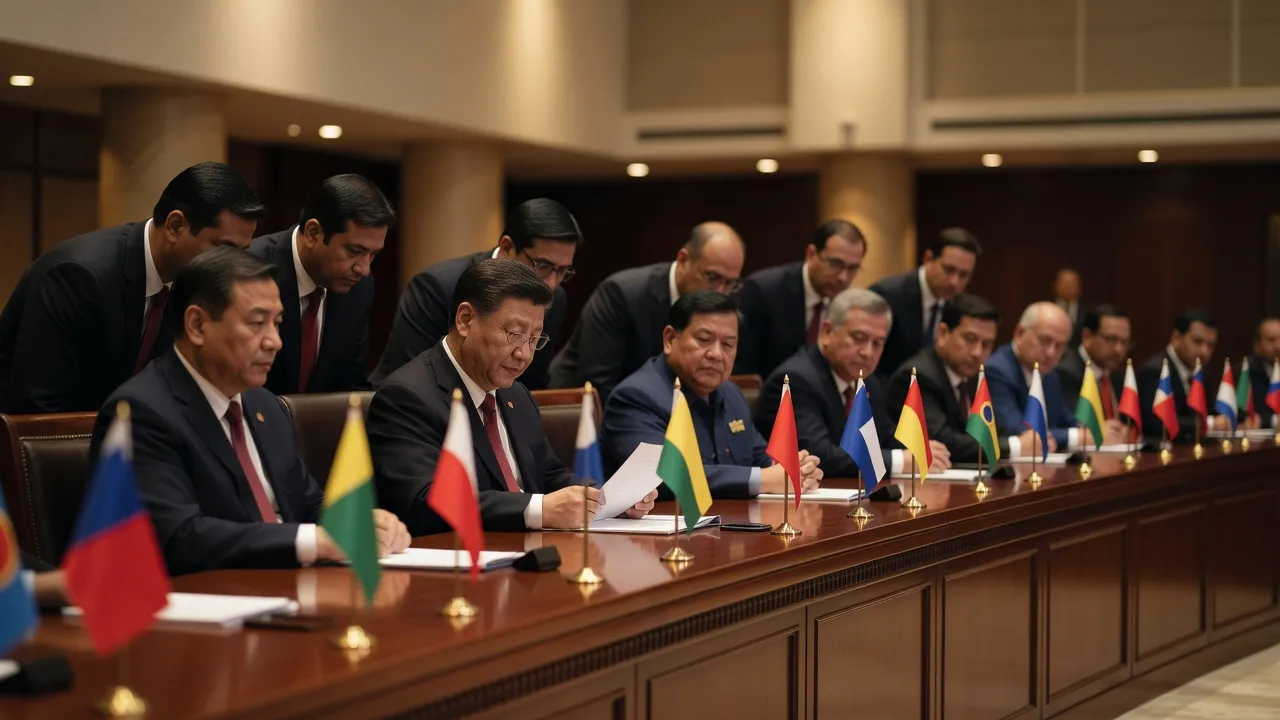
The BRICS summit concluded on Sunday in New Delhi, India, bringing together the eleven members of the bloc and ten partner countries. Xi Jinping called on members and partners to maintain "stable and unimpeded" industrial and supply chains, as navigation through the Strait of Hormuz is disrupted by the war between the United States and Iran. The head of Roscosmos, Dmitri Bakanov, announced a BRICS space cooperation council, with sharing of satellite data and joint missions. A session with invited countries from the Global South brought together Indonesian President Prabowo Subianto, and Saudi and Indian Foreign Ministers Faisal bin Farhan and Subrahmanyam Jaishankar, who met on the sidelines.
The creation of the space council remains at a preparatory stage: its formation "is underway", with no agreement signed at the summit and no fixed schedule.
Roscosmos
Dmitri Bakanov specifies that the future council will not be a BRICS equivalent of the European Space Agency.
Moneyweb· outside the analysed corpusThe Saudi and Indian ministers
Faisal bin Farhan and Subrahmanyam Jaishankar reviewed bilateral cooperation and regional issues on the sidelines of the summit.
Saudi Gazette· outside the analysed corpusThe BRICS bloc
Founded in 2006 by Brazil, Russia, India, and China, it now represents about half of the world's population.
Invited countries
New Delhi has invited the presidency of the African Union, Burundi, the Philippines, Uruguay, and Bahrain to represent the Global South.
Understand the context
- SEP 12, 2026Adoption of the New Delhi Declaration on the first day of the summit
- SEP 13, 2026Summit closing: Xi Jinping's speech and announcement of the BRICS space council
What the comparison reveals
Common ground and differences in coverage across the media analysed.
What the media report in common
The BRICS summit ended on Sunday in New Delhi with the adoption of a joint statement, the New Delhi Declaration.
Xi Jinping called on BRICS members and partner countries to maintain industrial and supply chains that are "stable and unimpeded", in a context of disrupted navigation related to the war between the United States and Iran.
The summit brought together, in addition to the eleven full members, invited countries presented as representative of the developing regions of the Global South.
Where media coverage diverges
Overall Reading of the Summit
National coverage presents two opposing views of the summit: one as a demonstration of unity and multipolarity of the Global South, and the other as a constrained meeting, dominated by the conflict in the Middle East and marked by internal divisions.
Frictions over Critical Minerals
Narendra Modi's warning against the use of technology and minerals as critical weapons is presented by some coverage as a real limit to the cohesion of the bloc, while others barely mention it, subordinating this point to the narrative of multipolar unity.
Scope of the Sanctions Clause
The clause in the joint declaration condemning sanctions not authorized by the UN is presented by the South African press as confirmation of a consistent principled position, while the American press sees it as a tactical coalition reacting to Washington's policy of sanctions and tariffs.
The full text, country by country
 China
China
DOMINANT ANGLE
Beijing is upholding the unity of the Global South and multipolarity as the guiding principle of the New Delhi summit, presenting Xi Jinping's five cooperation initiatives as the foundation for a fairer and less Western-dependent international order.
KEY POINTS
- Xi Jinping has introduced five BRICS cooperation initiatives covering AI, trade, digital industry, smart manufacturing, and scientific talent training (ECNS).
- The share of New Development Bank projects funded in local currencies should exceed 45% by 2031, compared to 30% today, according to Russian Finance Minister Anton Siluanov (CGTN).
- The New Delhi Declaration, adopted on Saturday, decries attempts to unilaterally undermine multilateral institutions, including through deliberate withholding of contributions (ECNS).
ANALYSIS
Beijing, September 14, 2026. Following the 18th BRICS summit in New Delhi, the Chinese press is focusing less on internal rivalries and more on the solidarity displayed between countries of the global South in the face of an international order deemed unstable. On Sunday, during the second day of the summit, Xi Jinping called on the BRICS to "rally the global South" and play a stabilizing role in world affairs, as "the international landscape is volatile and risk-laden," according to his remarks reported by the ECNS agency. The Chinese president presented five initiatives for expanded cooperation covering artificial intelligence, trade facilitation, the digital industry, smart manufacturing, and the training of scientific and technological talent.
For Beijing, the collective rise of the global South constitutes "a key driver of global multipolarity." Xi urged members to defend international rule of law, sovereign equality, non-interference, and peaceful settlement of disputes — principles reiterated on Saturday in the New Delhi Declaration, which reaffirms the commitment to reform global governance and deplores attempts to unilaterally undermine multilateral institutions, including through the deliberate withholding of contributions.
According to the South China Morning Post, Xi concluded his trip by proposing to help members develop open-source AI and smart manufacturing, while offering to train young talent. The summit produced a united front against American tariffs and sanctions, but warnings from Indian Prime Minister Narendra Modi about the economic weapon of critical minerals revealed internal frictions, analysts note.
In financial terms, the New Development Bank, based in Shanghai, illustrates, according to CGTN, the ambition to reduce dependence on the dollar: the share of projects financed in local currencies is to exceed 45% by 2031, compared to 30% today, according to Russian Finance Minister Anton Siluanov. Researcher Wang Youming sees this as a means of strengthening the financial autonomy of emerging economies in the face of politically motivated sanctions.
 France
DOMINANT ANGLE
Paris is deciphering a constrained summit, where the conflict in the Middle East has eclipsed the expansion ambitions of the BRICS and reduced New Delhi to preserving appearances.
KEY POINTS
- The summit ended without expanding the circle of 11 full members, with the 10 partners being more closely associated with the bloc's work.
- New Delhi announced a logistics cooperation framework for supply chains, an early warning system for infectious diseases, and increased financial cooperation.
- Narendra Modi held multiple bilateral talks with the leaders of the Philippines, Kazakhstan, South Africa, Egypt, Burundi, Uganda, and Nigeria.
ANALYSIS
Paris, September 14, 2026. The BRICS summit closed on Sunday, September 13, in New Delhi in an atmosphere that the French press describes as subdued, far from the spectacular announcements sometimes expected from a bloc that claims to represent the global South. France 24 immediately summarizes the tone of the meeting, presented as a summit "dominated by the conflict in the Middle East", where the war between the United States and Iran, and its repercussions on navigation in the Strait of Ormuz, weighed on the debates more than any new initiative.
RFI notes that the Middle Eastern issue was only addressed in a "very vague" way in the joint statement, recalling that several members of the group, Iran and the United Arab Emirates in particular, are directly parties to the conflict, which makes any consensus fragile. In the absence of expansion, New Delhi has chosen to associate the ten partner countries more closely with the bloc's work: "the summit closed this Sunday, September 13, without a new extension of the circle of 11 full members", the agency reports.
In substance, three areas stand out from the announcements reported by the French press: a cooperation framework aimed at securing supply chains deemed vulnerable, a common early warning system for infectious diseases, and strengthened financial cooperation. Indian Prime Minister Narendra Modi, who has held numerous bilateral talks with the leaders of the Philippines, Kazakhstan, South Africa, Egypt, Burundi, Uganda, and Nigeria, summarized the group's ambition by stating that "the BRICS are not just a group of countries, but also an ecosystem of solutions."
For the French press, this summit illustrates the limits of a heterogeneous bloc, constrained to a facade of unanimity on geopolitical crises, while seeking to consolidate, through small institutional touches, a parallel architecture to Western institutions, without disrupting its eleven-member geometry.
 Indonesia
DOMINANT ANGLE
Jakarta is asserting its autonomy within the BRICS: Prabowo Subianto refuses to be "dictated to" by any power and demands concrete results on industrialization and supply chains.
KEY POINTS
- Prabowo Subianto: "Kami tidak suka didikte oleh satu atau dua kekuatan tertentu" — refuses to be dictated by one or two particular powers (CNN Indonesia).
- Prabowo at the summit podium: "BRICS essentially already has a supply chain in place. Our task is to connect and optimize to utilize our strengths for greater value" (Antara News).
- The BRICS bloc has expanded to include Brazil, China, Russia, India, South Africa, Egypt, Ethiopia, Iran, Saudi Arabia, the United Arab Emirates, and Indonesia (CNN Indonesia).
ANALYSIS
Jakarta, September 14, 2026. Following the BRICS summit in New Delhi, the Indonesian press first highlights the voice of its president. Before the leaders gathered at Bharat Mandapam, Prabowo Subianto stated that Indonesia "does not want to be dictated to by one or two powers in particular". "We must be resilient, and then we will truly be independent. We have strengthened our foundations to preserve peace and build trust," he said, according to the presidential secretariat, cited by CNN Indonesia — a phrase taken as a sign of a diplomacy that refuses subordination, whether it comes from Washington or Beijing.
This claim of autonomy is accompanied by a concrete economic aspect. Prabowo proposed "pursuing industrialization together and optimizing our resources and capabilities", recalling that the bloc "already has a supply chain" that needs to be "connected and optimized" to extract more value, according to Antara News. As an archipelago exposed to rising sea levels, natural disasters, and volcanic activity along the Pacific Ring of Fire, Indonesia is highlighting its reserves of critical minerals, rare earths, and forests as assets for what he calls the "green century".
Jakarta also emphasizes the political scope of the bloc, now expanded to include Brazil, China, Russia, India, South Africa, Egypt, Ethiopia, Iran, Saudi Arabia, the United Arab Emirates, and Indonesia. The official photo, where Prabowo appears in the front row alongside Xi Jinping and Vladimir Putin, is relayed as a symbol of the rank acquired by the archipelago. For the president, this collective strength "must not remain on paper", but "translate into opportunities for our societies" and give the Global South "a stronger voice" in global governance, as the 2030 deadline for the Sustainable Development Goals approaches.
 India
India
DOMINANT ANGLE
New Delhi claims the closing of the BRICS summit as its own diplomatic victory, that of having defused the rift between Iran and the United Arab Emirates to secure a joint statement.
KEY POINTS
- New Delhi had to "bridge the gap" between Iran and the United Arab Emirates, each of which wanted to name the other, to avoid a repeat of the collapse of the BRICS ministerial meeting
- Modi warned that "the weapon of technology and critical minerals" could hinder shared progress, in the presence of Xi Jinping, in India for the first time in seven years
- The MEA claims more than 50 concrete outcomes and 350 meetings in about thirty cities, and has selected the invited countries (African Union, Burundi, Philippines/ASEAN, Uruguay/CELAC, Bahrain/GCC) to represent the Global South
ANALYSIS
New Delhi, September 14, 2026. Following the conclusion of the 18th BRICS summit at Bharat Mandapam, Indian diplomacy claims a success of its own: having saved the New Delhi Declaration from an announced shipwreck. According to diplomats cited by Free Press Journal, New Delhi had to "bridge the gap" between Iran and the United Arab Emirates, Abu Dhabi wanting to name Tehran for attacks on Gulf territories, while Iran demanded a mention of "American-Israeli attacks". The precedent was worrying: "the BRICS foreign ministers' meeting had collapsed because Iran and the UAE both wanted to name names," recalls a senior diplomat. The retained formula, modeled on that of the Shanghai Cooperation Organization in Bishkek, avoids naming states while cataloging violations that, according to The Hindu Business Line, "clearly imply" Israeli conduct in Gaza.
Closing the proceedings on Sunday, Prime Minister Narendra Modi presented the BRICS as a "solution ecosystem" and called for transforming the declaration into "time-bound actions". He warned against "the weapon of technology and critical minerals", while Xi Jinping, visiting India for the first time in seven years, sat in the same room. Modi advocated for the global South to become a "rule-maker" rather than a "rule-taker".
The Ministry of Foreign Affairs detailed the selection of invited countries to the opening session: African Union, Burundi, Philippines on behalf of ASEAN, Uruguay for CELAC, Bahrain for the Gulf, a choice presented as reflecting "the voice of the global South". Secretary Sudhakar Dalela claims over 50 concrete results and 350 meetings organized in about thirty cities during the Indian presidency, identifying critical minerals as a future cooperation axis. The space council promised by Moscow occupies almost no place in this account, eclipsed by the national diplomatic feat highlighted by New Delhi.
 Pakistan
DOMINANT ANGLE
Islamabad first notes Beijing's call to secure global supply chains, as the Strait of Hormuz remains disrupted by the war between Washington and Tehran.
KEY POINTS
- Xi Jinping has called on BRICS members and partners to maintain "stable and unhindered" industrial and supply chains in the face of disruptions to the Strait of Hormuz related to the USA-Iran war.
- Xi described the Global South as a "key force driving the world towards multipolarity" and deemed the logic of "might makes right" outdated.
- Xi demanded WTO reform "in the right direction", support for the New Development Bank, and a global AI governance framework based on broad consensus.
ANALYSIS
Islamabad, September 14, 2026. The BRICS summit closed on Sunday in New Delhi with a call from Chinese President Xi Jinping to preserve "stable and unimpeded" industrial and supply chains, as the Strait of Hormuz remains disrupted by the war between the United States and Iran. The Pakistani press, via The Express Tribune and The Nation, reported this speech delivered during the final session of the 18th BRICS leaders' summit, titled "Resilience, innovation, cooperation and sustainability: shaping the future for inclusive global growth".
For Islamabad, which relies on trade routes crossing the Gulf and is linked to Beijing by structuring economic agreements, this call resonates directly: any prolonged disruption to traffic in the Strait of Hormuz would weaken the country's energy and industrial supplies, which are already under budgetary tension. Xi Jinping described the Global South as a "key force driving the world towards multipolarity", considering the logic of "might makes right" to be outdated. He called for strengthened multilateralism, a collectively written reform of international law, and respect for the authority of the United Nations, while supporting reforms to multilateral institutions.
On the economic front, the Chinese leader demanded a reform of the international financial architecture, better representation for developing countries, and a reform of the WTO "in the right direction". He promised that China "will continue its voluntary and unilateral opening-up", and called for support for the functioning and development of the New Development Bank, the financial pillar of the group. Xi also advocated for the acceleration of a global governance framework for artificial intelligence based on a broad consensus.
The two Pakistani newspapers reported almost word for word the same speech, without expanding to other voices from the summit — neither the Russian announcements on a future BRICS space council, nor the session with invited countries where Indonesian Prabowo Subianto defended national autonomy. The Pakistani account primarily retains the economic and commercial dimension of the summit, deemed the most directly relevant to a country exposed to the ups and downs of global supply chains.
 United States
DOMINANT ANGLE
The United States deciphers the New Delhi summit as proof that its own tariff and diplomatic pressure is pushing rivals to show a united front, more out of calculation than shared conviction.
KEY POINTS
- The summit concluded with a joint statement targeting a war launched by the United States in the Middle East, the tariff campaign, and Washington's sanctions policy (Bloomberg).
- Xi Jinping's visit to New Delhi was his first to India since 2019, marking a step in a cautious thaw after the deadly border clashes of 2020 (CNBC).
- Narendra Modi warned that the "weaponization of technology and critical minerals" could hinder global development and announced an early warning system against infectious diseases (ABC News).
ANALYSIS
The United States, September 14, 2026. The BRICS summit ended on Sunday in New Delhi without American commentators seeing it as a simple economic meeting of the global South. For the US press, the event is first and foremost a symptom: that of a world where Donald Trump's "America first" policy is driving rival powers to come closer together, more out of calculation than shared conviction. CNBC recalls that "Trump's policies are not the reason these countries are talking," emphasizing that India and Russia have long-standing ties and that the Sino-Indian thaw preceded the current trade tensions. The network notes, however, that the tariffs, sanctions, and economic pressure from Washington add an additional factor to the calculations of New Delhi and Beijing.
According to Bloomberg, the summit concluded with a joint statement directly targeting a war launched by the United States in the Middle East, as well as Washington's tariff campaign and sanctions policy — a sign, for American correspondents, of a united front displayed by Moscow and Tehran more than a convergence of substance. Xi Jinping's visit, his first to India since 2019, is presented as a cautious step in a thaw initiated after the deadly clashes in 2020 on the Himalayan border, even if India's trade deficit with Beijing and strategic rivalry in Asia remain, according to CNBC, persistent sources of tension.
Indian Prime Minister Narendra Modi also warned that the "weaponization of technology and critical minerals" could hinder global development, while announcing an early warning system for infectious diseases within the bloc. For the United States, this speech confirms above all that the eleven BRICS members, who represent half of the world's population, are seeking to influence international institutions without forming a homogeneous bloc: internal divisions, particularly Sino-Indian ones, continue to limit the actual scope of this cooperation, according to the American press.
 South Africa
DOMINANT ANGLE
Pretoria is defending in the final statement of New Delhi a confirmation of its consistent refusal to align itself with Western sanctions, whether they target Russia or now Iran.
KEY POINTS
- President Cyril Ramaphosa attended the summit alongside Vladimir Putin, Xi Jinping, and Masoud Pezeshkian
- The joint statement calls for "the elimination of these illegal measures, which undermine international law and the principles of the United Nations Charter" (sanctions not authorized by the UN)
- The BRICS bloc, founded in 2006 by Brazil, Russia, India, and China, now has 11 members representing about half of the world's population
ANALYSIS
Pretoria, September 14, 2026. The BRICS summit ended on Sunday in New Delhi with a joint declaration that South African diplomacy sees as a further step towards the autonomy of the Global South. President Cyril Ramaphosa, who attended alongside Vladimir Putin, Xi Jinping, and Iranian President Masoud Pezeshkian, supported a text that condemns the use of unauthorized sanctions by the UN and calls for "the elimination of these illegal measures, which undermine international law and the principles of the United Nations Charter," according to the declaration cited by Business Day. Pretoria views this as a confirmation of its consistent diplomatic line since its accession in 2010: refusing automatic alignment with Western sanctions, whether they target Russia since the invasion of Ukraine in 2022 or, now, Iran.
The text adopted in New Delhi also expresses concern over "deliberate attacks" on civilian infrastructure and nuclear facilities under the guarantees of the International Atomic Energy Agency — a formulation seen by the South African press as an indirect criticism of American and Israeli strikes against Iranian nuclear sites, without any country being named. Business Day notes that the bloc, founded in 2006 by Brazil, Russia, India, and China, now has 11 members representing approximately half of the world's population and a significant share of global output.
According to SABC News, citing four anonymous sources reported by Reuters, the agreement on this joint declaration required bridging the positions of Iran and the United Arab Emirates, located on either side of the Gulf conflict — a compromise presented as proof that the group can still speak with one voice despite its internal differences. For Pretoria, this displayed unity carries more weight than the technical details of the summit: neither the space council proposed by Moscow nor the supply chains mentioned by Beijing occupy a central place in South African coverage, which prioritizes the geopolitical scope of the text on sanctions and the Iranian nuclear issue.
Explore every perspective on this subject across 7 countries.
Compare viewpoints and see where they diverge.