
DOMINANT ANGLE
New Delhi claims the closing of the BRICS summit as its own diplomatic victory, that of having defused the rift between Iran and the United Arab Emirates to secure a joint statement.
Dominant angle identified — does not reflect unanimity of this country’s media
KEY POINTS
- 01
New Delhi had to "bridge the gap" between Iran and the United Arab Emirates, each of which wanted to name the other, to avoid a repeat of the collapse of the BRICS ministerial meeting
- 02
Modi warned that "the weapon of technology and critical minerals" could hinder shared progress, in the presence of Xi Jinping, in India for the first time in seven years
- 03
The MEA claims more than 50 concrete outcomes and 350 meetings in about thirty cities, and has selected the invited countries (African Union, Burundi, Philippines/ASEAN, Uruguay/CELAC, Bahrain/GCC) to represent the Global South
ANALYSIS
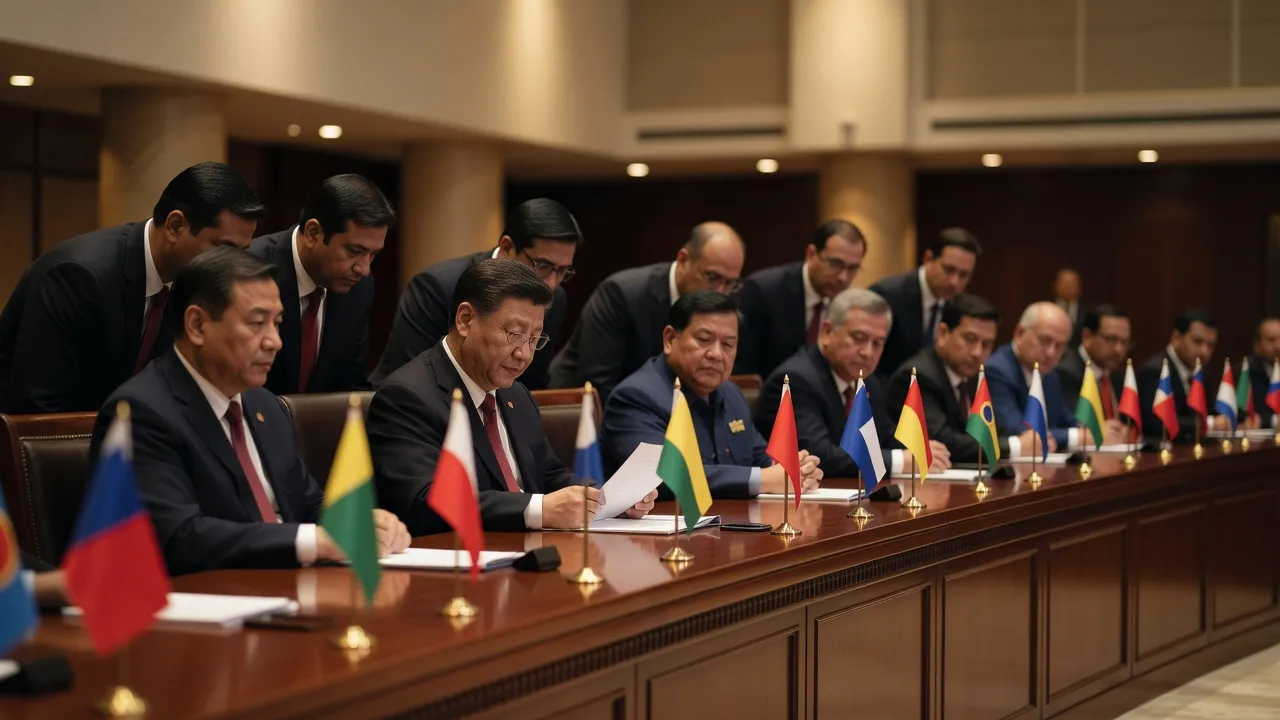
New Delhi, September 14, 2026. Following the conclusion of the 18th BRICS summit at Bharat Mandapam, Indian diplomacy claims a success of its own: having saved the New Delhi Declaration from an announced shipwreck. According to diplomats cited by Free Press Journal, New Delhi had to "bridge the gap" between Iran and the United Arab Emirates, Abu Dhabi wanting to name Tehran for attacks on Gulf territories, while Iran demanded a mention of "American-Israeli attacks". The precedent was worrying: "the BRICS foreign ministers' meeting had collapsed because Iran and the UAE both wanted to name names," recalls a senior diplomat. The retained formula, modeled on that of the Shanghai Cooperation Organization in Bishkek, avoids naming states while cataloging violations that, according to The Hindu Business Line, "clearly imply" Israeli conduct in Gaza.
Closing the proceedings on Sunday, Prime Minister Narendra Modi presented the BRICS as a "solution ecosystem" and called for transforming the declaration into "time-bound actions". He warned against "the weapon of technology and critical minerals", while Xi Jinping, visiting India for the first time in seven years, sat in the same room. Modi advocated for the global South to become a "rule-maker" rather than a "rule-taker".
The Ministry of Foreign Affairs detailed the selection of invited countries to the opening session: African Union, Burundi, Philippines on behalf of ASEAN, Uruguay for CELAC, Bahrain for the Gulf, a choice presented as reflecting "the voice of the global South". Secretary Sudhakar Dalela claims over 50 concrete results and 350 meetings organized in about thirty cities during the Indian presidency, identifying critical minerals as a future cooperation axis. The space council promised by Moscow occupies almost no place in this account, eclipsed by the national diplomatic feat highlighted by New Delhi.
SOURCES (2)
- The Hindu Business LineMEDIUM
- Free Press JournalMEDIUM