
DOMINANT ANGLE
Pretoria is defending in the final statement of New Delhi a confirmation of its consistent refusal to align itself with Western sanctions, whether they target Russia or now Iran.
Dominant angle identified — does not reflect unanimity of this country’s media
KEY POINTS
- 01
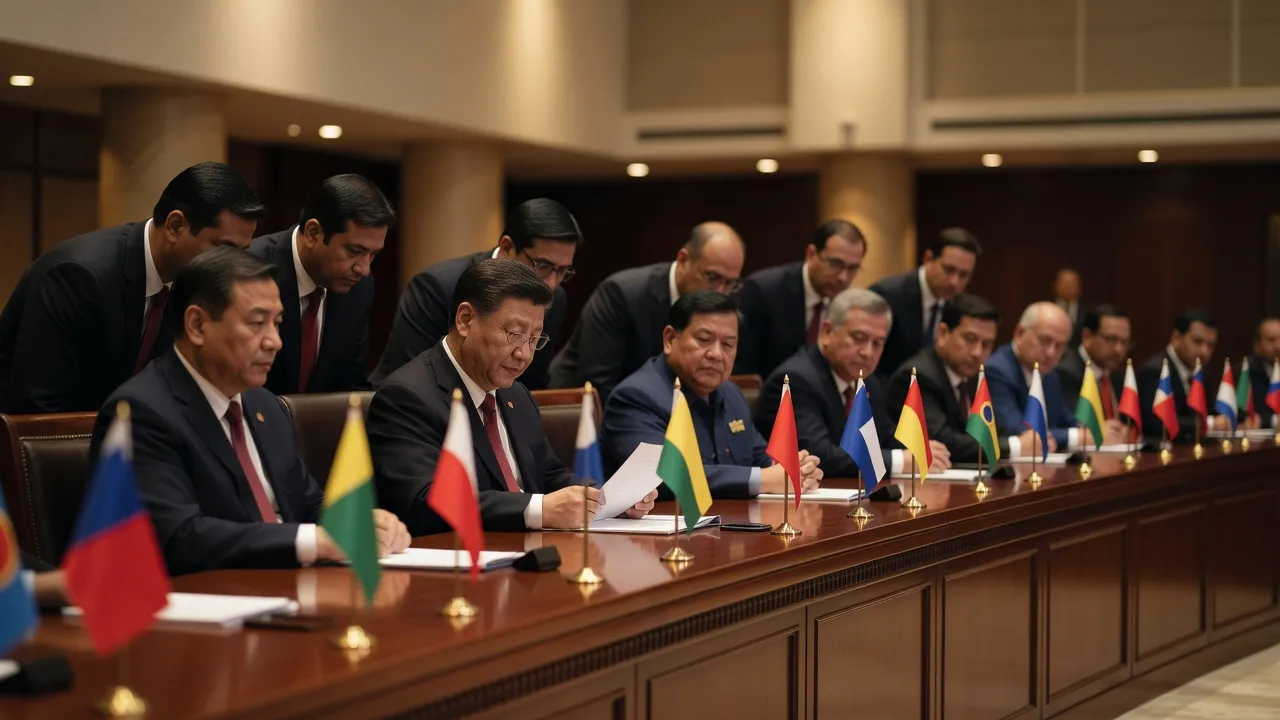
President Cyril Ramaphosa attended the summit alongside Vladimir Putin, Xi Jinping, and Masoud Pezeshkian
- 02
The joint statement calls for "the elimination of these illegal measures, which undermine international law and the principles of the United Nations Charter" (sanctions not authorized by the UN)
- 03
The BRICS bloc, founded in 2006 by Brazil, Russia, India, and China, now has 11 members representing about half of the world's population
ANALYSIS
Pretoria, September 14, 2026. The BRICS summit ended on Sunday in New Delhi with a joint declaration that South African diplomacy sees as a further step towards the autonomy of the Global South. President Cyril Ramaphosa, who attended alongside Vladimir Putin, Xi Jinping, and Iranian President Masoud Pezeshkian, supported a text that condemns the use of unauthorized sanctions by the UN and calls for "the elimination of these illegal measures, which undermine international law and the principles of the United Nations Charter," according to the declaration cited by Business Day. Pretoria views this as a confirmation of its consistent diplomatic line since its accession in 2010: refusing automatic alignment with Western sanctions, whether they target Russia since the invasion of Ukraine in 2022 or, now, Iran.
The text adopted in New Delhi also expresses concern over "deliberate attacks" on civilian infrastructure and nuclear facilities under the guarantees of the International Atomic Energy Agency — a formulation seen by the South African press as an indirect criticism of American and Israeli strikes against Iranian nuclear sites, without any country being named. Business Day notes that the bloc, founded in 2006 by Brazil, Russia, India, and China, now has 11 members representing approximately half of the world's population and a significant share of global output.
According to SABC News, citing four anonymous sources reported by Reuters, the agreement on this joint declaration required bridging the positions of Iran and the United Arab Emirates, located on either side of the Gulf conflict — a compromise presented as proof that the group can still speak with one voice despite its internal differences. For Pretoria, this displayed unity carries more weight than the technical details of the summit: neither the space council proposed by Moscow nor the supply chains mentioned by Beijing occupy a central place in South African coverage, which prioritizes the geopolitical scope of the text on sanctions and the Iranian nuclear issue.
SOURCES (2)
- Business DayMEDIUM
- SABC NewsMEDIUM