
DOMINANT ANGLE
The United States deciphers the New Delhi summit as proof that its own tariff and diplomatic pressure is pushing rivals to show a united front, more out of calculation than shared conviction.
Dominant angle identified — does not reflect unanimity of this country’s media
KEY POINTS
- 01
The summit concluded with a joint statement targeting a war launched by the United States in the Middle East, the tariff campaign, and Washington's sanctions policy (Bloomberg).
- 02
Xi Jinping's visit to New Delhi was his first to India since 2019, marking a step in a cautious thaw after the deadly border clashes of 2020 (CNBC).
- 03
Narendra Modi warned that the "weaponization of technology and critical minerals" could hinder global development and announced an early warning system against infectious diseases (ABC News).
ANALYSIS
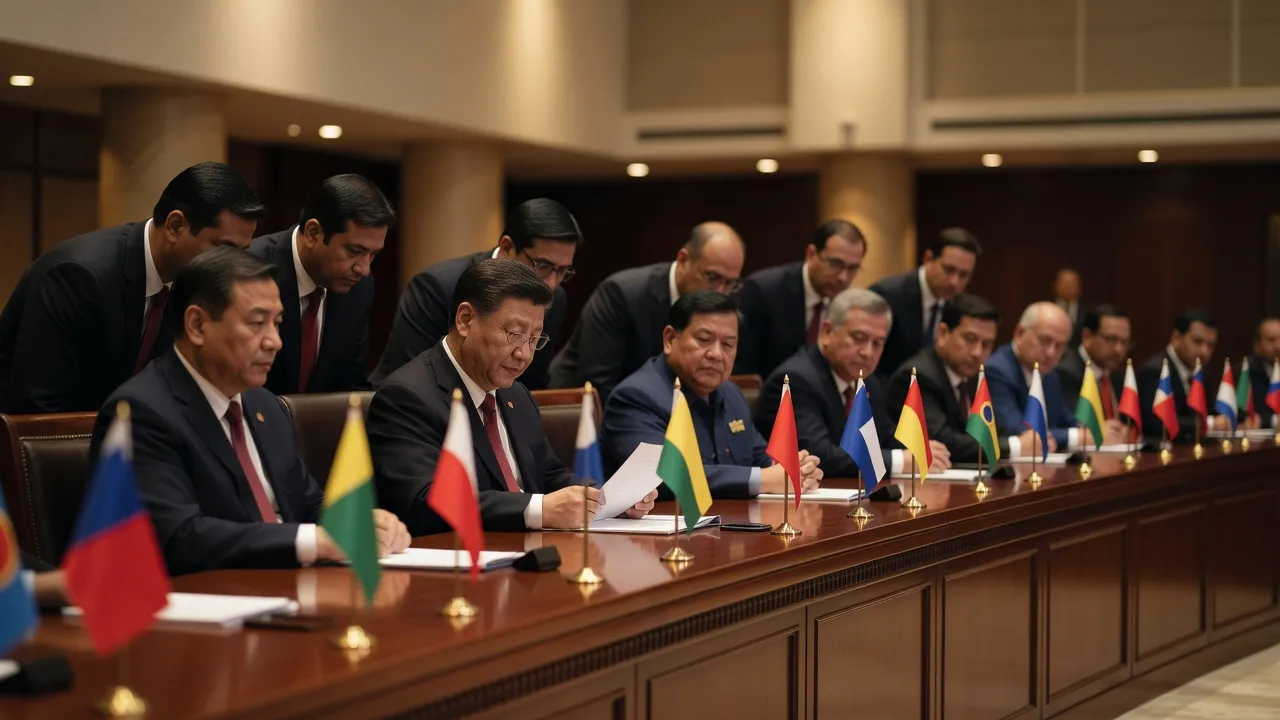
The United States, September 14, 2026. The BRICS summit ended on Sunday in New Delhi without American commentators seeing it as a simple economic meeting of the global South. For the US press, the event is first and foremost a symptom: that of a world where Donald Trump's "America first" policy is driving rival powers to come closer together, more out of calculation than shared conviction. CNBC recalls that "Trump's policies are not the reason these countries are talking," emphasizing that India and Russia have long-standing ties and that the Sino-Indian thaw preceded the current trade tensions. The network notes, however, that the tariffs, sanctions, and economic pressure from Washington add an additional factor to the calculations of New Delhi and Beijing.
According to Bloomberg, the summit concluded with a joint statement directly targeting a war launched by the United States in the Middle East, as well as Washington's tariff campaign and sanctions policy — a sign, for American correspondents, of a united front displayed by Moscow and Tehran more than a convergence of substance. Xi Jinping's visit, his first to India since 2019, is presented as a cautious step in a thaw initiated after the deadly clashes in 2020 on the Himalayan border, even if India's trade deficit with Beijing and strategic rivalry in Asia remain, according to CNBC, persistent sources of tension.
Indian Prime Minister Narendra Modi also warned that the "weaponization of technology and critical minerals" could hinder global development, while announcing an early warning system for infectious diseases within the bloc. For the United States, this speech confirms above all that the eleven BRICS members, who represent half of the world's population, are seeking to influence international institutions without forming a homogeneous bloc: internal divisions, particularly Sino-Indian ones, continue to limit the actual scope of this cooperation, according to the American press.