17 perspectives, each in the voice of that country's press.
Lisbon retains particularly the fervor of the youth and the praise of France's Christian roots, relegating the pope's warning on artificial intelligence and the debate on end-of-life issues to the background.
3 sources
Argentina took note of Léon XIV's Parisian visit, particularly his warning about the "paradise of machines", seen as a dress rehearsal for his November visit to Buenos Aires.
3 sources
Brussels sees the visit of Léon XIV to France as a reflection of its own secularization, between technological warnings and reminders about end-of-life issues.
3 sources
Brazil particularly notes from the papal visit to France the warning on artificial intelligence, which the local press explicitly links to the tensions between Donald Trump and the media, more than to the French debates on secularism or end of life.
3 sources
Ottawa interprets the papal warning about the "paradise of machines" as the direct extension of the first encyclical of Leo XIV dedicated to artificial intelligence.
2 sources
Berlin sees the visit of Pope Leo XIV as a direct challenge to French laws on end-of-life issues and abortion, rather than a courtesy religious visit.
France takes away from the visit of Léon XIV a diagnosis of its own society more than a simple diplomatic meeting: secularism, end of life and the awakening of a Catholic youth seeking meaning occupy a place just as central as the warning about artificial intelligence.
Rome interprets the visit of Léon XIV to France as a reprimand on morals more than as a diplomatic meeting, particularly retaining the end of life, secularism, and the Catholic resurgence of the country.
Nigeria is particularly mindful of Pope Leo XIV's warning against a "paradise of machines", a message that its press links to its own concerns about artificial intelligence and technological dehumanization, more than the diplomatic stakes of the visit.
Lima particularly notes that the Pope, who came to warn Paris about the "paradise of machines", is the former bishop of Chiclayo, ahead of his own highly anticipated visit to Peru in November.
Bucharest sees the visit of Pope Francis to France as a lesson in society addressed to Paris - end of life, secularism, youth seeking faith - more than a simple protocol exercise at the Elysée.
Singapore first takes note of Léon XIV's warning about a "paradise of machines", which ties in with the local debate on regulating artificial intelligence more than a strictly French religious issue.
Chad first took note of the state protocol: the reception of Emmanuel Macron at Orly, the speech by Léon XIV at the Élysée in front of the diplomatic corps, then the stop at UNESCO where the pope renewed his call to regulate artificial intelligence.
London is particularly interested in the protocol game between the Elysée and the Vatican, where discussions on artificial intelligence and the staging of the welcome weigh as much as the religious dimension of the papal visit.
The United States first takes note of the universal scope of the papal warning on artificial intelligence and nuclear deterrence, before highlighting the American biography of the pontiff and his implicit support for a free press, which has a delicate relationship with the White House.
Caracas remembers the Parisian stage of León XIV less for the state visit than for the warning launched at UNESCO against a technology that has become an "instrument of domination and injustice", a message that the Venezuelan press reads as going beyond just France.
Pretoria is particularly mindful of the Pope's warning about the crisis of multilateral institutions and the UN, more so than the message addressed to French society on secularism or end-of-life issues.
3 sources
Cross-media analysis
What the comparison reveals
Common ground and differences in coverage across the media analysed.
What the media report in common
1
Leon XIV warned, notably in his speech at the Élysée, against the risks of a society where technology and artificial intelligence would take precedence over humans, calling for regulation and education in ethical discernment.
2
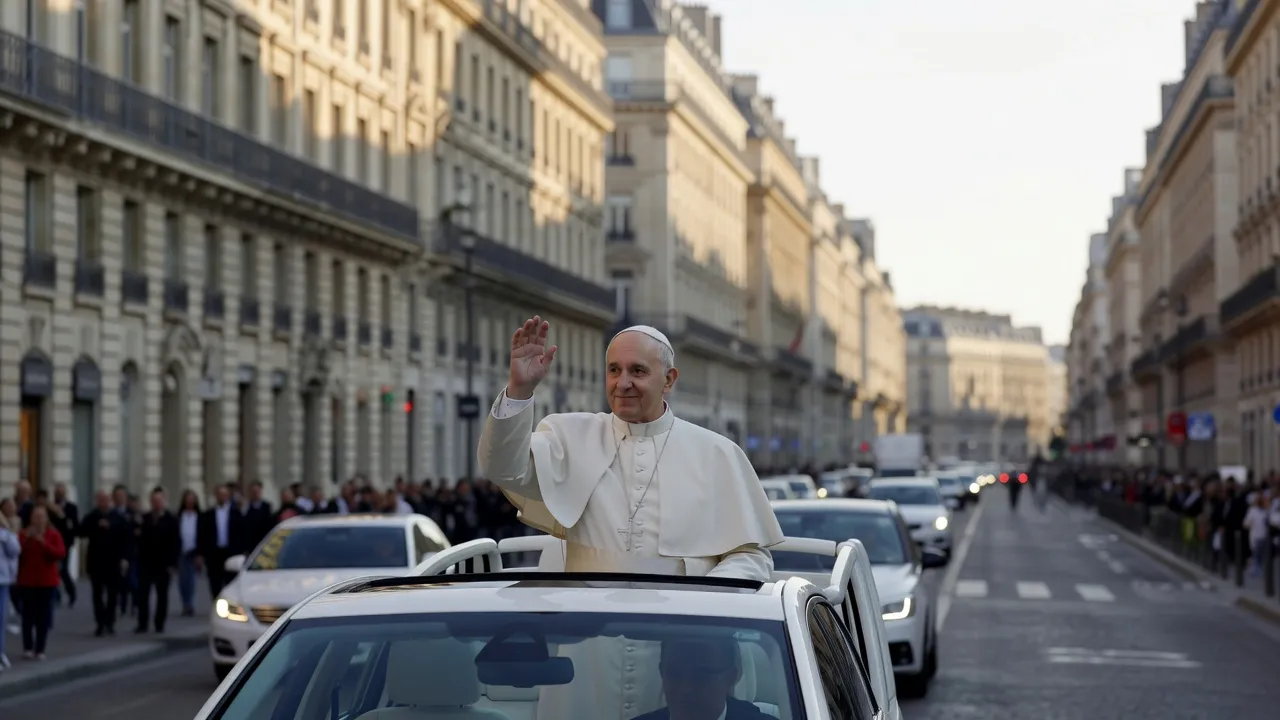
On Friday, September 25, 2026, Leon XIV was welcomed in France by Emmanuel Macron and visited the Élysée Palace, where his visit and remarks before the authorities were reported in the overall coverage of the first day of his visit.
Where media coverage diverges
Thematic Priority
The coverage diverges on the central axis of the passage to the Élysée: some retain the warning about technology and artificial intelligence, while others focus on the address to French debates on end-of-life issues, abortion, and secularism.
The papal speech is read by some coverage as a broad critique touching nuclear deterrence, the crisis of multilateralism, or the tensions between the Trump administration and the press, while others link it primarily to the French context.
Coverage aligned with this reading
Coverage that diverges
Interpretation of Protocol
The protocol rollout of the arrival (refusal of the Republican Guard, absence of Macron at religious services) is presented by some coverage as a sign of tension with the Élysée, and by others as simply respecting the secular and diplomatic framework.
Coverage aligned with this reading
Coverage that diverges
This grouping describes the publications analysed, not the position of these countries’ populations or of their governments.
Lisbon retains particularly the fervor of the youth and the praise of France's Christian roots, relegating the pope's warning on artificial intelligence and the debate on end-of-life issues to the background.
KEY POINTS
According to SAPO Notícias, Pope Léon XIV was received by Emmanuel Macron at the Élysée Palace upon his arrival in Paris, for a four-day official visit.
The Jornal Económico reports that Léon XIV deemed journalistic coverage "very important", echoing the White House access ban targeting CNN, MSNOW and Politico decided by the Trump administration.
RTP indicates that 80,000 young people signed up for the vigil at the Stade de France, saturating the venue's capacity in 25 minutes.
ANALYSIS
Lisbon, September 26, 2026. The Portuguese press closely followed the arrival of Pope Leo XIV in Paris on Friday for his first visit to France in eighteen years from the Holy See's side. The news site SAPO Notícias reports on the warm welcome given by Emmanuel Macron to the pontiff, who landed at Orly Airport before heading to the Élysée Palace for a four-day official visit. According to SAPO, in his first speech, the pope addressed "the issue of secularism" and praised the "Christian roots" of France, emphasizing the importance of religion in the public sphere, before also discussing artificial intelligence and peace.
The Jornal Económico takes a more unexpected angle: it reports on the pope's comments on press freedom, made to the journalists accompanying him to France. Leo XIV assured that "good coverage [journalistic] is very important" and that the media will "always have a place" on his plane — a statement that the title explicitly links to the Trump administration's decision to ban access to the White House to CNN, MSNOW (formerly MSNBC), and Politico, which have since taken legal action for infringement on freedom of expression. The newspaper also notes that the pontiff landed "this morning" at Orly for his visit to France and UNESCO, before heading to the Lourdes sanctuary and Metz.
The RTP, for its part, mainly retains the scope of the mobilization of young people: some 80,000 of them registered for the vigil at the Stade de France, saturating the stadium's capacity in just 25 minutes. The public media outlet qualifies this first highlight of the apostolic visit as a milestone in the pope's stay in France.
Through these three readings, the Lisbon press insists less on the pope's warning against a "paradise of machines" — mentioned indirectly, via AI and digital — than on the religious and social dimension of the visit: secularism, Christian roots, and the fervor of young people. The Trump-media sequence, grafted by the Jornal Económico onto the pope's visit, also illustrates how the Portuguese coverage links the Parisian event to broader international issues, at the risk of diluting the message specifically addressed to French society on end-of-life issues and secularism.
Argentina
DOMINANT ANGLE
Argentina took note of Léon XIV's Parisian visit, particularly his warning about the "paradise of machines", seen as a dress rehearsal for his November visit to Buenos Aires.
KEY POINTS
At the Élysée, Léon XIV warned against the risk of "losing our humanity in the midst of the machine paradise", reports Perfil, also citing Macron's call for a "servant and not a master" for AI.
Ámbito reports that the pope described genetic manipulation, surrogacy, organ trafficking, and euthanasia as "aberrations", before a country that legalized euthanasia and assisted suicide in July.
The pope is set to land on November 8 at Jorge Newbery airport, where Javier Milei will greet him at the foot of the plane, according to Ámbito; a Zubán-Córdoba poll cited by Perfil credits him with 68.5% positive opinions in the country.
ANALYSIS
Buenos Aires, September 26, 2026. The Argentine press is following Leon XIV's visit to Paris with an eye on its own agenda: the pontiff is set to arrive in Buenos Aires on November 8, where he will be greeted by Javier Milei at Jorge Newbery Airport, for a four-day tour that will take him to the capital, Córdoba, and Luján. The media is particularly focused on the warning about the "paradise of machines" from last Friday in Paris: after being received at the Élysée by Emmanuel Macron, Leon XIV cautioned against the risk of "losing our humanity amidst the paradise of machines that invade and condition our daily lives," according to Perfil. The newspaper recalls that the pope had already addressed the issue in May in his first encyclical, Magnifica Humanitas, and that he called for "training minds to an ethical discernment capable of distinguishing what is morally good." Macron, for his part, advocated for an "international organization" that would prevent the most advanced AI models from ending up "in the hands of a few," stating that "artificial intelligence must be a servant and not a master," as reported by AFP and cited by Perfil.
Ámbito details the other "excesses" denounced by the pope before the French authorities: genetic manipulation, surrogacy, organ trafficking, and "offers of programmed death," which are attributed to science and technology not guided by conscience. The newspaper emphasizes that these statements resonate in France, the first country to have enshrined abortion in its Constitution in March 2023 and which legalized euthanasia and assisted suicide in certain cases in July.
Belgium
DOMINANT ANGLE
Brussels sees the visit of Léon XIV to France as a reflection of its own secularization, between technological warnings and reminders about end-of-life issues.
KEY POINTS
300,000 people cheered the pope in the popemobile in Paris on Friday and 80,000 young people filled the Stade de France, according to the Vatican as cited by La Libre Belgique.
Léon XIV refused the Republican Guard upon his arrival at the Élysée and chose the itinerary of his visit himself, according to VRT NWS.
The proportion of French people claiming to be Catholic has dropped from around 70% in the early 1980s to about thirty percent today, according to VRT NWS.
ANALYSIS
Brussels, 26 September 2026. The Belgian press is following the first visit of a pope to France since Benedict XVI in 2008 as a revelation of the kingdom's own religious trajectory, more than as a simple protocol meeting. Arriving on Friday at Orly airport, welcomed by Emmanuel and Brigitte Macron, Leo XIV spoke at the Élysée to warn against the advent of a "paradise of machines", before calling on artificial intelligence developers and political leaders to slow down the pace, according to VRT NWS. The Flemish media outlet emphasizes that the pope refused the Republican Guard upon his arrival, choosing to set himself "the rhythm, the accents, and the symbolism" of his stay, without letting the French president dictate the course of events.
However, it is the societal issues that are holding the most attention in Brussels. At Notre-Dame, Leo XIV called on France to "welcome life without condition [...] and accompany with respect [...] every stage of existence", in the midst of the application of the French law on the end of life, reports La Libre Belgique. He also mentioned "open secularism", which does not exclude the public expression of religions - a notion familiar to a country that has itself experienced its own debates on state neutrality. VRT NWS recalls that in France, the proportion of declared Catholics has fallen from around 70% at the beginning of the 1980s to around thirty percent today, a secularization comparable to that observed in Belgium.
Brazil
DOMINANT ANGLE
Brazil particularly notes from the papal visit to France the warning on artificial intelligence, which the local press explicitly links to the tensions between Donald Trump and the media, more than to the French debates on secularism or end of life.
KEY POINTS
At the Élysée Palace, Léon XIV warned against a "paraíso de máquinas" that would threaten to make humanity lose control of the Earth (G1).
On the Rome-Paris flight, the pope defended press freedom by citing the restrictions imposed by Donald Trump on CNN, MS NOW, and Politico at the White House, later reinstated by a federal judge (Veja).
About 600,000 people have signed up for the outdoor mass scheduled for Saturday near the Champs-Élysées, and Léon XIV is to meet with survivors of sexual abuse committed by priests during his four-day stay (Folha).
ANALYSIS
São Paulo, September 26, 2026. The Brazilian press first notes from the first papal visit to France in nearly twenty years the warning from Léon XIV against a "paraíso de máquinas", a "paradise of machines" that threatens to cause humanity to lose control of the Earth. Arriving on Friday, September 25, at Paris-Orly airport, where he was welcomed by Emmanuel and Brigitte Macron as well as children who came to sing for him, the pope delivered his first official speech at the Élysée Palace, where he placed artificial intelligence at the center of his remarks. "If we want to avoid losing our humanity amidst a paradise of machines that invades and conditions our daily lives, there is an urgent need for education in ethical discernment," he stated, according to G1.
For the Veja portal, this warning goes beyond just France: a few hours earlier, on the plane that took him from Rome to Paris, Léon XIV defended press freedom by referencing the restrictions imposed by Donald Trump on newsrooms like CNN, MS NOW, and Politico, which were barred from the White House before a federal judge ordered their return. "Good coverage (...) is very important, and we must have it everywhere, for everyone," he told the journalists accompanying him. Veja headlined that the pope "picks on" Trump.
Canada
DOMINANT ANGLE
Ottawa interprets the papal warning about the "paradise of machines" as the direct extension of the first encyclical of Leo XIV dedicated to artificial intelligence.
KEY POINTS
Léon XIV warned, Friday, September 25, 2026, that a "paradise of machines" risks causing humanity to lose its humanity, in his speech at the Élysée in front of Emmanuel Macron.
The Pope devoted his first encyclical, Magnifica Humanitas, to artificial intelligence, calling for robust regulation and developers' work for the common good rather than profit.
He termed the doctrine of nuclear deterrence an "error" fueling a new arms race, stating that peace "is built day after day, through dialogue and justice".
ANALYSIS
Ottawa, September 26, 2026. For the Canadian press, the first speech of Léon XIV in France, on Friday, September 25, 2026, is first and foremost a technological warning. The Pope warned that humanity risks sinking into a "paradise of machines" if artificial intelligence is not framed by ethical reflection. Speaking before Emmanuel Macron and the diplomatic corps at the Élysée, he stated: "If we want to avoid losing our humanity within a 'paradise of machines' that invades and conditions our daily lives, there is an urgent need for education in ethical discernment."
The Globe and Mail and CBC News link this warning to the Pope's first encyclical, Magnifica Humanitas, entirely dedicated to artificial intelligence, in which he called for robust regulation and urged developers to work for the common good rather than for profit. CBC recalls that Léon XIV has, since the beginning of his pontificate, identified AI as one of the greatest challenges for humanity, and that he has asked developers and politicians to "slow down" in the face of growing calls for safeguards. On his way to Paris, he said he was satisfied that his message was being heard.
The trip, the first official visit of a Pope to France in eighteen years, is also seen as a test for a Church that, according to The Globe and Mail, has lost ground on ethical issues in a country where secularism is enshrined in the Constitution. Léon XIV invoked the "deep Christian roots" of France, a country from which his paternal ancestors originated, while reaffirming the Vatican's opposition to nuclear weapons, qualifying the doctrine of deterrence as an "error" that fuels a new arms race: "Peace is not a balance of powers; it is built day by day, through dialogue and justice."
Germany
DOMINANT ANGLE
Berlin sees the visit of Pope Leo XIV as a direct challenge to French laws on end-of-life issues and abortion, rather than a courtesy religious visit.
KEY POINTS
The pope called for a "new fraternity" including respect for life "from conception to death", targeting the assisted dying law voted on this summer and the right to abortion enshrined in the French Constitution (Tagesschau, Die Zeit).
He warned against the idea that a balance of nuclear forces would guarantee security, while remaining the only nuclear power in the European Union (Tagesschau).
About 80,000 young people attended the Friday evening vigil at the Stade de France, before a mass scheduled at the Place de la Concorde, which nearly 600,000 people have signed up for (Die Zeit).
ANALYSIS
Berlin, September 26, 2026. The German press followed on Friday the first visit of a pope to France in eighteen years, reading it less as a religious time than as a direct confrontation between Leon XIV and French societal choices. Received at the Élysée with military honors by Emmanuel and Brigitte Macron, the American pope, whose grandmother is from Normandy, hailed France as a "country of human rights" before, according to Tagesschau, "mahnen" - warning. Die Zeit quotes his words at the Élysée: "Der Schutz des Rechts auf Leben bildet die unverzichtbare Grundlage für alle anderen Menschenrechte", or the protection of the right to life as the indispensable foundation of all other human rights. The editorial offices explicitly link this appeal to a "new fraternity" to the law on active assistance in dying voted this summer by the National Assembly, and to the right to abortion enshrined in the Constitution under Emmanuel Macron. Leon XIV, Tagesschau specifies, opposes both.
The warning against a "paradise of machines" and the risks of uncontrolled artificial intelligence is reported, but in a secondary position compared to the question of respect for life. Tagesschau also notes the papal warning against the idea that a balance of nuclear forces would guarantee security, with peace born "from dialogue and justice" rather than from the arsenal - France remaining the only nuclear power in the European Union.
France
DOMINANT ANGLE
France takes away from the visit of Léon XIV a diagnosis of its own society more than a simple diplomatic meeting: secularism, end of life and the awakening of a Catholic youth seeking meaning occupy a place just as central as the warning about artificial intelligence.
KEY POINTS
Léon XIV warned at the Élysée against the advent of a "machine paradise" and stated that "just secularism does not consist of excluding religion from the public space" (Le Monde/France 24)
300,000 people cheered the pope in the popemobile in Paris and 80,000 young people attended the vigil at the Stade de France where he called on them to live the "combat of faith" without "weapons of violence, contempt, or oppression" (Le Monde)
The Church estimates the cost of the visit at 27 million euros, with 18 million missing for the Parisian stage, while the Conference of Bishops records more than 21,000 baptisms at Easter 2026, three times more than ten years ago (RFI)
ANALYSIS
Paris, September 26, 2026. After eighteen years without a papal visit, the French press sees Leon XIV's stay as less of a diplomatic ritual and more of a mirror held up to society. Welcomed on Friday at Orly Airport by Emmanuel and Brigitte Macron, the Pope spoke at the Élysée just after the President, before cardinals and political leaders, to warn against the advent of a "paradise of machines" and affirm that "just secularism does not consist of excluding religion from the public sphere", according to Le Monde. He praised the collaboration between the State and the Church, echoing Emmanuel Macron who defended a "French secularism" that is "in no way a negation of" faith. RFI reports that he was "offensive" on GPA and end-of-life issues, two social debates that are stirring the country; the HuffPost notes, however, that he almost never pronounces the words "euthanasia" or "abortion" himself in his speeches. Before UNESCO, he repeated his call to regulate artificial intelligence: BFMTV details his project for an "international tribunal" of AI and quotes his phrase, "disarming does not mean renouncing technology". In the evening, 80,000 young people gathered at the Stade de France heard him call to live the "combat of faith" without resorting to "the arms of violence, contempt or oppression", while 300,000 people acclaimed him in the popemobile in Paris, according to the Vatican. France 24 highlights the hope of militants from the Anuncio movement: "May his message awaken France". RFI notes a religious resurgence embodied by a Catholic youth in search of "meaning and community", with more than 21,000 baptisms at Easter 2026, triple the number ten years ago according to the Conference of Bishops of France. On the political level, 20 Minutes notes the expected presence on Saturday at the Concorde mass of Marine Le Pen, Gabriel Attal and Édouard Philippe, presidential candidates, but the absence of Emmanuel Macron. The cost of the visit, budgeted at 27 million euros by the Church, remains, according to RFI, underfinanced by 18 million for the Parisian stage alone, an event tourism that has boosted bookings to Lourdes by 171%.
Italy
DOMINANT ANGLE
Rome interprets the visit of Léon XIV to France as a reprimand on morals more than as a diplomatic meeting, particularly retaining the end of life, secularism, and the Catholic resurgence of the country.
KEY POINTS
On end-of-life issues, the pope judged that one cannot offer "a programmed death" and called to "learn to welcome life without conditions" (Ansa).
Adnkronos reports a Catholic resurgence in France: over 20,000 baptisms in 2025 compared to 15,000 the previous year, and specifies that Macron will not attend any mass during the stay.
At UNESCO, the pope compared current globalization to the Tower of Babel, denouncing "greedy financial colonialism"; writer Éric-Emmanuel Schmitt links this speech to the pope's encyclical on artificial intelligence (Repubblica).
ANALYSIS
Rome, September 26, 2026. The Italian press is reporting hour by hour on the fifth apostolic voyage of Léon XIV, the first American pope, who arrived in Paris on Friday for a four-day visit to France, until September 28. At Orly Airport, Emmanuel and Brigitte Macron welcomed him at the foot of the plane; a long handshake opened a brief exchange, with the president gesturing towards the center of Paris before departing for the Élysée, according to Ansa.
For the Italian media, the pontiff's message to France is first and foremost a rebuke on morals. On end-of-life issues, Léon XIV repeated that "a programmed death" cannot be a response, calling to "welcome life without conditions, support fragility with tenderness" and recalling that "the protection of the right to life constitutes the indispensable foundation of all other human rights." On secularism, he judged that "an authentically free society does not impose uniformity, but protects the diversity of consciences, preventing authoritarian drifts" — a dialogue deemed "all the more urgent in today's France." Ansa sums it up in one sentence: "Rearmament, end of life, secularism. Pope Leone XIV has arrived today in a France that, on many subjects, marks its distance from the Holy See."
Nigeria
DOMINANT ANGLE
Nigeria is particularly mindful of Pope Leo XIV's warning against a "paradise of machines", a message that its press links to its own concerns about artificial intelligence and technological dehumanization, more than the diplomatic stakes of the visit.
KEY POINTS
The pope warned at the Élysée: "if we want to avoid losing our humanity in the midst of a machine paradise that invades and conditions our daily life, there is an urgent need for education in ethical discernment" (Vanguard).
More than half a million faithful are expected on Saturday at the Place de la Concorde for the papal mass, according to Punch Nigeria.
France adopted a law in June opening up a right to end-of-life care for certain adult patients; the pope expressed concern over genetic manipulation, surrogacy, and organ trafficking, according to Vanguard.
ANALYSIS
Abuja, September 26, 2026. The Nigerian press has widely reported on the warning issued by Pope Léon XIV against a "paradise of machines," delivered on Friday at the Élysée the day after his arrival in France for his first visit to the country in eighteen years. According to Vanguard, the American pontiff, welcomed by President Emmanuel Macron upon his arrival at Orly, warned that "if we want to avoid losing our humanity amidst a paradise of machines that invades and conditions our daily life, there is an urgent need for education in ethical discernment."
Punch Nigeria highlights that this message, relayed by the BBC, marks the beginning of a four-day visit characterized by an exceptional mobilization: over half a million faithful are expected to gather at the Place de la Concorde on Saturday for the grand mass, an altar having been set up under high security around the Champs-Élysées.
For the Nigerian press, France remains a case study on the role of religion in the public sphere. Vanguard recalls that the Pope, in a secular country since 1901, advocates for "authentic secularism" that does not consist of excluding religion from the public sphere or education, but rather of facilitating dialogue between the state and religious institutions for the common good. The article notes that French politicians have invoked this secularism to justify the ban on religious symbols, including Muslim women's attire, in public spaces and schools — a debate that resonates particularly in Nigeria, which faces its own tensions between Christian and Muslim communities over the wearing of the hijab in schools.
Peru
DOMINANT ANGLE
Lima particularly notes that the Pope, who came to warn Paris about the "paradise of machines", is the former bishop of Chiclayo, ahead of his own highly anticipated visit to Peru in November.
KEY POINTS
According to Andina (AFP), upon arrival at Orly, the pope criticized gestation for others and euthanasia, described as an "offer of programmed death", and called for "training minds in ethical discernment" in the face of technological progress.
The archdiocese of Cuzco is preparing, according to Andina, the pope's visit on November 15 to the Sacsayhuamán esplanade, with an initial capacity of 50,000 people and tickets via QR code in preparation.
In Callao, residents of the Hermanitas de los Ancianos Desamparados hospice are awaiting the pope's visit on November 16, as reported by Andina with Teresa and Rosa.
ANALYSIS
Lima, September 26, 2026. For the Peruvian press, the first visit of a pope to France in eighteen years is first read through a personal thread: Léon XIV, who was a bishop in Chiclayo, in northern Peru, before his election in 2025. The Andina agency, relaying an AFP dispatch, reports that upon his arrival at Orly Airport, where he was welcomed by Emmanuel and Brigitte Macron, the pontiff criticized gestation for others and euthanasia, which he described as a "programmed death offer", as "drifts" of science that would no longer be guided by conscience. At the Élysée Palace, he called for "training minds in ethical discernment capable of distinguishing what is morally good", so that technological progress remains at the service of human dignity, a formula that the local press retains as a warning against a "paradise of machines".
But the bulk of Peruvian coverage is already turning to November. Andina details the preparations of the archdiocese of Cuzco for the pope's visit on November 15 to the esplanade of Sacsayhuamán, where an initial capacity of 50,000 people, according to site manager Francisco Solís, could be expanded; a meeting also took place with Culture Minister Alberto Beingolea to finalize the details. Tickets with QR codes are being prepared, says Father Julio Velasco Paz: "There is already a confirmed day, a confirmed schedule by the Holy See, it remains to prepare each of these moments." In Callao, the residents of the Hermanitas de los Ancianos Desamparados hospice are waiting for his visit on November 16: "I would like to ask him for the union of my family, because it is distant," Teresa tells Andina, while Rosa hopes "to give him a kiss on the hand". RPP Noticias reports in Lima the unveiling of a mural fresco created by teenagers in homage to the pope.
Romania
DOMINANT ANGLE
Bucharest sees the visit of Pope Francis to France as a lesson in society addressed to Paris - end of life, secularism, youth seeking faith - more than a simple protocol exercise at the Elysée.
KEY POINTS
Léon XIV has become the first pope to enter Notre-Dame since its reopening in December 2024, a visit that his predecessor François had refused during the inauguration, according to Digi24.
At the Élysée, the pope denounced "genetic manipulations", "gestation for others", "organ trafficking" and "offering a programmed death" as drifts that risk diverting science towards lucrative businesses, according to Mediafax.
Hungarian Prime Minister Péter Magyar was received in private audience by the pope in Rome on Thursday, a half-hour devoted to wars, the energy crisis and artificial intelligence, before inviting the pontiff to Hungary, according to Mediafax.
ANALYSIS
Bucharest, Saturday, September 26, 2026. On Friday, in Paris, Léon XIV began the first visit of a pope to France in eighteen years, a four-day trip that the Romanian press is reconstructing hour by hour: a Parisian stage, then Lourdes on Saturday evening, and Metz on Monday. Digi24 notes that the pontiff has become the first pope to enter Notre-Dame since its reopening in December 2024, after the 2019 fire — a stage that his predecessor François had refused during the inauguration. The newspaper also notes that the pope did not fail to recall his "Norman and Béarnaise family origins," a personal wink seen as a sign of closeness to the visited country; according to Mediafax, one million people were expected in the French capital for the entire stay.
At the Élysée, received by the Macron couple, Léon XIV addressed, according to Digi24, "without detour" secularism, the dangers of artificial intelligence, and end-of-life issues. He denounced "genetic manipulations," "gestation for others," "organ trafficking," and "offers of programmed death," qualified as "drifts" that risk "diverting science and technology towards lucrative businesses." Mediafax extensively quotes his reasoning: "technological development has contributed over the centuries to a significant improvement in the living conditions of humanity; at the same time, each stage of progress has also shown the ambiguous face of instruments capable of harming when they are not oriented towards the good." The pope hammered home that "the protection of the right to life constitutes the indispensable foundation of all other human rights," recalling that the Universal Declaration of Human Rights was proclaimed in Paris.
Singapore
DOMINANT ANGLE
Singapore first takes note of Léon XIV's warning about a "paradise of machines", which ties in with the local debate on regulating artificial intelligence more than a strictly French religious issue.
KEY POINTS
At the Élysée, Pope Léon XIV warned against a "paradise of machines" and pleaded for "urgent education in ethical discernment" (Channel News Asia).
This is the first visit by a pope to France since Benedict XVI in 2008, for a four-day stay in Paris, Lourdes, and Metz (Straits Times).
According to the Straits Times, 600,000 people had signed up for the outdoor mass on Saturday in Paris, and the papal plane landed at 10am, or 4pm in Singapore.
ANALYSIS
Singapour, 26 September 2026. For Singapour, a city-state that has made regulating artificial intelligence a pillar of its digital policy, the first visit by a pope to France since Benedict XVI in 2008 is seen primarily through the alert issued by Léon XIV on a "paradise of machines". The Straits Times takes care to specify that the papal plane landed at Orly on Friday, 25 September at 10 am, or 4 pm in Singapour, a sign of the local attention paid to the trip. Channel News Asia begins its account with the phrase "paradise of machines", recalling that the first American pope has made the alert on the risks of AI "a central axis" of his sixteen-month papacy and that he has placed the subject at the heart of his visit to France. Before Emmanuel and Brigitte Macron at the Élysée, the pope pleaded for "urgent education in ethical discernment", in order to avoid losing humanity in the face of machines that "invade and condition" daily life.
The Straits Times also relays this priority: at UNESCO, that same afternoon, Léon XIV was to develop his call for global regulation, in an organization weakened by the American withdrawal in 2025. The day before, at the Vatican, the pontiff had already warned that AI introduces "new dangers for international security and peace", exhorting leaders to "govern with wisdom".
The Singaporean press links this message to other firm positions: opposition to euthanasia, two months after the adoption of a French law on end-of-life care, to gestation for others and organ trafficking, presented as lucrative drifts. The Straits Times also highlights the political agenda of the four-day trip, which is to take the pope to Paris, the sanctuary of Lourdes, and then to Metz, seven months before a French election where the far right hopes to win, in a context of clerical abuse that the Church is seeking to settle. According to the newspaper, 600,000 people had signed up for the outdoor mass scheduled for Saturday in Paris, along the Champs-Élysées.
Chad
DOMINANT ANGLE
Chad first took note of the state protocol: the reception of Emmanuel Macron at Orly, the speech by Léon XIV at the Élysée in front of the diplomatic corps, then the stop at UNESCO where the pope renewed his call to regulate artificial intelligence.
KEY POINTS
Pope Leo XIV, welcomed by Emmanuel Macron at Orly, began a four-day visit to France on Friday, the first since Benedict XVI's in September 2008.
At the Élysée, he delivered a speech around 11:45 am to the authorities, civil society, and the diplomatic corps, before speaking at UNESCO around 3:00 pm, where he was to renew his call to regulate artificial intelligence.
The program includes a stop in Lourdes, where the pope is to meet with people who were victims of sexual abuse within the Church, before concluding his trip in Metz on Monday.
ANALYSIS
Au Tchad, le protocole d'État domine le récit de l'arrivée du pape Léon XIV en France, première visite pontificale dans l'Hexagone depuis celle de Benoît XVI en septembre 2008, il y a près de dix-huit ans. According to Tchad Infos and Le Pays Tchad, the sovereign pontiff landed on Friday at Paris-Orly airport, where he was welcomed by President Emmanuel Macron. The bells of France's churches rang out for seven minutes to greet his arrival.
From the airport, Léon XIV went directly to the Élysée Palace for a meeting with the head of state, before delivering, at around 11:45, a speech in front of French authorities, civil society, and the diplomatic corps. He was offered several gifts, including a partial reproduction of one of the new stained-glass windows of Notre-Dame de Paris and a "piece of synthetic DNA" on which a unique copy of the Gospel was affixed.
In the afternoon, around 3:00 pm, the pope spoke at the UNESCO headquarters, where he was to renew his call to regulate artificial intelligence, in a context of growing concern about the possible drift of algorithms. On the plane that took him to Paris, he had hailed the "spiritual thirst" perceptible in France, where baptisms are on the rise, and stated that he was traveling "as a disciple of Jesus Christ", wishing to "proclaim peace, the peace of Christ throughout the world".
United Kingdom
DOMINANT ANGLE
London is particularly interested in the protocol game between the Elysée and the Vatican, where discussions on artificial intelligence and the staging of the welcome weigh as much as the religious dimension of the papal visit.
KEY POINTS
More than 600,000 Catholic faithful are expected on Saturday for the giant mass at the Place de la Concorde, according to the BBC.
Emmanuel Macron will not attend any of the pope's masses due to the strict separation of Church and State in France, leaving his wife Brigitte and Prime Minister Sébastien Lecornu to represent him (BBC).
On board his flight to France, Léon XIV told journalists they were "all welcome", in response to restrictions imposed by the Trump administration on media outlets like CNN (The Independent).
ANALYSIS
In Britain, the four-day visit of Pope Léon XIV to France is first and foremost seen as an exercise in high-level diplomatic protocol, rather than a simple pilgrimage. The BBC reports that President Emmanuel Macron welcomed the pontiff on Friday at Orly Airport, before meeting with him at the Élysée to discuss geopolitical issues and artificial intelligence. However, the British press emphasizes what French protocol does not allow: in accordance with the strict separation of Church and State, Emmanuel Macron will not attend any of the pope's masses, leaving his wife Brigitte and Prime Minister Sébastien Lecornu to represent the executive at the Place de la Concorde.
According to the BBC, tensions allegedly arose between Macron's team and the Vatican team responsible for organizing the visit, with the president reportedly wanting a more ceremonial aspect - including a horseback escort on the Champs-Élysées. The Élysée denied any disagreement, recalling that a visiting head of state, a status recognized for the pope, traditionally benefits from high-level protocol considerations.
The scale of the welcome also strikes London newsrooms: more than 600,000 Catholic faithful are expected on Saturday along the Champs-Élysées to the Arc de Triomphe for the grand mass at the Place de la Concorde, a figure that, according to the BBC, translates to a "growing spiritual thirst" among the French and Europeans. French political personalities from all sides are also expected to attend, from Marine Le Pen to Édouard Philippe, Gabriel Attal, and Bruno Retailleau - a sign, for the British press, that the event goes beyond the sole religious framework to become a political meeting ahead of the presidential election.
United States
DOMINANT ANGLE
The United States first takes note of the universal scope of the papal warning on artificial intelligence and nuclear deterrence, before highlighting the American biography of the pontiff and his implicit support for a free press, which has a delicate relationship with the White House.
KEY POINTS
Pope Leo XIV warned, at the Élysée and then at UNESCO, that a "paradise of machines" risked "undermining humanity", linking this observation to the nuclear arms race (NPR).
Leo XIV, born Robert Prevost in Chicago, is the first American pope in history; when asked about the White Sox qualifying for the series after 121 losses in 2024, he replied "no comment" (NBC News).
Asked on board the papal plane about the temporary ban targeting CNN, MS NOW, and Politico at the White House, lifted Thursday by a federal judge, the pope stated that journalists were "all welcome" (HuffPost / NBC News).
ANALYSIS
Aux États-Unis, January 10. The opening of Pope Leo XIV's visit to France is being read less as a French event than as a message with global reach. The US government justifies the pontiff's warning that a "paradise of machines" risks "undermining humanity", posing "fundamental questions about what it means to be human in the era of artificial intelligence, nuclear arms races, and other threats to life itself". ABC News picks up on this same alert and emphasizes that it aims to make people think far beyond France's borders, at a time when AI "questions the very essence of what it means to be human". NPR and ABC News both cite the figure of "more than one million" people expected in the streets of the capital to catch a glimpse of the papal procession, a sign, according to them, of unexpected interest in this first papal visit to France in eighteen years.
Part of the coverage focuses on the biography of the traveler more than on the French political scene. Fox News and NBC News recall that this is the first papal visit to France since Benedict XVI in 2008, but also devote long passages to the fact that Leo XIV, born Robert Prevost in Chicago, remains the first American pope in history. Fox News also notes that in France, officially secular, more than 21,000 adults have joined the Church this year, an increase driven by 18-25 year olds, which retired bishop Marc Stenger describes to Reuters as a "true wave". NBC reports that when asked about the White Sox's surge, a childhood team qualified for the series after losing 121 games in 2024, the pope smiled and replied "no comment".
Venezuela
DOMINANT ANGLE
Caracas remembers the Parisian stage of León XIV less for the state visit than for the warning launched at UNESCO against a technology that has become an "instrument of domination and injustice", a message that the Venezuelan press reads as going beyond just France.
KEY POINTS
León XIV landed on Friday, September 25, in Paris for a four-day official visit to France, greeted on the plane's stairs by a procession led by Emmanuel Macron (El Nacional).
At Unesco, the pope called for technologies to "continue serving humans" and not become "an additional instrument of domination and injustice" (Últimas Noticias).
León XIV stated that human dignity is destroyed neither by illness nor by pain, denouncing a judgment of life based on the criteria of efficiency and productivity.
ANALYSIS
Caracas, September 26, 2026. Léon XIV landed on Friday, September 25, in Paris, where he began a four-day official visit to France, reports El Nacional. On the plane's stairs, the pope was greeted by a procession led by French President Emmanuel Macron, with whom he was to have a first meeting in the airport's honor lounge.
The Venezuelan press particularly retains from this first day the pontiff's intervention at UNESCO, where he called for technologies to "continue to serve humans" and not become "an instrument of further domination and injustice," according to Últimas Noticias. In this speech dedicated to the dignity of human life, Léon XIV mentioned the risks posed by new technologies, including artificial intelligence.
He recalled that many tasks previously performed by humans "have been entrusted to machines," and that certain artificial systems have been attributed "even the name of our human faculty of thinking: intelligence." "At the same time, our ideas and relationships risk being impoverished by a process of dehumanization," he warned.
The pope lamented that while intelligence is attributed to computer systems, humanity struggles to recognize the inalienable dignity of individuals, "whose lives are judged according to the criterion of efficiency and who are rejected when they are no longer deemed productive." He described this reality as "painful," inviting reflection on the fragility of human nature and on the "immense dignity" of each person, a dignity that, he assured, is not destroyed by illness or pain.
South Africa
DOMINANT ANGLE
Pretoria is particularly mindful of the Pope's warning about the crisis of multilateral institutions and the UN, more so than the message addressed to French society on secularism or end-of-life issues.
KEY POINTS
Léon XIV warned, in a speech to UNESCO, that the UN and multilateral bodies are going through a "crisis of effectiveness" and risk becoming a "charade".
Donald Trump threatened Tuesday to "annihilate" Iran if Tehran did not agree to end the war, and dozens of delegates walked out of the room Thursday during Benjamin Netanyahu's speech to the UN General Assembly.
On the plane to Paris, the Pope stated that journalists were "welcome", responding to a question about the White House's attempt to bar CNN and other media outlets.
ANALYSIS
Pretoria, September 26, 2026. The South African press is reporting on the first papal visit to France in eighteen years through the lens of international institutions rather than French societal debates. According to SABC News, Léon XIV warned from the Paris headquarters of UNESCO that the UN and other multilateral bodies are going through an "efficacy crisis", cautioning against international dialogue becoming a mere "charade". The pope denounced, without naming names, leaders who "invoke the law when it serves their interests and ignore it when it constrains them", treating justice "like a commodity". This speech comes as the UN General Assembly, which ends on Monday in New York, has been marked by high tensions: Donald Trump threatened on Tuesday to "annihilate" Iran if Tehran did not agree to end the war, and dozens of delegates walked out of the room on Thursday during Benjamin Netanyahu's speech. Léon XIV, already at odds with Washington after criticizing the war in Iran earlier this year, is speaking out as Trump withdrew the United States from UNESCO in 2025, depriving the organization of major funding. Press freedom is also a central theme in the South African coverage: on the plane to Paris, the pope assured journalists they were "welcome", responding to a question about the White House's attempt to bar CNN and other media outlets. He had already called, during his first audience in 2025, for the release of imprisoned journalists. Greeted at Orly by Emmanuel and Brigitte Macron under a blue sky, Léon XIV also indicated his desire to revive calls for global rules on artificial intelligence, before heading to Lourdes and then Metz during his four-day stay. Daily Maverick notes that France remains a secular nation since the 1905 law, marked by a constant decline in Catholic affiliation, and that the pope is also seeking to restore the image of the Church after the abuse scandals that shook the country. But it is the institutional and diplomatic aspect - UNESCO, UN, press freedom - that structures the view from Pretoria on this visit, rather than the French debates on end-of-life issues or secularism, which are barely mentioned in the available coverage.
Explore every perspective on this subject across 17 countries.
On his first visit to France, Leo XIV warns of a "paradise of machines" and challenges Paris on end-of-life law
published on
September 26, 2026
17
countries
49
sources
67
articles
54%
gap
On the same Friday, the international press did not retain the same passage from Léon XIV's speech at the Élysée, with some headlines reading it as a global warning on artificial intelligence and nuclear issues, others as a targeted message on French end-of-life and secularism laws, and a third group focusing on protocol tensions with the Vatican.
The financing of the visit is not finalized: the Catholic Church estimates its total cost at 27 million euros, with 18 million euros still to be found for the Parisian stage alone.
Two readings from the same day
The Brazilian, Canadian, Nigerian, Singaporean, American, and Venezuelan editorial teams — G1, CBC News, Vanguard Nigeria, Channel News Asia, NPR, Últimas Noticias — place at the center of their narrative the pope's warning against excessive confidence in technology, presented as a message addressed to the world rather than just France.
In contrast, the German, French, Italian, Romanian, and Belgian press — Tagesschau, Le Monde, Ansa, Mediafax, La Libre Belgique — reads the same passage as a direct address to French societal choices: end of life, abortion, secularism, in a country that these titles describe as marked by advanced secularization.
A third group of editorial teams — British, South African, Portuguese, Chadian, via the BBC, SABC News, SAPO Notícias, and Tchad Infos — primarily retains the protocolary and diplomatic sequence of the day, rather than its doctrinal content.
The abuses named by the pope
Before French authorities, according to an AFP dispatch relayed by the Peruvian agency Andina and by Perfil in Argentina, Léon XIV listed the practices he considers problematic: genetic modification, gestation for others, organ trafficking and offering a programmed death. G1 in Brazil and Ámbito in Argentina report the same terms.
He also called into question the doctrine of nuclear deterrence, which he described as an error fueling a new arms race, stating that peace is built through dialogue and justice rather than a balance of power: a quote noted by the Globe and Mail and CBC News in Canada, as well as by Tagesschau in Germany, which note that France remains the only nuclear power in the European Union.
BFMTV provides details on an institutional project that has remained in the background of public discourse: the Vatican would advocate for the creation of an international tribunal specifically responsible for artificial intelligence, a mechanism distinct from the call to slow down issued to developers.
Protocol tensions
The BBC reports tensions between Emmanuel Macron's team and the Vatican team in charge of organizing the visit, the president having wanted, according to sources cited by the British channel, a more ceremonial aspect, including a horseback escort on the Champs-Élysées. The Élysée denied any disagreement.
On its part, the Flemish media VRT NWS notes that Léon XIV refused the Republican Guard upon his arrival, choosing to set the pace and tone of his stay himself, without letting the president decide the course of events.
Due to the strict separation of churches and state, Emmanuel Macron will not attend any mass during the stay, according to Tagesschau, Die Zeit, the BBC, and Vanguard Nigeria; his wife Brigitte Macron and Prime Minister Sébastien Lecornu will represent him on Saturday, September 26, at the Place de la Concorde. The BBC adds that several French political figures — Marine Le Pen, Édouard Philippe, Gabriel Attal, Bruno Retailleau — are also expected to be present, seven months before the presidential election.
A scope that goes beyond Paris
On the plane that took him from Rome to Paris on Thursday, September 24, Léon XIV defended press freedom in the face of restrictions imposed by the Trump administration on CNN, MS NOW, and Politico, which were barred from the White House and then reinstated after a judicial decision made on the same day, according to The Independent and Veja.
« I am very happy that you are all welcome here »
Léon XIV, on the papal plane, Thursday, September 24, 2026, remarks reported by The Independent and Veja
In a separate statement relayed by SABC News, the pope warned of a crisis in multilateralism, citing leaders who invoke the law when it serves their interests and ignore it when it constrains them. The South African press relates this observation to the tensions that marked the United Nations General Assembly in New York, where delegates left the room during Benjamin Netanyahu's speech.
For Argentina and Peru, this Parisian Friday already marks the countdown to another tour: Léon XIV is set to arrive in Argentina on November 8, where he will be welcomed by Javier Milei, before a Peruvian leg on November 15 and 16 in Cuzco and Callao, a region where he was bishop of Chiclayo before his election. In Callao, a resident of a hospice, Teresa, told the Andina agency that she wants to ask him to pray for her family to be reunited, as she is separated from them.
His first encyclical
Léon XIV devoted his first encyclical, "Magnifica Humanitas", to the regulation of artificial intelligence.
First American pope
Born Robert Prevost in Chicago, he is the first pope born in the United States.
Baptisms on the rise in France
More than 20,000 baptisms were recorded in France in 2025, compared to 15,000 the previous year.
First Pope at Notre-Dame
Léon XIV is the first pope to enter Notre-Dame since its reopening in December 2024.
Clarín situates this stage in a four-day visit to multiple sensitive areas: sexual abuse in the Church — a 2021 report mentions 330,000 minor victims in France since 1950, and the pope is set to meet with seven victims on Sunday in Lourdes —, debate on euthanasia after the law passed in July, and migration, just seven months before the French presidential election.
On the Argentine side, Perfil publishes a Zubán-Córdoba survey: 68.5% of positive opinions about Leon XIV, 7.2% negative, ahead of his visit in November — a climate in which the local press is already framing the messages heard in Paris.
The popular magnitude of the event is nonetheless striking the editorial offices: 300,000 people acclaimed the pope in the popemobile in Paris on Friday, according to the Vatican, 80,000 young people filled the Stade de France the same evening, and 600,000 faithful were expected on Saturday at the Place de la Concorde and on the Champs-Élysées for a giant mass, mobilizing a ton of hosts and 27 million euros, according to La Libre Belgique. The newspaper also notes the presence of many candidates for the 2027 French presidential election - Marine Le Pen, Gabriel Attal, Édouard Philippe - but the absence of Emmanuel Macron at the mass.
The Belgian editorial offices, on the other hand, are devoting little attention to the stage dedicated to immigration, scheduled for Saturday morning at the Maison Bakhita, a diocesan association for welcoming migrants.
The pope also reaffirmed the Church's "firm" opposition to the French law authorizing assisted dying, which has been in effect since August, without explicitly citing it, according to G1. He expressed concern over trends that transform science into lucrative businesses promoting "genetic manipulation, gestation for others, human organ trafficking, or the possibility of programming one's own death".
La Folha finally recalls the internal challenge for the Church: restoring its reputation after the 2021 report on sexual abuse committed by priests, which had provoked outrage in the country. Léon XIV is to meet with survivors during his four-day stay, which is also set to take him to Lourdes and attract, according to organizers, around 600,000 registered attendees for the outdoor mass planned for Saturday near the Champs-Élysées.
Macron hailed a visit that brings "a source of hope", recalling that France defends "peace, effective multilateralism, and respect for international law". According to Canadian media, up to a million people were expected to see the Pope, whose program then included a visit to UNESCO, vespers at the reopened Notre-Dame, followed by Lourdes and Metz.
Die Zeit also questions the place of French secularism: a long format asks how many popes the French "support", recalling that Macron will not attend any of the weekend's masses, including the one planned at the Place de la Concorde in front of around 600,000 registered faithful. This absence illustrates, according to the weekly, the executive's caution in the face of the strict separation of Church and State in force for over a century on most of the territory. The some 80,000 young people gathered at the Stade de France for Friday evening's vigil are presented as a sign of persistent Catholic vitality, in a country that the German press describes first and foremost by its bioethical laws and secular framework.
At UNESCO, Repubblica retains another image: that of the Tower of Babel, taken from the encyclical Magnifica Humanitas, to denounce "greedy financial colonialism" and a science "reduced to a technique of power." Writer Éric-Emmanuel Schmitt, interviewed by Repubblica, sees a resonance with the encyclical on artificial intelligence, described as "a form of human resistance," comparable, in his view, to Joan of Arc or the Resistance.
A jab is also aimed at Washington: when asked by CNN about the exclusion of journalists from the White House, the pope responded that he was "glad you are all here," pleading for "good media coverage everywhere and for all."
Adnkronos recalls the itinerary — Paris, Lourdes, Metz — and a context of renewed Catholicism in France: more than 20,000 baptisms in 2025, compared to 15,000 the previous year. A detail noted by all: Macron will not attend any of the masses during the visit.
The pontiff also expressed concern, still according to Vanguard, over trends "to transform science and technology into profit-oriented enterprises," citing genetic manipulation, surrogacy, and organ trafficking, following the adoption in June of a law granting the right to assisted dying for certain adult patients.
Nigerian Eye reports that the visit, also expected to address migration, climate, and the role of religion in modern society, comes seven months before the French presidential election, in a climate marked by the announced surge of the far right. Macron, due to the strict separation of church and state, will not attend the mass, unlike his wife Brigitte Macron and Prime Minister Sébastien Lecornu.
El Comercio, for its part, follows Léon XIV's passage to UNESCO, the first visit of a pope since 1980, where he watered a peace olive tree and consulted the "Letter of the three popes", a document submitted in 1952 under Pie XII and signed by the future Paul VI. The French issues of secularism and end of life, at the heart of the Élysée speech, are thus reported as the prelude to a message that the pontiff should repeat at home, in a country he knows from the inside.
The evening shifted to a completely different register: a vigil bringing together 80,000 young people at the Stade de France, combining pop music, dialogues with the pontiff, and an exhibition of the "holy tunic of Christ," a relic preserved in Argenteuil.
On the sidelines of French current events, Mediafax recalls that Hungarian Prime Minister Péter Magyar was received in private audience by the pope in Rome on Thursday, a half-hour exchange on wars, the energy crisis, and artificial intelligence, concluded by an official invitation to visit Hungary — a sign, for the Romanian press, that the pontiff's agenda far exceeds the sole Parisian framework.
For Singapour, where the government and industry promote "trustworthy" AI, the pontifical warning resonates as an external validation of a debate already underway on the place of ethics in technological governance, rather than as a strictly religious or Franco-French issue.
In front of the Parisian church of Saint-Eustache, Andrée Estienne, a 76-year-old retiree quoted by AFP, testified that this visit "brings calm to a troubled world" and allows the faithful to be "united around him".
The program, detailed by Le Pays Tchad, then includes vespers at Notre-Dame and a vigil with young people at the Stade de France, before a second stage in Lourdes on Sunday, where the pope will pray at the Massabielle grotto, celebrate a mass, and meet with people who have been victims of sexual abuse within the Church. The trip will end on Monday in Metz, with an interfaith meeting dedicated to peace and European unity, before a mass at the Saint-Étienne cathedral.
A second angle covered in the United Kingdom, via The Independent, moves away from Paris: on board his flight to France on Friday, Léon XIV defended press freedom in the face of the Trump administration, which seeks to limit access to media like CNN at the White House. "I am very happy that you are all welcome here," he told the journalists accompanying him, recalling that a judge had granted a stay to CNN, MS NOW, and Politico on Thursday. For the British media, this dual approach - cautious diplomacy in Paris, defense of the press against Washington - outlines a papacy that handles institutional prudence and public positioning.
A third thread, specifically American, runs through several articles: the defense of press freedom. Asked on the papal plane about the temporary ban imposed by the Trump administration on CNN, MS NOW, and Politico from accessing the White House, lifted on Thursday by a federal judge, Leo XIV assured journalists that they were "all welcome" and that "good coverage" of current events "is very important". HuffPost and NBC link this phrase, spoken without ever naming Donald Trump, to the absence of live broadcast by major networks of the state dinner hosted on the same day for Xi Jinping. Fox News, on the other hand, highlights the revelations about the abuses committed within the Church in France — 330,000 children affected according to a 2021 report — and the announced meeting in Lourdes with seven victims.
For the Venezuelan media, this passage through UNESCO goes beyond the French framework: the warning about the "paradise of machines" and the productivity criterion resonates beyond France, in a context where debates on automation are also gaining ground in Latin America. The coverage remains centered on these two moments — the protocolary arrival and the technological speech — without detailing the stages planned in Lourdes or Metz, or the political meetings mentioned elsewhere.