
DOMINANT ANGLE
Caracas remembers the Parisian stage of León XIV less for the state visit than for the warning launched at UNESCO against a technology that has become an "instrument of domination and injustice", a message that the Venezuelan press reads as going beyond just France.
Dominant angle identified — does not reflect unanimity of this country’s media
KEY POINTS
- 01
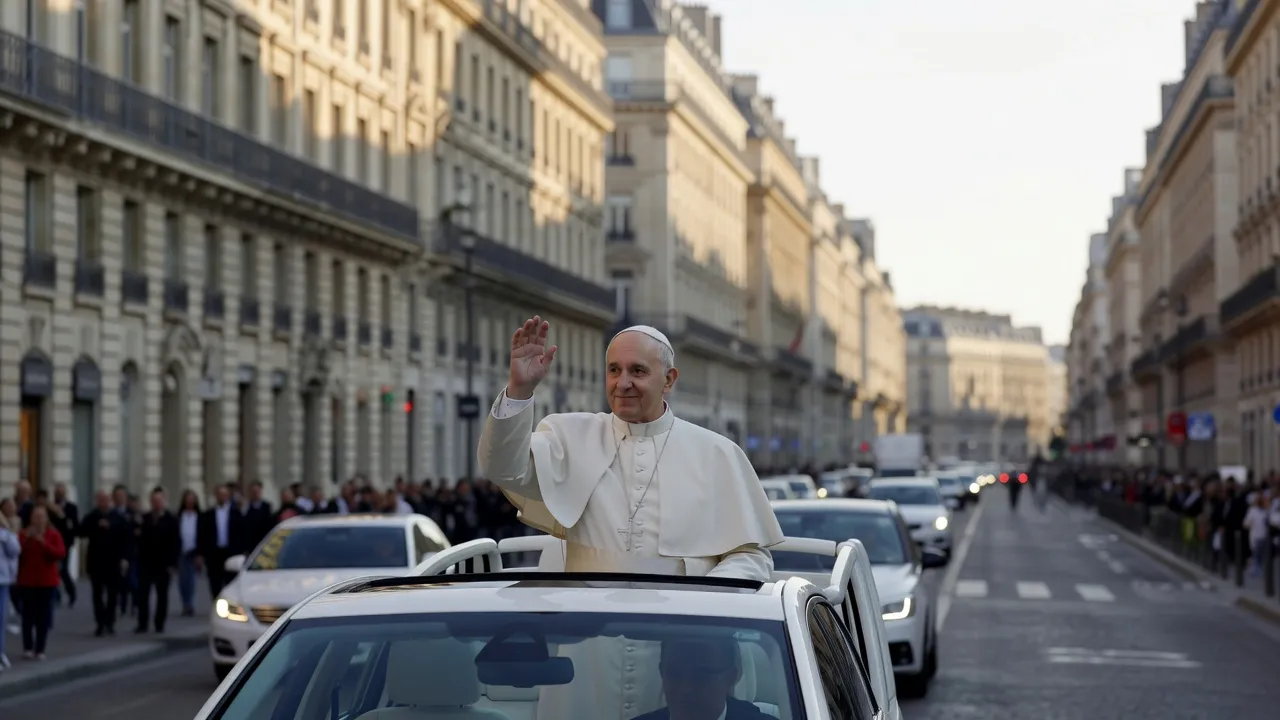
León XIV landed on Friday, September 25, in Paris for a four-day official visit to France, greeted on the plane's stairs by a procession led by Emmanuel Macron (El Nacional).
- 02
At Unesco, the pope called for technologies to "continue serving humans" and not become "an additional instrument of domination and injustice" (Últimas Noticias).
- 03
León XIV stated that human dignity is destroyed neither by illness nor by pain, denouncing a judgment of life based on the criteria of efficiency and productivity.
ANALYSIS
Caracas, September 26, 2026. Léon XIV landed on Friday, September 25, in Paris, where he began a four-day official visit to France, reports El Nacional. On the plane's stairs, the pope was greeted by a procession led by French President Emmanuel Macron, with whom he was to have a first meeting in the airport's honor lounge.
The Venezuelan press particularly retains from this first day the pontiff's intervention at UNESCO, where he called for technologies to "continue to serve humans" and not become "an instrument of further domination and injustice," according to Últimas Noticias. In this speech dedicated to the dignity of human life, Léon XIV mentioned the risks posed by new technologies, including artificial intelligence.
He recalled that many tasks previously performed by humans "have been entrusted to machines," and that certain artificial systems have been attributed "even the name of our human faculty of thinking: intelligence." "At the same time, our ideas and relationships risk being impoverished by a process of dehumanization," he warned.
The pope lamented that while intelligence is attributed to computer systems, humanity struggles to recognize the inalienable dignity of individuals, "whose lives are judged according to the criterion of efficiency and who are rejected when they are no longer deemed productive." He described this reality as "painful," inviting reflection on the fragility of human nature and on the "immense dignity" of each person, a dignity that, he assured, is not destroyed by illness or pain.
For the Venezuelan media, this passage through UNESCO goes beyond the French framework: the warning about the "paradise of machines" and the productivity criterion resonates beyond France, in a context where debates on automation are also gaining ground in Latin America. The coverage remains centered on these two moments — the protocolary arrival and the technological speech — without detailing the stages planned in Lourdes or Metz, or the political meetings mentioned elsewhere.