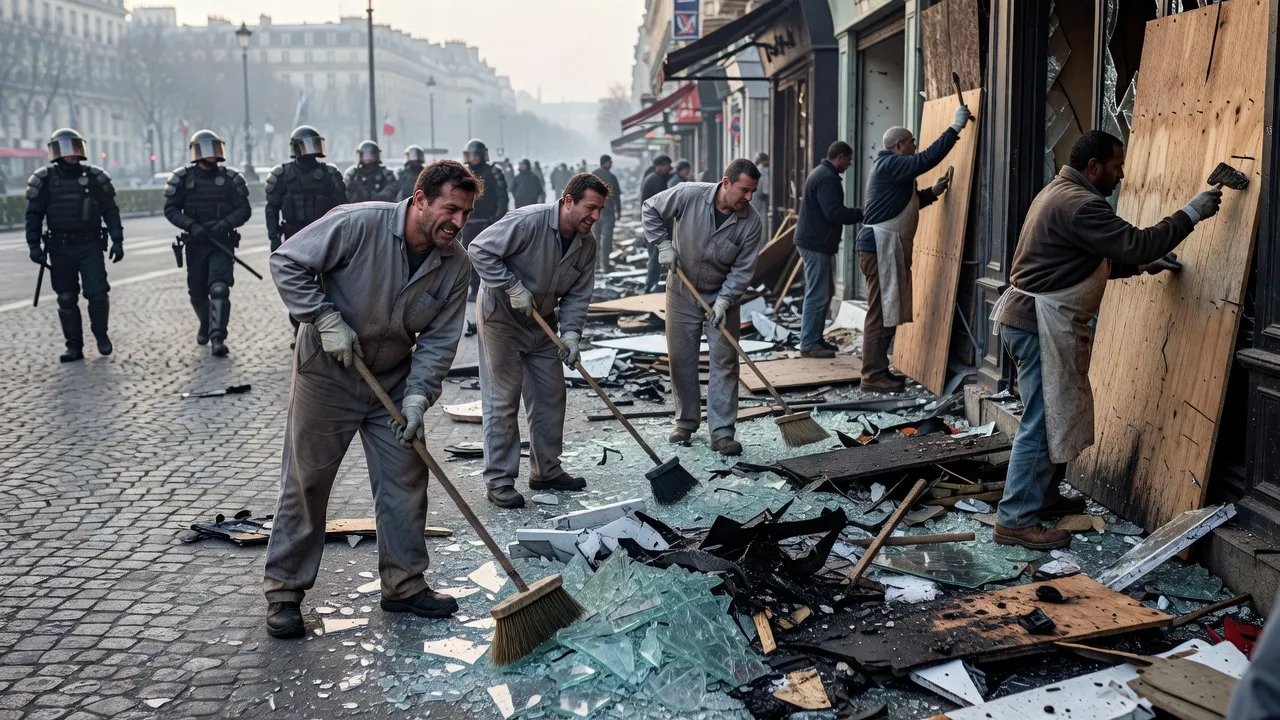
Common ground and differences in coverage across the media analysed.
What the media report in common
1
The rally against the high cost of living on Saturday, October 17, brought together more than half a million people, according to the Ministry of the Interior, and degenerated into looting, fires, and clashes in many cities.
2
The Ministry of the Interior reports a high number of arrests, between 1,200 and 2,400 depending on the time of the count, including a record 855 in Paris, and several hundred injured police officers, gendarmes, and firefighters.
3
Emmanuel Macron addressed the French on Sunday evening: he promises firmness and transparency in maintaining order, says he feels "anger" and "shame", and leaves it up to the prefects to ban certain gatherings.
Where media coverage diverges
Scope of the presidential address
Question: does the address respond to the situation? Some of the press notes the promised firmness and transparency; another highlights the lack of announcement on social demands and reports the criticism of the opposition, unions, and Edouard Philippe.
Question: who is to blame for the violence? Emmanuel Macron and Sebastien Lecornu cite the far left, delinquents, and a 'political maneuver'; Donald Trump invokes immigration, and Haaretz notes that the link to pro-Palestinian activism is based on few elements.
Paris differs on the political scope of the speech: in the face of the violence of October 17, the press notes firmness without a social response, contested even within the presidential camp.
Accra first notes a social anger over the high cost of living, drowned out by images of smashed store windows, looting and more than 1,000 arrests in France.
Buenos Aires stands out on the ground of order: the Argentine press is mainly following the balance of looting and arrests, and Macron's promise of an "implacable" response, before social demands.
Paris differs on the political scope of the speech: in the face of the violence of October 17, the press notes firmness without a social response, contested even within the presidential camp.
KEY POINTS
Emmanuel Macron denounced "troublemakers from far-left groups, joined by many criminals" and promised firmness and "transparency" without announcing anything on social demands.
Laurent Nuñez announced 1,800 arrests; the Paris Police Prefecture counted 855 in Paris, a "record figure", for 550,000 protesters according to the ministry and 800,000 according to the organizers.
Édouard Philippe, Manuel Bompard, and yellow vests criticized the speech; Sébastien Lecornu is to meet with political parties and unions.
ANALYSIS
Paris, October 18, 2026. The day after the mobilization against the "high cost of living" on Saturday, October 17, the French press is focusing on Emmanuel Macron's political response more than the demands. The president addressed the French for about ten minutes: "We all feel anger, shame tonight." He denounced "troublemakers from ultra-left groups, joined by many delinquents," while refusing to "confuse" the protesters with "legitimate demands" with "those who destroyed, broke, looted." Le Monde reports that the executive will be "inflexible" and that prefects will be able to "ban" certain gatherings.
The toll is fueling the narrative. Interior Minister Laurent Nuñez announced 1,800 arrests; in Paris, the Prefecture of Police counted 855, a "record figure." The ministry estimates the mobilization at 550,000 people, the organizers at 800,000. France 24 mentions around 1,500 affected stores; in Limoges, the belfry of the town hall collapsed. A protester died of a malaise in Paris. New tensions erupted on Sunday at the Place de la République, in Lyon, and in Marseille.
It is, however, the reception of the speech that dominates. 20 Minutes judges it "as short as disappointing": no announcement on the cost of living or public services. Édouard Philippe would have preferred "decisions and initiatives allowing a return to order"; Manuel Bompard (LFI) considers it "absolutely irresponsible to speak tonight to say nothing"; yellow vests denounce a "vacuous speech." Sébastien Lecornu is in charge of bringing together political parties and unions.
The law and order system is also being called into question. In Marseille, Benoît Payan regrets that there was only "one company of CRS," and socialist senators are calling for a debate and an investigation committee, judging that these violent acts "cannot, however, exonerate the Ministry of the Interior from its responsibilities." Macron promised "transparency." Donald Trump claims that "France is burning," and L'Obs relays foreign press reports that evoke the end of Macronism, six months before the presidential election.
Ghana
DOMINANT ANGLE
Accra first notes a social anger over the high cost of living, drowned out by images of smashed store windows, looting and more than 1,000 arrests in France.
KEY POINTS
About 1,800 people arrested on Saturday for some 550,000 protesters, according to MyJoyOnline.
More than 500 police officers, gendarmes, and firefighters injured, according to the French Ministry of the Interior.
The roof of the city hall of Limoges partially collapsed after a fire, reports GBC Ghana Online.
ANALYSIS
Accra, October 18, 2026. The Ghanaian press, through MyJoyOnline and GBC Ghana Online, recounts Saturday, October 17, through images of damage and figures. MyJoyOnline describes a France that "woke up" on Sunday to broken windows, burned-out cars, charred bicycles, and piles of glass on the sidewalks of Paris. According to the media, the police arrested around 1,800 people on Saturday, while some 550,000 protesters took to the streets in largely peaceful marches against fuel price hikes, the cost of living, and the deterioration of public services, including schools.
The account emphasizes the contrast between the procession and the violence. Groups dressed in black, masked or hooded, appeared in Paris, Marseille, and elsewhere; looting affected Paris, Marseille, and Lille. In Marseille, protesters forced their way into the city hall using a metal barrier as a battering ram; in Lille, a McDonald's was set on fire and an Apple Store was burglarized. In Paris, the police used tear gas and water cannons, and charged protesters with batons. More than 500 police officers, gendarmes, and firefighters were injured, according to the Ministry of the Interior, and around 1,500 businesses were damaged, according to the commerce federation.
GBC Ghana Online, under the pen of Nana Karikari, opens with earlier tolls: more than 160 people arrested in France, including over 100 in Paris, then at least 1,200 arrests, which the French government described as an "escalation of violence". The site reports the fire at the city hall of Limoges, whose roof partially collapsed, and that of the tourist office in Lyon, which Mayor Grégory Doucet called a "tragedy". Prime Minister Sébastien Lecornu reported 150 police officers injured.
Argentina
DOMINANT ANGLE
Buenos Aires stands out on the ground of order: the Argentine press is mainly following the balance of looting and arrests, and Macron's promise of an "implacable" response, before social demands.
KEY POINTS
Ámbito reports around 1,800 arrests, including 855 in Paris, and 550,000 protesters according to the Ministry of the Interior, compared to over 800,000 according to the organizers.
Infobae: Gérald Darmanin has asked prosecutors for an "extremely firm" judicial response and provisional detention for those who attack law enforcement and public buildings.
Perfil: Macron deems the demands regarding the cost of living "legitimate" but announced no new economic measures, and promises "rapid aid" to merchants.
ANALYSIS
Buenos Aires, October 18, 2026. The Argentine press is dedicating its pages to Emmanuel Macron's televised speech, delivered Sunday evening after Saturday's day of mobilization against the high cost of living on October 17. La Nación (AFP dispatch) highlights the phrase "Nada justifica la violencia" and the attribution of the violence to "radicales de la extrema izquierda". Perfil quotes the formula "Nada lo justifica, nada lo explica, nada lo excusa" and the president's "rabia y vergüenza".
The tolls vary depending on the headlines. Ámbito reports 1,800 arrests, including 855 in Paris, and 550,000 protesters according to the Ministry of the Interior, compared to more than 800,000 according to the organizers. La Nación, according to AFP, mentions nearly 2,400 people arrested and 1,000 police officers injured, then "more than 2,000" detainees in another text. Infobae relays the count from TF1 and LCI: 270 looted businesses. The fire at the city hall of Limoges, whose dome collapsed, is detailed by Ámbito, with the words of Mayor Guillaume Guérin: "No hay palabras para condenar lo que ha ocurrido".
The repressive aspect takes center stage. Infobae quotes Justice Minister Gérald Darmanin, who has asked prosecutors for an "extremadamente firme" judicial response and provisional detention for those who attacked police, firefighters, and public buildings. Ámbito headlines the possibility of banning gatherings and reiterates Macron's phrase about those who wanted to "derribar la República". La Nación notes that prefects will be able to make protection decisions and that the president promises "total transparencia".
Australia
DOMINANT ANGLE
Australia is gauging the cost of these riots for a Macron at the end of his term: a promised firmness, without exceptional measures, six months from a presidential election.
KEY POINTS
About 550,000 protesters on Saturday, October 17; 1,800 arrests announced by Laurent Nuñez, including 855 in Paris (SBS).
Macron: "We all feel anger and shame"; prefects authorized to ban gatherings and "full transparency" promised (ABC, PerthNow).
Donald Trump wrote "France is burning!"; the toll has risen to nearly 2,400 arrests and almost 1,000 injured police officers (SMH, SBS).
ANALYSIS
Canberra, 18 October 2026. The Australian press is covering the French riots as a crisis that is weakening a president at the end of his term. SBS writes that the "convulsion" of Saturday, 17 October "has raised the stakes" for Emmanuel Macron, who is in his final months in power before an election scheduled in six months. The Age mentions clashes that "will shape" national elections expected in a few months.
The facts are presented with precision. Around 550,000 people marched against the high cost of living and the quality of schools. The Parisian procession, estimated at 110,000 people, was largely peaceful before rioters attacked the police and stores. The city hall of Limoges was set on fire and its roof collapsed. Interior Minister Laurent Nuñez reported around 1,800 arrests, including 855 in Paris, a "record". ABC and SBS later updated the toll to nearly 2,400 arrests and almost 1,000 injured police officers and gendarmes, including seven seriously. Hundreds of businesses were looted, with estimated losses of several hundred million euros. A 78-year-old resident, Mehmet Ozeden, summed it up: "It's as if we had been at war."
The Sunday evening speech is closely reported. Macron said he felt "anger and shame", distinguished between protesters with "legitimate claims" and those who "destroyed, broke and looted", and targeted "agitators from ultra-left fringes, joined by many delinquents". PerthNow cited his promise of "full transparency" and his threat to ban certain gatherings through the prefects. SBS noted that he stopped short of drastic measures, such as a state of emergency or curfew. The media also highlighted the political quarrel over whether the state had done enough to prevent the destruction, as well as criticism of inadequate police preparation.
Bangladesh
DOMINANT ANGLE
Dhaka is watching the devastated French streets and the anger over the high cost of living, as it releases the tally before Emmanuel Macron's security response.
KEY POINTS
About 1,800 arrests, including 855 in Paris (a record), according to Interior Minister Laurent Nuñez, cited by The Daily Star.
550,000 protesters according to the Interior Ministry, 800,000 according to the CGT.
Macron attributes the violence to "insurrectionist elements from radical far-left groups, joined by numerous criminals" (TBS).
ANALYSIS
Dhaka, October 18, 2026. The English-language Bangladeshi press, The Daily Star and TBS, is following the French crisis through the lens of the street: devastated cities, looting, and anger over the high cost of living. The Daily Star opens with a question mark, "Revolution?", and describes a France that "woke up Sunday to devastated streets" after marches against the rising cost of living turned into "extreme" violence.
The newspaper provides the figures from both camps: 550,000 protesters according to the Ministry of the Interior, 800,000 according to the CGT. It links the mobilization to weeks of student mobilization and the upcoming presidential election, in six months. Prime Minister Sébastien Lecornu condemns violence "of extreme intensity" and speaks of a "miracle" that the toll is not heavier; Paris Mayor Emmanuel Grégoire asserts that entire streets have been "devastated". The daily also notes that a 17-year-old teenager had his hand torn off by a grenade in Saint-Étienne.
A second article in The Daily Star, "Never seen anything like it", gives the floor to witnesses: a 38-year-old art teacher, Alma, says she has "never seen anything like it" while "understanding" the revolt. The official toll is reported the next day: around 1,800 arrests, including 855 in Paris, a record, one dead protester, and hundreds of injured police officers.
TBS devotes its article to Sunday's speech. Emmanuel Macron expresses "anger" and "shame", attributes the troubles to "insurrectionist elements from radical far-left groups, joined by numerous criminals" and promises that "those who looted will have to pay back". He instructs the prefects to protect buildings and businesses with the mayors, including by banning demonstrations. TBS quotes Interior Minister Laurent Nuñez: the right to demonstrate is fundamental, not disorder through violence. The city hall of Limoges, whose roof collapsed, serves as the central image.
Belgium
DOMINANT ANGLE
Brussels is dissecting the political reception of Macron's speech: a firmness speech without a social response, deemed insufficient by the French political class six months ahead of the presidential election.
KEY POINTS
Macron denounced "troublemakers from ultra-left groups, joined by many delinquents" and promised "transparency" on law and order (DH).
Alexandre Bompard (Federation of Commerce and Distribution) estimates that 1,500 merchants were directly affected, for "several hundred million euros" (DH).
Fabien Roussel, Marine Tondelier, and Mathilde Panot regret the lack of social responses in an eight-and-a-half-minute speech (La Libre Belgique).
ANALYSIS
Brussels, October 18, 2026. On Sunday evening, Emmanuel Macron addressed the French following the day of demonstrations on Saturday, October 17, which resulted in unrest in many cities. The Dernière Heure retains its opening phrase: "We all feel anger, shame this evening," and its denunciation of "troublemakers from ultra-left groups, joined by many delinquents." The president stated that "those who destroyed must pay, those who looted must reimburse," while distinguishing "protesters with legitimate claims" from vandals.
The Belgian press also notes the promises of "transparency" regarding the law enforcement strategy: the head of state asked the Minister of the Interior, Laurent Nuñez, to "draw all the lessons." Prefects will be able to ban certain gatherings, and Prime Minister Sébastien Lecornu will meet "in the coming days" with parties, unions, student organizations, local authorities, and parliamentarians to "build" solutions to social demands. The DH reports that several opposition leaders are calling for the resignation of the occupant of Beauvau.
The bulk of the Belgian coverage focuses on the reception of the speech. La Libre Belgique and the DH headline with a political class that is not convinced: "Lamentable," "He speaks to say nothing," "Irresponsible." Fabien Roussel regrets that in eight and a half minutes, the president did not provide any answers to the high cost of living. Marine Tondelier welcomes the distinction between protesters and vandals but says she is "very disappointed" that two seriously injured people, in Saint-Étienne and Mulhouse, were not mentioned. Mathilde Panot denounces the lack of response to the demands.
Brazil
DOMINANT ANGLE
Brasilia is tallying the damage from a night of riots and is particularly focused on Macron's law and order response, the record arrests, and the devastated cities, more so than the social anger that sparked the movement.
KEY POINTS
According to Reuters as reported by Veja, police made 855 arrests in Paris, a record, with nearly 1,800 nationwide; the revised Interior Ministry tally shows 2,397 detainees and 997 injured police officers.
Macron stated that "nothing justifies, nothing explains, nothing excuses" the violence and promised "total transparency" on the response of the security forces (G1, Folha).
The Limoges city hall, a 143-year-old building, was set on fire and its tower collapsed; Prefect Maurice Barate speaks of a "patrimonial catastrophe" (G1).
ANALYSIS
Brasília, October 18, 2026. The Brazilian press opens with the balance of Saturday, October 17. G1 and Veja, citing Reuters and the Ministry of the Interior, count more than 500,000 protesters, one death (cardiac arrest in Paris), over 500 injured police officers, and nearly 1,800 arrests, including 855 in Paris, a record. On Sunday, October 18, Folha and the Jornal de Brasília report a revised balance: around 2,400 arrested and nearly a thousand injured police officers; Veja specifies 2,397 detainees and 997 injured.
The account lingers on the images. In Limoges, the 143-year-old town hall was set on fire and its tower collapsed; G1 quotes a resident, Françoise Faurie: "I saw Notre-Dame again, except this time it was our city." In Bordeaux, according to Mayor Thomas Cazenave, around a hundred stores were looted. L'Estadão, present at the Place de la République between 4 pm and 7 pm, describes barricades, stone-throwing, and tear gas, while locals run or drink a beer on a terrace.
Regarding Macron's speech, Folha and G1 note "nothing justifies, nothing explains, nothing excuses" and the attribution of violence to "factions and groups of the ultra-left" joined by many criminals. G1 highlights the promise of "total transparency" on the response of the security forces, after criticism of inadequate preparation, and the request to Laurent Nuñez to "draw all the lessons." Folha emphasizes the gesture towards the youth at the origin of the movement, born in schools. Veja recalls that Prime Minister Sébastien Lecornu also attributed the unrest to the far left, and that pressure is mounting less than a year before the presidential election.
Canada
DOMINANT ANGLE
Canada first notes the public order assessment of Saturday: arrests, looted businesses, the city hall of Limoges collapsed, then the firmness promised by Macron.
KEY POINTS
The Interior Ministry reported at least 1,800 arrests, including 855 in Paris, a "record" number according to the police (National Post).
Macron denounced "left-wing extremist agitators, joined by many offenders" without a state of emergency or curfew (National Post).
The city hall of Limoges, which was intentionally set on fire according to Prefect Maurice Barate, partially collapsed (Globe and Mail).
ANALYSIS
Au Canada, Saturday, October 17, is being treated by the English-language press as a public order earthquake. The Globe and Mail describes "the worst episode of violence the country has seen in years": organizers claim 800,000 protesters, authorities 550,000, and most of the marches remained peaceful. The toll varies depending on the articles: at least 1,800 arrests for The Globe and Mail and the National Post, around 2,000 for another Globe article, nearly 2,400 for Global News and a second National Post article, which mentions almost 1,000 police and gendarmes injured, compared to over 500 in the initial dispatches.
The story opens with concrete scenes. Aline Li, owner of the La Barrique restaurant near the Place de la République, saw her establishment looted and then set on fire: "It's the end for me," she says. In Limoges, the 19th-century city hall partially collapsed; Prefect Maurice Barate speaks of an arson attack committed by "a savage horde". In Paris, the police report a "record" number of 855 arrests, and Deputy Mayor Lamia El Aaraje mentions a level of violence never seen before.
The Sunday evening speech is reported almost in its entirety. Emmanuel Macron states: "We all feel anger and shame tonight", denounces "insurrectional elements" from the far left joined by many delinquents, and affirms that "those who destroyed must pay". He instructs the prefects to work with the mayors to protect public buildings, including by banning gatherings, and orders an investigation into police intelligence. The National Post notes that he announced neither a state of emergency nor a curfew.
Switzerland
DOMINANT ANGLE
Bern is deciphering a France that is stunned, where social anger over the high cost of living is combined with a shift of responsibilities between political camps, six months ahead of the presidential election.
KEY POINTS
According to Le Temps, 550,000 protesters in total in France (800,000 according to the CGT), including 110,000 in Paris, based on official figures.
Le Temps reports 2,397 arrests and 997 police officers and gendarmes injured, including 855 arrests in Paris, a "record figure" according to the police prefecture.
According to SRF, Macron spoke of "Wut und Scham" and announced consultations with high school students, students, unions, and employers as early as this week.
ANALYSIS
Berne, October 18, 2026. The French-speaking and German-speaking Swiss press describe a France "stunned" in the aftermath of Saturday, October 17, where 550,000 people, according to official figures (800,000 according to the CGT), marched against the "high cost of living". Le Temps reports that the French are "seeking explanations and those responsible", six months before the presidential election.
The balance sheet varies depending on the time of publication. SRF quotes Interior Minister Laurent Nuñez: 1,800 arrests and 500 police and firefighters injured, then, later, more than 2,000 arrests and 600 injured. Le Temps reports 2,397 arrests and 997 police and gendarmes injured, including 855 arrests in Paris, a "record figure" according to the police prefecture. SRF reports the death of a protester, who died of a heart attack in Paris.
The Sunday evening speech is reported with nuance. Le Temps notes that Emmanuel Macron, who until then had only made brief statements, spoke of "anger" and "shame", promised that "those who destroyed must pay", and questioned the intelligence received before the demonstration. SRF emphasizes another aspect: the president asked not to confuse the protesters with "legitimate demands" with those who "destroyed and looted", announced consultations with high school students, unions, and employers, and left it up to the prefects to ban gatherings.
Chile
DOMINANT ANGLE
Santiago is particularly focused on Macron's response: the promised firmness against the "extreme left-wing groups", with figures of detainees and injured police officers at the forefront.
KEY POINTS
Macron has promised to be "implacable" in the face of violence while acknowledging the "legitimate claims" of protesters (La Tercera).
The Interior Ministry estimates that there were more than 550,000 participants on Saturday, October 17, with 1,800 detained and more than 500 officers injured, as reported by La Tercera.
The city hall of Limoges, a historic monument, was almost destroyed by a fire; its mayor believes the police lacked resources (BioBioChile).
ANALYSIS
Santiago, October 18, 2026. The Chilean press reports on Emmanuel Macron's speech from the perspective of public order. On Sunday evening, for about ten minutes, the president stated: "Esta noche, todos sentimos rabia y vergüenza." La Tercera notes that he distinguished the authors of the destruction from the protesters with "reivindicaciones legítimas" and promised: "Seremos implacables. Escuchar y dialogar no significa debilidad ni impunidad." BioBioChile recalls his call on parties to condemn violence "sin ambigüedad," his phrase "El país necesita orden, no escalada," and the possibility for authorities to ban certain gatherings.
The balance of Saturday, October 17, occupies a large space. According to La Tercera, the Ministry of the Interior counts over half a million participants in 110 marches, while the CGT claims 800,000, according to the New York Times. The articles cite 1,800 detainees and over 500 injured agents; another text from the same media, dated Sunday, reports 2,397 detainees and 997 injured police and gendarmes, according to the government. The fire at the city hall of Limoges, whose roof collapsed, becomes the central image. Its mayor, Guillaume Guérin, launched: "Es un monumento que se quema, pero no la República."
BioBioChile details the reaction of Prime Minister Sébastien Lecornu, who speaks of a "maniobra política que acepta la violencia" and attacks targeting the "centros de poder" (the Élysée, Matignon, the Assembly). He indicates that Justice Minister Gérald Darmanin has asked prosecutors to request provisional detention. The mayors of Paris, Marseille, and Lyon are seeking a meeting with him. In Paris, the first deputy Lamia El Aaraje denounces a "falta de medios" of the police.
Colombia
DOMINANT ANGLE
Bogotá is weighing Macron's firmness six months ahead of the presidential election: the Colombian press sees a power under pressure, between unprecedented riots and rivals seizing the chaos.
KEY POINTS
Laurent Nuñez announced at least 1,800 arrests, including 855 in Paris, a "record" figure according to the police (Semana, El Colombiano, La República).
According to the Federation of Commerce and Distribution, at least 1,500 stores were damaged and the city hall of Limoges was destroyed by a fire (El Colombiano).
Macron denounced left-wing extremist groups joined by delinquents, promised a "firm hand" and "no impunity", and entrusted dialogue with the parties (El Colombiano).
ANALYSIS
Bogotá, October 18, 2026. The Colombian press is treating the French riots as a political earthquake six months ahead of the presidential election. Semana notes that the chaos, described as "unprecedented" by the authorities, "has increased pressure on President Emmanuel Macron," who has already been facing student protests in recent weeks. The Interior Minister, Laurent Nuñez, reported at least 1,800 arrests, including 855 in Paris, a "record" figure according to the police. The Federation of Commerce and Distribution, cited by El Colombiano, counts at least 1,500 damaged businesses. The Deputy Mayor of Paris, Lamia El Aaraje, speaks of "a level of violence that we have never seen" in the city.
The newspapers detail the destruction: burned barricades, broken windows, a degraded Arc de Triomphe, looting in Marseille, Bordeaux, Nice, and Strasbourg, and especially the city hall of Limoges, a 19th-century building destroyed by a fire that the prefect attributes to "a savage horde." La República, with an economic tone, recalls that more than half a million people marched, that the peaceful marches focused on the state of schools and hospitals and the cost of living, and that funding requests are being met with a growing debt.
Macron's speech is reported by El Colombiano: "Tonight, we all feel anger and shame," "Nothing justifies this. It's inexplicable and unforgivable." He attributes the violence to small extreme left-wing collectives joined by many delinquents, promises "a firm hand" and "no impunity," while asking to distinguish the authors from the hundreds of thousands of protesters whose demands may be legitimate. He also instructs the government to dialogue with the parties. Prime Minister Sébastien Lecornu accused the extreme left of standing "alongside the rioters" and spoke of a "political maneuver," adding: "It's a miracle that the toll is not heavier."
Norway
DOMINANT ANGLE
Oslo is measuring the shockwave of a country angry about the high cost of living, a movement that started in high schools and escalated to looting, rather than settling the debate on presidential firmness.
KEY POINTS
According to the Interior Ministry, nearly 1,800 people were arrested and about 500 police officers were injured on Saturday, including 855 arrests in Paris, a record (Aftenposten, via Reuters).
Around 1,500 businesses were affected by looting and destruction, according to the French retail federation (VG).
The movement started with a strike by students from the Saint-Exupéry high school on September 21 and has affected more than 1,000 high schools in ten days (VG).
ANALYSIS
Oslo, October 18, 2026. The Norwegian press is covering Saturday, October 17, as a national shock. Aftenposten leads with the French being "shocked by the destruction": in Limoges, the 140-year-old belfry of the town hall collapsed after a fire started by masked individuals. According to the Ministry of the Interior, nearly 1,800 people were arrested and around 500 police officers were injured, including 855 arrests in Paris, a record number. The newspaper then relays an updated version, citing Le Monde: nearly 2,300 arrests and around 1,000 police officers injured. One person died of a heart attack, according to Reuters.
VG emphasizes the material cost. Around 1,500 businesses would be affected by looting and destruction, according to the French federation of commerce, which estimates the damage at several billion kroner. The newspaper recalls that a florist in Lyon, interviewed by AFP, had already seen her window broken during the Yellow Vests protests in 2018. It seeks the origin of the movement: the strike by students from the Saint-Exupéry high school, near Paris, on September 21, against the lack of staff and resources, then more than 1,000 high schools affected in ten days, according to the Ministry of the Interior.
On the mobilization figure, Aftenposten gives the two versions: 800,000 people according to the CGT, 550,000 according to the Ministry. It also notes that Prime Minister Sébastien Lecornu spoke of a "miracle" that the toll was not heavier, and that Interior Minister Laurent Nuñez had suspended the use of stun grenades after a 15-year-old boy lost a hand in Lens; a 17-year-old then lost his right hand in Saint-Étienne.
Germany
DOMINANT ANGLE
Berlin is first assessing the extent of the damage and the response from Paris: the German press is detailing the looting, arrests, and firmness promised by Macron, with fears of a "Flächenbrand".
KEY POINTS
According to Minister Laurent Nuñez (DW, Handelsblatt), approximately 1,800 arrests and 500 police officers and firefighters injured; 855 people in custody in Paris, according to the prefecture.
Macron, on Sunday evening: "Nichts rechtfertigt es, nichts erklärt es, nichts entschuldigt es"; prefects may ban certain demonstrations (Tagesschau, FAZ).
Handelsblatt quotes the FCD federation: 1,500 businesses destroyed; the town hall of Limoges, a classified building, largely burned down.
ANALYSIS
Berlin, October 18, 2026. The German press is reporting on the aftermath of Saturday, October 17. According to Interior Minister Laurent Nuñez, cited by DW and Handelsblatt, approximately 1,800 people were arrested, including 855 who were taken into custody in Paris, according to the police prefecture, and 500 police officers and firefighters were injured. Another article by Tagesschau reports even higher numbers attributed to the same minister, with 2,000 arrests and 600 injuries. One protester died of a heart attack in Paris. The demonstration drew 550,000 people, according to the government, and 800,000, according to the CGT.
The Handelsblatt describes neighborhoods where tear gas and the smell of burning filled the air, and reports, according to the FCD federation, that 1,500 businesses were destroyed. The FAZ takes the reader to the East train station, where about 20 trains from Germany arrive every day: a father, his two daughters on fall vacation, and tear gas as soon as they exit the hall. In Limoges, the 143-year-old city hall is "largely lost," says Prefect Maurice Barate; the roof collapsed onto the lower floors.
The political reactions follow. Prime Minister Sébastien Lecornu denounces the "appalling extent of violence" and a well-organized ultra-left, seeing "a political maneuver that condones violence." On Sunday evening, Emmanuel Macron declares that "nothing justifies, explains, or excuses" the violence and that "we all feel anger and shame." He distinguishes between protesters with "legitimate demands" and those who "destroyed, broke, and looted," announces that prefects will be able to ban certain gatherings, and promises "full transparency" on the actions of law enforcement, with an examination of potential intelligence failures.
Algeria
DOMINANT ANGLE
Algiers describes a France plagued by urban chaos: the Algerian press highlights the anger over the high cost of living and devastated cities, more than the response of the executive.
KEY POINTS
Laurent Nunez, Interior Minister, mentions nearly 550,000 protesters and about 400 arrests; the CGT claims around 800,000 participants (Algérie Eco).
The city hall of Limoges was set on fire, the town hall of Marseille was stormed, and the tourism office of Lyon was set on fire, according to Reuters cited by Algérie Eco.
The socialist mayor of Paris, Emmanuel Grégoire, describes "entire streets" as being "methodically ravaged" (TSA Algérie).
ANALYSIS
Alger, October 18, 2026. Algerian media covered Saturday, October 17, in France as a social explosion coupled with urban disorder. TSA Algeria opens with a visual inventory: "Town halls set on fire, prefectures attacked, streets and shops devastated." The site evokes scenes of chaos and looting in Paris, Lyon, Marseille, and Limoges, after a week of mobilization by high school students against the lack of resources in high schools.
On the scale of the mobilization, the figures diverge, and the two sites place them side by side. Algeria Eco relays Interior Minister Laurent Nunez, who counts nearly 550,000 participants and about 400 arrests, mainly adults, while the CGT estimates the mobilization at around 800,000 people. TSA also retains the figure of some 800,000 demonstrators, who came at the call of unions and left-wing parties.
The account of the damage is precise and local. Algeria Eco, which cites the Reuters agency, reports the fire at the town hall of Limoges, the intrusion of black-clad protesters into the city hall of Marseille, the fire at the tourist office of Lyon, and the use of tear gas in Paris, where banks, a Lacoste boutique, and an SFR store were damaged or looted. TSA gives the floor to local elected officials: Socialist Mayor of Paris Emmanuel Grégoire speaks of "entire streets" "methodically ravaged", and that of Marseille, Benoît Payan, of a situation "out of control".
Ecuador
DOMINANT ANGLE
Quito is particularly mindful of the public order balance sheet: arrests, injured police officers, looted businesses, and the town hall of Limoges destroyed, with a Macron who promises sanctions.
KEY POINTS
According to Laurent Núñez, 2,000 people were arrested and 600 police officers, gendarmes, and firefighters were injured during the October 17 demonstrations (provisional toll, Expreso).
The demonstrations brought together 550,000 people according to the government and more than 800,000 according to the organizers (El Universo, El Comercio).
Macron stated "Nada lo justifica, nada lo explica, nada lo excusa" and promised aid to merchants, without announcing anything on the cost of living (El Universo).
ANALYSIS
Quito, October 18, 2026. The Ecuadorian press treats the day of Saturday, October 17, in France first as an episode of urban violence. Expreso headlines with "2,000 detained" and "600 agents injured," provisional figures published Sunday at the first hour by the Minister of the Interior, Laurent Núñez, who sees the work of "various thousands of ultra-left individuals" joined by delinquents. The same media notes that around 1,500 businesses were vandalized, with damage that could reach hundreds of millions of euros according to the commerce sector.
The account insists on the images. El Universo describes town halls set on fire in Limoges and damaged in Marseille and Lille, shops looted in the heart of Paris. Expreso dedicates an article to the Limoges building, inaugurated in 1883 and classified as a historic monument, whose roof collapsed after a fire around 5 pm. The mayor, Guillaume Guérin, declares: "It's a monument that burns, but not the Republic." Primicias, from a Parisian boulevard, collects the testimony of a resident, Cécile Rogue, who deplores "packs of young people" looting "with total impunity."
On the mobilization itself, the Ecuadorian media give the two estimates: 550,000 people according to the government, more than 800,000 according to the organizers. El Universo recalls that the "Amarillos y Jóvenes" call was born on social networks and that slogans like "Macron resignation" were chanted, six months from the presidential election in which the head of state can no longer present himself.
Estonia
DOMINANT ANGLE
Tallinn sees the French riots as a social anger born in high schools and degenerating into violence, tallying arrests and damage more than it comments on the executive's response.
KEY POINTS
Interior Minister Laurent Nuñez announced more than 1,800 arrests, including 855 in Paris according to the Paris police (ERR).
550,000 protesters according to the Interior Ministry, 800,000 according to the CGT (ERR).
Nearly 1,500 businesses damaged, with losses of several hundred million euros, according to Alexandre Bompard (ERR).
ANALYSIS
Tallinn, October 18, 2026. The Estonian press is treating the French riots as a social movement born in high schools and turned violent, rather than as an episode of presidential politics. ERR reports that Interior Minister Laurent Nuñez announced on Sunday more than 1,800 arrests after Saturday's day, marked by clashes, fires, and looting. The Paris police had counted 855 in the capital alone.
Ohtuleht situates the origin of the movement last month, in high schools in the poor suburbs of northern Paris, where students were protesting against the lack of teachers and buildings in poor condition. According to the newspaper, hundreds of thousands of high school students, unionists, and discontented individuals have joined the protest, which now demands a decrease in the cost of living and denounces inequalities and the decline in the standard of living. The "yellow vests" of 2018 have joined in. A 19-year-old protester, Lola, is quoted: "We are fighting because the high cost of living is too burdensome and fuel is too expensive."
The participation figures are presented with their source. The Interior Ministry counts 550,000 protesters; the CGT claims 800,000. The ministry attributes the violence to the far left, according to Ohtuleht, which mentions attacks on police officers, public buildings, and media in Paris, Marseille, Rennes, Toulouse, and Angers.
ERR details the damage. Nearly 1,500 businesses have been damaged, many of which were looted, according to Alexandre Bompard, who represents the sector; the damage could amount to several hundred million euros, with no definitive estimate. The police used tear gas and water cannons against protesters throwing projectiles and fireworks. The mayor of Paris, Emmanuel Grégoire, describes entire streets devastated by groups of masked youths.
Spain
DOMINANT ANGLE
Madrid is interpreting Macron's speech as a law-and-order response with no social component: the Spanish press is highlighting the lack of measures to address the high cost of living and recalling the Yellow Vests of 2018.
KEY POINTS
According to Laurent Nuñez, more than 2,000 people were arrested in France on Saturday, with over 550 still being held in Paris on Sunday, at least 150 of them minors (ElDiario.es).
The protests drew 550,000 people according to the government and 800,000 according to the organizers, with over 600 police officers, gendarmes, and firefighters injured (HuffPost España).
Macron denounced "troublemakers" from the far left without announcing any special measures, except for the possible ban on "certain gatherings" (ElDiario.es).
ANALYSIS
Madrid, October 18, 2026. For the Spanish press, France is "burning". ElDiario.es headlines with "Francia arde en una jornada de protestas con 2.000 detenidos": over 2,000 people were arrested on Saturday, according to Interior Minister Laurent Nuñez, including over 550 still in custody on Sunday in Paris, at least 150 of them minors. More than 600 police officers, gendarmes, and firefighters were injured, and one person died in Paris from a cardiorespiratory arrest, according to the prefecture.
The reports emphasize the coexistence of two realities. Peaceful marches, which HuffPost España estimates at 550,000 people according to the government and 800,000 according to the organizers, took place against the rising cost of living and the deterioration of public education. Just a few meters away, violent groups attacked public buildings, luxury shops, supermarkets, and police vehicles. In Limoges, the town hall is "practically destroyed"; the mayor of Paris, Emmanuel Grégoire, describes the streets of the city center as "devastated". ElDiario.es compares the day to December 1, 2018, the third act of the Yellow Vests, when the Arc de Triomphe was damaged.
On Sunday at 8 pm, Macron addressed the French in a video message recorded at the Élysée. He denounced "troublemakers from ultra-left groups, joined by many delinquents" and stated: "Nada lo justifica, nada lo explica, nada lo excusa." ElDiario.es notes that he announced no special measures, except for better coordination between prefectures and town halls that could go as far as banning "certain gatherings". The newspaper also notes that the head of state is leaving on Monday for an official visit to several Gulf countries, and that he has called on parties and unions to meet.
Israel
DOMINANT ANGLE
Jerusalem is particularly mindful of the international echo of the French riots: Donald Trump's phrase, "France is burning", and the attempt to link the crisis to immigration and then to pro-Palestinian militancy, which Haaretz disputes.
KEY POINTS
According to the Jerusalem Post, Laurent Nuñez estimates around 550,000 protesters, the CGT estimates 800,000, and Sébastien Lecornu announces 1,200 arrests on Saturday evening.
Emmanuel Macron promises "total transparency" on the police response and the possibility for prefects and mayors to ban certain gatherings.
Donald Trump writes "France is burning!" and urges Paris to "close its borders"; Haaretz notes that the government links the unrest to pro-Palestinian militancy with little evidence.
ANALYSIS
Jérusalem, October 18, 2026. Israel's government views the situation in France, where Saturday, October 17, saw protests against the high cost of living and the decline of public services degenerate into violence in several cities. If hundreds of thousands of people marched peacefully, violent groups targeted public buildings, looted luxury stores and supermarkets, and attacked vehicles and police officers. In Limoges, the city hall was set on fire; in Marseille, protesters dressed in black broke in and covered it with graffiti; in Lyon, the tourist office was set on fire.
The government reports the official figures: around 550,000 protesters according to Interior Minister Laurent Nuñez, 800,000 according to the CGT, and 1,200 arrests announced by Prime Minister Sébastien Lecornu in the evening. The latter promised that the government would not be "intimidated" and accused the far left and delinquents, just a few months before next year's presidential election.
On Sunday, October 18, Emmanuel Macron addressed the nation. The government notes his statement: "Nothing justifies it, nothing explains it, nothing excuses it. Tonight, we all feel anger and shame." The president mentioned "insurrectional elements" from far-left groups, joined by many delinquents, promised "total transparency" on the police response, ordered an examination of potential intelligence and police preparedness failures, and announced that prefects and mayors could ban certain gatherings. Israel's government places this sequence in the last six months of a term subject to political, budgetary, and social pressures.
India
DOMINANT ANGLE
New Delhi first recalls the images of luxury store looting and smashed windows, and treats the crisis as a spectacular street disorder, with Donald Trump as a commentator.
KEY POINTS
According to Prime Minister Sébastien Lecornu, quoted by the Times of India, 1,200 people were arrested and 150 police officers injured late Saturday.
The Interior Ministry estimates the mobilization at 550,000 people, the CGT at 800,000 (Times of India).
Donald Trump claims that France is "burning" and asks it to close its borders, attributing the unrest to immigration (Free Press Journal).
ANALYSIS
New Delhi, October 18, 2026. In the Indian online press, the day of mobilization against the high cost of living is told through its damage. The Times of India headlines with protesters who "loot Hermès, Apple and other luxury stores" in several cities, and describes looters who ravaged luxury boutiques, electronics stores, and supermarkets on Saturday. In Marseille, dozens of businesses were vandalized, including Hermès, according to AFP. In Paris, a store window near the Place de la République was broken, products were thrown at the crowd, phones were thrown from a telecommunications store, and a bar named La Barrique caught fire. In Lille, an Apple Store was visited, according to Socialist Mayor Arnaud Deslandes.
The Free Press Journal, in a text dated Saturday, October 17, details Bordeaux, where Apple and Louis Vuitton were reportedly targeted on Rue Sainte-Catherine, according to Le Parisien, citing AFP. It also lists the public buildings affected: a tourist office set on fire in Lyon, town halls forced open in Marseille and Lille, and the historic city hall of Limoges severely damaged by a fire. Both media outlets highlight the extent of the human and police toll: Prime Minister Sébastien Lecornu reported 1,200 arrests and 150 injured police officers late Saturday, while the Ministry of the Interior counted 272 by 3 pm. The Times of India also reports that in Saint-Étienne, a 17-year-old boy lost his right hand.
Italy
DOMINANT ANGLE
Rome took from Macron's speech the law and order response to a "Francia a ferro e fuoco": record arrests, looted shops, the Limoges town hall set on fire, with social demands relegated to the background.
KEY POINTS
Macron: "Nothing justifies or explains what happened", "anger and shame", with "exemplary" justice and bans on gatherings (Libero Quotidiano).
Interior Minister Laurent Nunez reports 1,800 arrests and over 500 injuries among law enforcement and security forces (Libero, askanews).
855 arrests in Paris, a record according to the police, and over 1,200 nationwide according to the authorities at this stage (ANSA).
ANALYSIS
Rome, October 18, 2026. The Italian press is covering Emmanuel Macron's address to the nation from the angle of public order, following a Saturday, October 17, of protests against the "carovita" (high cost of living) that degenerated in several French cities.
Libero Quotidiano extensively reports the speech. "Nothing justifies or explains what happened," the president said, evoking "anger and shame" and "unheard-of violence against law enforcement." He called for "exemplary" justice: "Those who destroyed must pay and compensate." He admitted that it was necessary to listen to "legitimate anger," while promising to be "intransigent with the violent," with bans on gatherings where necessary. The newspaper reiterates its question about the fire at the Limoges town hall: "How can they go so far?" Macron also promised "maximum transparency" and a review of intelligence work, and assured affected merchants and artisans of his proximity.
Figures are circulating from one dispatch to another. ANSA reports a "record" number of 855 arrests in Paris, more than 1,200 nationwide according to the authorities, and specifies that the processions, organized against the rise in the cost of living and to denounce the shortcomings of the school system, brought together hundreds of thousands of people, with fires and looting of stores. Libero, via askanews, then quotes Interior Minister Laurent Nunez: "1,800" people arrested "so far," and more than 500 injured among law enforcement and security forces. The deputy mayor of Paris, Lamia El Aaraje, speaks of "a level of violence that I believe we had never seen before."
South Korea
DOMINANT ANGLE
Seoul describes riots of an unprecedented scale in decades, distinguishing between the peaceful masses and violent groups, and focusing on the tally of arrests and injuries.
KEY POINTS
At least 1,800 people have been arrested, including 855 in the Paris region, and more than 500 police officers, gendarmes, and firefighters have been injured (Korea Times).
Around 550,000 protesters according to the Interior Minister, 800,000 according to the CGT; the city hall of Limoges, which was set on fire, saw its roof collapse.
Lecornu claims that the government will not be "intimidated" and Macron promises to prosecute the perpetrators; a televised address is scheduled for Sunday.
ANALYSIS
Seoul, October 18, 2026. South Korea's press recounts Saturday, October 17, in France as a flare-up of urban violence. The Korea Herald and the Korea Times headline the "worst riots in years": according to them, protests against the rising cost of living and the deterioration of public services have degenerated, to the point of reaching "some of the worst violence the country has witnessed for decades".
The account distinguishes between hundreds of thousands of peaceful protesters and violent groups on the fringes of the marches, which targeted public buildings, looted luxury stores and supermarkets, and attacked police vehicles. In Limoges, the city hall was set on fire and its roof collapsed; in Marseille, protesters dressed in black forced their way into the city hall; in Lyon, the tourist office was set on fire.
The figures come from the authorities: Interior Minister Laurent Nuñez estimates around 550,000 protesters, while the CGT announces 800,000. The number of arrests ranges from 1,200, cited by Prime Minister Sébastien Lecornu, to at least 1,800 in the following dispatch, including 855 in the Paris region. More than 500 police officers, gendarmes, and firefighters are injured, and one person has died of a heart attack; the Paris prosecutor's office has opened an investigation.
Lithuania
DOMINANT ANGLE
Vilnius is tallying the damage and arrests first and foremost: the Lithuanian press is focusing on public order and the economic cost of the French riots, and is reporting Macron's speech without commenting on it.
KEY POINTS
According to the Interior Ministry cited by 15min, 2,397 people were arrested on Saturday and 997 police officers and gendarmes were injured.
Verslo žinios: around 1,500 stores and businesses were affected, with losses of "several hundred million euros" according to the commerce federation.
Emmanuel Macron: "We are all feeling anger and shame tonight"; Sébastien Lecornu will chair a crisis meeting on Monday, October 19.
ANALYSIS
Vilnius, October 18, 2026. The Lithuanian press is covering the French crisis from the angle of material damage and public order, before that of the claims. Verslo žinios headlines "1,500 damaged stores" and 1,800 people arrested, a number that the police describe as a record for a day of demonstrations. The economic daily relays the vice-mayor of Paris, Lamia El Aaraje, who says that the capital has faced "a level of violence that we had, I believe, never seen".
The newspaper details the looting: masked youths have ransacked dozens of stores in Paris, Marseille, Bordeaux, Nice, and Strasbourg. In Limoges, the 19th-century town hall burned down; Prefect Maurice Barate speaks of an arson attack committed by a "savage horde". The president of the trade federation, Alexandre Bompard, estimates the losses at "several hundred million euros", without a precise amount at this stage.
15min follows Emmanuel Macron's speech on Sunday evening. The head of state mentions "violence of incredible scope" in the cities and asserts that "nothing can justify" the riots: "We all feel anger and shame tonight." He also asks: "How can the French treat France like this?" The Lithuanian media reports that Prime Minister Sébastien Lecornu will chair a crisis meeting on Monday, October 19, to "gather support" for those going through difficult times, and that the perpetrators of the violence "will be held accountable".
Mexico
DOMINANT ANGLE
Mexico City first focuses on the security aspect of the French crisis: record arrests, injured police officers, the Limoges city hall set on fire and Lecornu's reading of a "political maneuver".
KEY POINTS
La Jornada: around 800,000 protesters in at least 1,750 marches, at least 1,200 arrests and 150 police officers injured.
Sébastien Lecornu denounces "a political maneuver that accepts violence" and says Darmanin has requested provisional detention for those arrested.
Reforma reports, according to AFP, over 2,000 detainees and new tear gas on Sunday at the Place de la République in Paris.
ANALYSIS
Mexico, October 18, 2026. The Mexican press covered Saturday, October 17, as a flare-up of urban violence, with details of arrests and damage. La Jornada estimated the mobilization at "unas 800 mil personas" in at least 1,750 marches against the rising cost of living, in support of high school students' demands, with at least 1,200 arrests and 150 police officers injured. The newspaper specified the social context: the anger targets inflation and the deterioration of public services.
El Informador relayed the version of Prime Minister Sébastien Lecornu. Just before midnight on Saturday, during a trip to support law enforcement, he mentioned 1,200 people arrested in one day and stated that behind the violence was "a political maneuver that accepts violence". He added that "no nos dejaremos intimidar" and that Justice Minister Gérald Darmanin had asked prosecutors to request provisional detention for "particularly violent and dangerous" profiles. Lecornu said that Parisian "centres of power", including the Élysée, Matignon, and the National Assembly, had been targeted.
The mayors of Paris, Marseille, and Lyon, Emmanuel Grégoire, Benoît Payan, and Grégory Doucet, requested to be received by Lecornu early in the week and demanded "a precise diagnosis" of the chain of events.
The toll worsened as the dispatches came in. El Informador reported around 1,800 national arrests, and Reforma, citing AFP, spoke of more than 2,000 detainees. Images of the burning city hall of Limoges, a 143-year-old building, opened several reports. El Norte and Reforma published the same AFP gallery: looting in France, a fire in front of Milan Cathedral, a camp in Lisbon, tear gas and rubber bullets in Albania, which inscribed the crisis in a European wave.
Malaysia
DOMINANT ANGLE
Kuala Lumpur is particularly mindful of devastated cities and social anger born out of the high cost of living, as reported by AFP and Reuters dispatches that show looting and fires six months ahead of the presidential election.
KEY POINTS
Around 1,200 arrests on Saturday; 550,000 protesters according to Interior Minister Laurent Nuñez, 800,000 according to the CGT.
The city halls of Limoges (set on fire) and Marseille (invaded) and the tourism office of Lyon (set on fire) were targeted.
Sébastien Lecornu states: "No one will impose their political agenda through violence", and Emmanuel Macron promises lawsuits against those responsible.
ANALYSIS
Kuala Lumpur, October 18, 2026. The Malaysian press covers Saturday, October 17, in France through news agency dispatches, with images of looted shops and burned public buildings at the forefront. The Vibes reports on a France "shaken by widespread violence": protests against the rising cost of living and the deterioration of public services have degenerated into clashes with the police, fires, and looting, with around 1,200 arrests.
Participation figures are reported from both sides: 550,000 protesters according to Interior Minister Laurent Nuñez, 800,000 according to the CGT. The Vibes, citing Reuters, highlights that hundreds of thousands of people marched peacefully, while violent groups targeted public buildings, businesses, and law enforcement. In Limoges, the city hall was set on fire; in Marseille, it was invaded and covered in graffiti; in Lyon, the tourist office was set on fire.
The Sun MY and Malay Mail retell the AFP's account in Paris: men in black sweatshirts forced metal curtains and emptied shelves of cigarettes, sunglasses, clothing, jewelry, and food, "without resistance from the authorities." A 38-year-old art teacher, Alma, says she has "never seen anything like it," while "understanding" the revolt. The police used tear gas and water cannons in response to projectile throwing and fireworks.
Nigeria
DOMINANT ANGLE
Abuja is particularly concerned with the international fallout from the French riots: between the toll of violence and Macron's speech, the Nigerian press highlights Trump's "France is burning!" and the country's image abroad.
KEY POINTS
The Interior Minister announced 1,800 arrests, a record 855 in Paris, according to Punch citing AFP.
Macron stated in his address: "Nothing justifies it, nothing explains it, nothing excuses it. Tonight, we all feel anger and shame."
Donald Trump wrote on Truth Social: "France is burning!" and called on France to "close its borders", after similar comments from JD Vance.
ANALYSIS
Abuja, October 18, 2026. The Nigerian press is covering the French crisis from two angles: the toll of the violence on Saturday, October 17, and, above all, Washington's reaction. Punch, quoting AFP, describes a country "in shock" the day after protests against the high cost of living: 1,800 arrests, including a record 855 in Paris, a historic city hall set on fire, and looting in Marseille, Bordeaux, Nice, and Strasbourg. According to the Commerce Federation cited by the newspaper, around 1,500 businesses were damaged, resulting in losses of several hundred million euros. Interior Minister Laurent Nuñez promises to identify the perpetrators to bring them to justice, and a 78-year-old resident confides, "It's as if we had been at war." Vanguard reports on Emmanuel Macron's televised address on Sunday, October 18: "Nothing justifies it, nothing explains it, nothing excuses it. Tonight, we all feel anger and shame." The newspaper notes that the president has ordered an examination of potential intelligence and police preparation failures, that prefects and mayors will be able to ban certain gatherings, and that the government will bring together students, teachers, parliamentarians, unions, and business leaders for "concrete proposals," without further details. Vanguard also places this sequence in the last six months of Macron's term, under political, budgetary, and social pressure, before the presidential election. But it's the American angle that dominates the coverage. Vanguard, Daily Post, and Nigerian Eye relay Donald Trump's message on Truth Social: "France is burning!" Immigration, he writes, has "broken this once-great country," and he calls on Paris to "close its borders" before it's "too late." Vanguard adds Vice President JD Vance's statement, who speaks of "madness" and a liberal West that has "imported the Third World," and notes the link with the midterm elections on November 3, where Republicans are not favored. Daily Post and Nigerian Eye present these comments as an expression of Trump's hardline stance on immigration and recall that France is experiencing recurring debates on integration and public security. The Nigerian perspective is thus focused on France's international image and Washington's political use of it, rather than on the social demands of the protesters.
Nepal
DOMINANT ANGLE
Kathmandu sees the French riots as an explosion of social anger over the high cost of living, relayed through Reuters dispatches and focused on the balance of destruction.
KEY POINTS
According to Interior Minister Laurent Nunez, around 550,000 people demonstrated; the CGT claims 800,000.
Nearly 1,800 people were arrested, including a record 855 in Paris, and more than 500 police officers were injured.
One protester died of a heart attack in Paris; the city hall of Limoges was set on fire.
ANALYSIS
Katmandou, October 18, 2026. Nepal's press, which largely relies on Reuters dispatches, describes France on Saturday, October 17, as a country where anger over the high cost of living has spilled over. The Kathmandu Post headlines "the worst riots in years": more than half a million people marched against price hikes and the deterioration of public services, according to Interior Minister Laurent Nunez, who claims 550,000 protesters. The CGT, on the other hand, claims 800,000.
The account distinguishes between two crowds. Hundreds of thousands of people demonstrated peacefully in dozens of cities, while violent groups targeted public buildings, looted luxury stores and supermarkets, and attacked vehicles and police officers. In Limoges, the city hall was set on fire; in Marseille, protesters dressed in black entered and covered it with graffiti; in Lyon, the tourist office burned.
The next day's toll occupies the second dispatch: nearly 1,800 arrests, including a record 855 in Paris, over 500 injured police officers, and one protester dead from a heart attack in the capital. Several hundred businesses were damaged. Dutch entrepreneur Tije De Boer, who came to Paris with his children, sums it up: "It's like a war zone here," after having to evacuate his hotel on the Place de la République. Khabarhub also describes streets littered with broken windows, burned-out cars, and charred bicycles.
On the political front, Nepal's press relays Prime Minister Sébastien Lecornu, who promises not to be "intimidated" and blames "the far left" and delinquents, just a few months before next year's presidential election. Emmanuel Macron has promised to pursue and punish the perpetrators of the attacks. The articles report that his speech is scheduled for 8 pm on Sunday, without disclosing its content.
Peru
DOMINANT ANGLE
Lima first assesses the public order situation: arrests, injured police officers, looted businesses, and the French government's security response following Saturday, October 17.
KEY POINTS
Between 550,000 (Interior Ministry) and 800,000 (organizers) protesters on Saturday, October 17, according to RPP and Diario Correo.
Laurent Núñez reports 1,800 then 2,000 arrests and 500 then 600 police, gendarmes, and firefighters injured, according to RPP and Andina.
Sébastien Lecornu calls for the provisional detention of those arrested and denounces "a political maneuver that accepts violence" (Diario Correo).
ANALYSIS
Lima, October 18, 2026. The Peruvian press is following the French crisis through news agency dispatches and the prism of law and order. RPP Noticias reports on "burning buildings, looting, and violent clashes" and 1,800 detainees. The October 17 mobilization brought together between 550,000 and 800,000 people, according to the Ministry of the Interior and the organizers, including high school students, unions, retirees, and supporters of the yellow vests. RPP connects it to the anger that started at the end of September in the high schools of northern Paris, then to inflation, fuel prices, and a 54 billion euro budget adjustment plan.
The narrative emphasizes the damage. Andina mentions town halls set on fire in Limoges and damaged in Marseille and Lille, and stores looted in the center of Paris. The Minister of the Interior, Laurent Núñez, speaks of "several thousand far-left individuals" joined by "delinquents"; his provisional toll has risen to 1,800 and then 2,000 arrests, and to 500 and then 600 injured police officers, gendarmes, and firefighters. The Commerce Federation estimates the damage at "hundreds of millions of euros" and 1,500 vandalized stores. El Comercio quotes Parisians in front of burned-out bicycles: "We've never seen such violence."
The government's response is detailed. Macron promises that the perpetrators will be "pursued and punished". The Keeper of the Seals Gérald Darmanin calls for provisional detention. Prime Minister Sébastien Lecornu sees it as "a political maneuver that accepts violence" and chairs an interministerial crisis cell. Diario Correo also relays the mayors of Paris, Marseille, and Lyon, who demand a "precise diagnosis", and the leader of the ecologists Marine Tondelier, who calls for Núñez's resignation.
Philippines
DOMINANT ANGLE
Manila is particularly mindful of the extent of the violence and the law and order response: devastated cities, numerous arrests, and Emmanuel Macron's promise of firmness, as reported by AFP and Reuters dispatches.
KEY POINTS
According to Interior Minister Laurent Nuñez, around 550,000 people demonstrated; the CGT claims 800,000 (GMA News, via Reuters).
Macron states that "nothing justifies" unbridled violence and promises "full transparency" on the action of the security forces (GMA News, via AFP).
The dispatch cited by GMA mentions nearly 2,400 arrests on Saturday and almost 1,000 police and gendarmes injured, including seven seriously.
ANALYSIS
Manille, October 18, 2026. The Philippine coverage of the French social earthquake relies on agency dispatches published by GMA News and Inquirer, and prioritizes the image of urban chaos. GMA headlines with mass demonstrations that "degenerate into the worst riots in years": on Saturday, October 17, the marches against the rising cost of living and the decline of public services turned, in several cities, into what the text describes as among the worst violence in the country in decades.
The account distinguishes the peaceful crowd, hundreds of thousands of people, from violent groups on the fringes who targeted public buildings, looted luxury shops and supermarkets, and attacked vehicles and law enforcement. In Limoges, the city hall was set on fire; in Marseille, protesters dressed in black entered the city hall and covered it with graffiti; in Lyon, the tourist office was set on fire. Inquirer, quoting AFP, devotes a dispatch to the Limoges blaze, a 143-year-old building, with a municipal employee seen in tears.
The figures are attributed: Interior Minister Laurent Nuñez mentions around 550,000 demonstrators, the CGT 800,000 according to Reuters. Prime Minister Sébastien Lecornu, who speaks of 1,200 arrests in the evening, refuses to be "intimidated" and accuses the far left and delinquents, just a few months before next year's presidential election.
Pakistan
DOMINANT ANGLE
Islamabad describes a France with devastated streets where anger over the high cost of living, which began with mass marches, has turned into riots that Macron's speech does not resolve.
KEY POINTS
More than half a million people marched on Saturday against the high cost of living; the police made a record 855 arrests in Paris and over 500 police officers were injured, according to Business Recorder.
Macron said: "Tonight, we all feel anger and shame", without announcing a state of emergency or curfew, according to Geo News.
Trump wrote on Truth Social "France is burning!" and attributed the unrest to immigration, after comments by JD Vance.
ANALYSIS
Islamabad, October 18, 2026. The Pakistani press, which mainly relays agency dispatches via ARY News, Geo News, Business Recorder, and Daily Times, describes a France awakened on Sunday to "devastated" streets after marches against the high cost of living that turned violent. According to Business Recorder, more than half a million people marched in dozens of cities, at the intersection of a month-old student movement and a broader malaise against price increases and the decline of public services. The Ministry of the Interior reports 550,000 participants, the CGT 800,000.
The toll is detailed: one demonstrator died of a heart attack in Paris, where the police made a record 855 arrests, more than 500 police officers were injured according to Interior Minister Laurent Nuñez, several hundred businesses were damaged, and a city hall was set on fire. The figures vary from one article to another: 1,200 arrests according to Prime Minister Sébastien Lecornu, nearly 1,800, more than 2,000, and then nearly 2,400 in the Geo text dated the next day. ARY reports that a 17-year-old had his hand torn off by a grenade in Saint-Étienne, and Daily Times relays accusations of excessive use of force by human rights organizations.
Regarding the speech, Geo News quotes Emmanuel Macron: "Tonight, we all feel anger and shame." He distinguishes between protesters with legitimate demands and those who "destroyed, broke, and looted," and promises to be uncompromising towards ultra-left agitators joined by many delinquents, without announcing a state of emergency or curfew. Geo sets the scene in the electoral context: Macron cannot run again, and Marine Le Pen, the Rassemblement national candidate, is high in the polls.
Sweden
DOMINANT ANGLE
Stockholm is gauging the French crisis by the yardstick of social anger: school and the cost of living take precedence over the president's rhetoric of firmness.
KEY POINTS
According to Laurent Nuñez, around 550,000 people demonstrated on Saturday, compared to 800,000 according to the organizers.
In Limoges, the city hall was set on fire and its roof collapsed onto the lower floors.
Macron defended the police, promised prosecutions, and acknowledged the need for full transparency regarding their actions.
ANALYSIS
Stockholm, October 18, 2026. The Swedish press reports on a France shaken by a day of mobilization that turned violent. Aftonbladet describes hundreds of thousands of protesters taking to the streets on Saturday, October 17, against the shortcomings of the school system, the rising cost of living, and cuts in the public sector. According to Interior Minister Laurent Nuñez, around 550,000 people marched, compared to 800,000 according to the organizers. The newspaper emphasizes that the vast majority protested peacefully, according to Reuters, but that groups of masked individuals attacked the police, looted stores, and vandalized public buildings.
The extent of the damage takes center stage: cars set on fire in Paris, entire commercial streets ravaged, luxury brands like Louis Vuitton as well as food stores looted. In Limoges, the city hall was set on fire and the roof collapsed onto the lower floors; in Marseille, the city hall was stormed; in Lyon, the tourist office burned down. Paris Mayor Emmanuel Grégoire, quoted by AFP, notes that "entire streets have been devastated". Aftonbladet also retraces the origins of the movement: high school students from the Paris suburbs protesting in September against the lack of teachers and dilapidated facilities, then a growing discontent with high prices and social fractures.
Regarding Sunday's speech, Svenska Dagbladet and Aftonbladet pick up the same dispatch: Emmanuel Macron defended the police's actions, deemed professional despite accusations of excessive violence, and recalled that those responsible would be prosecuted and punished. However, he showed some understanding towards the criticism, deeming it necessary to have full transparency regarding police action and requesting information to prevent such incidents from happening again: "We want to act", he said, particularly evoking the anger towards the school system.
Portugal
DOMINANT ANGLE
Lisbon is particularly focused on the law and order response: a record number of arrests, Emmanuel Macron's promise of sanctions, and Donald Trump's reaction, rather than the social demands.
KEY POINTS
About 1,800 arrests were made, including 855 in Paris ("a record number"), and over 500 police officers, gendarmes, and firefighters were injured, according to Minister Laurent Nuñez (Observador).
Macron promises that looters will compensate for the damage and that those who tried to "overthrow the Republic" will be held accountable (SAPO).
Trump writes on Truth Social: "France is burning!" and calls for the borders to be closed (RTP, Observador, Jornal Económico).
ANALYSIS
Lisbon, October 18, 2026. The Portuguese press is following Sunday evening, October 18, from the perspective of public order. L'Observador, SAPO, RTP, and Jornal Económico first report on the balance of Saturday, October 17: approximately 1,800 arrests, according to L'Observador and Jornal Económico, including 855 in Paris, a "record number" according to the police, and more than 500 police officers, gendarmes, and firefighters injured, according to Interior Minister Laurent Nuñez. The balance remains provisional, he warns. More than 500 people were still in custody, including 171 minors.
Jornal Económico and RTP estimate the mobilization at 550,000 people, according to the Interior Ministry, and more than 800,000, according to the organizers. The violence would have affected 1,500 businesses and cost "hundreds of millions of euros." SAPO focuses on Limoges: the town hall, a building from 1883, is "practically destroyed" after a fire, and Mayor Maurice Barate speaks of a "catastrophe for heritage."
Regarding the speech itself, SAPO emphasizes Emmanuel Macron's phrase: the demands are "legitimate," but he will be "inflexible" with those who "destroy and pillage." The president denounced "elements of radical left-wing groups, joined by many criminals" and stated: "We all feel anger and shame tonight." He promised that looters will have to compensate for the damage and that those who wanted to "overthrow the Republic" will be held responsible. He assured business owners that they will "not be alone": Prime Minister Sébastien Lecornu will chair a crisis unit, initially scheduled for Sunday, then postponed to Monday, October 19, in the morning, according to Le Monde, cited by L'Observador.
Qatar
DOMINANT ANGLE
Doha sees the French riots as an expression of a social crisis born in high schools and fueled by the high cost of living, which the presidential address does not resolve.
KEY POINTS
According to the Interior Ministry, around 550,000 people demonstrated in France on Saturday; unions and organizers announced 800,000 (Al Jazeera).
Interior Minister Laurent Nuñez reported 1,800 arrests, including a "record" 855 in Paris, and the city hall of Limoges was destroyed by a fire (Gulf Times).
Macron expressed "anger and shame" and promised that the rioters will pay, without declaring a state of emergency or curfew (Al Jazeera).
ANALYSIS
Doha, October 18, 2026. In Qatari media, Saturday, October 17, was first and foremost a day of social unrest. Al Jazeera recalls that the protests originated in September in high schools in the popular north of Paris, against the lack of teachers and the dilapidation of facilities, before spreading to Bordeaux, Rennes, Nantes, Lyon, Lille, and Marseille, and then joining the outrage against the high cost of living. According to the Ministry of the Interior, around 550,000 people demonstrated; unions and organizers announced 800,000. The channel emphasizes that most marched peacefully, while a minority attacked buildings, looted stores, and clashed with the police.
The toll is detailed. Gulf Times, citing Interior Minister Laurent Nuñez, reports 1,800 arrests, including 855 in Paris, a "record" according to the police. The 19th-century city hall of Limoges burned; Prefect Maurice Barate speaks of a "savage horde". Lamia El Aaraje, deputy mayor of Paris, evokes a violence that the capital had "never" seen. The figures vary: Al Jazeera cites nearly 2,400 arrests and around 1,000 injured police and gendarmes, while Sébastien Lecornu announced 1,200 arrests and 150 injured police.
On Sunday, Emmanuel Macron said he was seized with "anger and shame", promised that rioters and looters "will pay for their crimes", and distinguished between protesters with "legitimate claims" and those who "destroyed, broke, and looted". Al Jazeera notes that he did not declare a state of emergency or curfew, announced a crisis unit for urgent aid, and asked the government to draw lessons. His correspondent Natacha Butler judges the speech as without "surprises" and doubts that it will suffice to calm the streets.
Romania
DOMINANT ANGLE
Bucharest is particularly focused on the public order situation: looting, arrest and injury figures, and then Macron's promise of firmness, as relayed in the official statements.
KEY POINTS
Lecornu announced 1,200 arrests on Saturday evening and 150 injured police officers and gendarmes; the Ministry of the Interior reported 550,000 protesters, including 110,000 in Paris.
In Limoges, the town hall fire caused the roof to collapse onto the lower floors; numerous Parisian stores were looted.
Macron promises transparency and firmness: "Those who destroyed must pay, those who looted must compensate".
ANALYSIS
Bucharest, October 18, 2026. The Romanian press first retains the images of disorder from Saturday, October 17. G4Media, which reprints Mediafax, reports that many stores were looted and devastated in several cities during the protests against the high cost of living. In Paris, Monoprix, SFR, Yves Rocher, Carrefour City, Franprix, and Etam were targeted, and a Kawasaki showroom was set on fire; Dior reinforced the security of its boutique with a private team, doubting the protection that the police could provide. In Limoges, the fire at the town hall caused the roof to collapse on the lower floors.
The tolls are piling up. Prime Minister Sébastien Lecornu announced on Saturday evening 1,200 arrests, compared to around 400 at the beginning of the evening, and 150 injured police officers and gendarmes; he deemed it "miraculous" that the toll was not more severe. According to the Ministry of the Interior, around 550,000 people marched in 110 demonstrations, including 110,000 in Paris; the organizers claim 800,000. G4Media, citing Agerpres, reports nearly 1,800 arrests, including a record 855 in Paris, and one protester who died of a heart attack.
Emmanuel Macron's speech on Sunday evening at 8 pm is extensively reported according to Le Figaro: "Nothing explains, nothing justifies. We all feel anger and shame." He targets ultra-left extremists joined by many delinquents, promises total "transparency," and investigations conducted with the greatest firmness: "Those who destroyed must pay, those who looted must compensate." The articles also repeat the passage on the anxiety of young people and the "double responsibility" to listen to anger and support the republican order.
Russia
DOMINANT ANGLE
Moscow is calling out a French authority that has been overtaken: its agencies are releasing reports of arrests, damage, and calls for resignation, while Macron's speech is mainly being reported as a promise of order.
KEY POINTS
According to TASS citing AFP, 2,397 people were arrested and 997 law enforcement officers injured, including seven seriously.
Macron announced that prefects could ban certain gatherings and that Sébastien Lecornu would meet with parties and unions (TASS).
Jordan Bardella wrote that he expected Macron to "apologize and step down" (TASS).
ANALYSIS
En Russie, October 18. The agencies are reporting on the riots of Saturday, October 17, in terms of a numerical toll and the collapse of authority. TASS reports that in the evening, following the address from the Élysée, Emmanuel Macron spoke of a "very serious moment" and "unleashed violence from left-wing radical groups". He asked the government to draw lessons from this, mentioned bans on gatherings by prefects, and tasked Prime Minister Sébastien Lecornu with bringing together parties and unions to obtain a clear condemnation of violence. Sputnik also quotes his request to "draw all the lessons" regarding intelligence and anticipation.
The numbers dominate the coverage. Interfax and Vedomosti relay Interior Minister Laurent Nuñez: over 2,000 arrests and more than 600 police officers, gendarmes, and firefighters injured. TASS, citing AFP, reports 2,397 people arrested and 997 members of the security forces injured, including seven seriously. Sputnik headlines "1,500 businesses affected" and hundreds of millions of euros in damage, according to the Paris city hall, whose deputy mayor believes the city lacked police resources. Interfax notes that the unrest continued on Sunday, with stores looted in Paris.
TASS details the scenes: a police station in central Paris attacked, according to central Paris mayor Ariel Weil, and the collapse of the belfry of the Limoges city hall after a fire. The mayor, Guillaume Guérin, speaks of "chaos for the country" and claims that the rioters "came to kill".
Singapore
DOMINANT ANGLE
Singapore is tallying the damage and arrests in a France plagued by looting, and gauging Macron's law and order response, without a state of emergency or curfew.
KEY POINTS
According to CNA, Interior Minister Laurent Nuñez reports 1,800 arrests, including 557 people taken into custody in Paris after a "record" number of arrests.
Macron announces that local authorities will be able to ban certain gatherings "if necessary", without a state of emergency or curfew (Straits Times).
Trump writes on Truth Social "France is burning!" and Vance blames immigration and "assimilation" (Straits Times).
ANALYSIS
Singapour, 18 October 2026. Singapore's Channel News Asia and The Straits Times, which largely reproduce AFP dispatches, focus on the material and security assessment of Saturday, 17 October. "It's as if we had been at war," testifies Mehmet Ozeden, 78, a resident of central Paris, quoted by CNA. The Minister of the Interior, Laurent Nuñez, mentions 1,800 arrests and investigations to "identify the perpetrators." In Paris, 557 people are in custody after a "record" number of arrests, and Deputy Mayor Lamia El Aaraje speaks of a level of violence "never seen."
The figures vary from one title to another. The Straits Times mentions either more than 2,000 arrests or nearly 2,400, with almost 1,000 police and gendarmes injured, including seven seriously, compared to more than 600 officers in another dispatch. CNA estimates around 1,500 businesses damaged, with losses of several hundred million euros. More than half a million people marched, in the convergence of a month-long student movement with anger over the high cost of living; one protester died of a heart attack in Paris.
On Sunday, 18 October, clashes resumed at the Place de la République: tear gas, stun grenades, 42 arrests, and at least five looted stores, according to The Straits Times. In his address, Emmanuel Macron declares: "Tonight, we all feel anger and shame." He distinguishes between protesters with "legitimate claims" and those who "destroyed, broke, looted," promises to be "inflexible" with ultra-left "troublemakers," and announces that local authorities will be able to ban certain gatherings "if necessary." The newspaper notes that he stops short of declaring a state of emergency or curfew.
Senegal
DOMINANT ANGLE
Dakar describes a France gripped by social anger, where images of looting and the testimony of protesters on repression stand alongside Macron's promise of firmness.
KEY POINTS
Laurent Nuñez estimates around 550,000 protesters on October 17, including 110,000 in Paris, while the CGT claims 800,000 (PressAfrik).
Macron states on Sunday: "We all feel anger, shame tonight," distinguishing between protesters with "legitimate claims" and rioters (Dakaractu).
Sébastien Lecornu reports 1,200 arrests and over 150 injured police officers; the city hall of Limoges was set on fire (PressAfrik, Dakaractu).
ANALYSIS
Dakar, October 18, 2026. Dakaractu, PressAfrik, and Senego report on a France where the Saturday, October 17, mobilization day against the high cost of living turned violent. Dakaractu mentions "smashed windows, burned cars, official buildings targeted" in several cities, and lists town halls attacked in Lille and Marseille, the city hall of Limoges set on fire, the residence of the prefect of Gironde "ransacked", and many looted businesses.
The figures are presented with their discrepancies. The Minister of the Interior, Laurent Nuñez, counts about 550,000 demonstrators, including 110,000 in Paris, while the CGT claims 800,000. On the arrest side, PressAfrik first reports around 400 arrests according to Nuñez, then the toll of 1,200 given by Prime Minister Sébastien Lecornu, with more than 150 injured among the police forces. PressAfrik's title takes up the range "between 550,000 and 800,000 demonstrators".
The demands are detailed: faced with "the explosion of prices and budget austerity", unions, high school students, and collectives are demanding a revaluation of salaries, the minimum wage, and pensions, as well as means for public services and national education.
On the political level, the Senegalese press extensively quotes Emmanuel Macron. On Saturday, on X, he promised that those who had "smashed" and "looted" would be "pursued and punished" and called to "stand together against the sowers of chaos". On Sunday, in his speech, he declared: "We all feel anger and shame tonight", calling not to "confuse" the protesters with "legitimate demands" with the rioters. The provided articles do not report any social announcements from him.
Turkey
DOMINANT ANGLE
Ankara sees the French riots as a political test for Macron six months ahead of the election, between a record security balance and social demands from high school students and unions.
KEY POINTS
Around 1,800 people arrested according to Interior Minister Laurent Nuñez, including a record 855 in Paris (Daily Sabah)
On Saturday, 110 demonstrations: 800,000 participants according to the unions, 550,000 according to the Interior Ministry (Bianet)
The government is accelerating the "casseurs-payeurs" bill and Didier Migaud is meeting with prosecutors general on October 19 (Bianet)
ANALYSIS
Ankara, October 18, 2026. Two Turkish media outlets, Daily Sabah and Bianet, are reporting on the riots that followed Saturday's October 17 mobilization day against the high cost of living. Daily Sabah speaks of the "worst riots in years": around 1,800 people arrested, a historic city hall set on fire in Limoges, businesses looted in Paris, Marseille, Bordeaux, Nice, and Strasbourg. The Interior Minister, Laurent Nuñez, gave an update on X on Sunday, ensuring that investigations are underway to identify and prosecute the perpetrators. In Paris, the police recorded a record 855 arrests, and Deputy Mayor Lamia El Aaraje mentions "a level of violence that we have, I think, never seen".
Daily Sabah places the issue at the level of the executive: the unrest increases pressure on Emmanuel Macron, in his final months in power before an election in six months. The newspaper details the recriminations: the centrist government and Marine Le Pen accuse the "ultra-left", while Jean-Luc Mélenchon, who supported the protests, called for avoiding looting, "contrary to our methods". Prefect Maurice Barate attributes the fire in Limoges to a "savage horde".
Bianet goes back to the origin of the movement: high school students demanding equality in education, which became a social movement of hundreds of thousands of people. On Saturday, the 110 demonstrations across the country brought together 800,000 people according to the unions, 550,000 according to the Interior Ministry; most of the processions took place peacefully. The site gives a heavier toll: more than 2,000 people in custody and more than 600 police officers, gendarmes, and firefighters injured. It details the government's response: Prime Minister Sébastien Lecornu promises tougher sanctions, the government is accelerating the "casseurs-payeurs" bill, which aims to make the perpetrators pay for the damage, and the Keeper of the Seals is to meet with the general prosecutors on Monday, October 19.
Ukraine
DOMINANT ANGLE
Kyiv sees Macron's speech as a test of domestic power: a president at the end of his term, who targets the far left and promises firmness without addressing social anger.
KEY POINTS
According to Interior Minister Laurent Nuñez, 1,800 people were arrested after the demonstrations, including 557 in police custody in Paris after a "record" number of arrests.
Around 1,500 businesses were affected, with losses of several hundred million euros according to the Federation of Commerce and Distribution.
In his address, Macron denounced far-left rioters, left it up to prefects to ban gatherings, and acknowledged the legitimacy of concerns about the high cost of living.
ANALYSIS
Kyiv, October 18, 2026. Ukraine's press is following the French riots through the prism of Emmanuel Macron's political fragility. The Kyiv Post, quoting AFP, writes that France was "reeling" on Sunday from the previous day's violence: 1,800 people arrested, a historic city hall set on fire, and widespread looting. A 78-year-old resident of central Paris, Mehmet Ozeden, told AFP: "It's as if we had been at war." The media notes that the shock "raises the stakes" for a president in his final months in power, six months before the election that is to designate his successor, after weeks of sometimes violent student protests.
The material damage is a major concern. According to Interior Minister Laurent Nuñez, 1,800 people were arrested; in Paris, 557 people were in custody after a "record" number of arrests. Paris Deputy Mayor Lamia El Aaraje mentions a level of violence "never seen before". About 1,500 businesses were affected, with estimated losses of several hundred million euros, according to the Federation of Commerce and Distribution, whose president Alexandre Bompard is calling for accelerated insurance compensation. A death that occurred during the Paris march is presented, according to the authorities, as being of medical origin and unrelated to the violence.
Ukrinform, through its correspondent, reports on Macron's televised address on Sunday evening. Macron accused rioters from the far left, joined by many delinquents, cited the fires at the city hall in Limoges and the tourist office in Lyon, the intrusion at the town hall in Marseille, and the attack on the prefect's residence in Bordeaux, and emphasized that there is "no justification, no explanation, no excuse". "Those who wanted to overthrow the Republic will have to answer for it," he said. He instructed the government to draw lessons in terms of intelligence and early detection, and left it to the prefects, along with the mayors, to ban certain gatherings.
United Kingdom
DOMINANT ANGLE
London describes a France in the aftermath of chaos, where a massive and largely peaceful protest against the high cost of living was overshadowed by looting, as Macron promises order without a social response.
KEY POINTS
Around 550,000 protesters marched on Saturday, October 17, against the high cost of living, with about 1,800 arrests according to the BBC, including a record 855 in Paris according to the Independent.
In Limoges, the 19th-century city hall was ravaged by a fire, its roof and clock tower collapsing (BBC).
Macron stated "We all feel anger and shame" and asserted that "nothing justifies" the violence, while Trump wrote "France is burning!" (BBC, Independent).
ANALYSIS
London, 18 October 2026. The British press first focuses on images of a country waking up on Sunday amidst the rubble. The BBC describes broken shop windows, burnt-out cars, charred bicycles, and piles of glass on Parisian sidewalks. According to the BBC, the police arrested around 1,800 people on Saturday, 17 October, as some 550,000 protesters marched in "largely peaceful" processions against fuel price hikes, the cost of living, and the deterioration of public services, including schools. In an update, the channel now reports around 2,400 arrests, according to the Ministry of the Interior.
The Independent emphasizes the toll: in Paris, a record 855 arrests, one protester dead from a cardiac arrest, looted shops in Paris, Marseille, Lyon, Bordeaux, Rennes, or Strasbourg. In Limoges, the 19th-century city hall saw its roof collapse in flames. The mayors of Paris, Marseille, and Lyon have asked to meet with the Prime Minister "given the extent of the damage". The daily recalls that the movement was born last month in high schools in the northern suburbs of Paris, before becoming a national protest against inequality and the weakness of public spending.
Emmanuel Macron's speech is closely reported. The BBC quotes his phrase "We all feel anger and shame", his call for "calm and order", and his distinction between the "legitimate claims" of protesters and "those who have destroyed, vandalized, and looted". He asserts that "nothing justifies" this violence. Prime Minister Sébastien Lecornu has, according to The Independent, attributed some of the violence to groups of "radical far-left". Marine Le Pen estimates that the rioters have "spoiled" the protest.
United States
DOMINANT ANGLE
The United States capital views the French unrest as a political test for Macron, between a record on public order and criticism of his social conduct and silence.
KEY POINTS
Nearly 1,800 arrests, including 855 in the Paris region, and more than 500 police officers, gendarmes, and firefighters injured (Fox News, AP).
Macron spoke of "anger" and "shame" and asked prefects to ban demonstrations if necessary (HuffPost/AP).
According to Bloomberg, fiscal constraints limit the government's leeway in the face of economic demands, ahead of a presidential election.
ANALYSIS
Washington, October 18, 2026. The American press initially portrays the French uprising as a test for Emmanuel Macron. The AP agency, picked up by ABC News and HuffPost, describes a Saturday where 110 marches brought together approximately 550,000 people according to Interior Minister Laurent Nuñez, 800,000 according to the organizers, against the high cost of living and the state of schools. Masked groups attacked public buildings; in Limoges, the roof of the city hall collapsed. Prefect Maurice Barate sees it as "a deliberate act of hooligans" and "a catastrophe for heritage," as quoted by Fox News.
The toll is detailed: nearly 1,800 arrests, including 855 in the Paris region, more than 500 police officers, gendarmes, and firefighters injured, one protester dead from a heart attack in Paris. Nuñez writes on X: "The right to demonstrate is fundamental. Deliberately and collectively sowing disorder through violence is not." On Sunday, hundreds of people gathered again in the Place de la République, where the police used tear gas.
The televised speech is reported by AP: Macron expresses "anger" and "shame," mentions "insurrectional elements" from the far left joined by many delinquents, assures that those who looted will have to reimburse and that those who wanted to "overthrow the Republic" will be held accountable. He asks the prefects to work with the mayors, including by banning demonstrations if necessary.
Uruguay
DOMINANT ANGLE
Montevideo is measuring the pressure on Emmanuel Macron: chaos described as "unprecedented", 1,800 arrests and a president with no possible successor six months ahead of the presidential election.
KEY POINTS
At least 1,800 people arrested, including 855 in Paris, and 1,500 businesses damaged according to the Federation of Commerce and Distribution (El Observador, Subrayado).
Macron: "Nothing justifies it, nothing explains it, nothing excuses it", while promising "total transparency" and "rapid aid" to businesses (Subrayado).
Trump wrote that "France is on fire" and called for its borders to be closed, after comments from JD Vance (El Observador).
ANALYSIS
Montevideo, October 18, 2026. Uruguayan media is focusing on the aftermath of Saturday, October 17. El Observador and Subrayado, citing an AFP dispatch, report on unprecedented chaos, according to authorities: at least 1,800 people arrested, including 855 in Paris, a record number according to the police, and 1,500 businesses damaged, according to the Federation of Commerce and Distribution. Interior Minister Laurent Nuñez announced on X that investigations are underway to identify the perpetrators. Paris Deputy Mayor Lamia El Aaraje speaks of a level of violence that, she believes, has never been seen before.
Montevideo Portal puts the mobilization into context: around 550,000 protesters, according to the Interior Ministry, 800,000 according to the organizers, bringing together students, unions, former yellow vests, and far-left groups. The media mentions the rise in the cost of living and fuel, the rejection of the 2027 budget cuts by Prime Minister Sébastien Lecornu, justified by a debt close to 120% of GDP, and the high school movement born on September 17. La Diaria reports one death, hundreds of injured, including dozens of police officers, and over 2,000 detainees, according to its count.
Subrayado details the televised address on Sunday. Macron says he feels rage and shame, judges the violence as unbearable, and assures that nothing justifies, explains, or excuses it. He distinguishes between the rioters and the hundreds of thousands of peaceful protesters, blames extremist left-wing groups joined by many delinquents, promises total transparency, and rapid aid to affected merchants and artisans. La Diaria also reports that he described the protests as legitimate.
Venezuela
DOMINANT ANGLE
Caracas is particularly mindful of the public order balance sheet: record arrests, looted businesses and quantified damage, along with the firm response from Macron and Lecornu.
KEY POINTS
Interior Minister Laurent Nuñez announces at least 1,800 arrests, including 855 in Paris (El Nacional).
The Commerce Federation estimates 1,500 stores were affected and damage in the "hundreds of millions of euros" (Contrapunto).
Lecornu describes the violence as a "political maneuver" and calls for provisional detention for those arrested (El Nacional).
ANALYSIS
Caracas, October 18, 2026. The Venezuelan press covers the French violence of Saturday, October 17, from the angle of public order and material damage, based on agency dispatches (AFP, EFE) taken up by El Nacional, Contrapunto, and Efecto Cocuyo.
The count takes center stage. El Nacional reports "at least 1,800 people arrested", according to Interior Minister Laurent Nuñez, including 855 in Paris, a "record" detention reported by the police. Contrapunto mentions a provisional figure of 2,000 arrests and 600 injured police officers, gendarmes, and firefighters. Nuñez attributes the violence to "several thousand far-left individuals", joined by delinquents who looted businesses.
The damage is detailed. The Federation of Commerce and Distribution estimates that 1,500 stores were affected; its president, Alexandre Bompard (Carrefour), speaks of "hundreds of millions of euros" in damages and demands an acceleration of compensation. El Nacional notes that Limoges lost its city hall and quotes Paris Deputy Mayor Lamia El Aaraje, evoking "a level of violence that we had never seen".
The political register remains secondary. Efecto Cocuyo relays Macron's message from Saturday: "no place for violence", promising that troublemakers will be "pursued and punished" and calling for a "united front" against "those who sow chaos". Prime Minister Sébastien Lecornu sees "a political maneuver that accepts violence" and obtained from Justice Minister Gérald Darmanin requests for provisional detention. The mayors of Paris, Marseille, and Lyon demand to meet with him for a "precise diagnosis".
South Africa
DOMINANT ANGLE
Pretoria is measuring the fragility of a Macron at the end of his term, pressed by the streets and by the presidential deadline in six months, more than the social dimension of the demands.
KEY POINTS
Around 1,800 arrests were made in France on Saturday, including 855 in Paris (a record), and more than 500 police officers were injured, according to Business Day and TimesLIVE.
Over 500,000 protesters demonstrated against the high cost of living, with one protester dying of a heart attack in Paris.
Macron promised that prefects and mayors will be able to ban certain gatherings and called for unions, students, and employers to come together to discuss "concrete proposals".
ANALYSIS
Pretoria, October 18, 2026. The South African press mainly reprints Reuters and AFP dispatches on Saturday, October 17, which it describes as one of the most violent days in France in years. More than 500,000 people marched in dozens of cities, according to Business Day and TimesLIVE, at the convergence of a month-old student movement and broader discontent with the rising cost of living and the decline of public services. On the sidelines, violent groups set fire to a town hall, looted luxury shops and supermarkets, and attacked police vehicles.
The reported toll: around 1,800 arrests, according to Interior Minister Laurent Nuñez, including 855 in Paris, a record, more than 500 police officers injured, and one protester dead from a heart attack in Paris. The Citizen estimates that around 1,500 businesses were affected, with losses of several hundred million euros, according to the Federation of Commerce, and quotes a 78-year-old Parisian: "It's as if we had a war." SABC News, which reports higher figures (more than 2,000 arrests, more than 600 injured), reports new clashes on Sunday at the Place de la République, with tear gas and burned bicycles, and a Dutch tourist speaking of "a war zone".
Regarding Sunday evening's speech, TimesLIVE and Daily Maverick quote Emmanuel Macron: "Nothing justifies it, nothing explains it, nothing excuses it. Tonight, we all feel anger and shame." He ordered an examination of possible intelligence or police preparation failures, announced that prefects and mayors will be able to ban certain gatherings, and asked the government to bring together students, teachers, parliamentarians, unions, and business leaders this week to formulate "concrete proposals", without further details.
Explore every perspective on this subject across 43 countries.
France: after 1,800 arrests, Emmanuel Macron vows firmness against "seditious" groups
published on
October 18, 2026
43
countries
131
sources
180
articles
70/100
gap
The outlets in the corpus agree on the raw facts of this weekend, but each highlights a different aspect: the details of the speech, the revision of the reports, the high school origin of the mobilization, or the accusations being exchanged.
Sébastien Lecornu is to meet with parties and unions on Monday, October 19; the executive has announced no measures on social demands.
What the speech says, word for word
The Jerusalem Post reports Emmanuel Macron's opening phrase: "Nothing justifies it, nothing explains it, nothing excuses it." La Libre Belgique and DH note another phrase: "those who destroyed must pay, those who looted must reimburse." According to DH, the president also asked Laurent Nuñez to "draw all the lessons" from the day.
Emmanuel Macron, on Sunday, October 18, as reported by the Jerusalem Post
Several headlines focus on intelligence. Le Temps writes that the president questioned the intelligence received before the demonstration. The Jerusalem Post specifies that he ordered an examination of potential intelligence gaps and police force preparation.
Al Jazeera notes what the speech does not contain: neither a state of emergency nor a curfew. The channel mentions a crisis unit for urgent aid. Its correspondent Natacha Butler judges the address as having no "surprises". La Libre Belgique times the speech at eight and a half minutes.
Regarding the follow-up, DH writes that Sébastien Lecornu will meet "in the coming days" with parties, unions, student organizations, local authorities, and parliamentarians. SRF cites high school students, unions, and employers among the announced participants.
Death tolls reported at different times
The arrest numbers vary from one report to another. The Jerusalem Post cites 1,200 arrests announced by Sébastien Lecornu on Saturday evening. Al Jazeera reports that the Prime Minister mentioned 150 injured police officers, before a tally of around 2,400 arrests and 1,000 injured. SRF ranges from 1,800 to over 2,000, Le Temps gives 2,397.
These discrepancies follow updates from the Ministry of the Interior. They measure the time at which each editorial team picked up the figure: the corpus does not show two concurrent assessments. TASS, which cites AFP, specifies that among the 997 injured law enforcement members, seven are seriously injured.
ElDiario.es adds a detail about Paris: more than 550 people still in custody on Sunday, including at least 150 minors.
On the scene, local sources are cited by foreign media. TASS reports, according to Paris Center Mayor Ariel Weil, the attack on a police station. Limoges Mayor Guillaume Guérin speaks of "chaos for the country". Prefect Maurice Barate mentions a "deliberate act of hooligans" according to Fox News, a "savage horde" according to Le Temps.
Where the mobilization comes from
Al Jazeera places the start of the movement in September in popular high schools in northern Paris, protesting the lack of teachers and the age of the facilities. The protest then spread to Bordeaux, Rennes, Nantes, Lyon, Lille, and Marseille. The Independent describes a national protest over inequalities and the weakness of public spending.
SRF lists other motives: fuel prices, food and energy prices, agricultural concerns. The newspaper specifies that the call came from social networks under the slogan "On en a marre". Le Temps mentions the return of the yellow vests, relying on the New York Times and the Ansa agency. ElDiario.es draws a parallel with December 1, 2018.
The weight given to these causes varies depending on the coverage. According to the analysis of the corpus, the German press only mentions the demands in passing: Tagesschau cites the cost of living and the failures of the education system. This measures the editorial space given to the subject, not the content of the demands.
Bloomberg adds a budgetary angle. Its reporter Gaspard Sebag explains that fiscal constraints leave the government little room to respond to economic demands.
Who is to blame for the violence
On the allegations, the frameworks overlap without matching point by point. The FAZ reports that Sébastien Lecornu describes a far-left that is "very well organized". According to SRF, the government implicates La France insoumise, and Jean-Luc Mélenchon accuses "the leadership in Paris" of having allowed chaos to set in.
« a political maneuver that condones violence »
Sébastien Lecornu, Prime Minister, as reported by the FAZ
On the side of the Rassemblement national, TASS reports that Jordan Bardella expects Macron to "apologize and leave". According to the Independent, Marine Le Pen believes that the rioters have "spoiled" the demonstration. SRF also quotes her on a "threat to democracy".
Donald Trump writes "France is burning!" on Truth Social and attributes the situation to immigration, according to the Jerusalem Post and La Libre Belgique. Le Temps notes that J. D. Vance commented on the event. According to the analysis of the corpus, this message occupies a marked place in the presses of Israel, Nigeria, and Pakistan; this count measures editorial attention, not the opinion of their readers.
Haaretz reports that the Israeli government is trying to link the protests to pro-Palestinian militancy, with few elements other than Palestinian flags in the processions. In the UK and the US, the Daily Mail and Fox News focus on the Céline Dion concert that Macron attended on Friday evening.
The high school movement
Starting with the strike at Saint-Exupéry high school on September 21, it affected more than 1,000 high schools in ten days.
Trade
The trade federation estimates the damage at several hundred million euros.
Political reactions
Fabien Roussel, Marine Tondelier, and Mathilde Panot regret the lack of social responses in the address.
Key figures
550,000
Protesters on October 17, according to the Ministry of the Interior (800,000 according to the CGT)
The voice of peaceful protesters is preserved: young Parisians claim to be "pacifists" and seek to bring about change, but "nothing is moving". GBC places the movement within nearly a month of expanded student mobilization, which has grown into a challenge to government policy, with around 60 marches and 250 coordinated actions.
The articles provided do not report on Emmanuel Macron's speech or French political reactions: attention remains on the street, the damage, and social anger.
The political dimension is evident: La Nación emphasizes that Macron is speaking "bajo la presión de una clase política que ya se encuentra en plena campaña presidencial", and that the government and the far right accuse La France insoumise of Jean-Luc Mélenchon of fueling the violence. Perfil specifies that the president deemed the demands for the cost of living "légitimes", without announcing any measures, and promised "ayudas rápidas" to merchants and artisans.
The economic context is recalled by Perfil: a cumulative inflation of 20% mentioned around the protests and the rise in fuel prices since the start of the war in the Middle East. Clarín and Ámbito broaden the focus to Europe, with the clashes in Milan, which, according to Clarín, recall the French scenes.
The international dimension occupies a significant place. The Sydney Morning Herald and The Age headlined with Donald Trump's phrase, "France is burning!", and reproduced his call to "close the borders", which follows the comments of Vice President JD Vance on "importing the Third World". The "Macron condemns" label remains central, but Washington's agenda is cited prominently.
Dhaka finally relays Donald Trump's phrase, "France is burning!", cited by The Daily Star along with his attack on immigration, without commentary.
The material aspect is documented by the head of the Federation of Commerce and Distribution, Alexandre Bompard, who mentions on LCI 1,500 merchants directly affected and "several hundred million euros" in damages. The DH also reports on new clashes on Sunday at the Place de la République in Paris, where the CRS 8 was deployed for a second day in a row after an undeclared gathering.
The international dimension is only a sideline: La Libre quotes Donald Trump, who writes on Truth Social "France is burning!" and attributes the riots to immigration. It recalls that Macron is maintaining his trip from Monday to Wednesday to four Gulf countries.
The social backdrop is exposed in a few lines: a month-long student movement joined by discontent with the high cost of living and the decline of public services. The organizers claim 800,000 protesters, compared to 550,000 according to the government. Veja also reports two minors mutilated, one hand lost in Saint-Étienne and one eye in Mulhouse. Donald Trump, cited by G1 and Veja, attributes the chaos to immigration: "France is on fire! [...] Close your borders." Agência Brasil finally places these troubles in a wave of European demonstrations.
Interior Minister Laurent Nuñez distinguishes the fundamental right to demonstrate from the collective disorder sown by violence. On Sunday, the police used tear gas and stun grenades on the Place de la République, and clashes erupted in Lyon. The National Post puts the episode into the political calendar: Emmanuel Macron is in his final months of power, six months away from the presidential election, after weeks of sometimes violent high school mobilization. The demands regarding the cost of living and the state of schools remain in the background of the story.
The causes occupy a central place. SRF lists the rise in fuel prices, food, and energy, difficulties in schools, agricultural concerns, and recalls that the call came from social networks under the slogan "On en a marre". Le Temps traces the spark back to the distress of high school students and evokes the return of the yellow vests, relying on the New York Times and the Ansa agency.
The political aspect is presented as a shift of responsibilities. SRF correspondent Zoe Geissler notes that the camps "are blaming each other": the government blames La France insoumise, Jean-Luc Mélenchon accuses "the leadership in Paris" of having allowed chaos to settle in, and Marine Le Pen speaks of a "threat to democracy".
Limoges becomes a symbol: Le Temps describes a town hall destroyed by fire, attributed by the authorities to "a savage horde" of 800 individuals, and notes that US Vice President J. D. Vance commented on the event on social media.
The social context appears mainly as a backdrop: La Tercera mentions public education, the cost of living, and police violence over the past few weeks, after about a month of unrest. The message from Donald Trump, who judges France "en llamas," attributing the situation to immigration and launching: "¡Cierren sus fronteras y tomen el control antes de que sea demasiado tarde!", is reported as an external reaction distinct from the Élysée's discourse.
The international dimension occupies a significant place. Semana and El Colombiano repeat the message from Donald Trump ("France is burning!", "Close your borders") and that of JD Vance, who links the riots to the American legislative elections on November 3. Semana also gives a voice to Marine Le Pen, who describes a country "held hostage between violence and powerlessness" and a government "worn out." Semana finally notes clashes in Milan against the high cost of living, a sign of possible contagion in Europe.
From the Élysée, the newspaper retains Emmanuel Macron's words on Sunday evening: "Nothing justifies violence", "The country needs calm and order, not escalation", and "Those who destroyed must pay". It reports the promise of transparency on maintaining order and a crisis meeting on Monday morning. It cites Franck Orban, a lecturer in French at the Høgskolen i Østfold: "What we have seen now is a new level". It situates the crisis in the political uncertainty of a country preparing a presidential election in about six months.
The FAZ lists the phrases used by a political class seeking answers: "playing with fire," "red fascism," and "hostage-taking" by the far left. The Handelsblatt's headline, meanwhile, speaks of the growing fear of a "Flächenbrand," a generalized conflagration. The Tagesschau recalls that the protests also targeted the cost of living and failures in the education system, but the narrative remains focused on the violence and its repression.
On the government side, Algeria Eco reports that Prime Minister Sébastien Lecornu accuses the far left and delinquents, and refuses to let violence serve as a "warm-up" before the presidential election: "we will not be intimidated". He assures that these violent acts will not change the government's position.
The two articles date back to October 17 and do not cover the presidential address the next day or the subsequent arrest toll. The common thread remains that of social anger born of the rising cost of living, the difficulties of public services, and inequalities, whose violent translation occupies the essence of the account.
The response of the authorities occupies the rest. El Comercio reports that Prime Minister Sébastien Lecornu qualified the troubles as a "political maneuver," mentioned 1,200 arrests and 150 injured in a first report, and that Gérald Darmanin requested provisional detention for the arrested individuals. The newspaper had also reported, before the demonstrations, the authorization of stun grenades and other intermediate weapons.
For Sunday's speech, El Universo retains Macron's words: "Nothing justifies it, nothing explains it, nothing excuses it," as well as "anger and shame" and the promise of "total transparency." It also notes that the president judges the demands of peaceful protesters "legitimate," promises "rapid aid" to merchants, but makes no announcement on the cost of living. Primicias adds Donald Trump's reaction, "France is on fire!", which links the troubles to immigration.
On the political level, ERR notes that this violence exacerbates uncertainty in a country six months away from a presidential election that will designate Emmanuel Macron's successor. Ohtuleht describes these protests as the most violent in years. The two articles provided do not report on the presidential address on Sunday.
HuffPost España sees these violent acts as the trigger for a political crisis, which led Macron to convene an extraordinary council of government. The newspaper reports new clashes on Sunday at the Place de la République, with barricades, burned bicycles, and looted shops, as well as attempted looting in Lyon. The English-language website Euro Weekly News, based in Spain, focuses on the image of the Palestinian flag hoisted on the statue of the Republic and wonders: "Could Spain be next?"
The headline of ElDiario.es about the government that "does not listen" and "represses" sets the tone for a critical reading: violence is condemned, but the Spanish press points to the gap between the social anger expressed in the streets and a presidential response focused on order.
The other aspect of the coverage is American. The Jerusalem Post and Arutz Sheva reproduce Donald Trump's message on Truth Social: "France is burning!", immigration of people from "a completely different world" would have "destroyed" a once great country, and Paris should "close its borders". Arutz Sheva publishes the quote without comment.
Haaretz, alone in taking a step back, reports that Israel's government is trying to link the wave of protests to pro-Palestinian militancy, "despite few elements" other than Palestinian flags in the processions, while far-right officials blame the disorder on immigration and evoke a risk of civil conflict.
On the scale of the mobilization, the Indian daily compares two figures: 550,000 protesters according to the Ministry of the Interior, 800,000 according to the CGT. The police used tear gas and water cannons against protesters throwing projectiles and fireworks.
The political dimension is mainly carried by two voices: Emmanuel Macron, who promised on X that there would be judicial consequences for those who vandalized and attacked institutions, and Donald Trump, whom the Free Press Journal quotes in a headline: "Close your Borders". The American president claims that France is "burning" and attributes the unrest to immigration. The Indian account reproduces his statement without comment. The demands for purchasing power are mentioned as the starting point, but the treatment remains focused on the damage, arrests, and viral images, presented in video ("Watch").
La Repubblica, under the pen of its correspondent Anais Ginori, gives a more political reading of the street: more than 500,000 people took to the streets with students, but "the black blocs are taking center stage." The title cites the condemnation from the left, which treats the rioters as "useful idiots of the right," and reports more than a thousand arrests, 150 injured police officers, and the death of a young man.
Overall, the Italian coverage puts the images of devastation and the Élysée's authoritative response at the forefront. Social demands are mentioned but little developed, and the reactions of the French opposition to the lack of social announcements do not appear in these articles.
The Korea Times also reports that the police inspection is examining at least two dozen allegations of police violence, including a severed hand during clashes.
On the political side, the articles report the firmness of the executive. Lecornu assures that the government will not be "intimidated" and targets the far left and delinquents, just a few months before next year's presidential election. Emmanuel Macron promises to pursue and punish the perpetrators and denounces the "sowers of chaos". The Korea Times announces an emergency meeting and a televised address on Sunday.
The articles finally put the movement into a broader context: having started in September in high schools in popular suburbs north of Paris, against a backdrop of teacher shortages, it has expanded to grievances over inequalities and public spending. Belgium, Portugal, and Italy have seen more modest rallies.
The figures differ depending on the source: 15min reports, according to the Ministry of the Interior, 2,397 people arrested on Saturday and 997 police officers and gendarmes injured, including seven seriously. The media specifies that these troubles increase the pressure on a president whose term is coming to an end, six months before the elections.
Verslo žinios recalls the origin of the movement: high school protests in September over dilapidated schools, overcrowded classes, and a lack of teachers, later expanded to include inflation and the cost of living. The newspaper adds an update on Donald Trump's statement. Both media outlets stick to the account of events and official statements, without editorial commentary on French politics.
On Sunday, Reforma reported that the police dispersed several hundred people in the Place de la République in Paris with tear gas and stun grenades during an unauthorized gathering.
Donald Trump's reaction occupied a special place. El Informador quoted his message: "¡Francia está ardiendo!" and his call to close the borders, then contrasted it with the origin of the protests, initially led by students demanding better schools, joined by unions and frustrated citizens.
On the political front, the articles quote Prime Minister Sébastien Lecornu, who denounces "violence of extreme intensity" and asserts that the government will not be intimidated. He attributes the unrest to the far left and delinquents, and to those who want to use it as a "warm-up" before the presidential election, scheduled in six months. Emmanuel Macron promises to prosecute the "sowers of chaos" who want to "undermine our institutions."
The origin of the movement is recalled: high school students from popular suburbs in northern Paris last month, angry about the lack of teachers and the deterioration of schools, then a broader protest against inequalities, public spending, and the decline in living standards. The three media outlets therefore present a real social anger, but the focus is on the damage and political uncertainty that these scenes create as the election approaches.
The movement is presented as the convergence of a month-old student mobilization and broader social discontent. The framing remains that of an economic and social malaise that translates into destruction, rather than a public order issue.
Peruvian media are putting the episode into a broader context: an unpopular Macron, six months before the presidential election, a government threatened by a motion of censure during the 2027 budget debate, and a planned tour of the Gulf due to the war against Iran. RPP announces Macron's televised address at 8 pm on Sunday, October 18. The provided articles do not report its content, nor the word "factious".
On Sunday, October 18, GMA reprints Macron's speech: "We all feel anger, shame tonight." The president assures that "nothing justifies" unbridled violence, separates the protesters with "legitimate claims" from those who have "destroyed, broken, looted", promises that "those who have destroyed will have to pay" and "full transparency" on the action of the security forces, after criticism of insufficient police preparation. He asks Nuñez to "draw all the lessons", particularly on intelligence. The dispatch cites nearly 2,400 arrests and almost 1,000 police and gendarmes injured, including seven seriously.
The treatment remains factual and centered on public order; social claims and the reactions of the opposition or unions to the speech occupy almost no space.
Business Recorder also reports on the message from Donald Trump, "France is burning!", which attributes the troubles to immigration and calls on the country to "close its borders," after comments from Vice President JD Vance. Pakistani texts cite him without commenting. The testimonies give a human dimension: a Dutch entrepreneur, evacuated from his hotel on the Place de la République, compares the area to "a war zone." The common thread remains social: anger against the cost of living that, for these editorial offices, has not yet found a political response.
The account mainly retains the image of a president speaking in front of the gold ornaments of his office, a contrast that the daily newspaper finds striking with the anger of many French people facing the deterioration of their living conditions. The tolls vary according to the texts: 1,800 arrests and over 500 police officers and firefighters injured according to Nuñez in one article, nearly 2,400 arrests and around 1,000 police officers injured according to AFP in another. A crisis meeting preceded the speech, with Prime Minister Sébastien Lecornu convening representatives from several ministries.
L'Observador radio's 9 pm bulletin, an automatic transcription, gives a heavier toll, of approximately 2,300 arrests and nearly a thousand injured agents, seven seriously.
The international dimension involves Donald Trump. On Truth Social, he writes that "France is burning" and attributes the troubles to immigration: "Close the borders and take back control, before it's too late!" RTP and Jornal Económico reiterate this message without commentary.
One case remains on the sidelines: a 17-year-old lost a hand in Saint-Étienne, hit by a police tear gas grenade; the gendarmerie and police inspections have been seized. The articles consulted do not detail the criticisms of the opposition or the unions.
On the ground, the channel collects the consternation of Parisians in the Place de la République: "unacceptable", says Rabah, who has been living there for over 70 years. On the statue of Marianne, a graffiti proclaims: "Those who sow misery reap anger". Gulf Times puts the episode into the political calendar: Emmanuel Macron is ending his term, with a presidential election scheduled in six months. The government and Marine Le Pen blame the "ultra-left", while Jean-Luc Mélenchon, who supported the mobilization, is exposed. Al Jazeera adds that Belgium, Italy, and Portugal experienced similar protests against the high cost of living on the same day, and that one of its reporters was hit in the head in Rennes.
Digi24, according to Le Parisien, gives the floor to the opposing camp: Benjamin Ball, editor of the site 17octobregiletjaune.net and co-organizer of the day, refuses to condemn the violence ("This anger, I do not condemn it: I salute it") and calls for a general strike on November 5.
G4Media finally relays the Hungarian reaction: Péter Magyar invokes these violent acts to justify Budapest's strict line on migration, while distinguishing between peaceful demonstrations and vandalism.
The political aspect is provided by the opposition. TASS publishes the comments of Jordan Bardella, who expects Macron to "apologize and leave", and Marine Le Pen, who mentions a "deep crisis of trust and authority". Sputnik notes that opposition officials are calling for the resignation of Laurent Nuñez and that a parliamentary inquiry commission is being considered.
The Russian media limit themselves to economic causes in the form of "rising fuel prices" and "decreasing purchasing power". They repeat the discrepancy between the organizers (800,000 protesters) and the ministry (550,000, including 110,000 in Paris).
The domestic political dimension comes second: six months before the presidential election, Marine Le Pen judges the Macron administration "exhausted." The international aspect occupies two separate articles: Donald Trump writes on Truth Social "France is burning!" and attributes the unrest to immigration, while J.D. Vance mentions a failure of "assimilation" and links it to the American mid-term elections on 3 November.
Dakaractu also gives the floor to the street. On the Place de la République, in Paris, Fatou, a medical student, wonders to RFI: "We don't understand why the police started to charge", while Fabienne denounces "a repression movement that is scary". The newspaper notes that a protester had his hand torn off by a police grenade in Saint-Étienne.
The media finally quotes Jean-Luc Mélenchon, who believes that "the aberrant command opened the door to chaos" but asks his supporters not to participate in the looting, and the mayor of Paris Emmanuel Grégoire, for whom "entire streets" have been "methodically ravaged".
Thus, the Turkish press mainly retains the domestic political dimension: a weakened France approaching the election, an executive responding with repression and law, and unions whose demands remain at the heart of the debate.
Ukrinform also notes the distinction that the president asks to be made between protesters and rioters, and his acknowledgement that concerns about the cost of living and fuel prices are legitimate. The Prime Minister, quoted by Le Figaro, is calling for the accelerated examination of a bill making the authors of destructions responsible for the damage: "It is not possible for a minority to smash everything while the same people always end up paying." Nuñez recalls that protesting is a right, not a coordinated riot. Ukrainian articles remain descriptive and do not comment on the opposition's criticism or the international reaction.
The international dimension is present: The Independent quotes Donald Trump writing "France is burning!" and attributing the situation to immigration. The tabloid Daily Mail adopts a more polemical tone. It compares the Macrons to Marie Antoinette after images of the couple dancing at a Céline Dion concert on Friday evening, and talks of a "failing" government, paralyzed by political deadlock and deteriorated public finances.
Testimonies collected by the BBC give voice to residents: "It's as if we had been at war", says a Parisian to AFP, while a neighbor finds it "terrifying" to see young people "smashing everything, with impunity". The articles consulted do not detail the precise demands of the unions or the responses the government could provide.
Fox News slants the story towards questioning the head of state. It headlines "Where's Macron?" while recalling that he attended a Celine Dion concert in Nanterre on Friday evening, after two days at the European Council in Brussels. It also relays an editorial from the Figaro, a conservative daily, signed by Vincent Trémolet de Villers, according to which Macron's criticism of the police for being too little "empathetic" will remain "an indelible stain," and denounces a "technocratic monarchy."
Bloomberg adds a budgetary angle: its reporter Gaspard Sebag explains that fiscal constraints leave little room for the government to respond to economic demands, ahead of a presidential election. NPR, very briefly, notes that most of the demonstrations were peaceful, but some turned to chaos.
The Uruguayan account emphasizes the political calendar: six months away from a presidential election in which he can no longer run, the head of state sees his government accused of not having anticipated the unrest. He has asked to draw all the lessons from this in terms of intelligence and anticipation. El Observador adds an international dimension: Donald Trump writes on Truth Social that France is on fire due to immigration and urges it to close its borders, after similar comments from Vice President JD Vance. The provided articles do not detail the responses to wage demands or the opposition's criticism.
Venezuelan sources also highlight the controversy over the security device. Contrapunto indicates that the executive claims to have made the absence of victims its priority, and questions whether this was done to the detriment of the protection of public buildings and businesses. They note a discrepancy in the mobilization: 550,000 demonstrators according to the government, 800,000 according to the organizers, while the ministry had forecast no more than 150,000 until Friday.
Anger over the high cost of living is mentioned as a motive for the day, without being developed. The articles provided do not report the content of the presidential address on Sunday.
The dominant prism is that of a weakened president: Business Day headlines the pressure on Macron, and SABC News mentions a leader who will leave power in 2027 after a decade marked by social discontent, a stagnant economy, and ballooning debt. The selected articles do not report on the reactions of the opposition and unions, or foreign comments.
More divergent than 81% of recent comparable stories (reference: 90 recent stories measured with the same method).