
DOMINANT ANGLE
Algiers describes a France plagued by urban chaos: the Algerian press highlights the anger over the high cost of living and devastated cities, more than the response of the executive.
Dominant angle identified — does not reflect unanimity of this country’s media
KEY POINTS
- 01
Laurent Nunez, Interior Minister, mentions nearly 550,000 protesters and about 400 arrests; the CGT claims around 800,000 participants (Algérie Eco).
- 02
The city hall of Limoges was set on fire, the town hall of Marseille was stormed, and the tourism office of Lyon was set on fire, according to Reuters cited by Algérie Eco.
- 03
The socialist mayor of Paris, Emmanuel Grégoire, describes "entire streets" as being "methodically ravaged" (TSA Algérie).
ANALYSIS
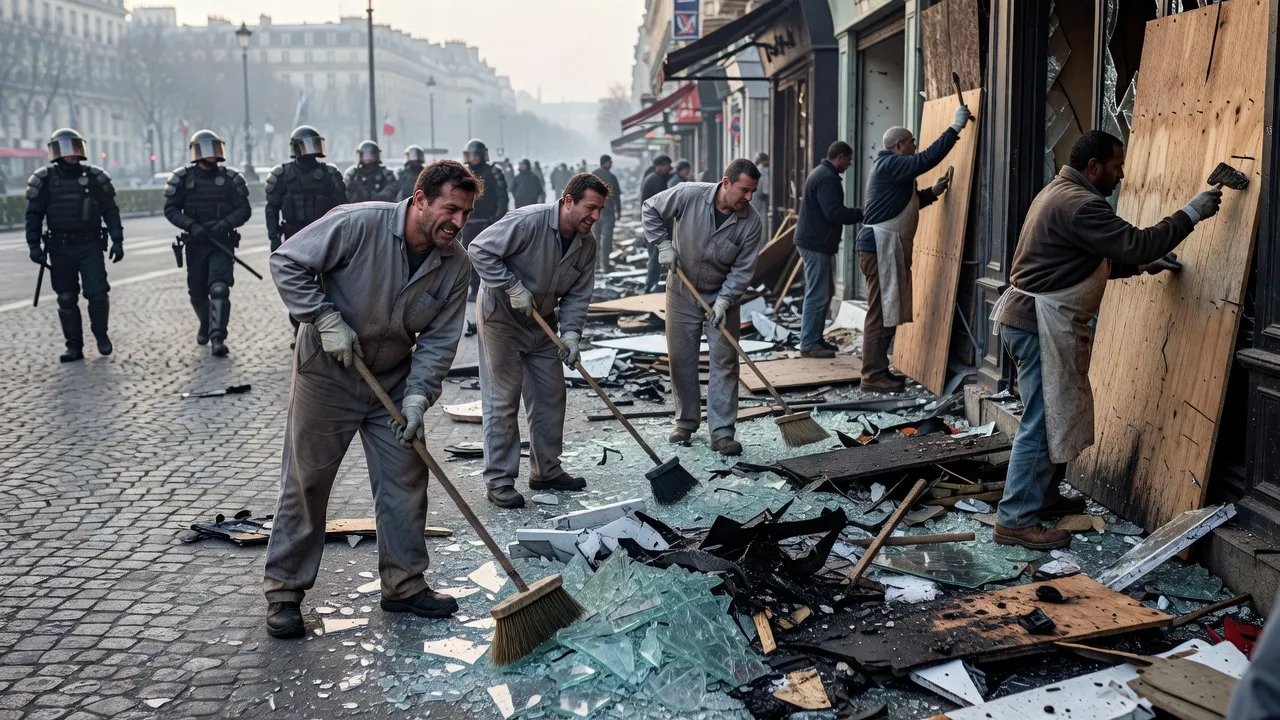
Alger, October 18, 2026. Algerian media covered Saturday, October 17, in France as a social explosion coupled with urban disorder. TSA Algeria opens with a visual inventory: "Town halls set on fire, prefectures attacked, streets and shops devastated." The site evokes scenes of chaos and looting in Paris, Lyon, Marseille, and Limoges, after a week of mobilization by high school students against the lack of resources in high schools.
On the scale of the mobilization, the figures diverge, and the two sites place them side by side. Algeria Eco relays Interior Minister Laurent Nunez, who counts nearly 550,000 participants and about 400 arrests, mainly adults, while the CGT estimates the mobilization at around 800,000 people. TSA also retains the figure of some 800,000 demonstrators, who came at the call of unions and left-wing parties.
The account of the damage is precise and local. Algeria Eco, which cites the Reuters agency, reports the fire at the town hall of Limoges, the intrusion of black-clad protesters into the city hall of Marseille, the fire at the tourist office of Lyon, and the use of tear gas in Paris, where banks, a Lacoste boutique, and an SFR store were damaged or looted. TSA gives the floor to local elected officials: Socialist Mayor of Paris Emmanuel Grégoire speaks of "entire streets" "methodically ravaged", and that of Marseille, Benoît Payan, of a situation "out of control".
On the government side, Algeria Eco reports that Prime Minister Sébastien Lecornu accuses the far left and delinquents, and refuses to let violence serve as a "warm-up" before the presidential election: "we will not be intimidated". He assures that these violent acts will not change the government's position.
The two articles date back to October 17 and do not cover the presidential address the next day or the subsequent arrest toll. The common thread remains that of social anger born of the rising cost of living, the difficulties of public services, and inequalities, whose violent translation occupies the essence of the account.