7 perspectives, each in the voice of that country's press.
Bangladesh sees the oil stake as the primary motivation behind the French announcement: Yanbu, which has become the emergency route for Saudi crude after the Iranian blockade of the Strait of Hormuz, is now the focus of Houthi strikes and the military guarantee of Paris.
2 sources
Berlin is first and foremost concerned with the energy implications of the deployment of French troops to Yanbu, rather than its strictly military aspect.
2 sources
Paris justifies sending soldiers to Yanbu due to the fuel crisis affecting the French, rather than a choice to become involved in the Yemeni conflict.
5 sources
Islamabad anchors its reading of the Yanbu crisis in the trilateral Mecca pact, reviewing its institutional structures with Riyadh and Ankara rather than in the military setup announced by Paris.
4 sources
Moscow sees the deployment of French troops to Yanbu as a direct consequence of the American-Iranian war and its impact on oil traffic via the Strait of Hormuz, rather than a simple Saudi defense measure.
2 sources
Riyadhh is tightening its circle of allies around the Mecca defense pact, prioritizing Ankara and Islamabad over Paris, as its forces announce they have intercepted six Houthi ballistic missiles targeting Taif and Yanbu.

2 sources
Singapore gauges the escalation in the Red Sea in light of its own status as a petroleum and maritime hub, rather than as a distant military security issue.
2 sources
Common ground and differences in coverage across the media analysed.
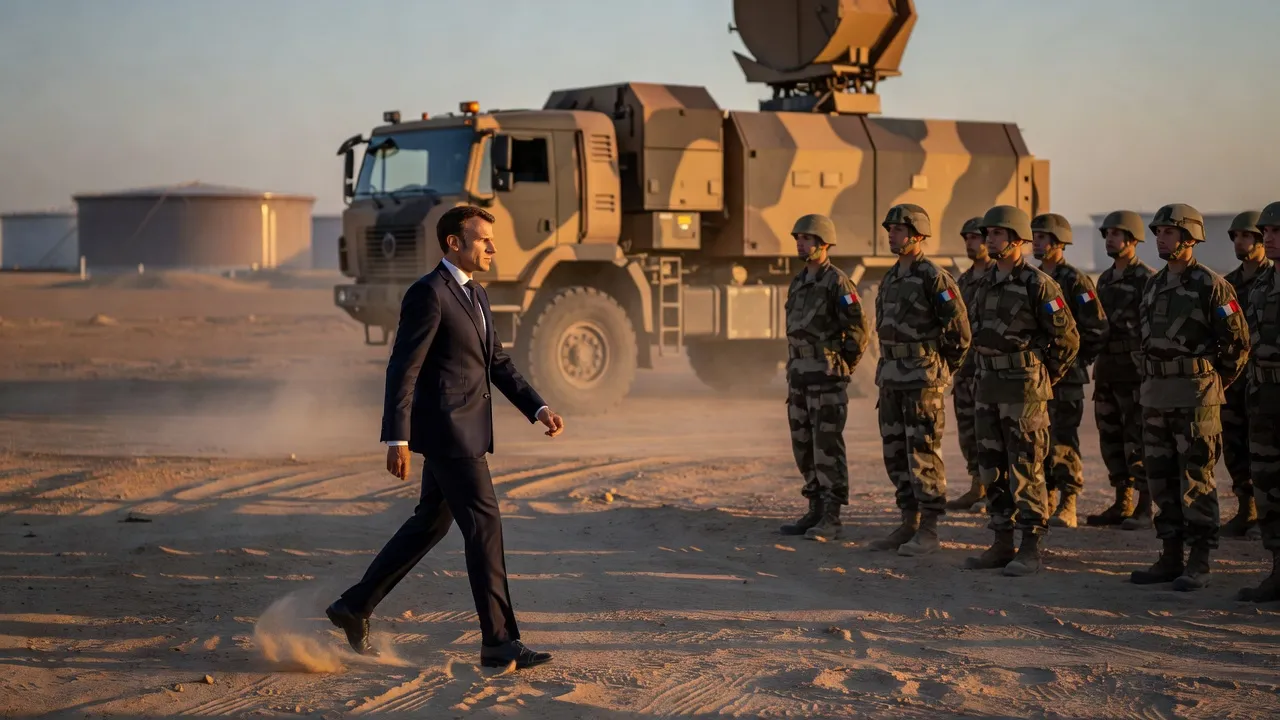
Emmanuel Macron announced the deployment of soldiers, radars, and defense systems to protect the Saudi port of Yanbu, during a television interview on Thursday, September 24, 2026.
Saudi forces claim to have intercepted Houthi ballistic missiles targeting Yanbu, among other sites, while the Houthis claim to have struck several Saudi sites, including Aramco facilities.
The reported events — the French announcement, Saudi interceptions, and ministerial meeting in New York — took place on Thursday, September 24, 2026.
Perspectives do not retain the same axis to read the French announcement: some emphasize the oil stake and fuel prices, others the architecture of the Saudi-Turkish-Pakistani defense pact.
Coverage aligned with this reading
Coverage that diverges
Pakistan indicates that Iran expressed no reservations about the Mecca pact, while the Russian press situates the episode within the framework of the American-Iranian war and the blockade of the Strait of Hormuz attributed to Tehran.
Coverage aligned with this reading
Coverage that diverges
A French political commentator cited by the press mentions a Saudi Arabia 'well alone' justifying Paris' gesture, while Pakistan and Saudi Arabia highlight the common defense pact concluded with Turkey.
Coverage aligned with this reading
Coverage that diverges
This grouping describes the publications analysed, not the position of these countries’ populations or of their governments.
DOMINANT ANGLE
Bangladesh sees the oil stake as the primary motivation behind the French announcement: Yanbu, which has become the emergency route for Saudi crude after the Iranian blockade of the Strait of Hormuz, is now the focus of Houthi strikes and the military guarantee of Paris.
KEY POINTS
ANALYSIS
Dhaka, September 25, 2026. Three dispatches picked up by the Bangladeshi press outline an escalation centered on a single point on the global energy map: the Saudi port of Yanbu, on the Red Sea. According to The Daily Star, French President Emmanuel Macron announced on Thursday, in an interview with TF1 and France 2, that Paris would send "military means, i.e. soldiers, radars, and defense systems" to protect the site. The article emphasizes that Yanbu has become the lifeline for Saudi oil exports "after the Iranian blockade of the Strait of Hormuz at the start of the Middle East war," making this port a strategic hub for global energy flows.
On the same day, the Saudi civil defense issued alerts for Mecca, as well as for the regions of Yanbu, Taif, Jeddah, and Tabuk, signals that, The Daily Star notes, "often precede attacks" by the Iran-backed Yemeni Houthis. The group is accused of having targeted Mecca for the first time since 2017, and then having struck Riyadh for the first time in years. It has also taken control of strategic coastal areas overlooking the Bab al-Mandab Strait.
TBS News reports that Saudi Arabia claims to have intercepted six ballistic missiles fired towards Taif and the Yanbu area, while the Houthis claim to have hit "a sensitive target" in Riyadh, military sites in Jazan, and Aramco facilities in Yanbu, boasting of "dozens" of missiles and drones and "precise and direct" strikes. No independent Saudi confirmation of these damages has been reported.
For the Bangladeshi press, the French announcement is part of a conflict that is blocking two major energy corridors, Hormuz and Bab al-Mandab, on which the Gulf's supplies depend. The country, which is dependent on crude oil imports and employs hundreds of thousands of migrant workers in the Gulf, is watching this escalation as a direct risk factor for energy prices and regional stability, from which a large part of its expatriate revenue comes.
DOMINANT ANGLE
Berlin is first and foremost concerned with the energy implications of the deployment of French troops to Yanbu, rather than its strictly military aspect.
KEY POINTS
ANALYSIS
Berlin, September 25, 2026. The German press first notes the energy implications of Emmanuel Macron's announcement, on Thursday, in a television interview: France will send "military means, i.e. soldiers, radar systems and defense systems" to protect the Saudi port of Yanbu, on the Red Sea, a repeated target of Houthi missiles. Tagesschau emphasizes that Yanbu is home to the terminus of the east-west pipeline, which allows bypassing the Strait of Ormuz blocked by Tehran since the start of the war with Iran, and that up to five million barrels of crude oil could be loaded there every day. According to Macron, quoted by the public channel, a relaxation of tension at this site would have an impact "two days later" on prices at the pump.
FAZ, in its live blog on the Iranian war, places the announcement in a context of high energy prices: Macron assured the French that the country had sufficient reserves of gas and oil before winter, and described a potential American ban on diesel exports as "catastrophic" for the world and the American economy. Neither of the two titles specifies the number of soldiers or the exact nature of the defense systems sent; Macron himself, according to Tagesschau, did not provide any numerical indication on this point.
The French president insists, in both accounts, that this is not about "getting involved in conflicts": the military dimension of the announcement is presented as a gesture of protection of infrastructure, not engagement in combat against the Houthis. Tagesschau recalls that the Yemeni militia, supported by Iran, has recently taken control of large portions of the coastline near the strategic Strait of Bab al-Mandab, and that the Janbu facilities have been, according to Macron, "heavily damaged" by these attacks.
DOMINANT ANGLE
Paris justifies sending soldiers to Yanbu due to the fuel crisis affecting the French, rather than a choice to become involved in the Yemeni conflict.
KEY POINTS
ANALYSIS
Paris, September 25, 2026. Emmanuel Macron announced, on Thursday, September 24, during a joint interview on the 8 pm news on TF1 and France 2, the deployment of "military means, namely soldiers, radar, and defense systems" to protect the Saudi port of Yanbu, the kingdom's main crude oil export terminal on the Red Sea and a regular target of the Houthis from Yemen. The President of the Republic specified that this did not mean "engaging" in the conflict between Riyadh and the pro-Iranian rebels, while not excluding the use of Rafale fighter jets "as needed".
The head of state presented this deployment less as a military choice than as a lever against the surge in fuel prices. According to him, a easing of tensions at this strategic site would have an "immediate impact on fuel prices". He assured that the supply of "diesel, gas, and fuel" would remain guaranteed "until the end of the year", without excluding difficulties "if the crisis were to worsen" in early 2027, and did not rule out having to lower fuel taxes in the long term. He also announced his intention to "bring together the G7 countries" to study a possible release of strategic oil and gas stocks.
On BFMTV, former Prime Minister Dominique de Villepin saw this move as a way for Macron to show support for Saudi Arabia, "which finds itself very alone" against the Houthis, while Ségolène Royal, a socialist primary candidate, judged that "the French will be very disappointed" by the president's announcements on purchasing power. Macron also described a potential US ban on diesel exports as "catastrophic", an additional cause of tension on domestic prices.
DOMINANT ANGLE
Islamabad anchors its reading of the Yanbu crisis in the trilateral Mecca pact, reviewing its institutional structures with Riyadh and Ankara rather than in the military setup announced by Paris.
KEY POINTS
ANALYSIS
Islamabad, September 25, 2026. The joint defense pact of Mecca, signed on August 7 between Pakistan, Saudi Arabia, and Turkey, structures the Pakistani reading of the Yanbu crisis. On Friday, on the sidelines of the 81st session of the United Nations General Assembly in New York, Vice Prime Minister and Foreign Minister Ishaq Dar met with his Saudi counterpart, Prince Faisal bin Farhan Al Saud, and Turkish Foreign Minister Hakan Fidan. The three ministers examined, according to Dar, "progress towards establishing the institutional structures" of the agreement, which he presented on the X network by evoking his "brothers" Saudi and Turkish. The text, signed the day after a bilateral strategic mutual defense agreement between Islamabad and Riyadh, provides that an aggression against one of the parties will be considered an aggression against all. The diplomats also prepared an urgent meeting of the chiefs of staff of the three countries, aimed at defining the means of supporting Saudi Arabia in the face of Houthi strikes, which targeted Mecca, Jeddah, and Yanbu, the kingdom's backup oil port on the Red Sea, on Thursday. Riyadh claims to have intercepted six ballistic missiles; the Yemeni rebels claim dozens of missile and drone strikes. The Saudi Ministry of Foreign Affairs indicated that the three allies condemned these strikes while reaffirming Riyadh's right to defend itself. On the regional level, Defense Minister Khawaja Asif assured from New York that Iran "has no reservations" about the Mecca pact, specifying that a secretariat will be set up in October and that several Islamic countries wish to join. Islamabad has already appointed retired Lieutenant General Nauman Mahmood as the first secretary general of the agreement. It is within this trilateral framework, more than in the Parisian announcement of sending soldiers, radars, and defense systems to protect Yanbu, that Pakistani diplomacy situates its contribution: Asif summarized the spirit of the New York meetings by estimating that as long as meetings and exchanges continue, there remains hope for an improvement in relations.
DOMINANT ANGLE
Moscow sees the deployment of French troops to Yanbu as a direct consequence of the American-Iranian war and its impact on oil traffic via the Strait of Hormuz, rather than a simple Saudi defense measure.
KEY POINTS
ANALYSIS
Moscow, September 25, 2026. Moscow sees the deployment of French soldiers to Yanbu as a consequence of the escalation caused by the American-Iranian war, which has made the Strait of Ormuz impassable for tankers and turned this Saudi port on the Red Sea into a vital emergency route for crude oil exports. According to RT, Emmanuel Macron announced on Thursday on TF1 and France 2: "We will send military means, that is to say soldiers, radar systems and defense systems, to protect the Yanbu site." The French President specified that his forces would not join the fighting, limiting themselves to protecting an energy facility "very seriously damaged" during previous attacks.
RT emphasizes that France is the last country Riyadh is turning to for military assistance, after Washington renounced direct intervention demanded by Crown Prince Mohammed bin Salman. A Greek Patriot battery already deployed in the kingdom intercepted a ballistic missile and a drone near Yanbu on Thursday, according to information reported by RT.
TASS, for its part, gives considerable coverage to the Houthi version. The military spokesman for Ansar Allah, Yahya Saree, claims that his forces carried out two operations, one against an "important" facility in Riyadh, the other against Aramco sites in Yanbu, using ballistic missiles, cruise missiles, and drones. Saree also claims that Saudi Arabia has carried out 1,018 strikes against Yemen since the beginning of the escalation, with civilian casualties, including women and children, according to the movement.
DOMINANT ANGLE
Riyadhh is tightening its circle of allies around the Mecca defense pact, prioritizing Ankara and Islamabad over Paris, as its forces announce they have intercepted six Houthi ballistic missiles targeting Taif and Yanbu.
KEY POINTS
ANALYSIS
Riyadh, September 25, 2026. While Paris announces the deployment of troops, radar systems, and defense systems to Yanbu, the Saudi press is focusing its coverage on another front: the joint defense pact of Mecca, signed on August 7 with Turkey and Pakistan. On Thursday in New York, Foreign Minister Faisal bin Farhan met with his Turkish counterpart Hakan Fidan and Pakistani Vice Prime Minister Mohammad Ishaq Dar at the Saudi mission to the UN. The three ministers condemned the attacks targeting Mecca and the kingdom's civilian and economic installations, praised the vigilance of the Saudi armed forces, and reaffirmed Riyadh's right to defend itself under Article 51 of the UN Charter. They also agreed to prepare an emergency meeting of the three countries' chiefs of staff, as the Mecca agreement stipulates that an attack on one of its members constitutes an attack on all; the ministers also recalled the importance of maritime navigation freedom, a direct stake for a port like Yanbu.
On the ground, Saudi air defense forces claim to have intercepted and destroyed six ballistic missiles fired by what General Turki Al-Maliki, spokesperson for the coalition to support legitimacy in Yemen, calls the "Houthi terrorist militia," targeting Taif and Yanbu. He promises that escalations and violations will be dealt with firmly. The Civil Defense, on the other hand, triggered and then lifted, in a few hours, an alert for Mecca, Jeddah, Taif, Yanbu, and Tabuk, calling on residents to remain calm, not to film or gather, and to dial 998 in case of need.
DOMINANT ANGLE
Singapore gauges the escalation in the Red Sea in light of its own status as a petroleum and maritime hub, rather than as a distant military security issue.
KEY POINTS
ANALYSIS
Singapour, September 25, 2026. For the city-state, a global hub for refining and maritime trade, the escalation in the Red Sea is first and foremost seen through the prism of energy supply. Straits Times and Channel News Asia report that Saudi Arabia intercepted several Houthi ballistic missiles on September 24, after issuing alerts for Mecca, Yanbu, Taif, Jeddah, and Tabuk, which were lifted a few minutes later. The Riyadh-led coalition claims to have neutralized six missiles, foiling attacks targeting Taif and the Yanbu oil terminal, which has become the primary backup point for Saudi exports since the Houthis imposed a naval blockade on oil tankers and infrastructure. Coalition spokesman Turki al-Maliki warned on X that "violations by the Houthi terrorist militia will be dealt with firmly".
In this context, France has announced the deployment of "military assets" to protect Yanbu, a move that local media directly associates with securing oil flows that the Gulf, the world's largest crude exporter, depends on. The two publications emphasize that the Houthi gains since July, when the multi-year truce collapsed, consolidate Iran's and its allies' grip on strategic straits, including Bab al-Mandab, described as vital for regional control and oil exports. The Houthis have also seized large swaths of Yemen's Red Sea coastline, essential for Saudi exports, strengthening their control over the two maritime routes that the entire Gulf relies on to export oil and fuel. Fighting on the ground has also intensified, with casualties on both sides, according to a tally compiled by AFP from seven sources.
Explore every perspective on this subject across 7 countries.
Compare viewpoints and see where they diverge.
published on
countries
sources
articles
gap
Seven weeks after the signing of the Mecca pact, Macron's announcement is read differently in various capitals: Paris sees it as a lever on fuel prices, Islamabad as an alliance clause to be consolidated, Riyadh as proof that it is not alone, and the Houthis as a battle of narratives over losses.
No figures on the number of soldiers or the exact nature of the systems sent to Yanbu were disclosed by Macron or reported by the German press.
On TF1 and France 2, Emmanuel Macron did not present the deployment of soldiers as a military choice, but as a means to influence prices at the pump: according to him, a relaxation in Yanbu would quickly impact the price of fuel in France, report RFI and Le Monde.
« Emmanuel Macron wants to make a gesture towards Saudi Arabia, which finds itself quite alone »
The president guaranteed the supply of "diesel, gas, and fuel oil" until the end of the year, without ruling out difficulties at the beginning of 2027 or a possible reduction in fuel taxes, according to Le Monde. He said he wanted to bring together the G7 countries to study the release of their strategic oil and gas reserves, and did not exclude the use of Rafale planes "as needed", according to RFI.
On BFMTV, former Prime Minister Dominique de Villepin saw this move as a way for Macron to show his support for Riyadh. Socialist primary candidate Ségolène Royal, on the other hand, judged that the president's announcements on purchasing power would leave the French disappointed, according to BFMTV.
On the sidelines of the 81st session of the United Nations General Assembly in New York, Pakistani Vice Prime Minister Ishaq Dar met with his Saudi counterpart, Prince Faisal bin Farhan Al Saud, and Turkish Foreign Minister Hakan Fidan, reports The Express Tribune. The three ministers discussed the establishment of the pact's institutional structures, according to Dar, who mentioned his "brothers" from Saudi Arabia and Turkey on network X.
The Mecca pact, signed on August 7, had been preceded by a bilateral mutual defense agreement between Islamabad and Riyadh, reports Geo News. Pakistani Defense Minister Khawaja Asif stated from New York that Iran had expressed no reservations about it, and that several Islamic countries wanted to join, according to ARY News.
The Saudi Civil Defense triggered and then lifted, in a matter of hours, an alert for Mecca, Jeddah, Taif, Yanbu, and Tabuk, asking residents to remain calm, not to film or gather, and to dial the emergency number 998, reports Asharq Al-Awsat.
« the violations by the Houthi terrorist militia will be dealt with firmly »
The joint statement by the Saudi, Turkish, and Pakistani ministers in New York invokes Article 51 of the United Nations Charter to justify Riyadh's right to defend itself, according to Saudi Gazette.
Today's Saudi press, however, does not mention the French announcement of reinforcements to Yanbu: it highlights the pact with Ankara and Islamabad, as well as the interception capacity of its own defenses.
The Houthi military spokesman, Yahya Saree, claims to have carried out two separate operations on Thursday: one against "an important facility" in Riyadh, the other against Aramco sites in Yanbu, using ballistic missiles, cruise missiles, and drones, according to TASS.
Saree also claims that Saudi strikes in Yemen have resulted in civilian casualties, including women and children, according to his statements reported by TASS; no independent Saudi toll is cited in response.
On the ground, fighting has intensified since the collapse in July of a multi-year truce, with casualties on both sides recorded by the AFP from seven sources, according to the Straits Times and Channel News Asia. The Houthis are also maintaining a naval blockade targeting Saudi oil tankers, according to the same sources.
Iranian President Massoud Pezeshkian denied on Thursday directing the Houthis, according to the Straits Times and Channel News Asia. The Daily Star also notes that the Houthis are accused of having targeted Mecca for the first time since 2017, and Riyadh for the first time in several years, while taking control of coastal areas near the Bab al-Mandab Strait.
Pakistan has appointed General Nauman Mahmood as the first secretary general; installation is scheduled for October 2026.
Already deployed in Saudi Arabia, it intercepted a ballistic missile and a drone near Yanbu on Thursday.
The United States has given up on a direct intervention that Crown Prince Mohammed bin Salman had requested, according to Russian media.
Neither FAZ nor Tagesschau mentions, in the available excerpts, the meeting of Saudi, Turkish and Pakistani ministers in New York or the defense pact of Mecca: the German subject remains focused on the French announcement and its consequences for oil and fuel prices, rather than on the regional alliance architecture being drawn around Riyadh.
The announcement comes as Saudi Arabia claims to have intercepted six Houthi ballistic missiles targeting Taif and Yanbu, and as Riyadh, Turkey, and Pakistan have convened an emergency meeting of their chiefs of staff in New York under their common defense pact. In France, the debate remains focused on the domestic consequences: taxes, fuel prices, and the credibility of a diplomacy presented as an economic policy tool rather than a military commitment to a regional war.
TASS recalls that the conflict has opposed since August 2014 the forces supported by Riyadh and the Houthis, and that tensions have worsened since early September after an Ansar Allah offensive in the southwest of the country, with rebels seeking to cut off roads to Mokha and advance towards the Bab-el-Mandeb Strait. On September 12, a Houthi political official had already announced to TASS that the movement controlled areas in western Yemen giving access to the strait.
For the Russian press, the French announcement confirms above all that the Yemeni conflict is becoming internationalized without Washington assuming a direct role, leaving France, Greece, and the Gulf monarchies to fill the military vacuum around a now disputed energy hub.
In this narrative, the French announcement of military means for Yanbu takes a back seat: today's Saudi articles do not mention it, preferring to highlight regional solidarity and the kingdom's ability to respond. The message being conveyed is twofold: internally, to reassure a population subjected to repeated sirens; externally, to show that Riyadh already has, with Ankara and Islamabad, a diplomatic-military security net that does not depend on a single Western power. Yanbu, which has become the lifeline for the kingdom's oil exports since the tensions in the Red Sea, remains at the center of a battle where Riyadh is promoting its own alliances as much as its own defenses.
The editorial teams also note that Iranian President Massoud Pezeshkian denied on Thursday that Tehran controls the Houthis, without the articles providing further details. For an economy that relies on maritime transit and refining, the repetition of alerts in Saudi regions illustrates the persistent fragility of hydrocarbon routes that Singapour closely monitors, without the articles mentioning any repercussions on prices or flows passing through local refineries for now.