Common ground and differences in coverage across the media analysed.
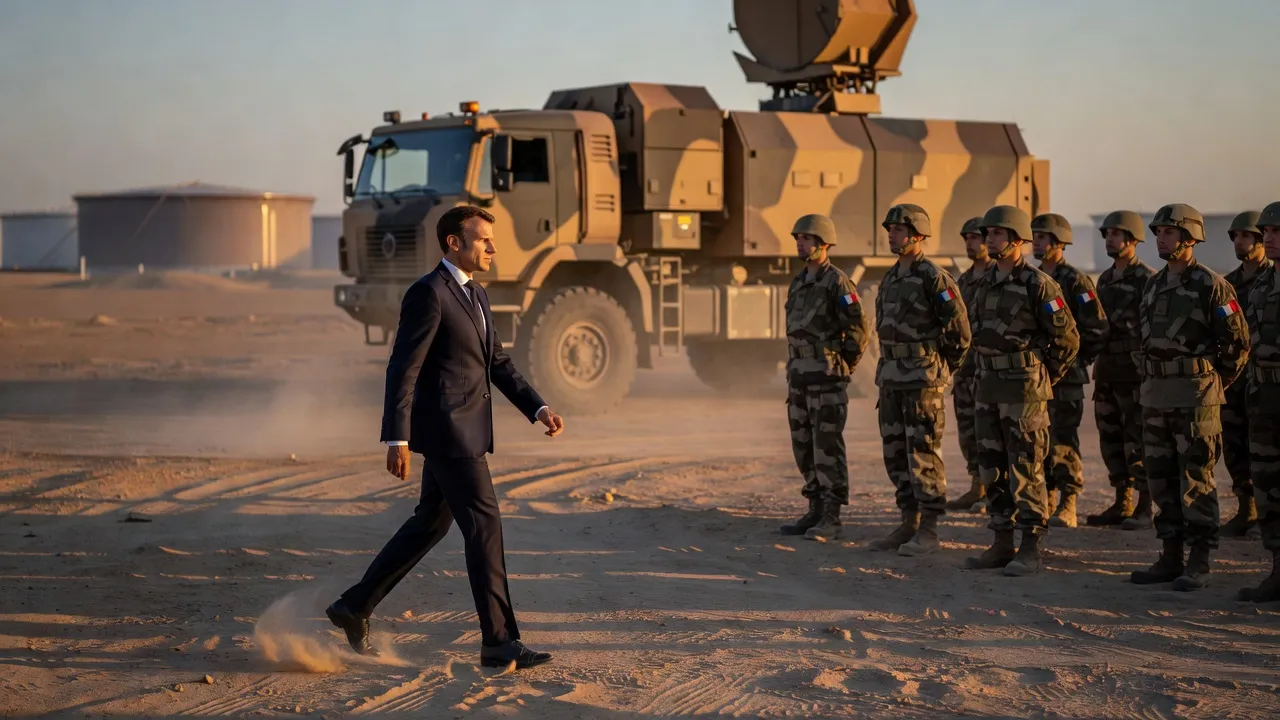
Emmanuel Macron announced the deployment of soldiers, radars, and defense systems to protect the Saudi port of Yanbu, during a television interview on Thursday, September 24, 2026.
Saudi forces claim to have intercepted Houthi ballistic missiles targeting Yanbu, among other sites, while the Houthis claim to have struck several Saudi sites, including Aramco facilities.
The reported events — the French announcement, Saudi interceptions, and ministerial meeting in New York — took place on Thursday, September 24, 2026.
Perspectives do not retain the same axis to read the French announcement: some emphasize the oil stake and fuel prices, others the architecture of the Saudi-Turkish-Pakistani defense pact.
Coverage aligned with this reading
Coverage that diverges
Pakistan indicates that Iran expressed no reservations about the Mecca pact, while the Russian press situates the episode within the framework of the American-Iranian war and the blockade of the Strait of Hormuz attributed to Tehran.
A French political commentator cited by the press mentions a Saudi Arabia 'well alone' justifying Paris' gesture, while Pakistan and Saudi Arabia highlight the common defense pact concluded with Turkey.
Coverage aligned with this reading
Coverage that diverges
This grouping describes the publications analysed, not the position of these countries’ populations or of their governments.
What the coverage of each country leaves aside, while others put it forward.
Saudi Arabia
France
Preview: 3 of 7 media perspectives. Syntheses of the media analysed — not direct quotations. Method & limitations
Bangladesh sees the oil stake as the primary motivation behind the French announcement: Yanbu, which has become the emergency route for Saudi crude after the Iranian blockade of the Strait of Hormuz, is now the focus of Houthi strikes and the military guarantee of Paris.
2 sources · View sources
Berlin is first and foremost concerned with the energy implications of the deployment of French troops to Yanbu, rather than its strictly military aspect.
2 sources · View sources
Paris justifies sending soldiers to Yanbu due to the fuel crisis affecting the French, rather than a choice to become involved in the Yemeni conflict.
5 sources · View sources
DOMINANT ANGLE
Bangladesh sees the oil stake as the primary motivation behind the French announcement: Yanbu, which has become the emergency route for Saudi crude after the Iranian blockade of the Strait of Hormuz, is now the focus of Houthi strikes and the military guarantee of Paris.
ANALYSIS
Dhaka, September 25, 2026.
DOMINANT ANGLE
Berlin is first and foremost concerned with the energy implications of the deployment of French troops to Yanbu, rather than its strictly military aspect.
ANALYSIS
Berlin, September 25, 2026.
DOMINANT ANGLE
Paris justifies sending soldiers to Yanbu due to the fuel crisis affecting the French, rather than a choice to become involved in the Yemeni conflict.
ANALYSIS
Paris, September 25, 2026.
DOMINANT ANGLE
Islamabad anchors its reading of the Yanbu crisis in the trilateral Mecca pact, reviewing its institutional structures with Riyadh and Ankara rather than in the military setup announced by Paris.
ANALYSIS
Islamabad, September 25, 2026.
DOMINANT ANGLE
Moscow sees the deployment of French troops to Yanbu as a direct consequence of the American-Iranian war and its impact on oil traffic via the Strait of Hormuz, rather than a simple Saudi defense measure.
ANALYSIS
Moscow, September 25, 2026.
DOMINANT ANGLE
Riyadhh is tightening its circle of allies around the Mecca defense pact, prioritizing Ankara and Islamabad over Paris, as its forces announce they have intercepted six Houthi ballistic missiles targeting Taif and Yanbu.
ANALYSIS
Riyadh, September 25, 2026.
DOMINANT ANGLE
Singapore gauges the escalation in the Red Sea in light of its own status as a petroleum and maritime hub, rather than as a distant military security issue.
ANALYSIS
Singapour, September 25, 2026.
Explore every perspective on this subject across 7 countries.
Compare viewpoints and see where they diverge.
published on
countries
sources
articles
gap
Seven weeks after the signing of the Mecca pact, Macron's announcement is read differently in various capitals: Paris sees it as a lever on fuel prices, Islamabad as an alliance clause to be consolidated, Riyadh as proof that it is not alone, and the Houthis as a battle of narratives over losses.
No figures on the number of soldiers or the exact nature of the systems sent to Yanbu were disclosed by Macron or reported by the German press.
On TF1 and France 2, Emmanuel Macron did not present the deployment of soldiers as a military choice, but as a means to influence prices at the pump: according to him, a relaxation in Yanbu would quickly impact the price of fuel in France, report RFI and Le Monde.
« Emmanuel Macron wants to make a gesture towards Saudi Arabia, which finds itself quite alone »
The president guaranteed the supply of "diesel, gas, and fuel oil" until the end of the year, without ruling out difficulties at the beginning of 2027 or a possible reduction in fuel taxes, according to Le Monde. He said he wanted to bring together the G7 countries to study the release of their strategic oil and gas reserves, and did not exclude the use of Rafale planes "as needed", according to RFI.
On BFMTV, former Prime Minister Dominique de Villepin saw this move as a way for Macron to show his support for Riyadh. Socialist primary candidate Ségolène Royal, on the other hand, judged that the president's announcements on purchasing power would leave the French disappointed, according to BFMTV.
On the sidelines of the 81st session of the United Nations General Assembly in New York, Pakistani Vice Prime Minister Ishaq Dar met with his Saudi counterpart, Prince Faisal bin Farhan Al Saud, and Turkish Foreign Minister Hakan Fidan, reports The Express Tribune. The three ministers discussed the establishment of the pact's institutional structures, according to Dar, who mentioned his "brothers" from Saudi Arabia and Turkey on network X.
The Mecca pact, signed on August 7, had been preceded by a bilateral mutual defense agreement between Islamabad and Riyadh, reports Geo News. Pakistani Defense Minister Khawaja Asif stated from New York that Iran had expressed no reservations about it, and that several Islamic countries wanted to join, according to ARY News.
The Saudi Civil Defense triggered and then lifted, in a matter of hours, an alert for Mecca, Jeddah, Taif, Yanbu, and Tabuk, asking residents to remain calm, not to film or gather, and to dial the emergency number 998, reports Asharq Al-Awsat.
« the violations by the Houthi terrorist militia will be dealt with firmly »
The joint statement by the Saudi, Turkish, and Pakistani ministers in New York invokes Article 51 of the United Nations Charter to justify Riyadh's right to defend itself, according to Saudi Gazette.
Today's Saudi press, however, does not mention the French announcement of reinforcements to Yanbu: it highlights the pact with Ankara and Islamabad, as well as the interception capacity of its own defenses.
The Houthi military spokesman, Yahya Saree, claims to have carried out two separate operations on Thursday: one against "an important facility" in Riyadh, the other against Aramco sites in Yanbu, using ballistic missiles, cruise missiles, and drones, according to TASS.
Saree also claims that Saudi strikes in Yemen have resulted in civilian casualties, including women and children, according to his statements reported by TASS; no independent Saudi toll is cited in response.
On the ground, fighting has intensified since the collapse in July of a multi-year truce, with casualties on both sides recorded by the AFP from seven sources, according to the Straits Times and Channel News Asia. The Houthis are also maintaining a naval blockade targeting Saudi oil tankers, according to the same sources.
Iranian President Massoud Pezeshkian denied on Thursday directing the Houthis, according to the Straits Times and Channel News Asia. The Daily Star also notes that the Houthis are accused of having targeted Mecca for the first time since 2017, and Riyadh for the first time in several years, while taking control of coastal areas near the Bab al-Mandab Strait.
Pakistan has appointed General Nauman Mahmood as the first secretary general; installation is scheduled for October 2026.
Already deployed in Saudi Arabia, it intercepted a ballistic missile and a drone near Yanbu on Thursday.
The United States has given up on a direct intervention that Crown Prince Mohammed bin Salman had requested, according to Russian media.
More divergent than 99% of recent comparable stories (reference: 90 recent stories measured with the same method).