EXPLORE THIS STORY

FRANCE PERSPECTIVE
HOUTHIS DECLARE NAVAL BLOCKADE OF SAUDI ARABIA, OPENING A NEW FRONT IN THE US-IRAN WAR
DOMINANT ANGLE
France is gauging the link between the Houthi maritime blockade and the escalating American-Iranian military tensions, fearing a lasting energy surge after months of tension in the Gulf.
Dominant angle identified — does not reflect unanimity of this country’s media
ANALYSIS
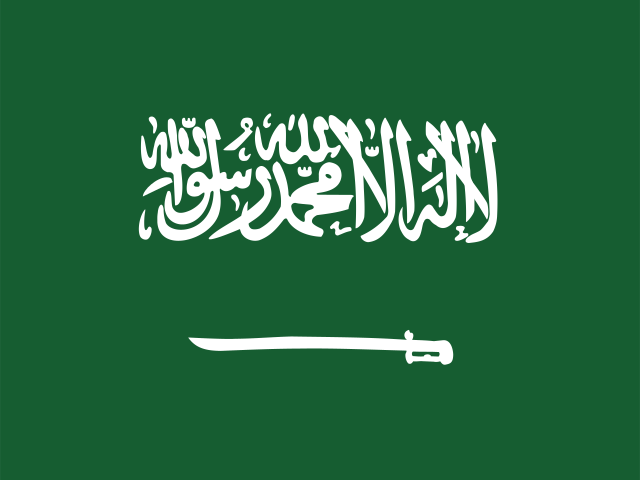
Paris, July 21, 2026. The French press is dedicating its editions today to a new development in the Middle East: Monday's announcement of a maritime blockade by Yemen's Houthi forces against Saudi Arabia. The Express reports on the statement from the Houthi armed forces, which decrees "a maritime embargo against the criminal Saudi enemy, based on the law of retaliation, effective immediately," presented as a response to the "unjust and oppressive siege" they claim has been imposed on Yemeni ports and airports. The daily newspaper highlights a key documented element: Tehran had allegedly pressured the Houthis, four days earlier, to close the strategic Bab el-Mandeb passage if US strikes against Iranian energy infrastructure continued. As early as June 1, the commander of the Qods Force, Esmaeil Qaani, had mentioned this possibility.
Le Parisien and Sud Ouest are closely following the escalation of the US-Iranian conflict: the ninth consecutive night of US strikes on Monday, Iranian retaliations against Kuwait, Bahrain, and Jordan's Aqaba airport, and the claimed attack on two tankers in the Strait of Hormuz. Donald Trump has assured that the US has struck "very hard," with bombings carried out "in honor" of the 17 American soldiers killed since late February. La Tribune also notes the call for "military restraint" issued by the IAEA after a strike on the under-construction Darkhovin nuclear power plant, which has been deemed to pose no radiological risk at this stage.
French headlines are emphasizing the energy implications of the Houthi blockade, which could exacerbate an already sensitive crisis for global supply via Bab el-Mandeb and Hormuz, while noting that the price of a barrel of oil remains surprisingly stable — Brent at $88.11 — as Tehran claims that diplomatic channels via mediators remain open despite the fighting.
KEY POINTS
- France is closely monitoring the situation as the Houthis imposed a "maritime embargo" on Saudi Arabia on Monday, citing the principle of "an eye for an eye"
- The French government is aware that Iran has reportedly asked the Houthis to be prepared to close the Bab el-Mandeb Strait if US strikes were to continue
- The US death toll has reached 17 since late February, with three deaths in three days; Iran claims responsibility for attacking two tankers in the Strait of Hormuz
COGNITIVE BIASES IDENTIFIED
France's military and diplomatic focus on Western capitals, including Paris and Tehran, provides limited insight into the concrete operation of the announced Houthi blockade
French government and media outlets show a preference for agency sources and official statements, such as those from Centcom, Reuters, and the IAEA, with few direct quotes from Saudi or Yemeni voices
There is limited coverage of the economic consequences for France and Europe resulting from the blockade, despite mentions of oil price fluctuations
SOURCES (5)
MEDIUM
Le Parisien International
MEDIUM
Does this analysis seem accurate?