Common ground and differences in coverage across the media analysed.
The perspectives of the fifteen countries report on the third anniversary of October 7, 2023, and its commemorations, including ceremonies, mourning for the victims, and testimonies from survivors.
Each corpus places the date in a broader context than the ceremony itself: Israeli election campaign, antisemitism, Gaza truce, or bilateral relations.
When asked whether the anniversary should be seen through the responsibility of the Prime Minister before the election, the German, French, Israeli, Italian, Dutch, and Swedish presses answer yes; the American, Australian, and British presses focus on mourning and commemorations.
Coverage that diverges
When asked about the place of the Gaza toll in the coverage of the date, Doha News and Al Jazeera put it in the spotlight (over 74,000 deaths, 82% of buildings destroyed or damaged), La Libre recalls it in an editorial, while DW summarizes it in one sentence and NBC does not mention it.
Coverage that diverges
When asked about the investigation into responsibilities, the Swedish, Belgian, and Israeli presses make it a central issue (polls, vote on a politically appointed investigation in July), while the American, Australian, and Brazilian corpora do not mention it in the selected articles.
This grouping describes the publications analysed, not the position of these countries’ populations or of their governments.
What the coverage of each country leaves aside, while others put it forward.
Australia
Belgium
Brazil
Germany
Preview: 3 of 15 media perspectives. Syntheses of the media analysed — not direct quotations. Method & limitations
Canberra is measuring on October 7, through the lens of survivors and the Australian Jewish community, between mourning, gratitude from former hostages and concern over antisemitism.
4 sources · View sources
Brussels sees this third anniversary as a national mourning that the Israeli election campaign prevents from closing: the security failure, the absence of a commission of inquiry and the war in Gaza remain unsettled.
3 sources · View sources
Brasília still feels the lasting trauma from October 7, where the memory of the victims, including a Brazilian, and politics are intertwined three years after the attack.
2 sources · View sources
DOMINANT ANGLE
Canberra is measuring on October 7, through the lens of survivors and the Australian Jewish community, between mourning, gratitude from former hostages and concern over antisemitism.
ANALYSIS
Sydney, October 7, 2026.
DOMINANT ANGLE
Brussels sees this third anniversary as a national mourning that the Israeli election campaign prevents from closing: the security failure, the absence of a commission of inquiry and the war in Gaza remain unsettled.
ANALYSIS
Brussels, October 7, 2026.
DOMINANT ANGLE
Brasília still feels the lasting trauma from October 7, where the memory of the victims, including a Brazilian, and politics are intertwined three years after the attack.
ANALYSIS
Brasília, October 7, 2026.
DOMINANT ANGLE
Berlin weighs in on the electoral terrain: three years after October 7, the German press is questioning Netanyahu's political survival and what he knew before the attack.
ANALYSIS
Berlin, October 7, 2026.
DOMINANT ANGLE
Copenhagen notes that the October 7 commemoration comes three weeks ahead of the Israeli legislative elections, where the attack is expected to have significant weight, while also noting the security alert of the day.
ANALYSIS
Copenhagen, October 7, 2026.
DOMINANT ANGLE
Paris is scrutinizing the Israeli campaign on October 7: Netanyahu's responsibility, between ignored warnings and refusal to investigate, is becoming a key issue in the October 27 legislative elections.
ANALYSIS
Paris, October 7, 2026.
DOMINANT ANGLE
Jerusalem weighs in on October 7 on the electoral terrain: the commemoration is intertwined with the issue of Netanyahu's responsibility and the commission of inquiry, twenty days from the legislative elections.
ANALYSIS
Jérusalem, October 7, 2026.
DOMINANT ANGLE
Rome recalls a security failure from October 7, which has become an electoral issue: the anniversary weighs on Netanyahu's candidacy, while the date also fuels Italian community and political debates.
ANALYSIS
Rome, October 7, 2026.
DOMINANT ANGLE
The Netherlands is deciphering a divided Israel: three years after October 7, the Dutch press is linking the memory of the victims to the election that will judge Netanyahu.
ANALYSIS
Amsterdam, October 7, 2026.
DOMINANT ANGLE
Lisbon sees an Israeli society "divided as before": the third anniversary of October 7 is seen as a prelude to the October 27 legislative elections, with a European aspect of remembrance and the fight against anti-Semitism.
ANALYSIS
Lisbon, October 7, 2026.
DOMINANT ANGLE
Doha is examining the October 7 anniversary through the lens of Gaza: an October 2025 ceasefire that failed to halt the strikes, 74,000 dead and a territory in ruins.
ANALYSIS
Doha, October 7, 2026.
DOMINANT ANGLE
Stockholm views October 7 as a national trauma that has become an electoral issue: the Swedish press is highlighting the investigation commission that was refused by Netanyahu and the October 27 election.
ANALYSIS
Stockholm, October 7, 2026.
DOMINANT ANGLE
London recalls the human face of 7 October: through a devastated kibbutz and a diaspora reunited at dawn, the British press tells of three years of mourning and difficult reconstruction.
ANALYSIS
London, 7 October 2026.
DOMINANT ANGLE
The United States prioritizes mourning over politics: the American press brings the third anniversary of October 7 back to the pain of the hostages and their families, without referencing the Israeli campaign.
ANALYSIS
Washington, October 7, 2026.
DOMINANT ANGLE
Montevideo is downplaying the commemoration of October 7 by linking it to its local and regional effects: antisemitism felt in Uruguay on one hand, and the threat of war in the West Bank on the other.
ANALYSIS
Montevideo, October 7, 2026.
Explore every perspective on this subject across 15 countries.
Compare viewpoints and see where they diverge.
published on
countries
sources
articles
gap
Three weeks before the legislative elections, coverage of the third anniversary of October 7 follows four threads: the political responsibility and the demanded investigation, the security alert of the day, the stories of survivors, and the focus on Gaza and foreign capitals.
No state commission of inquiry has been established: the government refuses it, and the October 27 vote is to be held 20 days after the anniversary.
The Israeli press is quantifying this debate. According to an N12 survey reported by the Jerusalem Post, 65% of respondents believe that Benyamin Netanyahou bears "great responsibility" and 66% support a state commission of inquiry, which is 93% of opposition voters and 37% of coalition voters. The Israel Democracy Institute notes that 62% of Israelis consider the 7 October incident central to their voting choice. SAPO Notícias, in Portugal, cites 68% of Israeli Jews: this is not the same population or the same survey.
« The failure of the security apparatus and the government led by Benjamin Netanyahu continues to haunt the Israelis »
The Swedish press is making the investigation its main topic. A dispatch picked up by Expressen, Aftonbladet, and Svenska Dagbladet indicates that the Parliament adopted a law in July instituting an investigation with political nomination. The group of close associates The October Council believes this text was made "to bury the truth". Anders Persson, from Linné University, estimates that the Prime Minister "probably fears the conclusions".
La Libre Belgique recalls the series of resignations, from Aharon Haliva, head of Aman, in April 2024, to Herzi Halevi, Yossi Sariel, Yaron Finkelman, and Oded Basiuk. It also quotes Chief of Staff Eyal Zamir, who mentioned on Sunday, October 4, "the extent of the disaster". ANSA writes that Netanyahou would be the only one, unlike Herzi Halevi and former Shin Bet director Ronen Bar, not to have acknowledged his share of responsibility.
According to Politiken, Defense Minister Israel Katz announced on Tuesday, October 6, that the army was on high alert, following intelligence on attacks that Hamas would attempt on Wednesday against soldiers in Gaza. Sud Ouest and La Repubblica also mention the alleged attempted attack on a flydubai flight. La Repubblica adds alerts from the West Bank and Iran.
Interpretations differ on the scope of this alert. Gadi Eisenkot, quoted by the Israeli press, sees it as "an indictment of the October 7 government". Haaretz writes that Netanyahou is amplifying the threats for political gain. The Jerusalem Post, on the other hand, judges an invasion of the same type to be very unlikely in the coming year.
The army has released its own assessment: nearly 100,000 targets struck since 2023, including 65,000 in Gaza, according to the Israeli press. La Diaria, in Uruguay, reports that the Defense Minister threatened the Palestinian Authority with war in the West Bank on Tuesday.
The kibbutz Nir Oz, about 1.6 km from the border, with 400 inhabitants, was visited. Mailboxes have red stickers for the dead and black for the hostages. The Siman Tov family is among them: Tamar and Yonatan were shot through the door of their shelter.
« One in four of us: murdered or kidnapped »
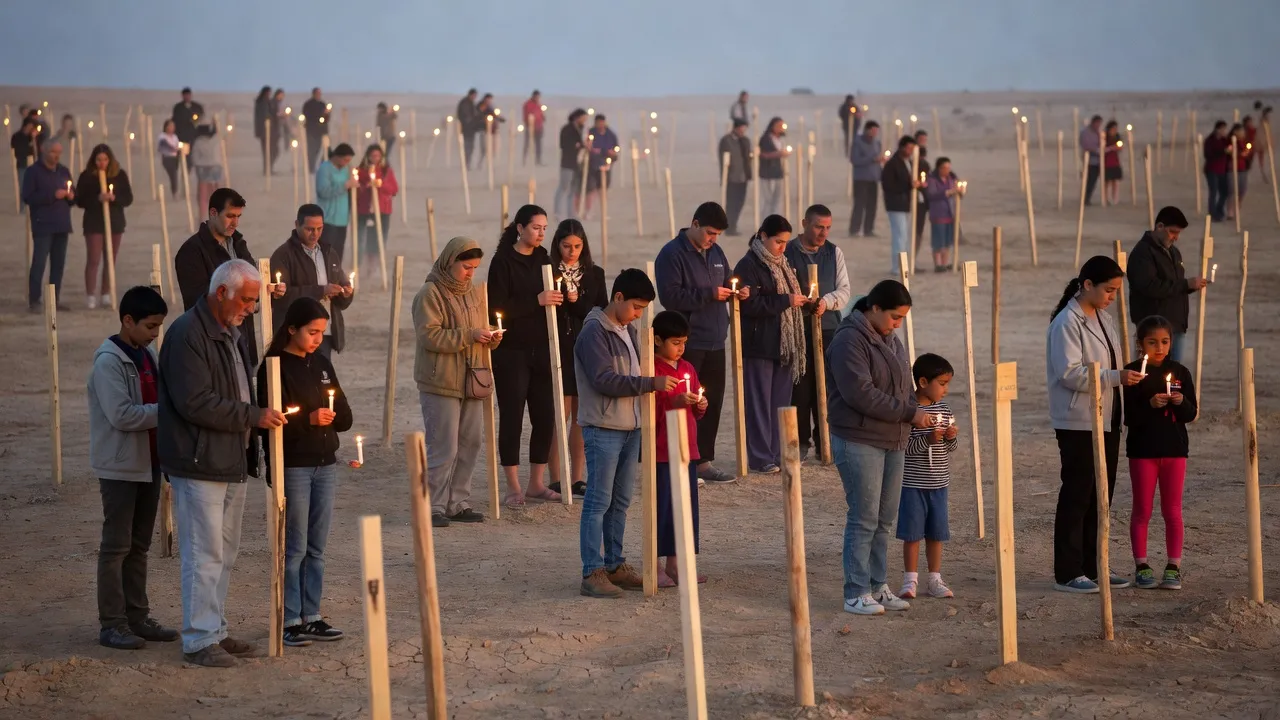
Expressen gives a voice to Ron Segev, a survivor of Nova, who says he has only been out of depression and panic attacks for a year. NRC describes the festival site turned memorial: young women dance there for Simhat Torah, and Iris Shapira, a 54-year-old lawyer, protests, saying they should not dance "on their blood".
In the United States, Time publishes the op-ed by Rachel Goldberg-Polin, mother of Hersh, held for 328 days in Gaza. She compares the way those close to hostages are consoled to the way families of 9/11 victims were consoled. In Australia, ABC describes a vigil in Bondi, and SBS collects the testimony of former hostage Emily Damari, released in January 2025.
The treatment of Gaza varies from one corpus to another. Doha News devotes most of its analysis to it: more than 1,400 Palestinians killed since the October 2025 truce, or about four per day, and 82% of buildings destroyed or damaged according to the Palestinian Central Bureau of Statistics. DW summarizes it in one sentence, and the American corpus does not mention it. The perspective counts here measure what the selected articles have chosen to cover, not the opinion of their readers.
In France, Le Monde reports that the police prefect has banned an Urgence Palestine demonstration in Paris, citing a "high terrorist threat". The collective speaks of "political censorship" and appeals to the administrative court.
In Strasbourg, an exhibition on 7-Octobre has given rise to a controversy. Libero relays the accusation of Pina Picierno, who reproaches Rima Hassan for having "desecrated" the exhibition by trampling flags. RTP Notícias talks about flags left on the ground. Roberta Metsola mentioned the duty towards the Jewish community of Europe.
Excerpts published on September 8: Mohammed bin Zayed allegedly warned Netanyahu ten days in advance; his office denies it and is suing the newspaper.
Nearly 400 of the more than 1,200 deaths occurred at the Nova festival, according to DW.
51 French nationals died on October 7, 2023; Jean-Noël Barrot traveled to Israel on October 7, 2026.
More divergent than 37% of recent comparable stories (reference: 90 recent stories measured with the same method).