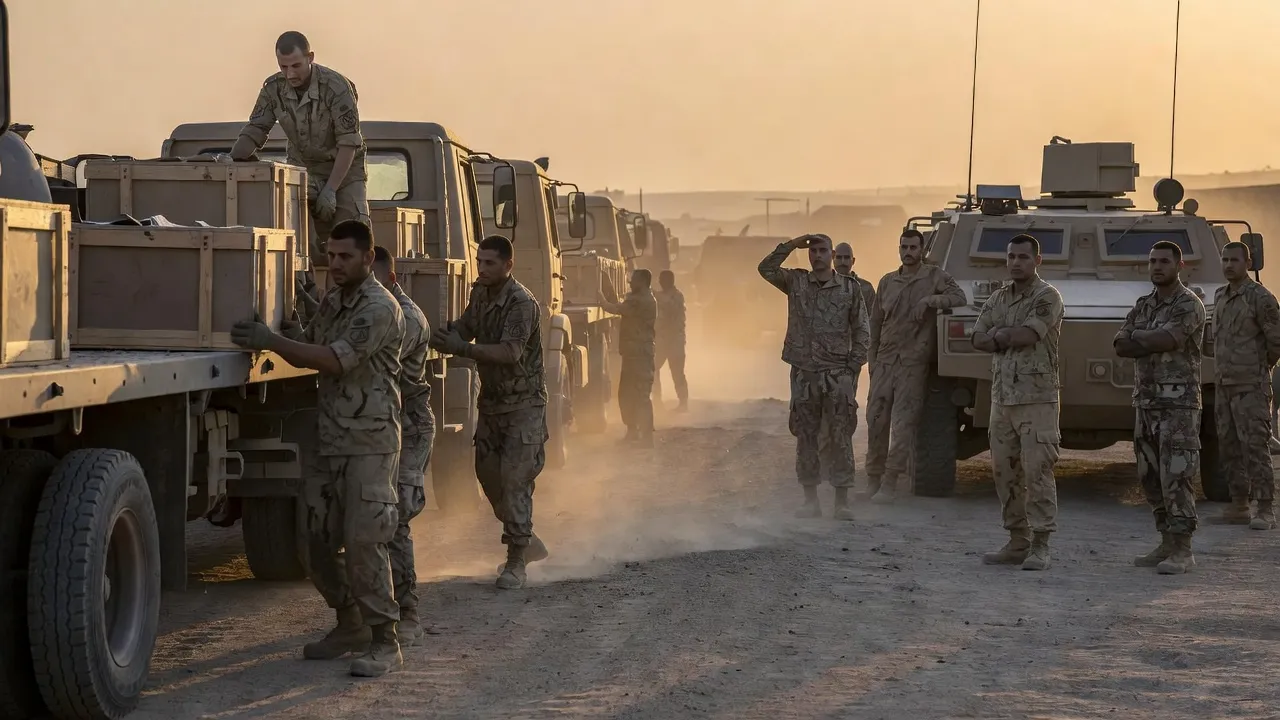
The last US troops leave Iraq, where Iran's influence is growing
published on
countries
sources
articles
Beyond the deadline itself, coverage focuses on what comes next: the end of twelve years of coalition presence, the conditions for the potential disarmament of factions, and how each press outlet interprets this departure.
The withdrawal deadline is September 30; the disarmament of pro-Iranian factions has not begun and several groups have announced their refusal.
Twelve years of presence, an inherited calendar
The world puts the departure into long-term perspective. According to the daily, the anti-jihadist coalition was deployed in 2014 against the Islamic State organization. After the victory over the group in 2017 in Iraq, then in 2019 in Syria, its forces remained to track down the last elements.
Still according to the daily, the coalition left Syria earlier this year. It had begun its withdrawal from Iraq in 2025, limiting its presence to Erbil airport, in Kurdistan.
BBC Türkçe, based on an analysis by BBC Monitoring, raises the question of the nature of the departure: end of mission or redeployment. The text reports that Washington reaffirms its commitment to the deadline and that Iraqi officials describe it as a "firm and definitive date". The BBC also notes that the debate continues on the American presence in Iraqi Kurdistan and on the role of American forces in protecting diplomatic sites.
A disarmament that depends on the war
The New York Times reports that Ali Al-Zaidi, who came to power in the spring, has committed under pressure from Washington to secure the disarmament of pro-Iranian factions. His government had initially set a deadline of September 30. The newspaper reports that the Prime Minister has called for October 1 to be celebrated as "Sovereignty Day". The heads of the executive, legislative, and judicial powers see it as a "national event" and stress the need to address the issue of "weapons escaping state authority".
« If there is an agreement between the United States and Iran, I think this whole issue becomes very easy to handle. »
The Daily Star, relaying AFP, writes that the issue is "much more complicated" than the announcements. The newspaper recalls that Iranian-backed groups have targeted American facilities in Iraq and the region hundreds of times. According to Iraqi analyst Sajad Jiyad, cited extensively, the factions are demanding assurance that the United States will not target them before considering surrendering their arms.
In an op-ed, Al Jazeera Arabic speaks of a "facade disarmament". The author writes that the Iraqi government is seeking to respond to American demands targeting Iran's allies, such as those addressed to Lebanon and Syria. He recalls that these factions have official recognition and a budget separate from that of the Ministry of Defense.
The same dispatch, other angles
The Australian, Pakistani, Qatari, and Turkish corpora reprise the same Reuters dispatch. It describes a departure "celebrated as a victory by Iran and its allies" and cites analyst Jasim al-Bahadli, who says Iran "is in a position to benefit strategically" from the end of a long-standing counterweight. This observation measures the reuse of a common source by these outlets, not the scope of opinions in Iraq.
On the Iranian side, Mehr News publishes a video captioned "Footage shows US military equipment leaving Iraq". The text indicates that the images show the US military removing its equipment from the region, without specifying a location or filming date. The Young Journalists Club (YJC), published on Tuesday, September 29, quotes Commander Abou Mojtaba al-Yasseri. According to him, the departure shows that Iraq's sovereignty "is not guaranteed by foreign forces".
Al Jazeera airs a video report from Baghdad dated Tuesday, September 29. It states that American soldiers have entirely left the capital's base, with military planes taking off from the city.
The risk of a security vacuum
France 24 reports on fears of a security vacuum and writes that Iraqi officials and analysts warn that the departure could embolden pro-Iranian militias. The channel adds that it could give the Islamic State, which it describes as resurgent, an opportunity to regroup.
« security gaps can be extremely dangerous »
According to the text reproduced by SBS News and PerthNow, the departure is widely popular among Iraqis. However, those who are concerned about the strength of Iran-backed groups consider it premature. France 24 notes that some doubt that security forces trained and funded by the United States can protect the country.
In the provided Iranian texts, neither Mehr nor YJC mention the risk of an Islamic State resurgence. This silence applies to these two texts, not to the entire Iranian press.
Baghdad aims for the disarmament of all militias by June 2027; several groups say they will refuse.
Iraqi officials quoted by AFP say that Iran will not accept this disarmament during the regional war.
Iraqi security officials cited by Reuters fear a resurgence of the Islamic State.
How each country reads it
7 perspectives, each in the voice of that country's press.
 France
Paris is weighing the departure of the last American troops in light of the security vacuum it could create in Iraq, between pro-Iranian militias and the resurgence of the Islamic State.
2 sources
 Australia
Canberra is eyeing the US withdrawal from Iraq through the lens of security risks: a vacuum that would benefit Iran, its armed allies, and a possible resurgence of the Islamic State.
2 sources
 Bangladesh
Dhaka sees the coalition's departure as a diplomatic test for Baghdad, whose disarmament of pro-Iranian factions depends on an agreement between Washington and Tehran.
2 sources
 Iran
IranTehran hails the US departure from Iraq as a victory for the "resistance": the Iranian press relays the voice of a pro-Iranian commander and shows images of evacuated equipment.
2 sources
 Pakistan
Islamabad weighs the US withdrawal from Iraq in terms of Tehran's strategic gain: the Pakistani press relays the analysis that Iran and its allies emerge strengthened from a withdrawal agreed upon in 2024 and completed in the midst of war.
3 sources
 Qatar
QatarDoha is gauging the US withdrawal from Iraq in terms of the regional balance: Gulf Times sees it as a strategic opening offered to Iran, Al Jazeera doubts a disarmament of the militias that would be only superficial.
3 sources
 Turkey
Ankara is gauging the US withdrawal from Iraq in terms of the strategic vacuum it leaves for Tehran, and the question posed by the Turkish press: end of mission or mere redeployment?
2 sources
What the comparison reveals
Common ground and differences in coverage across the media analysed.
What the media report in common
The last American forces of the coalition must have left their Iraqi bases by Wednesday, September 30 at the latest: the seven corpora report it.
A commander of the Islamic Resistance in Iraq, Abu Mojtaba al-Yasiri, describes the withdrawal as a 'historic victory': the statement is repeated in the Australian, Iranian, Pakistani, Qatari, and Turkish corpora.
The risk of a resurgence of the Islamic State after the American departure, cited by Iraqi officials or analysts, is mentioned in the Australian, French, Pakistani, Qatari, and Turkish corpora.
Where media coverage diverges
Disarmament of pro-Iranian factions
Question: Can Baghdad obtain the disarmament of these factions? The French press reports the commitment of Prime Minister Ali al-Zaidi; the Bangladeshi and Qatari sources highlight the limitations, between dependence on the regional war and disarmament that would be superficial.
Coverage aligned with this reading
Coverage that diverges
Interpretation of the withdrawal: victory or vacuum
Question: what does the US departure mean for Iraq? The Iranian press presents it as a « historical victory » of the resistance; the Australian, French, and Turkish sources primarily approach it as a possible security vacuum.
This grouping describes the publications analysed, not the position of these countries’ populations or of their governments.
The full text, country by country
France
DOMINANT ANGLE
Paris is weighing the departure of the last American troops in light of the security vacuum it could create in Iraq, between pro-Iranian militias and the resurgence of the Islamic State.
KEY POINTS
- The US-led anti-jihadist coalition is ending its mission in Iraq on Wednesday, September 30, after twelve years of presence, according to Le Monde.
- Prime Minister Ali Al-Zaidi has called for October 1 to be celebrated as "Sovereignty Day" and pledged to secure the disarmament of pro-Iranian factions.
- France 24 notes that several groups still refuse to lay down their arms and that 4,500 American soldiers have died in Iraq over more than twenty years of war.
ANALYSIS
Paris, September 30, 2026. The anti-jihadist coalition led by the United States is completing its mission in Iraq on Wednesday, September 30, twelve years after its deployment in 2014, notes Le Monde. These forces had been sent to Iraq and Syria to counter the Islamic State organization, which had conquered vast territories. After the victory over the Islamic State in 2017 in Iraq, and in 2019 in Syria, they remained to track down the last elements of the group. The newspaper recalls that Baghdad and Washington decided in 2024 to put an end to it. The coalition left Syria earlier this year and had begun its withdrawal from Iraq in 2025, limiting its presence to Erbil airport, in Kurdistan.
The French narrative highlights the internal political dimension. Prime Minister Ali Al-Zaidi has called for celebrating October 1 as the "Day of Sovereignty". The heads of the executive, legislative, and judicial powers see it as a "national event" that "consolidates the presence of the State and its institutions", while emphasizing the need to address the issue of "weapons escaping state authority". Le Monde specifies that Ali Al-Zaidi, who came to power in the spring, has committed under pressure from Washington to obtain the disarmament of pro-Iranian factions, and that his government had initially set September 30 as the deadline.
France 24 emphasizes the follow-up: this withdrawal relaunches the question of disarmament, which several groups still refuse to surrender. Its English-language version speaks of a departure "celebrated as a victory" by Tehran and its allies, while the Trump administration wages war against Iran, which weighs in on Iraq through its proxies. Iraqi officials and analysts warn that this departure could embolden the militias and offer the Islamic State, described as resurgent, the opportunity to rebuild.
The channel also places the episode in the long term: the withdrawal comes 23 years after the overthrow of Saddam Hussein by American forces, which triggered chaos and the rise of the Islamic State, and after the death of 4,500 American soldiers in over twenty years of war. While the departure is largely popular among Iraqis, some doubt that security forces trained and funded by the United States can protect the country. Analyst Jassim al-Bahadli, quoted by the channel, draws the lesson: "security vacuums can be extremely dangerous".
Australia
DOMINANT ANGLE
Canberra is eyeing the US withdrawal from Iraq through the lens of security risks: a vacuum that would benefit Iran, its armed allies, and a possible resurgence of the Islamic State.
KEY POINTS
- US forces must leave their last Iraqi bases by Wednesday, September 30, according to SBS and PerthNow.
- Around 4,500 American soldiers have died in Iraq over more than two decades of war.
- An Islamic Resistance commander in Iraq describes the withdrawal as a "historic victory"; Iraqi security officials fear a return of the Islamic State.
ANALYSIS
Canberra, 30 September 2026. SBS News and PerthNow are reporting on the departure of the last American forces from their Iraqi bases, expected on Wednesday, 30 September. They describe a departure "celebrated as a victory by Iran and its allies", who now exert a profound influence in a country where 4,500 Americans have died over more than two decades of war.
The two articles highlight the paradox of the calendar: the withdrawal, agreed upon in 2024 under Joe Biden, is being carried out by the administration of Donald Trump while Washington is at war with Iran. SBS presents it as the end of the most costly war for the United States in the 21st century.
The strategic analysis comes from an Iraqi analyst, Jasim al-Bahadli, a specialist in Shia armed groups aligned with Tehran. For him, "Iran is in a position to benefit strategically" from the departure of the coalition, which eliminates a military presence that has long served as a counterbalance. He predicts that pro-Iranian militias will seek to "translate this momentum into increased influence" over security and political decisions.
The report also gives a voice to Abu Mojtaba al-Yasiri, commander of the Islamic Resistance in Iraq, who describes the withdrawal as a "historic victory" and a "crushing defeat of the American project". He told Reuters that 30 September would mark the "dark page" turned in Iraqi history.
The second aspect is the jihadist risk. Iraqi security experts believe that the withdrawal could leave space for a return of the Islamic State and other US adversaries. The article notes that the departure of troops is widely popular among Iraqis, but those who worry about the strength of Iran-backed groups consider it premature.
The available excerpts do not mention the Australian contribution to the coalition or a reaction from Canberra: the coverage is based on international dispatches and Iraqi voices.
Bangladesh
DOMINANT ANGLE
Dhaka sees the coalition's departure as a diplomatic test for Baghdad, whose disarmament of pro-Iranian factions depends on an agreement between Washington and Tehran.
KEY POINTS
- Prime Minister Ali al-Zaidi has promised that pro-Iranian groups will turn in their arms to the state after the coalition's departure, scheduled for this Wednesday (The Daily Star, according to AFP).
- Several high-ranking Iraqi officials tell AFP that Iran will not accept the disarmament of the factions as long as the regional war continues.
- Italy completed its withdrawal from Iraq on Tuesday after twelve years of presence; two carabinieri remain under the EUAM Iraq mission (TBS News).
ANALYSIS
Dhaka, September 30, 2026. The English-language Bangladeshi press is treating the departure of the US-led anti-jihadist coalition as a test for Baghdad more than as a military event. The Daily Star, which relays AFP, recalls that Iraq is a country "caught between its allies," Washington and Tehran, and that the coalition is leaving the territory this Wednesday.
Prime Minister Ali al-Zaidi, who came to power this year with the blessing of the United States, has promised that after this departure, pro-Iranian groups will hand over their arms to the state. The newspaper emphasizes that the issue is "much more complicated" than simple announcements. Several high-ranking Iraqi officials, quoted by AFP, assert that Iran will not accept that the factions hand over their arms, especially during the regional war, and that it has clearly conveyed this message.
Iraqi analyst Sajad Jiyad, quoted extensively, places the key between Washington and Tehran: "If there is an agreement between the United States and Iran, I think this whole issue becomes very easy to handle." According to him, Iran cannot abandon its strategic capabilities as long as the conflict lasts, including the ability to attack American interests in Iraq and in the region. The situation remains "delicate," however, as Tehran does not want an "unstable Iraq." The factions are also demanding assurance that the United States will not target them before considering giving up their arms.
The context of war is presented straightforwardly: Iran-backed groups have targeted American installations in Iraq and the region hundreds of times, which has deepened Iraq's involvement in the conflict.
TBS News covers the other side of the withdrawal, that of European contingents. Italy completed the withdrawal of its last troops from Iraq on Tuesday, ending twelve years of military presence, according to a statement from its Ministry of Defense. Rome had recalled most of its personnel in March 2026, after a nighttime strike against a base in the Kurdistan region. Minister Guido Crosetto sees this as a transition towards greater Iraqi responsibility for its own security. Two carabinieri remain in the country as part of the European Union's EUAM Iraq mission, conducted with the agreement of the Iraqi government.
Iran
DOMINANT ANGLE
Tehran hails the US departure from Iraq as a victory for the "resistance": the Iranian press relays the voice of a pro-Iranian commander and shows images of evacuated equipment.
KEY POINTS
- Mehr News (September 30) releases a video purportedly showing US military equipment leaving Iraq.
- YJC (September 29): US forces are to leave their last Iraqi bases on Wednesday, September 30.
- A commander of the "Islamic Resistance" speaks of a "historic victory" and a "heavy defeat of the American project".
ANALYSIS
Tehran, September 30, 2026. The Iranian press is treating the departure of the last American troops from Iraq as a done deal and a success of the "resistance", with very little factual development.
The Mehr News agency, in its English version, published a video dated September 30 titled "Footage shows US military equipment leaving Iraq". The text is limited to one sentence: the images "indicate that the US army is removing its military and war equipment from the region". No specific location, filming date, or figures are given; the image serves as proof of the departure.
The Young Journalists Club (YJC), published on Tuesday, September 29, relies on "English-language media" and Sputnik: American forces must leave their last bases in Iraq "by tomorrow", namely Wednesday, September 30 (8 Mehr). The article mainly gives the floor to Abu Mojtaba al-Yasseri, presented as one of the commanders of the "Islamic Resistance" in Iraq.
He describes this withdrawal as a "historic victory for the Islamic Resistance groups in Iraq and the honorable Iraqis" and a "heavy defeat for the American project". He adds that Iraq will celebrate on September 30 "the end of a dark page in its history".
The same commander draws a political lesson, taken up without contradiction by YJC: this departure would show that Iraq's sovereignty "is not guaranteed by foreign forces", but depends on the resistance and the will of the country's population. The narrative thus places the withdrawal in a logic of a won power struggle on the ground rather than a schedule agreed upon between Baghdad and Washington.
Neither Mehr nor YJC, in the provided texts, mention the disarmament of militias promised by the Iraqi government, the risk of a resurgence of the Islamic State, or the state of war between Iran and the United States. The Iranian reading therefore retains the symbolic triumph and sovereignty defined by the resistance, not Baghdad's security concerns.
Pakistan
DOMINANT ANGLE
Islamabad weighs the US withdrawal from Iraq in terms of Tehran's strategic gain: the Pakistani press relays the analysis that Iran and its allies emerge strengthened from a withdrawal agreed upon in 2024 and completed in the midst of war.
KEY POINTS
- US forces must have left their last bases in Iraq by Wednesday, September 30, according to Reuters as reported by ARY News, Business Recorder, and Geo News.
- The withdrawal, agreed upon in 2024 under Joe Biden, is being carried out by the Trump administration, at war with Iran; 4,500 Americans have died in Iraq.
- Commander Abu Mojtaba al-Yasiri speaks of a "historic victory"; analyst Jasim al-Bahadli anticipates a gain in influence for Tehran and a possible return of the Islamic State.
ANALYSIS
Islamabad, September 30, 2026. The three Pakistani titles in the corpus, ARY News, Business Recorder, and Geo News, published on September 29 the same Reuters dispatch, dated from Baghdad: US forces must have left their last bases in Iraq by Wednesday. They open with the viewpoint of the proclaimed winners: a departure "celebrated as a victory by Iran and its allies, who now exert a profound influence" in a country where 4,500 Americans have died in more than two decades of war.
The text recalls the chronology: the withdrawal was agreed upon in 2024 under Joe Biden and carried out by the administration of Donald Trump, even as it is at war with Iran. This irony structures the Pakistani reading, which presents a calendar inherited and executed by a successor in open conflict with Tehran.
The central voice is that of Iraqi experts and militiamen. Security analyst Jasim al-Bahadli estimates that Iran "benefits strategically from the coalition's departure, as it eliminates a military presence that has served for years as a counterweight" to its influence. He predicts that pro-Iranian groups will present the withdrawal as their victory and will seek to gain more weight in security and political decisions.
Abu Mojtaba al-Yasiri, commander of the Islamic Resistance in Iraq, which federates factions supported by Iran, speaks of a "historic victory" and a "crushing defeat of the American project". He announces that on September 30, "the black page turned" will be celebrated and affirms that Iraqi sovereignty is not obtained through foreign forces but through resistance.
The articles nuance this enthusiasm: while the departure is largely popular among Iraqis, those who worry about the power of armed groups consider it premature and believe that Iraq is not yet ready to assume sole responsibility for the security dossier. The cited experts also warn that other enemies of the United States, including the Islamic State, could return.
None of the three media outlets add editorial commentary or Pakistani reaction: the national perspective is based on the selection and reproduction of this dispatch, which emphasizes the regional balance of power rather than the balance sheet of the American presence.
Qatar
DOMINANT ANGLE
Doha is gauging the US withdrawal from Iraq in terms of the regional balance: Gulf Times sees it as a strategic opening offered to Iran, Al Jazeera doubts a disarmament of the militias that would be only superficial.
KEY POINTS
- Gulf Times: US forces are leaving their last Iraqi bases by Wednesday, in a country where 4,500 Americans have died in over twenty years of war.
- Abu Mojtaba al-Yasiri, commander of the Islamic Resistance in Iraq, speaks of a "historic victory"; Iraqi officials fear a return of the Islamic State.
- Al Jazeera shows the complete withdrawal of American soldiers from the Baghdad base on September 29, 2026, marking the end of a presence born out of the 2003 invasion.
ANALYSIS
Doha, September 30, 2026. Qatari media are covering the US withdrawal from Iraq as a shift in regional power dynamics rather than just a military schedule. Gulf Times, quoting a Reuters dispatch, writes that US forces are leaving their last bases by Wednesday, "a departure celebrated as a victory by Iran and its allies," in a country where 4,500 Americans have died over more than twenty years of war. The article highlights the paradox of a withdrawal agreed upon in 2024 under Joe Biden, executed by the Donald Trump administration while Washington is at war with Iran.
The newspaper quotes Jasim al-Bahadli, an Iraqi analyst of Shia armed groups, who says Iran "stands to benefit strategically" from a departure that eliminates a long-time counterbalance to Tehran's influence. Abu Mojtaba al-Yasiri, commander of the Islamic Resistance in Iraq, describes the withdrawal as a "historic victory" and "crushing defeat of the American project." Iraqi security officials also fear that the vacuum left behind may allow a return of the Islamic State.
Al Jazeera, on the other hand, aired a video report from Baghdad dated September 29: US soldiers have entirely left the capital's base, with military planes taking off from the city, marking the end of a presence born out of the 2003 invasion against Saddam Hussein.
The Arabic version of Al Jazeera published a more critical op-ed. It presents September 30, 2026, as a "decisive turning point" and claims that the coincidence between the withdrawal and the disarmament of militias is not fortuitous: the government of Prime Minister Ali al-Zaidi would be trying to meet US demands targeting Iran's allies, such as those addressed to Lebanon and Syria. The author recalls that these factions, forged in the fight against the Islamic State, have official recognition and a separate budget from the Ministry of Defense, and judges it difficult to withdraw this legitimacy from them.
The title of the op-ed itself speaks of a "facade disarmament" allowing Tehran to maintain discreet influence under the cover of the Iraqi state. Qatari coverage thus articulates three elements: the victory proclaimed by pro-Iranian factions, the security risk for Baghdad, and skepticism about promises of sovereignty.
Turkey
DOMINANT ANGLE
Ankara is gauging the US withdrawal from Iraq in terms of the strategic vacuum it leaves for Tehran, and the question posed by the Turkish press: end of mission or mere redeployment?
KEY POINTS
- The last American forces are to have left their bases in Iraq by Wednesday, September 30, at the latest, under an agreement reached in 2024 under Joe Biden and implemented by the Trump administration (Daily Sabah).
- Commander Abu Mojtaba al-Yasiri, of the Islamic Resistance in Iraq, describes the withdrawal as a "historic victory" (Daily Sabah, citing Reuters).
- Iraqi authorities describe September 30 as a "firm and final date", while debate continues on the American presence in Iraqi Kurdistan and around diplomatic sites (BBC Türkçe).
ANALYSIS
Ankara, September 30, 2026. Turkish forces are not involved, but US forces must leave their last bases in Iraq by this Wednesday, September 30, at the latest. Daily Sabah, a pro-government daily, headlines a withdrawal that leaves "a void for Iran" after two decades of presence. The newspaper recalls that the agreement dates back to 2024, under Joe Biden, and is being carried out by the Trump administration "even as it wages war against Iran".
The newspaper highlights the Iranian reading: the departure is celebrated as a victory by Tehran and its allies, who have deep influence in a country where 4,500 Americans have died. Jasim al-Bahadli, an Iraqi security analyst, estimates that Iran derives a strategic benefit from this, as the coalition has been a counterweight for years. Abu Mojtaba al-Yasiri, commander of the Islamic Resistance in Iraq, speaks of a "historic victory" and a "crushing defeat of the American project", and announces that September 30 will be celebrated as "a black page turned". According to the newspaper, this withdrawal could also allow other enemies of the United States, including Daesh, to return.
BBC Türkçe, based on an analysis by BBC Monitoring, raises another question: does this departure mark the end of a mission or a strategic redeployment? The text recalls that the mission launched after the Islamic State took control of large areas of Iraq in 2014 is ending, and that US troops had already withdrawn in 2011, eight years after the overthrow of Saddam Hussein. The two governments affirm that the schedule is being respected. Washington reiterates its commitment to the September 30 deadline, and Iraqi officials describe it as a "firm and final date", saying that October 1 will be "a new day in the country's trajectory".
The BBC notes, however, that the debate continues on the future of the US military presence in Iraq and in the Kurdistan region, as well as on the role that US forces could play in protecting diplomatic sites. The Turkish perspective remains that of a regional rebalancing, where Iran appears as the main beneficiary, and where the security of Baghdad against Daesh is a secondary but real concern.
Explore every perspective on this subject across 7 countries.
Compare viewpoints and see where they diverge.