
DOMINANT ANGLE
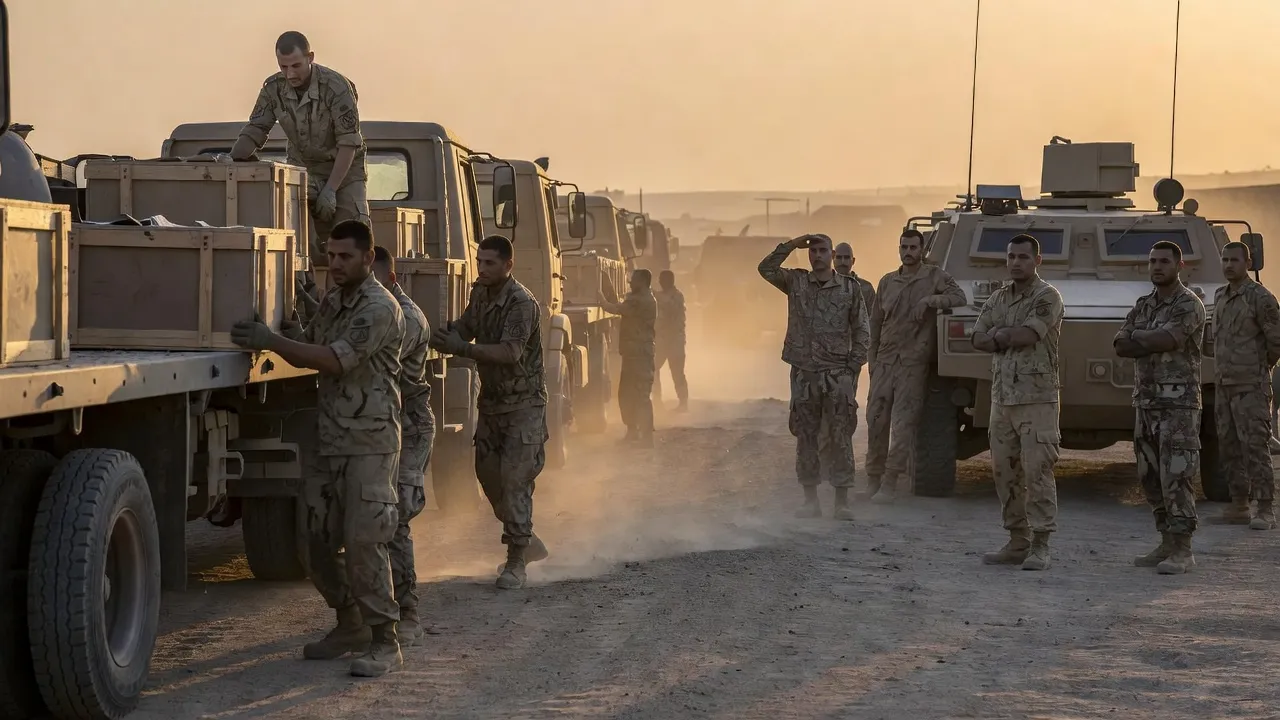
Tehran hails the US departure from Iraq as a victory for the "resistance": the Iranian press relays the voice of a pro-Iranian commander and shows images of evacuated equipment.
Dominant angle identified — does not reflect unanimity of this country’s media
KEY POINTS
- 01
Mehr News (September 30) releases a video purportedly showing US military equipment leaving Iraq.
- 02
YJC (September 29): US forces are to leave their last Iraqi bases on Wednesday, September 30.
- 03
A commander of the "Islamic Resistance" speaks of a "historic victory" and a "heavy defeat of the American project".
ANALYSIS
Tehran, September 30, 2026. The Iranian press is treating the departure of the last American troops from Iraq as a done deal and a success of the "resistance", with very little factual development.
The Mehr News agency, in its English version, published a video dated September 30 titled "Footage shows US military equipment leaving Iraq". The text is limited to one sentence: the images "indicate that the US army is removing its military and war equipment from the region". No specific location, filming date, or figures are given; the image serves as proof of the departure.
The Young Journalists Club (YJC), published on Tuesday, September 29, relies on "English-language media" and Sputnik: American forces must leave their last bases in Iraq "by tomorrow", namely Wednesday, September 30 (8 Mehr). The article mainly gives the floor to Abu Mojtaba al-Yasseri, presented as one of the commanders of the "Islamic Resistance" in Iraq.
He describes this withdrawal as a "historic victory for the Islamic Resistance groups in Iraq and the honorable Iraqis" and a "heavy defeat for the American project". He adds that Iraq will celebrate on September 30 "the end of a dark page in its history".
The same commander draws a political lesson, taken up without contradiction by YJC: this departure would show that Iraq's sovereignty "is not guaranteed by foreign forces", but depends on the resistance and the will of the country's population. The narrative thus places the withdrawal in a logic of a won power struggle on the ground rather than a schedule agreed upon between Baghdad and Washington.
Neither Mehr nor YJC, in the provided texts, mention the disarmament of militias promised by the Iraqi government, the risk of a resurgence of the Islamic State, or the state of war between Iran and the United States. The Iranian reading therefore retains the symbolic triumph and sovereignty defined by the resistance, not Baghdad's security concerns.





