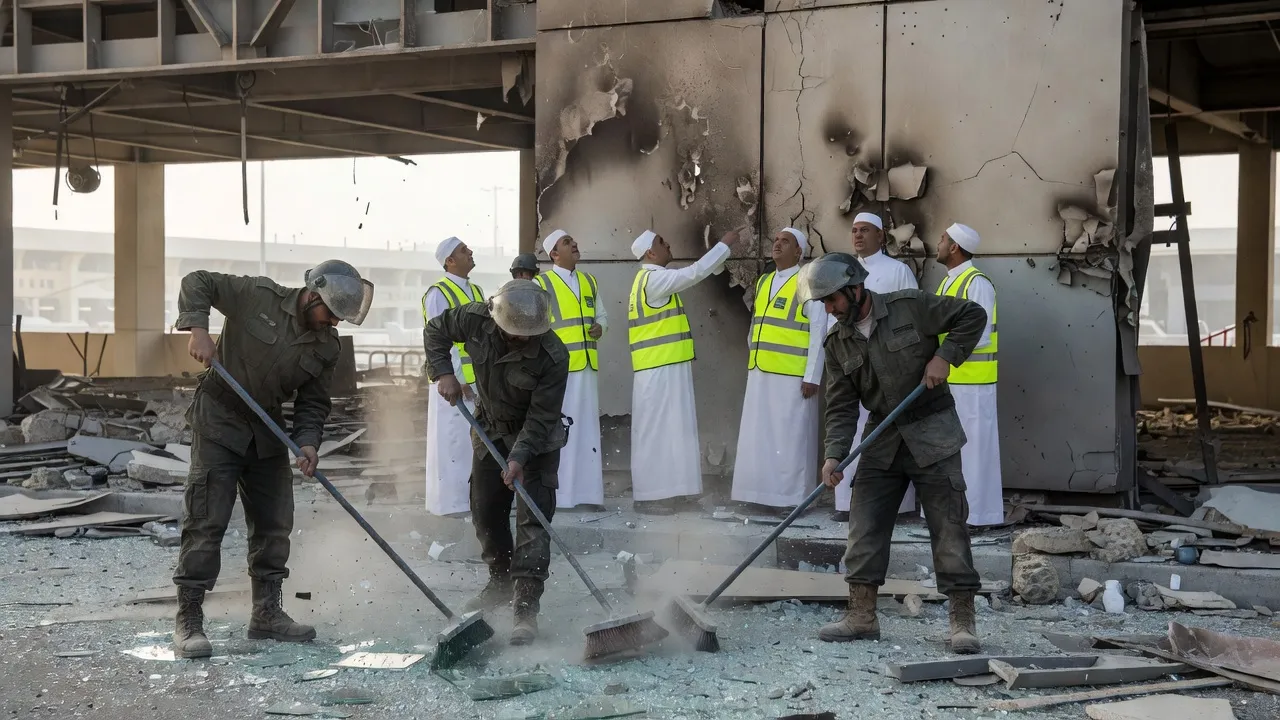
Common ground and differences in coverage across the media analysed.
What the media report in common
1
The US State Department has ordered the departure of non-essential government employees and their families from Saudi Arabia, citing Houthi attacks backed by Iran.
2
An attack on Dammam's King Fahd International Airport killed at least one person and injured several others.
Where media coverage diverges
Departure of families from the Gulf
Question: does the departure measure extend to other US missions in the Gulf? US officials cited by Reuters say yes; Tommy Pigott, cited by other media, limits it to Saudi Arabia.
Question: who launched the drone intercepted near Shaybah? Saudi press attributes the drones to the Houthis, while Nigerian and Swedish articles note that the author is not officially designated.
Berlin is weighing the cost of Houthi attacks on Saudi Arabia's "Vision 2030": the image of security and investor confidence are deemed to be at stake.
Buenos Aires sees the departure order given by Washington as a diplomatic signal: the United States considers the risk high enough to reduce their presence in Riyadh, at a time when the war with Iran is spreading.
Dhaka is gauging the Houthi escalation by the Saudi airports where its flights land: departures of American diplomats, attack on Dammam and gradual resumption of Biman connections.
Berlin is weighing the cost of Houthi attacks on Saudi Arabia's "Vision 2030": the image of security and investor confidence are deemed to be at stake.
KEY POINTS
According to official figures cited by Tagesschau, 18 people have died since early October at Riyadh airport, with more than 300 injured.
Economy Minister Katherina Reiche attended the World Petroleum Congress in Riyadh, which opened the day after the deadliest attack.
The coalition's spokesman, Turki al-Maliki, announced on Wednesday that five Houthi drones were destroyed over Medina, according to Handelsblatt.
ANALYSIS
Berlin, October 22, 2026. The German press is treating the Houthi escalation more as a threat to the Saudi modernization project than as a military episode. In its analysis, Tagesschau describes a "Vision 2030" in danger: Crown Prince Mohammed bin Salman wants to open his country to tourists and investors, but the Houthi attacks "destroy the image of security and stability." The story begins with a surveillance video of an explosion at the terminal of Riyadh's airport, where Muslim pilgrims are queuing.
According to the cited official figures, 18 people have died since the beginning of October at Riyadh's airport, with more than 300 injured. Tagesschau considers it possible that the toll may be heavier: the kingdom would have little interest in continuously informing the global public, while the Houthi militia claims and boasts about its attacks. The day after the deadliest attack, the World Petroleum Congress opened in Riyadh. German Economy Minister Katherina Reiche participated, arriving before the attack, while other participants canceled at short notice.
The Handelsblatt, in its thread dedicated to the "Iran war", emphasizes the regional chain of events. The United States is ordering diplomats to leave Saudi Arabia after the Houthi attacks. Turki al-Maliki, spokesman for the coalition led by Riyadh, announced on Wednesday that five drones from the militia were destroyed over Medina, the holy city of Muslims. The Houthis, for their part, claim to have struck a military camp at Aden's airport.
The thread then broadens its view to the Gulf: two tankers were hit by unidentified projectiles, according to the British agency UKMTO, one of which caught fire off the coast of Oman; Iran is threatening to target underwater cables; Benyamin Netanyahu names the downfall of the Iranian leadership as an objective; Emmanuel Macron is also traveling to Riyadh; the Iranian foreign minister is advocating for diplomacy despite his mistrust of Washington.
The German angle thus remains economic and focused on image: what the war is doing to Saudi attractiveness, to investors, and to energy players, rather than the fate of civilians or the Yemeni dimension of the conflict.
Argentina
DOMINANT ANGLE
Buenos Aires sees the departure order given by Washington as a diplomatic signal: the United States considers the risk high enough to reduce their presence in Riyadh, at a time when the war with Iran is spreading.
KEY POINTS
On Wednesday, October 21, the State Department ordered the departure of non-essential personnel from the US embassy in Saudi Arabia and their families (Perfil, Clarín).
Tommy Pigott denied that families were also forced to leave the UAE, Jordan, Qatar, and Bahrain (La Nación).
Riyadh claims to have intercepted six drones; two people, from Nepal and the Philippines, died when debris fell on an Aramco site (La Nación).
ANALYSIS
Buenos Aires, October 22, 2026. The Argentine press treats the American order as a diplomatic signal above all. La Nación, Perfil, and Clarín (which reprints an AP dispatch) report that the State Department ordered, on Wednesday, October 21, the departure of non-essential personnel from the US Embassy in Saudi Arabia and their families, after a series of attacks by Houthi rebels from Yemen, supported by Iran.
Perfil focuses on the text of the decision. Spokesman Tommy Pigott explains that it responds to the escalation of hostilities against the kingdom, "including attacks on civilian airports and other critical infrastructure," which have caused casualties and disrupted travel. The newspaper clarifies that the order does not mean a total withdrawal of Americans still in place, and quotes Pigott: the security of personnel and their families remains "the absolute priority."
La Nación highlights a nuance: the spokesman denied an earlier version that families of diplomatic personnel would also have to leave the United Arab Emirates, Jordan, Qatar, and Bahrain. The daily also reports that Riyadh claims to have intercepted six drones, one of which targeted the Medina region, and that the Saudi Ministry of Energy reported two deaths, nationals of Nepal and the Philippines, due to debris falling on a site operated by Aramco; the injured came from Pakistan and India.
Bangladesh
DOMINANT ANGLE
Dhaka is gauging the Houthi escalation by the Saudi airports where its flights land: departures of American diplomats, attack on Dammam and gradual resumption of Biman connections.
KEY POINTS
The State Department has ordered the departure of non-essential employees and their families from Saudi Arabia, according to spokesman Tommy Pigott.
On Wednesday, October 21, an attack at King Fahd Airport in Dammam killed one person and injured eight others; drone debris near an Aramco field killed two people.
Biman resumed flights to Dammam on October 21 and scheduled a flight to Riyadh on October 25, departing from Dhaka at 1:25 on the 26th.
ANALYSIS
Dhaka, October 22, 2026. The Bangladeshi press is covering the Houthi escalation from the angle of Saudi airports, which its readers use. The Daily Star and The Business Standard (TBS) report that the US State Department has ordered the departure of non-essential US government employees and their families from Saudi Arabia, due to Houthi attacks, supported by Iran, against "civilian airports and other critical infrastructure".
Spokesman Tommy Pigott specified that the order targeted Saudi Arabia only. Four US officials cited by Reuters add that other missions in the Gulf will also send families back. The Daily Star recalls that Washington had sent personnel back to the region in recent months, after a withdrawal prompted by Iranian attacks on US facilities, following the US-Israeli war against Iran that began at the end of February.
The reported toll is precise: on Wednesday, October 21, one person died and eight were injured at King Fahd International Airport in Dammam, according to the Saudi civil aviation authority, with injuries ranging from "minor to serious". Debris from a drone intercepted over an oil field operated by Aramco killed two people and injured two others. TBS, citing the BBC, notes that Saudi authorities have not identified the perpetrator of the drone targeting Shaybah, and that a recent strike on Riyadh airport would have been the deadliest attack in Saudi Arabia in years.
Israel
DOMINANT ANGLE
Jerusalem decodes the American departure order as a diplomatic signal: Washington recognizes that the war against Iran is now spilling over into Yemen and the Gulf.
KEY POINTS
The State Department has ordered the departure of non-essential employees and their families from Saudi Arabia only, according to spokesman Tommy Pigott.
At King Fahd Airport in Dammam, one person was killed and eight injured; a drone attack on an oil field killed two people.
Four US officials told Reuters that missions from other Gulf countries would also order the departure of families.
ANALYSIS
Jérusalem, October 22, 2026. The Israeli government notes that the US State Department has ordered some of its diplomats and their families to leave their missions in Saudi Arabia, and plans to withdraw families from several other missions in the region, according to American officials cited by Reuters.
The Jerusalem Post quotes the statement of spokesman Tommy Pigott, published on X: the departure concerns "non-essential American government employees and their families in Saudi Arabia only", due to Houthi attacks, aligned with Iran, against civilian targets. Pigott asserts that these rebels "have increasingly engaged in hostilities against Saudi Arabia, including attacks against civilian airports and other critical infrastructure". He did not specify the planned changes in missions outside the kingdom, but four American officials indicated to Reuters that other Gulf countries would give the same order to families.
The newspaper details the day's toll: one person killed and eight injured at King Fahd International Airport in Dammam, according to the Saudi civil aviation authority, and two dead in a drone attack on an oil field. It recalls that Washington had sent back diplomats in the region in recent months, after a massive withdrawal following Iranian strikes against American facilities, launched when the American-Israeli war against Iran began, at the end of February.
Nigeria
DOMINANT ANGLE
Abuja notes an increase in attacks on Saudi airports, which the Nigerian press reports based on American alerts and civilian tolls.
KEY POINTS
The State Department ordered the departure of non-essential employees and their families from Saudi Arabia on Wednesday, October 21, according to Vanguard.
Punch reports that operations remain suspended at King Khalid Airport in Riyadh and that the October 7 attacks left three dead and 36 injured.
According to the Saudi Ministry of Energy, debris from an intercepted drone near the Shaybah field killed two people, a Filipino and a Nepali.
ANALYSIS
Abuja, October 22, 2026. Punch and Vanguard, the two Nigerian titles in the corpus, are treating the Houthi escalation against Saudi Arabia as a matter of civilian and airport security. Vanguard reports that Washington ordered, on Wednesday, October 21, the departure of non-essential personnel from its embassy and their families, according to the State Department. Spokesman Tommy Pigott specified on X that the order targeted "non-emergency US government employees and their family members in Saudi Arabia only" and that the security of personnel "remain our highest priority". A diplomatic source cited by AFP also mentions families to be sent back from the Emirates, Jordan, Qatar, and Bahrain, countries targeted by Iran during the Middle East war.
Punch focuses on the security alert published on the same day by the American mission. It describes Houthis "backed by Iran" attacking civilian airports, with victims and serious travel disruptions, and judges that the hostilities "have the potential to escalate rapidly beyond that immediate area". Operations remain suspended at Riyadh's King Khalid International Airport, and American employees must obtain special authorization from the head of mission to use any Saudi airport.
The newspaper recalls its previous articles: on October 7, attacks on Saudi airports had killed three people and injured 36, with the Houthis claiming responsibility for the strikes against King Khalid in Riyadh and Abha. An alert on October 11 also reported a targeted attack on Dammam's King Fahd Airport.
Pakistan
DOMINANT ANGLE
Islamabad weighs the Houthi escalation in terms of the barrel: Brent above $110, and a Pakistani national among the injured in Shaybah.
KEY POINTS
Brent gained $1.93 (1.77%) to $110.75 a barrel on Thursday, October 22, with WTI reaching $98.58 (Business Recorder).
The State Department ordered the departure of non-essential employees and their families from Saudi Arabia, a measure limited to this country according to Tommy Pigott (Geo News, Business Recorder).
In Shaybah, two expatriates (one Filipino, one Nepalese) were killed and two others (one Pakistani, one Indian) were injured by debris from an intercepted drone (Saudi Ministry of Energy).
ANALYSIS
Islamabad, October 22, 2026. Pakistani media, led by Business Recorder, are treating the escalation between the Houthis and Saudi Arabia primarily as a shock to the markets. On Thursday, October 22, Brent crude gained $1.93, or 1.77%, to $110.75 a barrel, and WTI gained $1.43, to $98.58. Analysts at ING, cited by the newspaper, note that prices "remain well bid" after new deadly attacks against the kingdom.
The second thread of the narrative is diplomatic. On Wednesday, October 21, the State Department ordered the departure of non-essential employees from the US embassy and their families. Its spokesperson, Tommy Pigott, specified that the measure targeted Saudi Arabia "only", while linking the decision to the strikes against airports and affirming that the security of personnel remained "our highest priority". According to a diplomatic source cited by AFP, the families of diplomats would also have been ordered to leave the UAE, Jordan, Qatar, and Bahrain, all targeted by Iran during the regional war. Geo News and Business Recorder are repeating this chronology almost word for word.
The human toll is reported based on Saudi statements. ARY News, citing Saudi Gazette, reports one expatriate killed and eight injured at King Fahd International Airport in Dammam, according to the civil aviation authority. At the Shaybah field, operated by Saudi Aramco, the Ministry of Energy reports two deaths, a Filipino and a Nepali, and two injured, a Pakistani and an Indian, hit by debris from an intercepted drone. ARY puts the Pakistani in its title, and Business Recorder in its title: the national angle is imposed in the headlines.
Saudi Arabia
DOMINANT ANGLE
Riyadhh documents Houthi strikes as an aggression against its civilian and energy infrastructure, and highlights the interception of drones and the overt support from Paris and Amman.
KEY POINTS
One person killed and eight injured at King Fahd Airport in Dammam on Wednesday evening, according to the GACA; the coalition intercepted four drones in the Eastern Province.
Two foreign workers (one Filipino, one Nepalese) killed and two injured in Shaybah; the Ministry of Energy says activities were not affected.
Emmanuel Macron, in Riyadh on Wednesday, announced a French defensive military deployment in place for the past eight days and offered to protect the East-West pipeline.
ANALYSIS
Riyadh, October 22, 2026. The Saudi press is treating the Houthi escalation as a matter of defending the territory, through official statements. The Saudi Gazette reports that on Wednesday evening, a foreign national was killed and eight others were injured, from lightly to seriously, in an attack on Dammam's King Fahd International Airport, according to the General Authority of Civil Aviation (GACA). The authority specifies that material damage is being assessed and that further information will follow. The spokesperson for the coalition in support of legitimacy in Yemen, General Turki Al-Maliki, announces on his part the interception and destruction of four drones in the Eastern Province.
On Wednesday morning, a drone attack targeting a Saudi Aramco facility on the Shaybah field killed two people, a Filipino and a Nepalese, and injured two others, a Pakistani and an Indian, the Ministry of Energy announces. The air defenses intercepted the drone; the fire of a subcontractor's vehicle, outside the perimeter, did not affect operational activities, the ministerial source specifies. The ministry presents its condolences to the families.
The diplomatic aspect is framed around the support received. The Saudi Gazette reports Emmanuel Macron's arrival in Riyadh on Wednesday, the first visit by a Western leader since the intensification of attacks this month. The French President affirms that France has deployed military personnel and defensive means over the past eight days and proposes to participate in the restoration and protection of the East-West oil pipeline, which was damaged. "We are moving forward with Saudi Arabia in this direction," he says. Asharq Al-Awsat reports that Prince Faisal bin Farhan received his Jordanian counterpart Ayman Safadi, who expressed Amman's "full solidarity" and support for all the Kingdom's measures to protect its security and citizens. The two ministers also discussed de-escalation and freedom of navigation in the Strait of Hormuz and the Bab el-Mandeb Strait, in the name of global market stability.
Sweden
DOMINANT ANGLE
Stockholm is primarily retaining the diplomatic signal of the American withdrawal: a departure order confirmed by Washington for Saudi Arabia, presented with caution as "information" from the AFP.
KEY POINTS
According to a diplomatic source cited by AFP, Washington has ordered its diplomats and their families to leave Saudi Arabia.
Tommy Pigott confirms on X the departure of most employees from Saudi Arabia but denies that the measure targets the four other countries mentioned.
The Saudi Energy Ministry announces two deaths and two injuries after intercepting a drone near a petroleum facility close to the Emirates.
ANALYSIS
Stockholm, October 22, 2026. The Swedish press is treating the matter as a last-minute diplomatic dispatch, published on the evening of Wednesday, October 21. Aftonbladet and Dagens Nyheter are reporting the same information: Washington has ordered its diplomats and their families to leave Saudi Arabia, according to a diplomatic source cited by AFP. The headline is cautious, "Uppgifter", meaning "according to information", as the order was initially known only through an anonymous informant.
The State Department spokesperson, Tommy Pigott, later confirms on X that the majority of employees in Saudi Arabia have been ordered to leave. However, he dismisses the idea that the measure extends to the four other countries mentioned by the AFP source. According to this source, families of employees at American embassies in the United Arab Emirates, Jordan, Qatar, and Bahrain have also been sent back to the United States. Aftonbladet reports this denial without taking a stance between the two versions.
On the same evening, around 9:30 pm, the Saudi Ministry of Energy announces that two people have been killed and two others injured when the air defense shot down a drone over a petroleum installation near the border with the Emirates. The newspaper notes that it is unknown who is behind the attack and therefore does not explicitly attribute it to the Houthis.
Singapore
DOMINANT ANGLE
Singapore sees the signal from Washington: the withdrawal of some of its diplomats from Saudi Arabia, relayed by the press via Reuters, as a new front in the regional conflict related to Iran.
KEY POINTS
The State Department has ordered the departure of "non-essential employees" and their families from Saudi Arabia only, according to spokesman Tommy Pigott.
At least one dead and eight injured in the Dammam civil airport, two dead in a drone attack on an oil field.
Four US officials told Reuters that other missions in the Gulf would also be pulling out families.
ANALYSIS
Singapour, 22 October 2026. Singapore's Channel News Asia and the Straits Times, both of which picked up a Reuters dispatch dated 21 October, make the US departure order the central fact. The State Department has ordered its "non-essential" employees and their families to leave Saudi Arabia, and four US officials told Reuters that missions in other Gulf countries will also ask families to leave.
Spokesman Tommy Pigott, in a message on X, justifies the decision due to Houthi attacks, backed by Iran, against civilian airports and other critical infrastructure, which have caused "civilian casualties and significant disruptions to travel". He did not specify any change for missions located outside Saudi Arabia.
The articles detail the day's toll: at least one dead and eight injured at Dammam's civilian airport, two dead in a drone attack on an oil field. The US embassy in Riyadh had published a security alert on Wednesday about possible new attacks, following deadly strikes, including one against Riyadh's airport.
The Singaporean press places the episode in a broader chronology. Washington had brought back part of its diplomatic personnel in the region in recent months, after a massive withdrawal following Iranian attacks on US facilities, launched when the US-Israeli war against Iran began at the end of February. The latest withdrawal "follows an escalation of fighting in Yemen", which opens "another front" in the regional conflict triggered by this war.
United Kingdom
DOMINANT ANGLE
London sees the American departure order as a sign of an escalation that can spiral out of control, following the Houthi strikes on Saudi airports.
KEY POINTS
The State Department has ordered the departure of non-essential US government employees and their families from Saudi Arabia, warning that hostilities "have the potential to escalate rapidly" (BBC).
Three dead according to the BBC: two from debris of an intercepted drone over an oil field, one at King Fahd Airport in Dammam, where eight people were injured.
Riyadh airport, closed on October 10, reopened on Wednesday to limited traffic from Saudi airlines, with Lufthansa and Air France having cancelled their flights until mid-November (The Independent).
ANALYSIS
London, October 22, 2026. The UK government is taking note of the US State Department's decision to order the departure of non-essential government employees and their families from Saudi Arabia, as attacks intensify. Three people have been killed in strikes across the country: according to Saudi authorities, debris from an intercepted drone during an attempted attack on an oil field killed two people, and a third died after a strike against Dammam's King Fahd International Airport, where eight people were injured, ranging from "minor to severe".
The UK cites the US State Department spokesperson at length, who says that the Houthis, backed by Iran, "have increasingly engaged in hostilities against Saudi Arabia, including attacks on civilian airports and other critical infrastructure" that have caused civilian casualties and "significant disruptions" to travel. The same spokesperson warns that hostilities "have the potential to escalate quickly". The UK notes that the conflict between the Houthis in Yemen and Riyadh has intensified over the past month, with rebels responding to Saudi strikes with missiles and drones targeting airports, energy facilities, and military bases, and that a recent strike on Riyadh's airport was the deadliest in the kingdom in years. It also points out that the Ministry of Energy has not said who launched the drone directed at the Shaybah field, near the border with the United Arab Emirates.
United States
DOMINANT ANGLE
The United States is weighing its exposure: the withdrawal of diplomats from Saudi Arabia is seen as a possible prelude to American intervention against the Houthis and new strikes against Iran.
KEY POINTS
The State Department has ordered the departure of non-essential employees and their families from Saudi Arabia only, according to Tommy Pigott.
According to ACLED, cited by Fox News, Houthi strikes on the kingdom have more than doubled in one week; the October 10 attack on Riyadh killed at least 13 people.
The New York Times, cited by CNBC, says Washington and Israel have prepared strikes against Iran after the midterm elections, without Trump's approval.
ANALYSIS
The United States government, on October 22, 2026, is taking a closer look at its involvement with Riyadh after an order to depart was given on Wednesday, October 21. The State Department has ordered non-essential government employees and their families to leave Saudi Arabia. Spokesman Tommy Pigott clarified that the measure only applies to Saudi Arabia, contradicting a Reuters article about a withdrawal from the Gulf, while AFP, citing a diplomatic source, mentioned embassy families in the UAE, Jordan, Qatar, and Bahrain. When asked, Donald Trump responded that he did not know if that was the case.
The official statement cites "attacks on civilian airports and other critical infrastructure" that have resulted in casualties and disrupted travel. CBS notes that the "restricted operations" status, introduced in August, allows other embassies to reduce their staff without mandatory evacuation. Fox News highlights the political dimension: Saudi Arabia's military vulnerability "could soon become the president's problem," as he evaluates direct strikes against the Houthis. Riyadh is demanding more interceptors, the UK is sending Typhoons, Egypt is already providing aid, and Israel has offered its assistance. According to ACLED, Houthi strikes and attempts have more than doubled in one week this month; the deadliest, on October 10 against Riyadh's King Khalid airport, killed at least 13 people, including an American, and injured over 300.
Explore every perspective on this subject across 11 countries.
Saudi Arabia: Houthi attacks intensify as Washington orders some of its diplomats to leave
published on
October 22, 2026
11
countries
26
sources
31
articles
65/100
gap
Behind the order to leave, opinions diverge on three points: the scope of the measure, the author of the Shaybah shooting, and what the escalation is putting at stake. The corpus brings together articles from eleven countries, from Buenos Aires to Singapore.
The attacks continue: the departure order only concerns Saudi Arabia, and air links resume partially, with limited traffic to Riyadh.
How far does the departure order go
The first question concerns the scope. According to four US officials cited by Reuters, as reported by Channel News Asia, the Straits Times, the Jerusalem Post, and the Daily Star, other Gulf missions will also evacuate families. A diplomatic source cited by AFP names the United Arab Emirates, Jordan, Qatar, and Bahrain.
« non-essential US government employees and their families in Saudi Arabia only »
Tommy Pigott, State Department spokesperson, in a message on X, as reported by the Jerusalem Post, October 22
The State Department spokesperson rules out this extension. La Nación and Aftonbladet report the denial, and the Swedish newspaper does not take a stance between the two versions. According to the US press, Donald Trump, when asked, replied that he did not know if the measure would go further.
CBS recalls a contextual element: the "restricted operations" status, introduced in August, allows other embassies to reduce their staff without mandatory evacuation. Clarín, which reprints an AP dispatch, adds that the embassy in Riyadh had been operating with a minimal staff for months, after being severely damaged at the start of the war with Iran.
In the four Saudi articles in the corpus, the American order is not mentioned. This observation describes what these articles retained, not Riyadh's position.
The Shaybah drone and the interceptions
The Saudi Ministry of Energy did not say who launched the drone targeting Shaybah. The BBC, Vanguard, and Aftonbladet each report this. The Saudi Gazette, for its part, classifies the intercepted drones in the Eastern Province among the attacks by what it calls, according to the coalition, the "Houthi terrorist militia".
The ministry indicates that the debris killed a Filipino and a Nepali, and injured a Pakistani and an Indian. It specifies that a subcontractor's vehicle burned outside the perimeter, with no effect on activities. ARY News puts the injured Pakistani in its title.
The counts of interceptions vary from one article to another: four drones in the Eastern Province according to the Saudi Gazette, five over Medina according to the Handelsblatt, which quotes coalition spokesman Turki al-Maliki, six according to La Nación. The texts do not say if these announcements overlap.
Business Recorder reports that the Houthis, through the voice of Yahya Saree, deny having launched drones towards Medina.
Airports, image of the kingdom, barrel
The tolls of the attack on Riyadh are read on different scales. According to ACLED, cited by Fox News, the October 10 strike on King Khalid Airport killed at least 13 people, including an American, and injured more than 300. Tagesschau cites official figures of 18 dead since early October at this airport, and considers a heavier toll possible. Punch recalls the attacks of October 7: three dead and 36 injured.
Tagesschau sees these attacks as a threat to Mohammed bin Salman's "Vision 2030", which aims to open the country to tourists and investors. It notes that the World Petroleum Congress opened in Riyadh the day after the deadliest attack, and that German Economy Minister Katherina Reiche participated. NPR reports the cancellation of the investors' forum nicknamed the "Davos of the Desert".
The Independent writes that the decline in air traffic "could signal longer-term economic consequences". It reports that the Houthis acknowledge having targeted the airport and claim, without evidence, that Riyadh was transiting military equipment there. On the markets, ING analysts, cited by Business Recorder, estimate that prices remain "well bid".
Washington between Riyadh and Tehran
The American press is shifting the question to the executive branch. Fox News writes that Saudi Arabia's military vulnerability "could soon become" Donald Trump's problem, as he evaluates direct strikes against the Houthis. The same article reports that Riyadh is demanding more interceptors, that the UK is sending Typhoons, that Egypt is already providing aid, and that Israel has offered its assistance.
« a complete failure »
A researcher from the Washington Institute, regarding the unintercepted Houthi strikes, as quoted by CBS News
CBS is questioning the effectiveness of the defense of a kingdom that spent $83 billion on defense last year, according to the SIPRI. A researcher at the Washington Institute sees this as a failure, while also noting that no country achieves 100% interception.
CNBC is linking the issue to Iran. According to the New York Times, the US and Israeli armies have prepared new strikes after the midterm elections, which Donald Trump did not approve, while negotiations on nuclear issues and the Strait of Hormuz are ongoing. The Handelsblatt is juxtaposing in its feed the goal of overthrowing the Iranian leadership that Benyamin Netanyahou mentions, and the position of the Iranian foreign minister, who is advocating for diplomacy despite his mistrust of Washington.
The airport in Riyadh
Closed on October 10, reopened on Wednesday with limited traffic; Lufthansa and Air France have cancelled their flights until mid-November.
French support
Emmanuel Macron, in Riyadh on Wednesday, announces a French defensive military deployment that has been underway for eight days.
The Biman flights
Biman resumed its flights to Dammam on October 21 and scheduled a flight to Riyadh on October 25.
Key figures
110.75 $
Brent barrel price on Thursday, October 22, up $1.93
Clarín, via AP, recalls that the embassy had been severely damaged at the beginning of the war with Iran and had been operating with a minimal staff for months, with a few diplomats returning recently. The new travel alert warns that hostilities "have the potential to escalate rapidly beyond this immediate area." King Khalid International Airport in Riyadh, which has been closed since October 10 after a severe attack, saw some Saudi airlines resume flights with prior authorization on Wednesday, while major airlines like Lufthansa remain absent.
The Argentine account thus places Washington's decision within the logic of a broader regional conflict between the United States and Iran, without drawing any conclusions about the markets or Argentine domestic politics.
The local angle appears in the coverage of Biman Bangladesh Airlines. In a statement on October 21, the company announced the resumption of flights to Dammam, with daily flights until October 26, using a Boeing 777 departing from Dhaka at 8 am. A flight to Riyadh is scheduled for October 25, departing from Dhaka at 1:25 am Bangladeshi time on October 26. Two Dhaka-Jeddah flights are planned for October 22, then one flight per day from October 23 to 25 at 7:20 pm. Flights to Medina have been operating normally since October 18. The company says it will decide on possible additional flights to Riyadh after assessing the situation.
The narrative thus remains one of disruption to air traffic and its management, rather than a reading of the regional war. The Daily Star mentions in one sentence that the conflict has "blocked global energy trade and penalized Gulf economies", without elaborating. The articles do not detail oil prices or the impact on Bangladeshi workers in the kingdom.
The framing is that of an expansion: according to the Jerusalem Post, these withdrawals follow an escalation in Yemen that opens "another front" in the regional conflict triggered by the American-Israeli war against Iran, which has disrupted global energy trade and weighed on the economies of the Gulf. Haaretz, in a brief text dated the same day, speaks of a measure that extends to the region "as Houthi attacks intensify in the context of the broader conflict".
The two titles remain factual and rely on Reuters and the State Department spokesman. They do not accompany this information with an official Israeli position, nor an analysis of the consequences for Israel: the angle retained is that of the signal sent by Washington, which judges the situation to be sufficiently degraded to reduce its diplomatic presence in its Saudi ally.
Vanguard adds that the kingdom is suffering from almost daily attacks this month, including a strike on Riyadh's airport, the deadliest in several years. On Wednesday, the Saudi Ministry of Energy indicated that the debris from an intercepted drone, targeting an oil facility, killed two people, a Filipino and a Nepalese, and injured two others; the Shaybah field, near the Emirati border, was the target. The coalition led by Riyadh in Yemen announced that it had intercepted six drones earlier in the day.
The account relies almost exclusively on American and Saudi communications, with little insight into Houthi motivations or the repercussions for Nigeria.
The coverage also recalls the Yemeni context. Business Recorder reports that the Houthis, through the voice of Yahya Saree, deny having launched drones towards Medina, contradicting the coalition led by Riyadh. The newspaper recalls that the 2022 truce, negotiated under the auspices of the UN, has ended and that the escalation opens "another front" in the US-Israeli war against Iran, with explosions reported in Sirik, in southern Iran, and threats from the Revolutionary Guards against US bases.
The articles remain factual and largely draw on Reuters and AFP dispatches. They do not address the official position of Islamabad, nor the consequences for the Pakistani diaspora in the Gulf beyond the injured person in Shaybah.
The coalition also indicates that it has intercepted five drones launched by what it calls the "Houthi terrorist militia", including one towards the Eastern Province. In the articles consulted, there is no mention of the American order to leave for part of the diplomatic personnel, or the price of Brent: the story remains focused on the recorded victims, interceptions, and mobilization of partners.
The context is set in one sentence: the kingdom is "hårt ansatt" (hard-pressed) by the attacks of the Houthi movement in Yemen, which is said to be supported by Iran. Aftonbladet recalls that Riyadh airport reopened on Wednesday, after a closure earlier in October following deadly Houthi attacks. The American order is thus presented as a follow-up to a series of incidents, rather than an isolated event.
The treatment remains factual and brief, without editorial or Swedish reaction: neither the government of Stockholm nor Swedish diplomacy is mentioned. The focus is on the signal sent by Washington, read through the administrative gesture of a personnel withdrawal, rather than the military balance or the consequences on oil markets, which are absent from both texts. Dagens Nyheter, whose article is largely reserved for subscribers, only provides the essential information from the dispatch.
CNA adds, in a truncated passage, that the expanded conflict has disrupted global energy exchanges, a sensitive topic for an import-dependent city-state. However, the article does not detail the reaction from Riyadh, Tehran, or the Houthis, and the text focuses on the signal sent by Washington rather than the causes of the resumption of hostilities in Yemen.
The tone remains that of a news agency dispatch: chronology, toll, official quotes, without editorial or commentary from Singaporean officials in the available excerpts.
The UK is also looking at the concrete consequences for aviation. Riyadh's King Khalid Airport, which was hit several times in October and closed on October 10, reopened on Wednesday, but only Saudi airlines, Saudia and FlyNas, were operating there, according to FlightAware data. Lufthansa and Air France have cancelled their flights until mid-November. The UK believes that this decline in air traffic "could signal longer-term economic consequences" for Saudi Arabia. It also reports that the Houthis have acknowledged targeting the airport, claiming without evidence that Riyadh was using it to transit military equipment for Yemeni government forces.
The UK finally notes that a British maritime security agency reported a projectile causing a fire on board a tanker off the coast of Oman, with the crew safe and sound. This detail highlights the exposure of regional navigation, which the UK relates to its own maritime interests.
CBS is investigating why a kingdom that spent $83 billion on defense last year, according to SIPRI, is failing to intercept these attacks; a researcher at the Washington Institute calls this failure "a big failure," while noting that no country achieves 100% interception. NPR reports the cancellation of the "Davos in the Desert" investor forum. CNBC links this to the Iranian dossier: The New York Times claims that the US and Israeli armies have prepared new strikes after the midterm elections, which Trump has not approved, while negotiations on nuclear issues and the Strait of Hormuz continue. On Wednesday, an attack killed one person at Dammam airport, and two people died in Shaybah.