
DOMINANT ANGLE
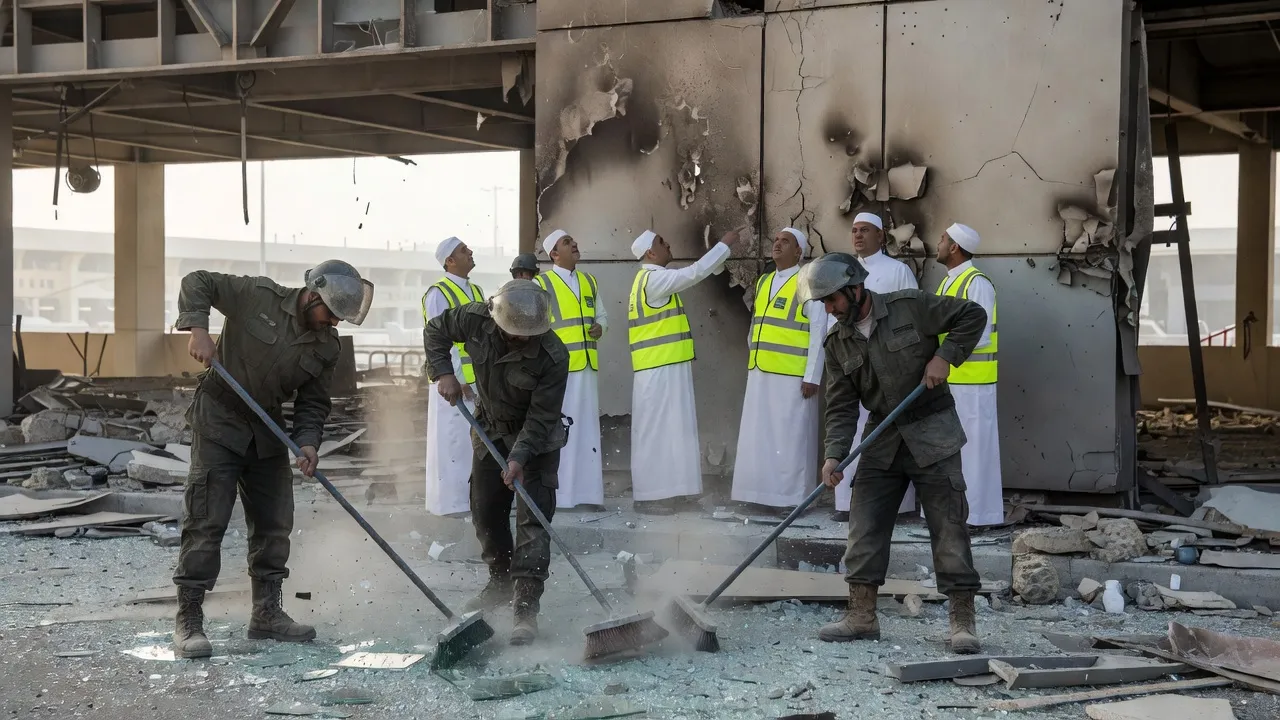
Buenos Aires sees the departure order given by Washington as a diplomatic signal: the United States considers the risk high enough to reduce their presence in Riyadh, at a time when the war with Iran is spreading.
Dominant angle identified — does not reflect unanimity of this country’s media
KEY POINTS
- 01
On Wednesday, October 21, the State Department ordered the departure of non-essential personnel from the US embassy in Saudi Arabia and their families (Perfil, Clarín).
- 02
Tommy Pigott denied that families were also forced to leave the UAE, Jordan, Qatar, and Bahrain (La Nación).
- 03
Riyadh claims to have intercepted six drones; two people, from Nepal and the Philippines, died when debris fell on an Aramco site (La Nación).
ANALYSIS
Buenos Aires, October 22, 2026. The Argentine press treats the American order as a diplomatic signal above all. La Nación, Perfil, and Clarín (which reprints an AP dispatch) report that the State Department ordered, on Wednesday, October 21, the departure of non-essential personnel from the US Embassy in Saudi Arabia and their families, after a series of attacks by Houthi rebels from Yemen, supported by Iran.
Perfil focuses on the text of the decision. Spokesman Tommy Pigott explains that it responds to the escalation of hostilities against the kingdom, "including attacks on civilian airports and other critical infrastructure," which have caused casualties and disrupted travel. The newspaper clarifies that the order does not mean a total withdrawal of Americans still in place, and quotes Pigott: the security of personnel and their families remains "the absolute priority."
La Nación highlights a nuance: the spokesman denied an earlier version that families of diplomatic personnel would also have to leave the United Arab Emirates, Jordan, Qatar, and Bahrain. The daily also reports that Riyadh claims to have intercepted six drones, one of which targeted the Medina region, and that the Saudi Ministry of Energy reported two deaths, nationals of Nepal and the Philippines, due to debris falling on a site operated by Aramco; the injured came from Pakistan and India.
Clarín, via AP, recalls that the embassy had been severely damaged at the beginning of the war with Iran and had been operating with a minimal staff for months, with a few diplomats returning recently. The new travel alert warns that hostilities "have the potential to escalate rapidly beyond this immediate area." King Khalid International Airport in Riyadh, which has been closed since October 10 after a severe attack, saw some Saudi airlines resume flights with prior authorization on Wednesday, while major airlines like Lufthansa remain absent.
The Argentine account thus places Washington's decision within the logic of a broader regional conflict between the United States and Iran, without drawing any conclusions about the markets or Argentine domestic politics.


