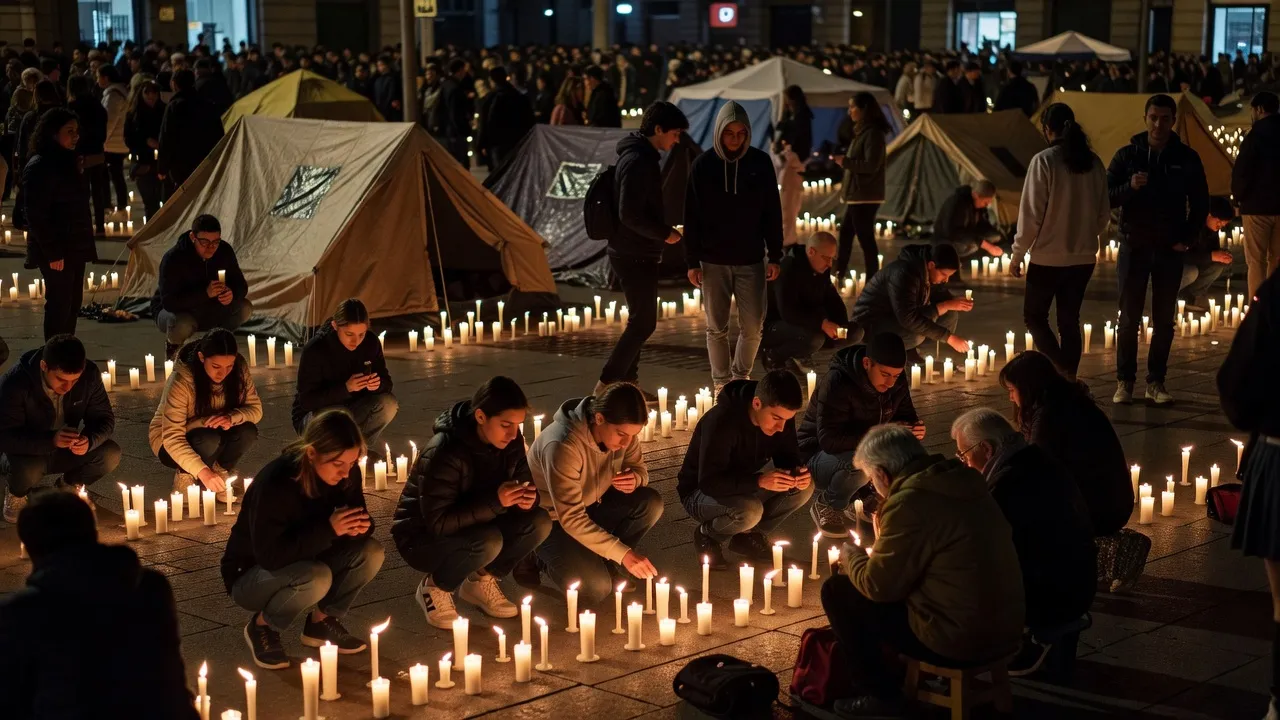
Common ground and differences in coverage across the media analysed.
What the media report in common
1
Maricarmen Abascal, 87 years old, died on Wednesday, October 7, in Madrid, after being evicted from the apartment she had occupied for over 70 years on September 23.
2
The death was announced by the Madrid tenants' union, which the reports cite as the source of the announcement.
3
She is presented as the face or symbol of the housing crisis and protests in Spain.
Where media coverage diverges
What death brings to the forefront
Question: is the death of Maricarmen Abascal primarily linked to the political sequence (rejected decrees, elections) or to the figure of the deceased? Spain, Venezuela, Sweden, Singapore, and Poland focus on the political sequence; Belgium, Italy, Mexico, or Portugal focus on the face.
Question: by how much has the rent increased? France, Germany, and Peru cite +275% to 2,650 euros; Italy talks about a change from 500 to 2,650 euros; Belgium mentions a tripled rent and Hungary a multiplied amount without a figure.
Question: who is named as the author of the rejection of the housing decrees? The Spanish press cites the PP, Vox, and Junts, and Venezuela mentions the votes of conservative parties; most other perspectives only write that the Parliament or Congress rejected them.
Buenos Aires links the death of Maricarmen Abascal to its own reality: local retirees who rent and whose incomes can no longer keep up with the cost of rent.
Buenos Aires links the death of Maricarmen Abascal to its own reality: local retirees who rent and whose incomes can no longer keep up with the cost of rent.
KEY POINTS
María del Carmen Abascal, 87 years old, died on Wednesday, October 7, at Gregorio Marañón hospital, after being evicted on September 23 from an apartment she had occupied for over 70 years (La Nación, Infobae).
La Nación links the case to the situation of Argentine retiree tenants, citing a report by Matías Araujo (Fundación Tejido Urbano) that compares Spain and Argentina.
Perfil reports that Sánchez has called for early elections on November 29 after the rejection of two housing decrees, and that the Union is calling for a general strike in November.
ANALYSIS
Buenos Aires, October 8, 2026. The Argentine press is devoting extensive coverage to the death of María del Carmen Abascal, known as Maricarmen, announced on Wednesday, October 7, by the Madrid Tenants' Union. She was 87 years old and died at the Gregorio Marañón hospital, where she had been hospitalized since her eviction on September 23, after more than 70 years in the same apartment.
La Nación takes a national angle. Its article recalls that the photo of the elderly woman being evacuated on a stretcher made the rounds of the world, and then poses a question that concerns Argentina: what happens when one reaches old age as a tenant, with income that is no longer the same? The newspaper specifies that Maricarmen had not stopped paying: she was paying the amount that her retirement could cover, but not the increase demanded. It relies on a report by Matías Araujo, from the Fundación Tejido Urbano, which compares the residential trajectories of Spain and Argentina, and asserts that the case has points of contact with a situation that affects Argentine retirees head-on.
Infobae, from its Spanish section, is following the event live. The site attributes the eviction to the spark of indignation against housing policy, with demonstrations and encampments, especially at the Puerta del Sol, and links two rejected decrees in Congress to the general elections. It quotes the Union, for which "rentism kills", as well as the message from Pedro Sánchez ("All my affection to Maricarmen's family") and the response from Alberto Núñez Feijóo: "No campaign, no parties, no self-interested use." It also cites the very harsh reaction of ERC spokesperson Gabriel Rufián, and the video recorded at the hospital, where Maricarmen hoped that her case "would serve so that it does not happen to others".
Perfil insists on the political dimension. After a minute of silence, the protesters marched towards Congress shouting "Maricarmen lives, the struggle continues". The newspaper recalls that Sánchez announced early elections for November 29, after the rejection of two housing decrees, that the Sol encampment continues despite this, and that the Union has called for a general housing strike in November. For the three media outlets, Maricarmen has become a symbol, and her death occurs after an agreement for her return home had been reached, without it being able to materialize.
Belgium
DOMINANT ANGLE
Brussels retains from the death of Maricarmen Abascal the image of a symbol: that of a Spanish housing crisis having become a European social fact.
KEY POINTS
Maricarmen Abascal, 87, died Wednesday at Gregorio Marañón hospital in Madrid, after being evicted on September 23 from the apartment she had occupied for over 70 years (VRT NWS).
The Madrid Tenants' Union says the agreement allowing her to return came too late and that her fight marked "a turning point in the history of this country" (La Libre, DH).
According to VRT, an investment fund that bought the building wanted to triple the rent, and the mobilization led to a "Maricarmen decree".
ANALYSIS
Brussels, 8 October 2026. The Belgian press reported the death of Maricarmen Abascal, 87, as early as Wednesday evening and immediately erected her as a symbol. VRT NWS calls her the "symbol" of the Spanish housing crisis, known throughout "all of Europe" by her first name alone. La Libre Belgique and La Dernière Heure speak of an "octogenarian who became the symbol of the housing crisis" and a retiree "at the origin of the protest movement" in Spain.
The three media outlets rely on the statement from the Union of Tenants in Madrid, which announces that Maricarmen died on Wednesday and asserts that her struggle marked "a turning point in the history of this country". VRT specifies that she died at the Gregorio Marañón hospital in Madrid, where she had been taken after her eviction. The union regrets that a "historic" agreement allowing her to return home came too late, a situation that, after "an exhausting process", could have been avoided.
The Belgian account recalls the starting point: on 23 September, the elderly woman, who had been living in her apartment for over 70 years, was evacuated on a stretcher. According to VRT, an investment fund that had bought the building wanted to triple the rent. The photo of this octogenarian, who was disabled and had reduced mobility, provoked massive protests, which VRT says led to a "Maricarmen decree".
Germany
DOMINANT ANGLE
Berlin sees the death of Maricarmen Abascal as a symbol of Spain's visible housing crisis, rather than just an episode in an election campaign.
KEY POINTS
Maricarmen Abascal, 87, had lived in her Madrid apartment for over 70 years; she was evicted on September 23 and died on Wednesday, according to the tenants' union (FAZ, Tagesschau).
An investor had raised the rent by 275% to 2,650 euros, according to the tenants' union; a return agreement came too late ("Diese Lösung kommt zu spät").
Sánchez, whose housing proposals failed to gain a majority, announced elections for late November on Monday; PP and Vox are leading in the polls (Tagesschau).
ANALYSIS
Berlin, October 8, 2026. The German press is welcoming the death of Maricarmen Abascal, announced on Wednesday, October 7, as the tragic end of a case that has become emblematic. For Tagesschau, her name "stands symbolisch für die spanische Wohnungskrise": it symbolized the Spanish housing crisis. The FAZ headlines with the "zwangsgeräumte Spanierin", the evicted Spanish woman, who died at 87 years old.
The two media outlets follow the same chronology. After more than 70 years in her Madrid apartment, Maricarmen was evacuated on September 23 on a stretcher, an investor having raised the rent by 275% to 2,650 euros, according to the tenants' union. Hospitalized for exhaustion, she saw an agreement on her return being reached a few days later, without being able to re-enter the premises. The FAZ specifies that she only survived a few days after this agreement.
The central source is the tenants' union. Both newspapers quote its statement: "Diese Lösung kommt zu spät", then "Eine völlig vermeidbare Situation nach einem qualvollen Prozess". The FAZ adds that it speaks of a césure "in der Geschichte dieses Landes".
The angle is primarily social. Both texts report that this fate has shown "auf besonders drastische Weise" the extent of the housing shortage and the explosion of rents. They relay the slogan of the demonstrations, "Wir sind alle Maricarmen", and the camp set up in the center of Madrid, the culmination of the protests born from the eviction.
Ecuador
DOMINANT ANGLE
Quito remembers Maricarmen Abascal's death as the face of an octogenarian who became a symbol of the right to decent housing, far more than the debate on the economic causes of the Spanish crisis.
KEY POINTS
Maricarmen Abascal, 87 years old, died on Wednesday, October 7, 2026, after fifteen days of hospitalization, according to the Sindicato de Inquilinas
She had lived 71 years in the same apartment in Madrid from which she was evicted on September 23; a return agreement had been reached on September 28 with the owner
The two housing decrees of the Sánchez government were repealed by Congress, which hastened the announcement of the election advance on Monday, October 5
ANALYSIS
Quito, October 8, 2026. The Ecuadorian press treats the death of Maricarmen Abascal as a human story before making it a Spanish political issue. El Universo, Primicias, and El Comercio, which largely rely on the EFE agency, report that this 87-year-old woman died on Wednesday, October 7, after fifteen days of hospitalization, according to a statement from the Sindicato de Inquilinas, the tenants' union.
The three newspapers recall the facts in the same order. Maricarmen Abascal had been living in the same Madrid apartment for 71 years. She was evicted on September 23. She suffered from a 50% disability and mobility problems. El Universo specifies that her old and affordable rental contract had been signed by her father, then transferred to her mother. The owner company, after acquiring the building, deemed the contract extinct and demanded a new rent that she could not pay. El Comercio emphasizes that her image being evacuated on a stretcher has become "one of the symbols of the protests".
The dimension of mobilization occupies a central place. According to EFE, cited by El Comercio, the demonstrations resulted in a camp at the Puerta del Sol. Primicias notes that the pressure pushed the government of Pedro Sánchez to adopt two housing decrees. El Universo adds that Congress subsequently repealed them with the votes of the conservative parties, which precipitated the early elections announced by Sánchez on Monday, October 5.
Spain
DOMINANT ANGLE
Madrid is taking a political hit: Maricarmen's death is being blamed on Parliament, which rejected the "Maricarmen decree", just seven weeks before early elections and five weeks before a general strike.
KEY POINTS
Maricarmen Abascal, 87 years old, died on Wednesday, October 7, at Gregorio Marañón hospital, fifteen days after her eviction on September 23 from her home in Retiro, according to the Sindicato de Inquilinas.
An agreement reached with the city on September 28 provided for an eight-year lease with rent capped at 30% of her net income, but "came too late" (El Confidencial, HuffPost España).
The PP of Ayuso refused a minute of silence at the Madrid Assembly ("No lo vemos"), while ElDiario.es recalls that the PP, Vox, and Junts brought down the "Maricarmen decree".
ANALYSIS
Madrid, October 8, 2026. The Spanish press is treating the death of Maricarmen Abascal, which occurred on Wednesday, October 7, at the Gregorio Marañón hospital, as the culmination of a 15-day political sequence. According to ElDiario.es, this woman, who remained "in absolute anonymity for 87 years," has become an icon whose expulsion on a stretcher on September 23 "precipitated" a housing decree, followed by early elections after its rejection by Congress, and then a general strike set for November 11. HuffPost España describes the same chain of events: demonstrations, a campout at Puerta del Sol, and two decrees that Congress subsequently rejected.
The factual account is shared. The Sindicato de Inquilinas, along with the family and lawyer, writes that a "historic agreement" would have allowed her to return home, but that this solution "came too late," in a situation that was "absolutely avoidable." El Confidencial specifies that the city hall had mediated on September 28: a new eight-year lease, with rent capped at 30% of her net income. HuffPost España adds that she died just hours before signing her new contract.
The partisan divide occupies a significant place. ElDiario.es reports that Pedro Sánchez stated that he "feels her death as his own," that Feijóo is asking not to make a "campaign" out of it, and that Vox is trying to blame the head of government. The newspaper recalls that the PP, Vox, and Junts brought down the "Maricarmen decree." HuffPost España reports that the PP, led by Isabel Díaz Ayuso, refused a minute of silence at the Madrid Assembly, responding "No lo vemos," while Más Madrid and the PSOE were requesting it.
France
DOMINANT ANGLE
Paris remembers the death of Maricarmen Abascal as the face of a social crisis: an 87-year-old retiree who became a symbol of housing that has become inaccessible to Spaniards.
KEY POINTS
Maricarmen Abascal, 87 years old, died on October 7, after being evicted on September 23 from an apartment she had occupied for nearly 70 years (BFMTV, Le Monde).
Her rent had increased by 275%, to 2,650 euros per month; the average rental price has almost doubled in ten years according to Idealista (BFMTV).
The rejection in Parliament of emergency housing measures led Pedro Sánchez to call for early elections on November 29 (France 24, 20 Minutes).
ANALYSIS
Paris, October 8, 2026. The French press is treating the death of Maricarmen Abascal as the culmination of a story that has become the face of a social crisis. The 87-year-old retiree died on Wednesday, October 7, after being evicted on September 23 on a stretcher from the apartment in the Retiro neighborhood she had occupied for nearly seventy years. Le Monde recalls that this housing had been rented by her father since 1956 under the old rent regime, and that after eight years of conflict with the owner company, an agreement offered her a new lease that she did not have time to sign.
The reports rely heavily on the statement from the Union of Tenants of Madrid: "We regret to announce that Maricarmen has died today," saluting a fight that had marked "a turning point in the history of this country." The union also judged that "this solution came too late" and that "the price paid" to put housing at the center of the debate was "too high." BFMTV specifies that the rent had been increased by 275%, to 2,650 euros per month, and that the last appeal to the Supreme Court had failed.
The image of the street takes center stage. Sud Ouest and HuffPost describe hundreds of protesters near Parliament chanting "Maricarmen lives, the fight continues," who came from the Puerta del Sol where they have been camping for ten days, with candles and a minute of silence. Le Monde also cites tougher slogans, including "This is not a death, it's a murder," and notes that the protesters are blaming both the socialist government and the People's Party, which runs the city and region of Madrid.
Hungary
DOMINANT ANGLE
Budapest is holding the fate of an octogenarian who has become a symbol of the Spanish housing protests, a story largely relayed by MTI agency dispatches and the BBC.
KEY POINTS
Maricarmen Abascal, 87 years old, died after fifteen days of hospitalization; the death was announced on Wednesday by the tenants' union, according to the MTI agency cited by Index and Telex.
According to 444, the owner company had agreed, under pressure, to a return to the apartment with a rent of 30% of her pension; the union considers the agreement to have come "too late".
According to Telex, the government measures on the rental market were rejected by Parliament and Pedro Sánchez announced early elections for late November.
ANALYSIS
Budapest, October 8, 2026. Hungarian media are treating the death of Maricarmen Abascal as a Spanish social issue with strong symbolic significance. Index, 444, and Telex are almost verbatim reproducing the statement from the Confederation of Tenant Unions, relayed by the MTI agency, announcing on Wednesday the death of this 87-year-old Madrid native, who became "the symbol of housing protests" across the country.
The three outlets quote the same phrase from the union: a "historically significant" agreement would have allowed her to return home, but this solution came "too late". The events that followed her eviction (mass protests, public space occupations, early elections, general strike) mark a historic turning point, according to the union, but at the cost of a "too heavy" sacrifice.
444 provides the most detailed account of the octogenarian's story. She had to leave, after a six-year procedure, the apartment she had occupied for seventy years. The owner company, since 2020, had multiplied the rent, beyond the amount of her pension. Under public pressure, the company had reached an agreement with its lawyers: return to the apartment, rent capped at 30% of her pension. The site also describes the permanent camp at Puerta del Sol, extended to Barcelona, Bilbao, Zaragoza, and Seville.
Italy
DOMINANT ANGLE
Rome remembers the face more than the case: the Italian press has made Maricarmen Abascal the symbol of a Spain that has taken to the streets for the right to housing.
KEY POINTS
Maricarmen Abascal, 87, died on October 7 at Gregorio Marañón hospital in Madrid, where she had been hospitalized since her expulsion on September 23 (ANSA, Adnkronos).
According to ANSA, the rent went from 500 to 2,650 euros per month after Urbangestion bought the building in 2020.
The Tenants' Union says an agreement allowing her to return came "too late" and calls the eviction an "absolutely avoidable situation" (Libero, Adnkronos).
ANALYSIS
Rome, October 8, 2026. The Italian press announced on October 7 the death of Maricarmen Abascal, 87, at the Gregorio Marañón hospital in Madrid, where she had been hospitalized since her expulsion on September 23. ANSA presents her as "the face of the battle for the right to housing in Spain" and recalls that she had been living in the apartment in the Retiro neighborhood, rented by her father in 1956, for 71 years. Alone, with a recognized disability of 50%, she paid 500 euros per month.
The Italian account emphasizes the images. According to ANSA, she was carried out on a stretcher, live on television, amidst a massive deployment of riot police who had to push through a crowd of hundreds of people determined to prevent the eviction. These images "have gone around the world". Adnkronos specifies that the Madrid protest, later extended to the entire country, was born from a video relayed by the Daily Mail showing the police bursting into the apartment, whose door she had barricaded with furniture.
Regarding the cause, ANSA indicates that the building was bought by the company Urbangestion and that the rent was multiplied by five in 2020, up to 2,650 euros per month, out of her reach. Libero adds that she had led a seven-year judicial battle against the eviction.
The Tenants' Union, which announced her death, is quoted by the three agencies and newspapers: a "historic agreement" would have allowed her to return home, but this solution "came too late". It describes the eviction as a "situation that was absolutely avoidable, after a process of torture". Adnkronos reprints the statement, co-signed by her family and her lawyer, according to which mass demonstrations, camping on the squares, early elections, and a call for a general strike are "a turning point in the history of this country", at "a much too high price".
Mexico
DOMINANT ANGLE
Mexico City first remembers the figure of an octogenarian who became a symbol of the fight against evictions, and treats her death as a social drama more than a Spanish electoral issue.
KEY POINTS
Maricarmen Abascal died on Wednesday, October 7, 2026, at 87 years old, at the Gregorio Marañón hospital in Madrid (Reforma).
She had been hospitalized since her eviction from her Madrid home on September 23 (Reforma, El Norte).
Reforma describes her as "a symbol of the fight against evictions in Spain", an AP-credited dispatch.
ANALYSIS
In Mexico, the press, represented here by Reforma and El Norte (Grupo Reforma), reprints the same dispatch: Maricarmen Abascal, "considered a symbol of the fight against evictions in Spain", died on Wednesday, October 7, at 87 years old at the Gregorio Marañón hospital. She had been hospitalized since her eviction from her Madrid home on September 23.
The text, credited to the AP agency, is brief and factual. It first establishes the character: an elderly woman who became an emblem of a collective fight against evictions, rather than a partisan figure. The title highlights the cause-and-effect link that the press retains, that of a forced displacement that "sparked protests", even before the details of the death.
The provided articles do not develop the political dossier. The context of the subject, however, is known: the rent for the apartment in the Retiro neighborhood, occupied for over 70 years, had been increased by 275% to 2,650 euros per month after being purchased by a real estate company. The Supreme Court had rejected the last appeal, and the image of the evacuation on a stretcher had provoked demonstrations in several cities as well as a campout on the Puerta del Sol.
On Wednesday evening, hundreds of people gathered near the Parliament chanting "Maricarmen lives, the fight continues". The Madrid tenants' union announced the death, specifying that an agreement to return to the home had arrived too late. Pedro Sánchez presented his condolences, and Alberto Núñez Feijóo called for "respect".
Peru
DOMINANT ANGLE
Lima remembers the death of Maricarmen Abascal as a symbol: that of an octogenarian who was evicted, whose image set Spain ablaze and precipitated early elections.
KEY POINTS
Maricarmen Abascal, 87, died Wednesday, October 7, at Gregorio Marañón hospital in Madrid, according to the Tenants' Union (Sindicato de Inquilinas), after an eviction on September 23.
According to Diario Correo, the rent had increased by 275%, to 2,650 euros per month, after the building was purchased by a real estate company; the eviction had been confirmed by the Supreme Court.
Pedro Sánchez has called for early elections on November 29, after the failure of two housing decrees repealed by Congress, according to El Comercio and RPP.
ANALYSIS
Lima, October 8, 2026. The Peruvian press is treating the death of Maricarmen Abascal as an event that goes beyond a mere news item. La República writes that this 87-year-old woman, whose expulsion on September 23 "set all of Spain ablaze", "generated the advancement of elections". She died on Wednesday, October 7, at the Gregorio Marañón hospital in Madrid, where she had been hospitalized since her evacuation; the newspaper counts fourteen days, RPP fifteen.
The four media outlets agree on the source of the announcement: the Tenants' Union, whose statement says "We regret to announce that today Maricarmen has passed away" and praises her "example of struggle". According to RPP, the union adds that a "historic agreement" would have allowed her to return home, but that this solution came "too late", after a "torturing process".
La República details the history of the housing. Maricarmen Abascal had arrived in 1956 on Alcalde Sainz de Baranda street, in the Retiro neighborhood. In 2018, the company Urbagestión bought the building, deemed her contract expired and offered either the purchase of the apartment for around 250,000 euros, or a rent of 1,650 euros, compared to a pension of around 1,400 euros. She continued to pay 450 euros. The newspaper specifies that the eviction was legal: a Madrid court had initially rejected the request, before the Audiencia Provincial and the Supreme Court ruled in favor of the company. Diario Correo, for its part, notes a rent increase of 275%, to 2,650 euros per month.
Poland
DOMINANT ANGLE
Warsaw recalls that the death of Maricarmen Abascal is the link that leads from her eviction to the early Spanish elections on November 29, housing becoming the country's political issue.
KEY POINTS
Maricarmen Abascal, 87, was evicted on September 23 from a rental property her family had leased since 1956; her death was announced Wednesday by the Madrid tenants' union (RMF24).
Lacking a majority in Congress for tenant protection projects, Pedro Sánchez dissolved Parliament and set early elections for November 29 (Rzeczpospolita).
A return to the apartment had been negotiated with a rent cap of 30% of net income, but the union believes it came too late (Rzeczpospolita, RMF24).
ANALYSIS
Warsaw, October 8, 2026. Rzeczpospolita and RMF24 report the death, announced on Wednesday, October 7, by the Madrid tenants' union, of Maricarmen Abascal, 87 years old. On September 23, she had been taken out of her apartment on a stretcher by rescue workers and taken directly to the hospital, from which she did not leave.
The two outlets detail the dispute. According to Rzeczpospolita, she occupied the apartment under old rules, with a rent of around 500 euros, which she paid for several years during the proceedings. The new owner, an investment fund that the newspaper describes as a "vulture" in Spain, would have raised it to around 1,650 euros, or 300 euros more than her retirement pension. RMF24 mentions an increase from 500 to 2,650 euros, then reduced to 1,650, and specifies that the family had been renting the apartment since 1956. The company Urbagestión offered her a lower rent, but she did not sign, as she was hospitalized.
Rzeczpospolita reports that a return to her home was subsequently negotiated by her lawyers with the mediation of the Madrid authorities, with a rent capped at 30% of her net income. The union, quoted by RMF24 according to the BBC, believes that the solution came too late and that her story was a "turning point in the country's history", but at too high a price. In a recording published by the union, she said: "I did not succeed in defending my home, but I fought so that others learn to fight".
Portugal
DOMINANT ANGLE
Lisbon retains from the death of Maricarmen Abascal the image of an octogenarian who became a symbol of the struggle for housing, relayed mainly by the street protests in Madrid.
KEY POINTS
Maricarmen Abascal, 87, died at Gregorio Marañón hospital in Madrid, where she had been hospitalized since her eviction on September 23 (SAPO Notícias).
Hundreds of protesters marched from Puerta del Sol to the Congress of Deputies, where two government decrees on housing had been rejected the previous week (Observador).
A general strike is set for November 11 and protesters promise to continue the fight for the right to housing (Observador).
ANALYSIS
Lisbon, October 8, 2026. The Portuguese press is treating the death of Maricarmen Abascal as an event that is primarily human and social, driven by the streets of Madrid. SAPO Notícias presents the 87-year-old woman as a "symbol of the fight for the right to housing": she died at the Gregorio Marañón hospital in Madrid, where she had been since September 23, the day she was forced to leave the home she had occupied since 1956 in the city center. The announcement came from the Tenants' Union, which recalled one of her phrases: "Lutem, continuem a lutar pelo que é vosso".
SAPO specifies that the eviction was carried out under a court decision that ruled in favor of the investment fund that owns the apartment. Under the slogan "Nem mais uma Maricarmen", thousands of people marched in several Spanish cities to demand deeper reforms, including automatic renewal of leases and measures against real estate speculation. According to the same article, the family, her legal representative, the union, and the owner company, Urbagestión Desarrollo e Inversión SL, had reached an agreement at the end of September.
The Observador's night bulletin highlights the scene from Wednesday evening. Hundreds of people camped out at the Puerta del Sol marched to the Congress of Deputies, where, the previous week, two government decrees on housing had been rejected. The protesters chanted that Maricarmen "não morreu, foi assassinada"; a minute of silence was observed and candles were lit, also in front of the building in the Retiro neighborhood where she had lived for 70 years. The media recalls the images of the old lady being evacuated on a stretcher by firefighters, which have become a symbol of the housing crisis in Spain, and the lease signed by her father in 1956, later passed on to her mother.
Romania
DOMINANT ANGLE
Bucharest is following the fate of an octogenarian who has become a symbol of the Spanish housing crisis, mainly by relaying dispatches from AP and the BBC.
KEY POINTS
Maricarmen Abascal, 87, died on Wednesday, according to the Madrid Tenants' Union, after being evicted on September 23 from the apartment she had occupied for over 70 years.
Parliament did not pass the government's housing reform; Pedro Sánchez announced early elections on November 29.
The owner company had agreed to let her return, but the agreement came too late, the tenants' union said.
ANALYSIS
Bucharest, October 8, 2026. Mediafax and Digi24 are dedicating their reports to the death of Maricarmen Abascal, 87, announced on Wednesday by the Madrid Tenants' Union. The two media outlets are picking up reports from international agencies: Mediafax cites AP, Digi24 cites the BBC.
The story begins on September 23. Mediafax describes a woman in a wheelchair, leaving her apartment after police cordoned off the street and pushed back protesters trying to prevent the eviction. The televised images of her being taken away on a stretcher, the site writes, provoked "indignation across the country", and then thousands of people took to the streets in Madrid and other cities.
Digi24 emphasizes the duration: she had been living in the apartment for over 70 years and could no longer afford the rent increased by the new owner. The real estate company then offered her the opportunity to return for a lower rent, but she died in the hospital before signing. The union talks about a "turning point in the country's history"; according to them, the "historic" agreement came "too late".
The political dimension takes up the second half of the texts. Digi24 recalls that the protests led the government to propose a housing reform, which the Parliament did not adopt. The first decree provided for the suspension of evictions of vulnerable tenants until 2030 and the extension of two years of leases expiring before 2028. After this failure, Pedro Sánchez announced early elections on November 29: "The time has come for the Spanish people to decide what future they want."
Sweden
DOMINANT ANGLE
Stockholm takes away from this death the political fallout: an expulsion that has become a symbol, followed by early elections called by Pedro Sánchez for November 29.
KEY POINTS
Maricarmen Abascal, 87, died Wednesday after being evicted on September 23 from the Madrid apartment where she had lived for over 70 years (Aftonbladet).
Pedro Sánchez called elections for November 29 after his housing proposals failed (Aftonbladet).
An agreement had provided for her return home upon discharge from the hospital, but she was unable to return (Aftonbladet, DN).
ANALYSIS
Stockholm, October 8, 2026. The Swedish press is treating the death of Maricarmen Abascal as an event that is first and foremost political: an elderly woman evicted, then a Prime Minister who calls for elections. Aftonbladet headlines "Vräkningen slutade med nyval" (the eviction ended with early elections), and Dagens Nyheter talks about an eviction that "utlöst nyval" (triggered early elections).
The facts are reported in a sober manner. María del Carmen Abascal, 87 years old, died on Wednesday at the hospital, according to the Madrid tenants' union, which is cited by Svenska Dagbladet in its news feed. Aftonbladet specifies that she had lived in the same apartment in the upscale Retiro neighborhood for over 70 years and could no longer afford to pay after a drastic rent increase, which occurred when the building changed owners in 2018. She was evicted on September 23 and taken out on a stretcher, then taken to the hospital.
The newspapers note that the outcome came too late: the family and the union had obtained an agreement for her to return home after her hospital discharge, but, Aftonbladet writes, "hon hann aldrig återvända" (she never got to return). Dagens Nyheter points out that the owner had finally backed down. For the protesters, according to SvD, she had become the symbol of the housing crisis in the capital.
The Swedish narrative thread is the electoral consequence. Aftonbladet recalls that Prime Minister Pedro Sánchez called for elections on November 29 after failing to pass his housing measures, and that the mass protests culminated in this decision. SvD mentions the same sequence: no majority for the reforms, then new elections. The Madrid tenants' union describes Maricarmen's fate as a "turning point in the country's history", as quoted by Aftonbladet.
Singapore
DOMINANT ANGLE
Singapore takes note of the death of Maricarmen Abascal as a pivotal moment in Spanish politics: a death that puts housing at the center of the snap elections on November 29.
KEY POINTS
Maricarmen Abascal, 87, died on October 7, according to the Madrid tenants' union, after being evicted on September 23 on a stretcher.
The Parliament's rejection of emergency housing measures led Pedro Sánchez to call for early elections on November 29, instead of 2027.
The tenants' union claims an agreement allowing her to return home had been reached: "This solution came too late".
ANALYSIS
Singapour, 8 October 2026. The Straits Times and Channel News Asia devoted a dispatch from AFP, published verbatim, to the death of Maricarmen Abascal, presenting the deceased as the starting point of a political crisis rather than a mere news item.
The text recalls that this 87-year-old woman from Madrid died on Wednesday, 7 October, according to the Madrid tenants' union. Her eviction on 23 September from her lifelong home on a stretcher had triggered demonstrations across the country after the apartment's owner had significantly raised the rent. The two media outlets retain the image of hundreds of people camping on the Puerta del Sol, "the most symbolic" of the mobilisations.
The account emphasises the institutional follow-up. The movement put pressure on the minority left-wing government, which was urged to present emergency measures: more restrictions on evictions and automatic renewal of leases. Their rejection in Parliament the previous week led Socialist Prime Minister Pedro Sánchez to call for early elections on 29 November, although the vote was scheduled for 2027. The articles specify that housing will occupy a prominent place in the election.
The only quote is from the tenants' union, which judges that Abascal's case marks "a turning point in the history of this country" and that "the debate on housing is central, but the cost of getting there was too high". It recalls that Abascal had been hospitalised for exhaustion after the eviction and that an agreement with the owner allowed her to return home: "This solution came too late. A totally avoidable situation after a tortuous process."
Venezuela
DOMINANT ANGLE
Caracas links the death of Maricarmen Abascal to the Spanish political chain of events: decrees repealed by Congress, early elections announced by Pedro Sánchez, housing becoming an issue of power.
KEY POINTS
Maricarmen Abascal, 87 years old, died on Wednesday, October 7, after fifteen days of hospitalization, according to a statement from the Tenants' Union (Efecto Cocuyo).
An agreement reached on September 28 was supposed to allow her to return home; the union believes it came "too late" (Efecto Cocuyo).
The two government decrees were repealed by Congress with the votes of conservative parties, which has hastened the announced electoral advance by Pedro Sánchez (Efecto Cocuyo, El Nacional).
ANALYSIS
Caracas, October 8, 2026. Venezuelan media covering the case, Efecto Cocuyo and El Nacional, tell it as a chain of causes leading from an eviction to a government crisis.
Efecto Cocuyo reports that Maricarmen Abascal, 87 years old, died on Wednesday, October 7, after fifteen days of hospitalization. Her eviction on September 23 in Madrid took place in the apartment she had been renting for 71 years. The media specifies that she suffered from a 50% disability and mobility problems. Her old and affordable lease had been signed by her father, then passed on to her mother. The announcement comes from a statement by the Tenants' Union, which speaks of a "historic agreement" that would have allowed her to return home. This agreement, concluded on September 28 with the company that owns the building, arrived according to the union "too late": "An absolutely avoidable situation after a torturous process."
The story then emphasizes the political aftermath. Maricarmen's and the union's fight would have strengthened the protests that led to a camp on the Puerta del Sol. It would also have led the Spanish government to approve two decrees. Congress then repealed them with the votes of the conservative parties, which hastened the announcement of early elections on Monday, October 5, by Pedro Sánchez.
Explore every perspective on this subject across 16 countries.
Spain: the death of Maricarmen Abascal, evicted at 87, rekindles anger over the housing crisis
published on
October 8, 2026
16
countries
46
sources
50
articles
46/100
gap
The perspectives in the corpus reconstruct an end of life in two stages: a return agreement concluded on September 28, then a death before the signing of the lease. Around the deceased, the press describes a vigil, a march to Congress, and a disagreement over the tribute paid.
Early elections are set for November 29 and major unions have called a general strike on November 11 for wages and against the housing crisis.
An agreement signed too late
According to El Confidencial, the Madrid city council acted as a mediator on September 28. The agreement provided for a new eight-year lease, with rent capped at 30% of her net income. Polish (Rzeczpospolita) and Hungarian (444) media outlets report the same cap, with 444 calculating it based on her pension.
« This solution has come too late, a situation that was totally avoidable after a tortuous process. »
Madrid Tenants' Union, in the AFP dispatch picked up by the Straits Times and Channel News Asia
HuffPost España reports that she died just hours before signing her new contract. The Sindicato de Inquilinas, along with her family and lawyer, describes it as a "historic agreement" that came too late, in a situation that was "absolutely avoidable".
Le Monde recalls that the apartment had been rented by her father since 1956, under the old rent system, and that the conflict with the owner company had been ongoing for eight years. Efecto Cocuyo and El Universo add that the lease had subsequently been transferred to her mother.
Amounts that vary depending on the media
The figure of 2,650 euros per month appears in several reports, but the other cited amounts do not match. ANSA writes that the rent went from 500 to 2,650 euros after Urbangestion's purchase of the building, and dates the increase to 2020.
La República (Peru) provides a different sequence. According to the newspaper, the company Urbagestión purchased the building in 2018 and offered either the purchase of the apartment for around 250,000 euros or a rent of 1,650 euros, compared to a pension of around 1,400 euros. Maricarmen continued to pay 450 euros. Rzeczpospolita also cites 1,650 euros, and RMF24 mentions an increase from 500 to 2,650 euros, later reduced to 1,650.
VRT talks about a fund that wanted to triple the rent, and 444 mentions an amount "multiplied" without a figure. These discrepancies concern the same issue, the amount demanded, and the perspectives do not resolve them. FAZ specifies that the figure of 275% comes from the tenants' union.
The street, then the divide over the tribute
ElDiario.es describes dozens of people holding a vigil with candles in front of the building on Sáinz de Baranda street. The Portuguese Observador also mentions candles in front of the same building and a minute of silence during the march to Congress.
« rentism has finished killing Maricarmen »
Alicia del Río, spokesperson for the Sindicato de Inquilinas, as reported by ElDiario.es
HuffPost España reports that Isabel Díaz Ayuso's PP refused a minute of silence at the Madrid Assembly, responding "No lo vemos", while Más Madrid and the PSOE requested it. ElDiario.es reports that Pedro Sánchez said he "felt the death as his own" and that Vox tried to blame the head of government.
Infobae quotes Alberto Núñez Feijóo's response: "Ni campagne, ni partis, ni utilisation intéressée." The newspaper also reprints the reaction of ERC spokesperson Gabriel Rufián, which it describes as very harsh. ElDiario.es recalls that PP, Vox, and Junts brought down the "Maricarmen decree".
What each press outlet highlights
The openings differ from one country to another. In the corpus, Spain, Venezuela, Sweden, Singapore, and Poland open with the sequence of decrees and elections; Belgium, Italy, Mexico, Portugal, France, and Romania open with the figure of the deceased. This count measures the angle of opening of the articles gathered, not the opinion of the readers.
These choices focus on different elements. Aftonbladet headlines "Vräkningen slutade med nyval", the eviction ended with early elections, while VRT talks about the "hét symbool" of the housing crisis. La Repubblica writes that the pressures of the movement have "activated the government crisis".
La Nación (Argentina) stands out by linking the case to the situation of Argentine retiree tenants, relying on a report by Matías Araujo, from the Fundación Tejido Urbano. Telex (Hungary) writes, according to the BBC, that a defeat of Pedro Sánchez's party would mean the end of one of the last left-wing governments in Europe.
ElDiario.es finally notes that Paca Blanco, 77 years old, a Sol activist, has an eviction set for November 30, the day after the vote, and promises not to give in.
The court appeal
The last appeal to the Supreme Court was rejected before the evacuation.
The Puerta del Sol camp
The image of the evacuation triggered demonstrations in several cities and a camp at the Puerta del Sol.
The political reactions
Alberto Núñez Feijóo called for "respect" ; the People's Party refused a minute of silence at the Madrid Assembly.
Key figures
275 %
Rent increase after the apartment was purchased, to 2,650 euros per month
La Libre and DH, which pick up the same dispatch, directly link this eviction to "massive demonstrations" and, "finally", to early elections in Spain. The reading is therefore social before being partisan: housing appears as the cause of a political shock, without the provided articles detailing the campaign or the positions of the parties.
VRT emphasizes the human dimension of the outcome, with a retiree who had learned "more than a week ago" that she could return home, but "she was no longer able to enjoy it". It quotes the motto that the deceased allegedly left: "Fight, keep fighting for what is yours".
The political dimension comes second. The FAZ writes that the case has provoked a lively controversy, demonstrations throughout the country, and ultimately early elections. Tagesschau details: the socialist Pedro Sánchez, at the head of a minority government, wanted to have his proposals against the housing crisis adopted by Parliament but did not gather a majority. He announced elections for late November on Monday. The conservatives of the PP and the far-right party Vox are currently leading in the polls, notes the public channel.
Both articles remain brief and factual, without an editorial. They do not report the reaction of the opposition or the version of the investor or the owner company, and do not attempt to explain the economic causes of the surge in rents.
The "too late" motive structures the three articles. An agreement concluded on September 28 with the owner company was supposed to allow her to return home, with a rent capped at 30% of her net income, according to El Comercio. The union lamented a solution that arrived "demasiado tarde" and a situation that was "absolutely avoidable" after a "proceso torturante". El Comercio also indicates that, from the hospital, she had participated in videos calling for the adoption of the "Maricarmen decree".
These articles say little about the structural causes of the Spanish rental market. They do not quantify the rise in rents and do not address the reactions of the opposition or the announced strike. The Ecuadorian perspective remains that of a social fact with symbolic scope: an old woman, a home, a collective struggle, and a political system under pressure.
On the streets, anger is being expressed without filter. Hundreds of people marched from Sol to Congress, shouting "Maricarmen vive, la lucha sigue" and "cómplices." A demonstrator spoke of "assassination"; the union's spokesperson, Alicia del Río, said: "rentism has finished killing Maricarmen." Dozens of people are also holding a candlelight vigil in front of her building on calle Sáinz de Baranda.
The press finally notes that the case goes beyond Madrid: Paca Blanco, 77, a Sol activist, has her own eviction set for November 30, the day after the election, and promises not to give in. Housing is thus imposing itself as the central theme of a campaign that is opening under the sign of mourning.
The political dimension is reported with sobriety. France 24 and 20 Minutes, which reprints the AFP, recall that the minority left-wing government had presented emergency measures, including a tightening of eviction conditions and the tacit renewal of leases. Their rejection in Parliament the previous week led Pedro Sánchez to call for early elections on November 29.
The economic context serves as an explanation more than a subject. BFMTV indicates that the average price per square meter for rent has almost doubled in ten years, to 15.1 euros in August according to Idealista, and that tourist rentals like Airbnb and "vulture funds" are accused of driving up prices. The case of an octogenarian, the channel estimates, "brutally illustrates" this crisis.
Index emphasizes the image that made the rounds of national and international press, that of the old woman evacuated on a stretcher on the day of the eviction, then hospitalized fifteen days before her death.
Telex adds a political dimension, citing the BBC: the Abascal case was the "spark" in Spanish society, and the government was forced to act. Its measures to toughen the rental market were rejected by Parliament on Friday, and Pedro Sánchez subsequently announced early elections for late November. The site specifies that a defeat for his party would mean "the end of one of the last left-wing governments in Europe". It presents the housing crisis as a European problem, not just a Spanish one.
The articles do not provide reactions from Sánchez and Feijóo, nor the figure of the rent increase, nor data on the evolution of rents. The tone remains factual and compassionate, without editorial commentary on Madrid's handling of the case.
The political dimension is only sketched. La Repubblica, through the pen of its correspondent Benedetta Perilli, quotes the condolences of Prime Minister Pedro Sánchez, "We feel her loss as our own", and states that the pressures of the movement have "activated the government crisis". Her motto, "Lottate, continuate a lottare per ciò che è vostro", is taken up by ANSA, Adnkronos, and Libero as an epitaph, and ANSA sees it as the inspiration for tens of thousands of "indignados" throughout Spain.
For the Mexican reader, the coverage therefore remains centered on the human and social dimension: a life of more than eight decades, a home of seven decades, a filmed eviction. The early elections of November 29 and the general strike of November 11 do not appear in the texts of this pool; only the story of the death and its immediate origins is reported, without analysis of rents or the Spanish real estate market.
RPP emphasizes the scene: a woman in a wheelchair, 30 minutes to gather her belongings, evacuated on a stretcher in front of hundreds of people shouting "¡Maricarmen, no estás sola!" and "¡Asesinos!". El Comercio recalls that Prime Minister Pedro Sánchez called for early elections on Monday for November 29, after the failure of two decrees aimed at mitigating the crisis. RPP specifies that Congress abolished them, which precipitated the election.
The mobilizations occupy the rest of the story: demonstrations in several Spanish cities and, according to El Comercio, hundreds of people camping for ten days on the Puerta del Sol, who observed a minute of silence at the announcement of the death. The newspaper quotes a phrase collected on the spot: "The debate on housing is at the center, but the cost to get here has been too high". The treatment remains factual and compassionate, centered on the trajectory of a person who has become an emblem.
The political aspect dominates in Rzeczpospolita. The protests for the right to housing led to a vote in the Congress of Deputies on government projects aimed at limiting evictions of people in her situation and strengthening tenants' rights. Due to a lack of majority, Pedro Sánchez dissolved Parliament and called for early elections on November 29. The newspaper's headline thus directly links the eviction to this election.
RMF24 emphasizes the street: a protest accompanied the eviction, the police used pepper spray and arrested participants, and the Puerta del Sol, the center of protests for two weeks, saw protesters gather there after the announcement of her death. Pedro Sánchez presented his condolences to the family on social media. For the media outlet, the case has become a symbol of a growing housing crisis and has provoked a political storm.
The two media outlets are reporting on the upcoming mobilization: the protesters promise not to leave the streets and a general strike is set for November 11. The Spanish political context, including early elections, remains in the background in these two texts, which focus primarily on Maricarmen's personal story and the anger it has sparked.
Mediafax gives the floor to Sánchez, who wrote on X "All my affection for Maricarmen's family and loved ones", and mentions Housing Minister Isabel Rodríguez. It also quotes lawyer Beatriz Duro, for whom the case leaves "the image of shameful violence" that these evictions can have on people's health. Both texts mention the gathering near the Parliament at the announcement of the death.
The Romanian coverage remains factual and compassionate. It does not dwell on the mechanisms of the rental market or the conservative opposition, and does not draw any parallel with the housing situation in Romania.
Sánchez expressed his condolences on X: "All min kärlek till Maricarmens familj och hennes närmaste" (all my love to Maricarmen's family and loved ones). The articles consulted do not detail the reactions of the opposition, the general strike, or the rent figures: the Swedish coverage remains brief, intended for a reader who is discovering the case and linking it to the Spanish electoral agenda.
The brief articles do not detail the amount of the rent, the opposition's reactions, or the structural causes of the price increase. No voice from the government, opposition, or owner is quoted: only the tenants' union is cited, and the two media outlets follow it without commentary. The framing remains that of a political chronicle: a death, a parliamentary rejection, an election.
El Nacional adopts the same reading order from its title and header: the forced eviction of an 87-year-old woman "has provoked massive mobilizations, the fall of government decrees in Congress, and the recent announcement of early elections." The available text is a brief summary, without details on rents, owners, or real estate market figures.
Both articles make Maricarmen a "symbol of the struggle for affordable housing." They do not develop the economic causes of the surge in rents or the reactions of Spanish leaders. The Venezuelan reader receives a story where the individual event, social outrage, and institutional crisis form a single thread, leading up to the early election.
More divergent than 22% of recent comparable stories (reference: 90 recent stories measured with the same method).