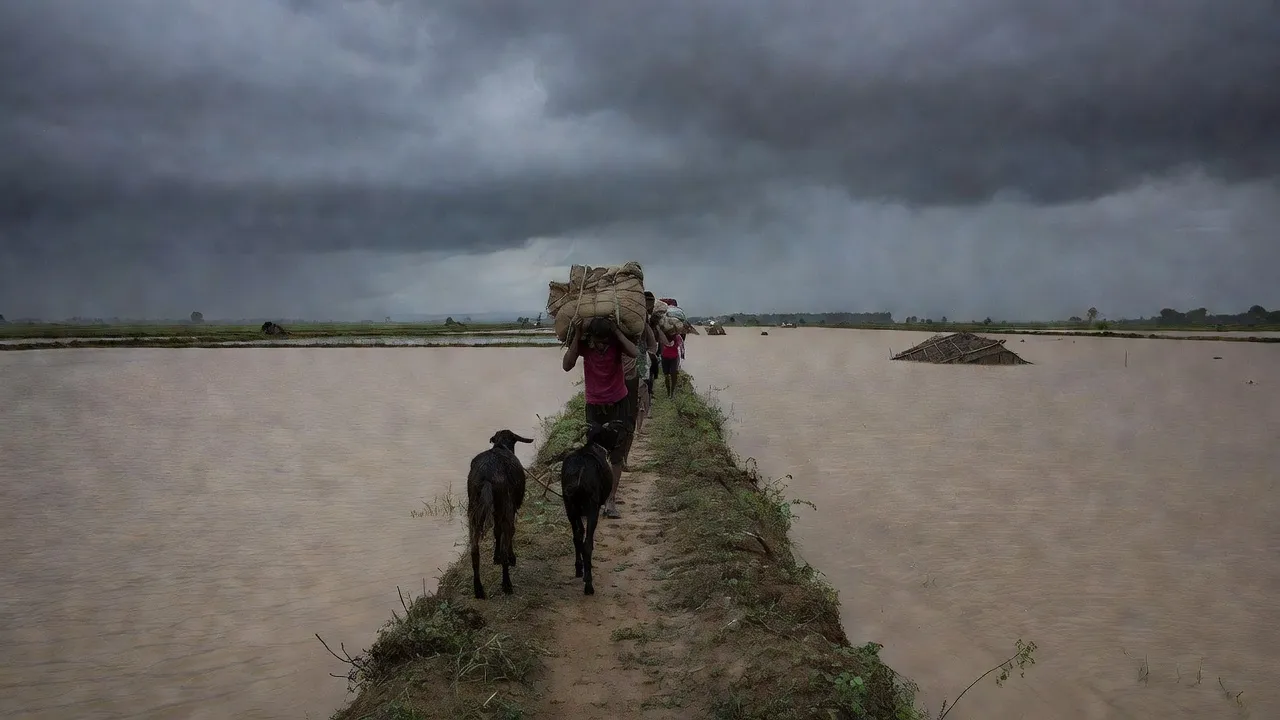
7 perspectives, each in the voice of that country's press.
Kuala Lumpur is assessing this new toll in light of an unresolved drama: 55 Malaysians remain missing since the Nepalese floods of August 26, a month later.
2 sources
Kathmandu is first tallying the economic toll of the relentless rains: over 1,000 megawatts of power cut, telecommunications at a standstill, and vegetable prices soaring in the valley, as relief efforts count their dead district by district.
4 sources
Canberra is primarily concerned with the fate of its 34 nationals still missing in Nepal, a month after the floods of August 26, as new torrential rains hit India and Nepal.
2 sources
Paris is deciphering the meteorological mechanism behind these rains, which are nine times higher than normal, by mobilizing the expertise of a CNRS researcher to explain the meeting of two disturbances between the Bay of Bengal and the westerly flow.
2 sources
New Delhi is assessing a situation that is worsening in Uttar Pradesh while keeping a close eye on its neighboring Nepal, which is still recovering from the August floods.
3 sources
Islamabad is first considering the human toll of the floods in India and Nepal, a count of the dead and missing that reminds Pakistanis of their own trauma from the 2022 monsoon.

3 sources
Doha is first calculating the economic cost of these new floods for Nepal, where tourism, a pillar supporting more than 1 million jobs, is experiencing a new wave of cancellations a month after the August flooding.
2 sources
Common ground and differences in coverage across the media analysed.
Heavy rains have caused deadly floods and landslides in India (Uttar Pradesh) and Nepal, with authorities reporting the toll on Sunday, September 27, 2026.
This new disaster comes about a month after the August 26 floods in Nepal, which killed more than 1,450 people and left thousands missing.
Should the narrative follow the fate of nationals still missing since the August floods, or the aggregate toll of the new rains in late September in India and Nepal?
Should Nepal's coverage prioritize the economic consequences (tourism, energy, food prices) of the floods, or the count of deaths and missing persons?
Coverage aligned with this reading
Coverage that diverges
This grouping describes the publications analysed, not the position of these countries’ populations or of their governments.
DOMINANT ANGLE
Kuala Lumpur is assessing this new toll in light of an unresolved drama: 55 Malaysians remain missing since the Nepalese floods of August 26, a month later.
KEY POINTS
ANALYSIS
Kuala Lumpur, September 28, 2026. The latest toll from the floods in India and Nepal, where at least 70 people died on Sunday, resonates in Malaysia as a painful reminder: a month after the landslides and glacial floods on August 26 in Nepal, which killed over 1,450 people, 55 Malaysians remain missing. On September 27, over a hundred relatives gathered for nearly four hours at Wisma Putra, the headquarters of the Ministry of Foreign Affairs in Putrajaya, for a new information session with the Royal Police (PDRM), the Department of Social Welfare, the National Disaster Management Agency (NADMA), and the Department of Chemistry, in charge of DNA analysis.
The spokesperson for Malaysia Solidarity: Families in Hope (MASFIH), Dr. Manivannan Rethinam, indicated that the Nepalese authorities are now considering ending search and rescue operations (SAR) to move on to a body recovery phase. The families, he said, "are starting to accept all possibilities" after 33 days without news. The Malaysian government had requested to extend the search perimeter in the Rasuwagadhi area, on the Tibetan border, to Syabrubesi; Nepal only authorized the Malaysian SMART team to search areas C and D, between Timure and Syabrubesi, excluding Rasuwagadhi, a sector considered the most likely by the families.
Beyond the anguish of waiting, the relatives are now demanding a special financial moratorium from Prime Minister Anwar Ibrahim, covering the commitments of the 55 missing people, several of whom were the main breadwinners of their households: frozen bank accounts, suspended insurance, ongoing loans. A measure deemed necessary "to help families cope until the death certificates are issued." Among the testimonies collected, that of a son, S. Sankara, who lost his mother K. Kalaimathi, who had gone to Nepal for a religious ritual, or that of Adura Masood, who still has no news of her husband, Dr. Mohd Padzil Daros.
The Malaysian press does not link this case to the new torrential rains reported in India and in the Nepalese districts of Manang, Mustang, or Baglung: it remains focused on the fate of its own citizens, a month after a tragedy that Kuala Lumpur has yet to close.
DOMINANT ANGLE
Kathmandu is first tallying the economic toll of the relentless rains: over 1,000 megawatts of power cut, telecommunications at a standstill, and vegetable prices soaring in the valley, as relief efforts count their dead district by district.
KEY POINTS
ANALYSIS
Katmandou, 28 September 2026. Four days of uninterrupted rain since Thursday, 24 September, have transformed the late monsoon into a multiform crisis, and the Nepalese press is devoting almost as much space to the economic bill as to the human toll. According to the National Authority for Disaster Risk Management, cited on Sunday, 27 September, by the Kathmandu Post, at least 12 people have died in the floods and landslides, seven others are still missing, and more than 1,100 people have been evacuated. The office of Prime Minister Balendra Shah reports a broader toll since 24 September: 21 dead and five missing across eleven districts, including Myagdi, Baglung, Dolpa, and Kavre, with 439 incidents recorded nationwide. In Myagdi and Baglung, local updates report separate tolls: six dead and three missing in a landslide in Myagdi, five dead in the same family in Baglung.
But it's the infrastructure aspect that structures the coverage. The Prime Minister has reported a cut of 1,013.2 megawatts of hydroelectric production, caused by damage to the transmission lines of the Kaligandaki, Marsyangdi, and Seti-Madi corridors. Nepal Telecom has announced, since 24 September, disruptions "in several regions of the country", damaged fibre optic cables, and weakened solar sites due to snow and clouds, apologizing to its customers. The Kaligandaki corridor alone has 46 landslide points between Maldhunga and Korala, cutting off transport to Mustang.
DOMINANT ANGLE
Canberra is primarily concerned with the fate of its 34 nationals still missing in Nepal, a month after the floods of August 26, as new torrential rains hit India and Nepal.
KEY POINTS
ANALYSIS
Canberra, September 28, 2026. A month after the flash floods that ravaged the Nepal-Tibet border, Australia still has 34 of its nationals among the thousands of people missing, as new torrential rains hit India and Nepal this weekend.
In Newcastle, Bhavin Patel refuses to give up hope of finding his wife, Reshma Patel, who went missing on August 26 during a two-week pilgrimage to Mount Kailash and Lake Mansarovar in the Himalayas. She had chosen to make the journey on foot rather than by helicopter, "before getting too old", while her husband stayed home with their two children. A torrent swept through the region that day. A month later, the Nepalese toll exceeds 1,400 dead and more than 5,500 people remain unaccounted for, including Mrs. Patel and 33 other Australians. "I still have hope," says Mr. Patel, who says he wants to return to the scene as soon as possible to continue the search. "I will never give up hope that she is somewhere safe, waiting."
Mr. Patel says he has received daily updates from the Australian government, before they stopped. The Department of Foreign Affairs and Trade (DFAT) says it has "serious concerns" for the 34 Australians still missing and acknowledges that it is "a deeply trying time for families and loved ones".
This tragedy has resurfaced as new bad weather hits the region: at least 62 dead in Uttar Pradesh after three days of torrential rains, with 46 injured and more than 1,000 houses damaged. Schools have remained closed in Lucknow. In neighboring Odisha, 75,000 people have been evacuated. In Nepal, 21 additional deaths have been recorded between Thursday and Sunday, five people are still missing, and 194 houses have been damaged by floods and landslides - a new shock for a country that has not finished counting its August dead. The authorities in Uttar Pradesh have advised residents to avoid unnecessary travel in flooded areas and to stay away from swollen rivers. According to Atul Kumar Singh, a scientist at the Regional Meteorological Center in Lucknow, the depression system formed over the Bay of Bengal is expected to weaken, even if light rains could still hit the east and west of the state in the coming days.
DOMINANT ANGLE
Paris is deciphering the meteorological mechanism behind these rains, which are nine times higher than normal, by mobilizing the expertise of a CNRS researcher to explain the meeting of two disturbances between the Bay of Bengal and the westerly flow.
KEY POINTS
ANALYSIS
Paris, Monday, September 28, 2026. The French press details, with figures, the exceptional extent of the rains that have hit India and Nepal since Friday. According to the reports released Sunday by the authorities of the two countries, at least 56 people have died in three days in the Indian state of Uttar Pradesh, and 12 to 14 others in neighboring Nepal, according to sources, bringing the total to at least 68 dead. In Uttar Pradesh, a state of more than 240 million inhabitants accustomed to the monsoon between June and September, 66.5 millimeters of rain fell between Friday and Sunday, compared to a seasonal average of 7.6 millimeters, or nearly nine times more. More than a thousand homes have been damaged.
In Nepal, already dealing with the consequences of the August 26 catastrophe, according to RFI, the spokesperson for the national disaster management authority, Shanti Mahat, told AFP that seven people have been missing since Thursday. In the Indian state of Odisha, more than 70,000 people living in low-lying areas have been evacuated after the rivers overflowed, reports Sud Ouest, citing the Indian channel NDTV; bridges have been damaged and the Devkund tourist site closed.
What distinguishes the French treatment is the scientific explanation of the phenomenon: RFI interviewed Fabio D'Andrea, research director at the CNRS and director of the geosciences department at the ENS-PSL, who details the meeting of two meteorological systems, a depression born over the Bay of Bengal, rising inland, and a disturbance coming from the West. This conjunction, according to him, has intensified precipitation throughout the Himalayan region.
DOMINANT ANGLE
New Delhi is assessing a situation that is worsening in Uttar Pradesh while keeping a close eye on its neighboring Nepal, which is still recovering from the August floods.
KEY POINTS
ANALYSIS
New Delhi, September 28, 2026. The Indian press is drawing up a balance sheet that is worsening by the hour: at least 56 dead and 46 injured in Uttar Pradesh, where more than 1,000 homes have been damaged by rains of unprecedented intensity. The state's relief commissioner, Hrishikesh Bhaskar Yashod, specified on Sunday that the region had received 66.5 millimeters of rain between September 25 and the morning of September 27, compared to 7.6 millimeters usually recorded during the same period, an excess of 775%. Fifty-six of the state's seventy-five districts have recorded above-normal precipitation, with Farrukhabad reaching 7,385% above seasonal averages.
Sitapur has suffered the heaviest toll, with seven dead, followed by Lakhimpur Kheri, Bahraich, and Balrampur, with five each. The commissioner met with district magistrates from the affected areas on Sunday, asking them to remain on the ground and maintain direct contact with those affected, without neglecting relief operations.
At the national level, the Central Water Commission is reporting a serious situation at thirty measurement stations across seven states: several major rivers, including the Ganges, Gandak, and Kosi, have exceeded their alert levels. Authorities have been tasked with assessing damage to crops for compensation purposes.
DOMINANT ANGLE
Islamabad is first considering the human toll of the floods in India and Nepal, a count of the dead and missing that reminds Pakistanis of their own trauma from the 2022 monsoon.

KEY POINTS
ANALYSIS
Islamabad, September 28, 2026. Not a word in the Pakistani press about the floods hitting India and Nepal escapes the parallel with 2022, when a third of Pakistani territory was underwater. Business Recorder, ARY News, and Geo News on Sunday reported the same toll released by the authorities: at least 56 dead in India and 14 in Nepal, where 11 people remain missing.
In Uttar Pradesh, 46 people were injured and over 1,000 houses damaged, according to Relief Commissioner Hrishikesh Bhaskar Yashod, who noted that 66.5 millimeters of rain fell between September 25 and the morning of September 27, compared to the usual 7.6 millimeters for this period. Local authorities have been instructed to assess crop damage and prepare compensation, while relief operations continue in the flooded areas.
Nepalese authorities have warned of a risk of sudden floods in 49 of the country's 77 districts. The power is out in the districts of Manang, Mustang, Myagdi, and Baglung, and the flood of the Rahuganga River damaged the structure and pylons of a 40-megawatt hydroelectric plant, according to Water and Energy Minister Biraj Bhakta Shrestha.
The spokesperson for Nepal's disaster management authority, Shanti Mahat, specified that Rasuwa and Nuwakot -- which were hit last month by floods that killed over 1,450 people and left thousands missing -- must remain "on alert" without being classified as high-risk areas. In India, the Central Water Commission reported a "grave situation" at 30 monitoring stations across seven states, with several major rivers, including the Ganges, exceeding their alert levels.
DOMINANT ANGLE
Doha is first calculating the economic cost of these new floods for Nepal, where tourism, a pillar supporting more than 1 million jobs, is experiencing a new wave of cancellations a month after the August flooding.
KEY POINTS
ANALYSIS
Doha, September 28, 2026. Barely a month after the floods that killed more than 1,450 people in Nepal, new torrential rains are hitting India and the Nepalese Himalayas, and the Qatari press first retains the price paid by an economy already on its knees. According to the office of the relief commissioner cited by Gulf Times, at least 56 people have died in three days in the Indian state of Uttar Pradesh, under "exceptionally heavy rain that has affected much of Uttar Pradesh". In Nepal, Al Jazeera reports a new toll of 14 dead and 11 missing, with the Chitwan district being the most affected, while 49 of the 77 districts in the country remain on alert for sudden floods.
But it's the tourism industry, a pillar of the Nepalese economy, that the Qatari channel puts at the center of its report. In Kathmandu, Pushpraj Rimal, a tour organizer and taxi driver, describes a disastrous season: "It is still a lockdown kind of situation", he confides to Al Jazeera, nearly a month after the August disaster. The sector accounts for nearly 8% of Nepal's gross domestic product and supports more than a million people; it had welcomed 1.15 million visitors last year, with nearly a third of them during the peak season from September to November, which is now opening with a series of cancellations.
Al Jazeera also recalls that the Nepalese leader had described the August floods as a "warning to the world", and that more than 500 Nepalese children had been left orphaned after the disaster. The Qatari channel thus links the two catastrophes: the one in August, which destroyed essential roads, and the one in September, which immediately closes the window of recovery that the entire tourism industry was counting on.
Explore every perspective on this subject across 7 countries.
Compare viewpoints and see where they diverge.
published on
countries
sources
articles
The reports released on Sunday, September 27, by India and Nepal reflect very different national perspectives: a scientific explanation of the phenomenon in France, a count of economic losses in Kathmandu, and a search for missing foreigners in Australia and Malaysia, one month after the August 26 disaster.
Rescue teams continue searching in Nepal and India while remaining vigilant in the face of the risk of new sudden floods.
These rains result from the meeting between a depression born over the Bay of Bengal, which moved inland, and a disturbance coming from the West, explains Fabio D'Andrea, research director at the CNRS and director of the geosciences department at ENS-PSL, to RFI. This conjunction intensified precipitation across the entire Himalayan region.
In Uttar Pradesh, fifty-six of the state's seventy-five districts received above-normal precipitation, according to the Free Press Journal, which reports a 7,385% surplus in Farrukhabad. Sitapur has the highest local toll, with seven deaths, followed by Lakhimpur Kheri, Bahraich, and Balrampur, each with five.
The state relief commissioner met with district magistrates from the affected areas on Sunday to ask them to stay on the ground, reports the Free Press Journal. In Lucknow, schools remained closed, notes PerthNow, which cites a scientist from the Regional Meteorological Centre predicting a weakening of the depression system in the coming days.
The office of Nepalese Prime Minister Balendra Shah has reported 439 incidents across the country since Thursday, September 24, with damage to the transmission lines of the Kaligandaki, Marsyangdi, and Seti-Madi hydroelectric corridors, according to Nepal News.
Nepal Telecom has announced service disruptions in several regions of the country since Thursday, with damaged fiber optic cables, according to Online Khabar. The Kaligandaki corridor alone has 46 landslide points between Maldhunga and Korala, cutting off transportation to Mustang.
In Kathmandu, where the Prithvi, BP, and Madan Bhandari highways are damaged or washed away, vegetable prices have risen, a phenomenon that Ratopati attributes in part to artificial scarcity and speculation on food.
The Nepalese army reports that it rescued 684 people in a single day in Parbat, Myagdi, Baglung, and Jajarkot, including 78 by helicopter. Infrastructure Minister Sunil Lamsal has promised to start reconstruction work on bridges and roads "within a month", according to Nepal News.
A month after the August 26 catastrophe, which killed more than 1,450 people in Nepal, only 1,451 bodies have been found among the more than 5,000 people reported missing, according to the Indian press citing Nepalese authorities.
« I will never give up hope that she is somewhere, safe, waiting. »
In Newcastle, Australia, Bhavin Patel is still waiting for news of his wife Reshma Patel, who disappeared on August 26 during a pilgrimage on foot to Mount Kailash and Lake Mansarovar, reports ABC News Australia. The Australian Department of Foreign Affairs and Trade says it has "serious concerns" for the 34 Australians still reported missing.
In Malaysia, more than a hundred relatives of 55 Malaysians still reported missing gathered on September 27 at Wisma Putra, the headquarters of the Ministry of Foreign Affairs in Putrajaya, for a new information session with the police, social welfare, and disaster management agency, according to The Sun MY.
The spokesperson for the Malaysia Solidarity: Families in Hope association, Manivannan Rethinam, indicates that the Nepalese authorities are considering ending the search operations to move on to a body recovery phase. The families are demanding a financial moratorium from Prime Minister Anwar Ibrahim on the bank accounts and loans of the missing persons.
In Kathmandu, tour operator and taxi driver Pushpraj Rimal describes a disastrous season, a month after the August disaster, according to Al Jazeera.
« This is still a confinement situation. »
The tourism sector accounts for nearly 8% of Nepal's gross domestic product and supports more than a million people; it had hosted 1.15 million visitors the previous year, with nearly a third of them coming during the peak season from September to November, which is currently opening, according to Al Jazeera.
The Chitwan district is the most affected by the new floods, reports Al Jazeera, which recalls that the Nepalese leader had described the August disaster as a "warning to the world" and that more than 500 Nepalese children had been left orphaned.
55 Malaysians remain missing since the floods of August 26, a month after the disaster.
The bad weather cut off the equivalent of 1,303 megawatts of production from the national grid.
Ratopati· outside the analysed corpusMore than 70,000 people from low-lying areas have been evacuated after the river flooding.
An avalanche linked to bad weather has left at least ten Nepalese climbers and guides missing.
BFMTV· outside the analysed corpusIn Katmandou, the valley depends on neighbouring districts and India for its vegetables; with the Prithvi, BP, and Madan Bhandari highways damaged or washed away, food prices have risen, a phenomenon that Ratopati attributes in part to artificial scarcity and speculation. The Nepalese army has announced that it has rescued 684 people in one day in Parbat, Myagdi, Baglung, and Jajarkot, including 78 by helicopter. Infrastructure Minister Sunil Lamsal has promised to open reconstruction work on bridges and roads "within a month", after a meeting with local elected officials on Sunday. The Prime Minister has called for vigilance in the face of a still-present risk and warned against disinformation and speculation during the crisis.
The articles also recall the agricultural damage: Indian farmers are worried about sowing delays for the next season, an economic issue that the French press directly links to the disruption of the monsoon rather than just local relief management. The systematic reminder of the August 26 catastrophe in Nepal, which had already killed many, highlights for the French media a repeated vulnerability of the Himalayan valleys to increasingly intense precipitation, barely a month after the previous deadly episode.
Neighboring Nepal, where 14 people have died and 11 remain missing, is receiving extensive coverage in the Indian press: Nepalese authorities are bracing for sudden new floods in 49 of the country's 77 districts, while a 40-megawatt hydroelectric plant was damaged by the flooding of the Rahuganga River, and power remains cut off in four districts. According to Nepal's disaster management authority, 13,795 people have already been rescued since the start of this episode, a sign of the scale of operations underway on both sides of the border.
The Indian press recalls that this new episode comes just a month after the August floods, which killed more than 1,450 people in Nepal and left over 5,000 missing, a grim toll of which only 1,451 bodies have been recovered to date. This chronological proximity is fueling, in the Indian treatment, a regional reading of the disaster rather than a strictly national account.
For the Pakistani press, which is reproducing these tolls almost word for word from a Reuters dispatch, the focus is primarily on the count of dead, injured, and missing, rather than on the climatic causes or political responsibilities. Pakistan, which is regularly exposed to the same monsoons, sees this as confirmation of a shared regional vulnerability to Himalayan and Ganges floods.
None of the articles in the corpus detail, on the other hand, the government response, either in New Delhi or in Kathmandu, or the extent of the relief efforts deployed in the Indian field, reduced to a brief official statement from the relief commissioner. The Qatari focus, dominated by the prism of Al Jazeera, thus draws a disaster seen through its impact on livelihoods rather than through the public action supposed to respond to it.