Common ground and differences in coverage across the media analysed.
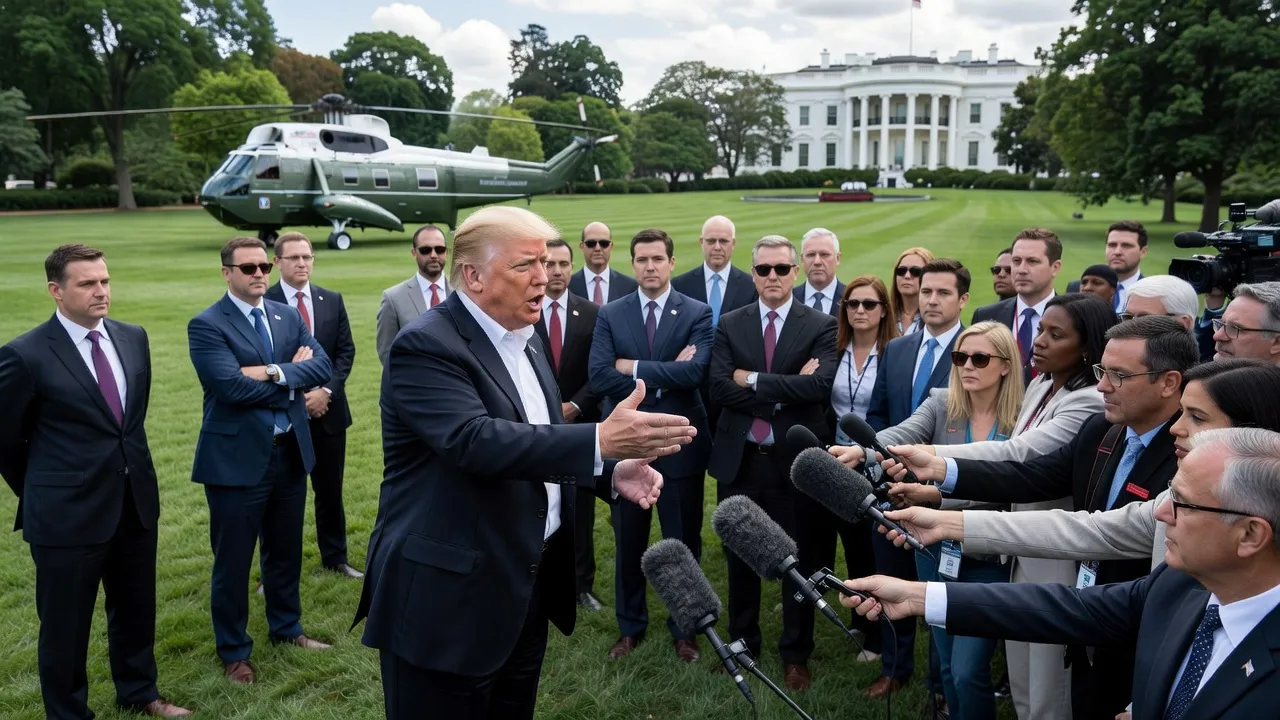
On Saturday, October 10, Donald Trump stated to the press at the White House that it was time for Ukraine to have a new president, or a leader capable of concluding an agreement.
This statement comes on the heels of the announced agreement with Vladimir Putin on Russian diesel, accompanied by a temporary lifting of American sanctions.
Donald Trump blames Volodymyr Zelensky for Ukrainian strikes on Russian refineries, which he links to the rise in diesel prices.
When asked what explains the statement, the press in several countries cites the fuel price and midterm elections; other sources link it to the agreement itself or the duration of Zelensky's term.
When asked if the agreement provides resources for the Russian war, Zelensky, Kaja Kallas, and several sources answer yes; US texts present it as a means to increase fuel supply.
Beyond the 300,000 immediate tonnes, sources give different totals: 1.5 million tonnes by the end of the year (Sweden), one million by December according to Novak (Russia), one million afterwards (Lithuania).
This grouping describes the publications analysed, not the position of these countries’ populations or of their governments.
What the coverage of each country leaves aside, while others put it forward.
Sweden
France
Preview: 3 of 20 media perspectives. Syntheses of the media analysed — not direct quotations. Method & limitations
Buenos Aires sees in Trump's outburst against Zelensky the consolidation of a rapprochement with Moscow, sealed by the agreement on Russian diesel and criticized by Europeans.
2 sources · View sources
Canberra is interpreting the episode as a fuel dispute: the Australian press is linking Trump's call to the new Ukrainian president to the surge in American diesel prices and the midterm elections.
5 sources · View sources
Brasília sees Trump's outburst against Zelensky as a campaign gesture: with the midterm elections approaching, the high cost of diesel is being blamed on Kiev rather than on the war waged by the United States in Iran.
2 sources · View sources
DOMINANT ANGLE
Buenos Aires sees in Trump's outburst against Zelensky the consolidation of a rapprochement with Moscow, sealed by the agreement on Russian diesel and criticized by Europeans.
ANALYSIS
Buenos Aires, October 11, 2026.
DOMINANT ANGLE
Canberra is interpreting the episode as a fuel dispute: the Australian press is linking Trump's call to the new Ukrainian president to the surge in American diesel prices and the midterm elections.
ANALYSIS
Sydney, October 11, 2026.
DOMINANT ANGLE
Brasília sees Trump's outburst against Zelensky as a campaign gesture: with the midterm elections approaching, the high cost of diesel is being blamed on Kiev rather than on the war waged by the United States in Iran.
ANALYSIS
Brasília, October 11, 2026.
DOMINANT ANGLE
Santiago is deciphering Trump's attack on Zelensky through the prism of diesel: Russian refineries hit, global prices under tension and American farmers invoked.
ANALYSIS
Santiago, October 11, 2026.
DOMINANT ANGLE
Berlin sees Trump's call to replace Zelensky as an electoral calculation linked to energy prices, recalling that the war comes from Russia and that the federal government is maintaining its sanctions.
ANALYSIS
Berlin, October 11, 2026.
DOMINANT ANGLE
Madrid is deciphering an open rift between Washington and Kiev: by calling for "a new president" for Ukraine, Trump would make Zelensky pay for his criticism of the deal on Russian diesel.
ANALYSIS
Madrid, October 11, 2026.
DOMINANT ANGLE
Paris is deciphering a head-on rupture between the White House and Kiev, where Trump's call to change the Ukrainian president, on the heels of the agreement on Russian diesel, is rallying European ranks around Zelensky.
ANALYSIS
Paris, October 11, 2026.
DOMINANT ANGLE
Budapest interprets Trump's attack on Zelensky through the lens of oil: Russian diesel, the price surge linked to Hormuz, and the midterms on November 3 take precedence over the issue of the Ukrainian president's legitimacy.
ANALYSIS
Budapest, October 11, 2026.
DOMINANT ANGLE
Rome is witnessing an unprecedented rift: the Italian press sees the "siluramento" of Zelensky by Trump as the turning point between Washington and Kiev, following the diesel deal with Putin.
ANALYSIS
Rome, October 11, 2026.
DOMINANT ANGLE
Vilnius sees the agreement on Russian diesel as additional financing for Moscow's war, and reports Trump's call to a new Ukrainian president as its direct follow-up.
ANALYSIS
Vilnius, October 11, 2026.
DOMINANT ANGLE
Mexico City mainly retains the diesel argument: Trump demands a new Ukrainian president, reproaching Kiev for strikes on Russian refineries that weigh on global prices.
ANALYSIS
Mexico, October 11, 2026.
DOMINANT ANGLE
Abuja is framing Trump's statement as a gas pump issue: the Nigerian press is focusing on diesel, American farmers, and the midterm campaign more than Zelensky's fate.
ANALYSIS
Abuja, October 11, 2026.
DOMINANT ANGLE
Islamabad takes away from the episode the price of diesel: the Pakistani press presents Trump's call to replace Zelensky as a dispute born of the agreement on Russian fuel and its effects on the Republican campaign.
ANALYSIS
Islamabad, October 11, 2026.
DOMINANT ANGLE
Lisbon is deciphering Trump's outburst against Zelensky through the price of diesel fuel: the Portuguese press is linking the call for a "new president" to the deal with Putin and the pressure on fuels.
ANALYSIS
Lisbon, October 11, 2026.
DOMINANT ANGLE
Moscow interprets Trump's statement as a challenge to Zelensky's legitimacy, which RT links to a "mandate expiring in 2024" and to martial law.
ANALYSIS
Moscow, October 11, 2026.
DOMINANT ANGLE
Stockholm is relaying Trump's attack on Zelensky as a brutal turning point, linking it to the agreement on Russian diesel announced the day before with Putin.
ANALYSIS
Stockholm, October 11, 2026.
DOMINANT ANGLE
Dakar is relaying the apparent rift between Washington and Kyiv: the Senegalese press is picking up on Trump's demand for a "new president" in Ukraine, backed by the agreement on Russian diesel.
ANALYSIS
Dakar, October 11, 2026.
DOMINANT ANGLE
Kyiv sees Trump's call for a "new president" as the direct consequence of the diesel agreement reached with Putin, and responds by defending its position against Washington.
ANALYSIS
Kyiv, October 11, 2026.
DOMINANT ANGLE
London sees Trump's outburst against Zelensky as posturing: expensive diesel, the Strait of Hormuz closed, and Russian refineries hit explain the call for a "new president".
ANALYSIS
London, 11 October 2026.
DOMINANT ANGLE
The United States government is taking a hardline stance: Fox News, Axios, and The Hill report that Trump is demanding Kyiv stop strikes on Russian refineries and is calling for a "new president", citing the needs of diesel and American farmers.
ANALYSIS
Washington, October 11, 2026.
Explore every perspective on this subject across 20 countries.
Compare viewpoints and see where they diverge.
published on
countries
sources
articles
gap
Behind Donald Trump's statement, the media are reconstructing a sequence: talks in Miami on October 9, American demands to stop the strikes, an agreement whose volumes vary according to the sources, here is what the perspectives add to the summary.
Trump's call to replace Zelensky is not followed by any formal action; the diesel agreement is in effect, its restrictions being suspended until April 7.
According to Axios, a US official claims that Donald Trump concluded the agreement after Volodymyr Zelensky ignored half a dozen American requests to stop striking Russian refineries. Expressen, which also cites Axios, writes that Zelensky would have proposed to stop if Russia ceased targeting Ukrainian power plants.
Talks took place on October 9 in Miami between a Ukrainian delegation, Steve Witkoff, and Jared Kushner, according to Meduza. The FAZ reports, according to Axios and an anonymous Ukrainian negotiator, that they ended earlier than expected. According to these sources, the American emissaries mentioned a cut in American intelligence if the strikes continued.
Le Monde adds, according to the New York Times, that Witkoff and Kushner had proposed to Moscow in September three economic incentives for a partial ceasefire, including the unblocking of frozen Russian assets. The 444 website explains on its part that the Ukrainian strikes aim to prevent Moscow from exporting diesel and financing the war, to the point that Russia briefly became an importer.
The media do not all report the same volume beyond the initial deliveries. According to Verslo žinios, Trump wrote on Truth Social that Russia would deliver more than 300,000 tonnes without delay, then 500,000 tonnes in November and 1 million tonnes afterwards. Expressen mentions 1.5 million additional tonnes by the end of the year. RT cites Vice Premier Alexander Novak, who says exports could reach 1 million tonnes by December. Kyiv Post talks about more than 1 million tonnes until 2027.
Meduza specifies that the US Treasury issued a temporary license valid until April 7, 2027. The ABC recalls that the agreement comes despite sanctions signed against Moscow the previous month, and The Independent sees questions about these sanctions. The Age emphasizes that it is not certain that Putin can keep his part, as Russia is struggling to feed its own economy.
On the market, the BBC writes that the war against Iran has led to the effective closure of the Strait of Hormuz, through which about a fifth of the world's petroleum products pass. Telex notes that the G7 announced in early October the release of 100 million barrels from strategic reserves. 444 notes that diesel costs twice as much as it did in January 2025 in the United States.
Zelensky described the agreement as a "birthday gift for Putin," according to Axios and Ukrainska Pravda, and as "neither just nor honest," according to 444. He also said that the Ukrainian delegation had served as a "cover" for discussions between Trump and Putin; Verslo žinios translates the same word as "screen". For the strike on Zaporizhia, Geo News and G1 report 20 deaths, including three children, SBS at least 21 deaths, including four children: the tolls cited vary depending on the media.
« Today, Russia said thank you for the lifting of sanctions on diesel exports by dropping five glide bombs on residential buildings in Zaporizhzhia. »
On the Russian side, Ukrainska Pravda relays Yury Ushakov, an advisor to Putin: during the call with Trump, the Russian president ruled out peace talks and said that Russia would continue its operations until it achieves "all its objectives". RT writes that Zelensky's mandate "expired in 2024" and that he remains in power by invoking martial law. The FAZ specifies that a change in the head of state is not possible at the moment, as the Ukrainian Constitution prohibits elections during wartime.
In Europe, Czech Prime Minister Andrej Babis considers the Trump-Putin agreement "a slap in the face for Europe" and says he understands that Trump is "on the eve of elections," according to Index. The FAZ indicates that the German government is maintaining its sanctions against Russia. ANSA mentions "furious" criticism from Kiev and Brussels against the agreement.
In the analysis of the 20 national corpora, twelve link the statement to the price of diesel, the strikes on refineries, and the midterm elections of November 3. Six others (Ukraine, Lithuania, Sweden, Spain, Italy, France) highlight the rift between Washington and Kiev and the reactions to the agreement. This count measures what the media included in the corpus emphasize, not the opinion of their readers, and these two angles answer different questions. The Swedish and Lithuanian excerpts do not mention the midterm elections.
Several media outlets correct or complete Trump's statements. Punch points out that Trump puts the loss of Ukrainian territory at 30%, while independent estimates place the area under Russian control at around 20%, and that reliable human tolls are lacking for the two million deaths he mentions. The Tagesschau notes that he said nothing about Russian attacks on civilians and recalls that the war was triggered by Russia.
On tone, ANSA speaks of "unprecedented verbal violence". Axios sees it as the most serious crisis between the two men since their meeting in February 2025.
The restrictions on Russian diesel are suspended until April 7, according to Fox News and the BBC.
Kaja Kallas writes that Europe will not ease the pressure; Andy Burnham expresses his "complete solidarity" with Zelensky.
The US midterm elections are being held on November 3, in a context of rising fuel prices.
More divergent than 63% of recent comparable stories (reference: 90 recent stories measured with the same method).