7 perspectives, each in the voice of that country's press.
Dhaka gauges the sale of F-35s in light of the war Riyadh is already waging on two fronts, against Iran and the Houthis, more than in terms of the qualitative military advantage Washington is supposed to guarantee Israel.
2 sources
Brasilia links the sale to the regional crisis: the press connects the American authorization to the renewed war against the Houthis and to the Israeli-Greek naval exercises targeting Turkey, an ally of Riyadh.
2 sources
Israel demands that Washington preserve its qualitative military edge before delivering any F-35s to Saudi Arabia
2 sources
Islamabad gauges the sale of F-35s in light of the war Riyadh is waging against the Houthis in Yemen, where the Saudi call for direct military aid from Washington carries as much weight as the arms contract itself.
3 sources
Riyadhh is celebrating in this sale less an arms contract than proof, after years of waiting, of the regained solidity of the strategic partnership with Washington.
2 sources
Singapore views the sale as a test of the qualitative military edge guaranteed to Israel, as well as a risk of the F-35's stealth technology leaking to China.

2 sources
The United States government is backing Riyadh: the State Department has notified Congress of the sale of 48 F-35s for $24.3 billion, fulfilling a 10-month-old presidential promise.
2 sources
Common ground and differences in coverage across the media analysed.
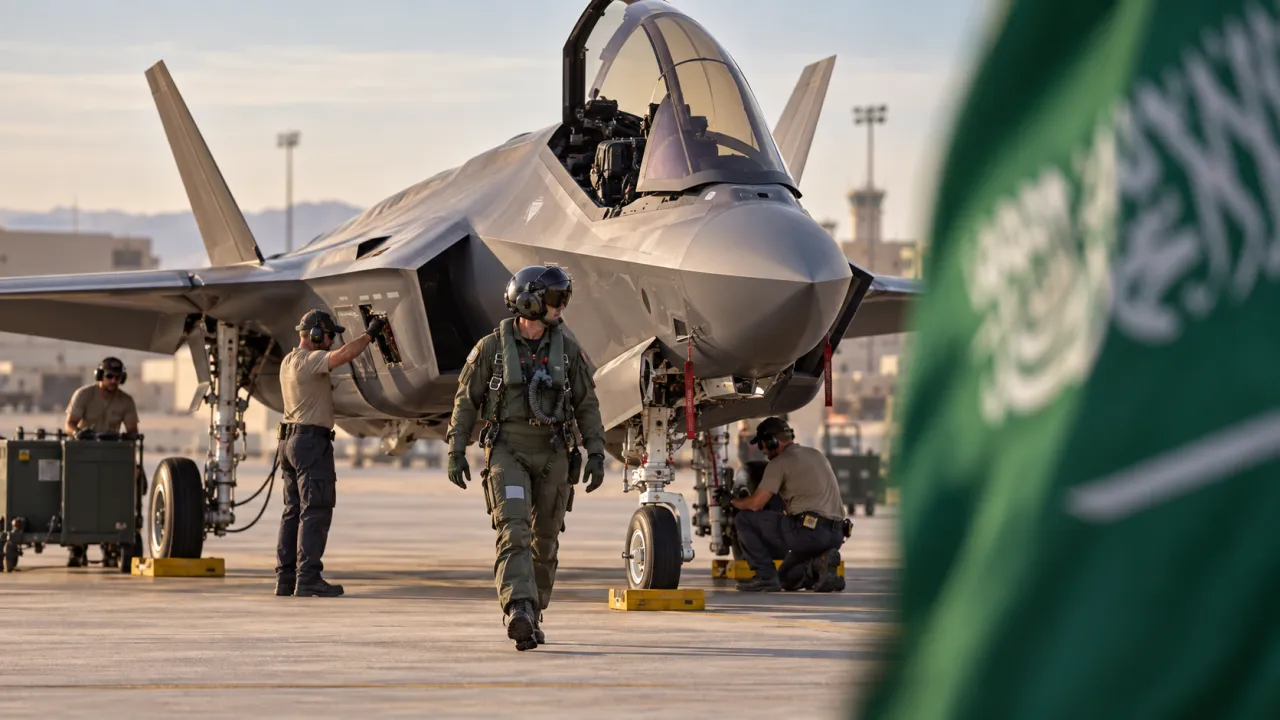
The US State Department approved, on Thursday, September 17, 2026, the potential sale of 48 F-35A aircraft and 49 Pratt & Whitney F135 engines to Saudi Arabia, for an estimated amount of 24.3 billion dollars.
The sale still needs to be reviewed by the US Congress before it can be finalized.
Israel remains the only country in the Middle East to operate the F-35, a status that the US Qualitative Military Edge (QME) law is supposed to protect.
Some perspectives place the approval in the ongoing war against the Houthis and Iran, while others present it primarily as proof of the solidity of the US-Saudi partnership.
Coverage aligned with this reading
Coverage that diverges
The question raised is whether the US guarantee to preserve Israel's qualitative military advance holds up to the sale: some relay the official assurance without challenging it, while others present it as a test or a source of concern.
Coverage aligned with this reading
Coverage that diverges
This grouping describes the publications analysed, not the position of these countries’ populations or of their governments.
DOMINANT ANGLE
Dhaka gauges the sale of F-35s in light of the war Riyadh is already waging on two fronts, against Iran and the Houthis, more than in terms of the qualitative military advantage Washington is supposed to guarantee Israel.
KEY POINTS
ANALYSIS
Dhaka, Friday, September 18, 2026. The Bangladeshi press, relaying international dispatches, reports that the US State Department approved the potential sale of 48 stealth F-35A fighter jets from Lockheed Martin to Saudi Arabia on Thursday, September 17, for an estimated amount of $24.3 billion. The contract also includes 49 Pratt & Whitney F135 engines, communication equipment, spare parts, and logistical support, the State Department specified, as cited by TBS News. The sale must still be reviewed by the US Congress before any delivery, which would be the first of its kind to the Saudi kingdom.
The two titles consulted in Dhaka, The Daily Star and TBS News, place the announcement in the context of the war that Riyadh is facing on several fronts. The Daily Star recalls that Saudi Arabia has been the repeated target of drone and missile strikes from Iran since Washington and Israel went to war against Tehran in February, and that it is also suffering attacks from Houthi rebels, supported by Iran, whose civil war in Yemen has flared up again in July. The Houthis have since declared a maritime blockade of the kingdom and targeted its ships in the Red Sea, a context that the dispatch presents as the backdrop for this arms purchase.
TBS News emphasizes another point: the sale would test the definition that Washington gives to maintaining the "qualitative military edge" of its Israeli ally, the only country in the region already operating the F-35. The Saudi embassy in Washington welcomed the operation on X, presenting it as a reflection of "the strength and durable nature" of the strategic partnership with the United States. The State Department, for its part, asserts that the sale will strengthen Riyadh's ability to deter threats without altering the regional military balance.
Neither article develops the fear, reported elsewhere, of Chinese access to the stealth technology of the aircraft via Riyadh's partnerships with Beijing: an angle absent from the two Bangladeshi dispatches, focused on the face-off with Iran and the Houthis rather than the technological dimension of the transfer.
DOMINANT ANGLE
Brasilia links the sale to the regional crisis: the press connects the American authorization to the renewed war against the Houthis and to the Israeli-Greek naval exercises targeting Turkey, an ally of Riyadh.
KEY POINTS
ANALYSIS
Brasília, September 18, 2026. The Brazilian press sees the US authorization to sell 48 F-35s to Saudi Arabia as a signal sent to the Middle East in the midst of recomposition, rather than just a simple arms transaction. According to the US Department of State, cited by the Jornal de Brasília via AFP, the sale involves 48 F-35A stealth fighter jets, accompanied by 49 Pratt & Whitney F135 engines, for an estimated amount of $24.3 billion (approximately 125 billion reais). The agreement still needs to pass Congress, which has now been notified.
Washington justifies the sale by stating that it "will improve Saudi Arabia's ability to deter current and future threats," by strengthening "the defense of its territory" and "interoperability with US forces." The State Department also notes that it "will increase the number of operational aircraft" in the kingdom and consolidate its air-to-air and air-to-ground self-defense capabilities.
The newspaper recalls that the announcement was made by Donald Trump in November, during the visit to Washington by Crown Prince Mohammed bin Salman, but that the authorization only comes now, "at a time of crisis for the Saudi kingdom." Riyadh had been demanding a fifth-generation aircraft for years, until now having a mixed fleet of American and European aircraft. In the region, only Israel operates F-35s — with, as Folha highlights, more real combat experience than the Americans themselves; its officials have expressed their reservations to Washington.
DOMINANT ANGLE
Israel demands that Washington preserve its qualitative military edge before delivering any F-35s to Saudi Arabia
KEY POINTS
ANALYSIS
Jérusalem, Friday, September 18, 2026. The US State Department approved on Thursday the potential sale of 48 F-35A Lightning II stealth fighter jets and 49 Pratt & Whitney F135 engines to Saudi Arabia, for an estimated $24.3 billion. The transaction, which includes equipment, training, and support, is not yet a final contract: it still needs to pass review by the US Congress. Washington asserts that this sale will strengthen Riyadh's ability to deter threats against the kingdom and improve interoperability with American, allied, and NATO forces, while ensuring that it "will not alter the military balance in the region".
For Israel, the only country in the Middle East currently operating the F-35, the announcement revives an old concern. According to Haaretz, the office of Prime Minister Benjamin Netanyahu claims that agreements reached with Washington will preserve Israel's advantage. But Israeli defense officials, cited by the same newspaper, fear that the presence of the aircraft in the Saudi air force may expose certain Israeli capabilities. President Donald Trump had confirmed this sale in November 2025, after a meeting with Crown Prince Mohammed bin Salman on the occasion of the signing of a series of diplomatic agreements.
In the Jerusalem Post, expert Jonathan Ruhe, from the Jewish Institute for National Security of America, estimates that the sale should only move forward once two issues are resolved: Saudi Arabia's integration into a US-led regional security architecture, and the preservation of Israel's qualitative military edge (QME), guaranteed by US law since 2008. "The entire F-35 program is designed to support US-led collective defense," he said, adding that "Israel's qualitative advantage is a key factor in this regional integration, and should be reflected in any potential F-35 sale to the kingdom".
DOMINANT ANGLE
Islamabad gauges the sale of F-35s in light of the war Riyadh is waging against the Houthis in Yemen, where the Saudi call for direct military aid from Washington carries as much weight as the arms contract itself.
KEY POINTS
ANALYSIS
Islamabad, September 18, 2026. The Pakistani press is reporting without hesitation the announcement from Washington: on Thursday, September 17, the US Department of State gave the green light to the potential sale of 48 stealth F-35A Lightning II aircraft from Lockheed Martin to Saudi Arabia, for an estimated amount of $24.3 billion. The package includes 49 Pratt & Whitney F135 engines, communication equipment, spare parts, and logistical support, according to the notification sent to Congress. According to The Express Tribune, lawmakers have 30 calendar days to review or oppose the transaction before its finalization.
For Islamabad, the sale is part of the immediate context of the war being waged by Riyadh against the Houthis in Yemen. The Express Tribune recalls that Crown Prince Mohammed bin Salman requested military aid from President Donald Trump last week to combat the Iran-aligned rebels, as they intensify their threats against the Red Sea. Trump has had at least two phone exchanges with the Saudi leader without agreeing to direct US strikes against the Houthis, but promising intelligence sharing and targeting assistance. Business Recorder notes, in the same context, that the Houthis claim to have shot down a Saudi fighter jet.
DOMINANT ANGLE
Riyadhh is celebrating in this sale less an arms contract than proof, after years of waiting, of the regained solidity of the strategic partnership with Washington.
KEY POINTS
ANALYSIS
Riyadh, September 18, 2026. The US State Department approved on Thursday, September 17, the potential sale of 48 F-35 Lightning II stealth fighter jets, built by Lockheed Martin, to Saudi Arabia, for an estimated $24.3 billion, according to a notification sent to Congress. The agreement also includes 49 Pratt & Whitney F135 engines, as well as associated equipment, training, and logistical support. This would be the first delivery of F-35s to the kingdom, which has been requesting them for years: Riyadh had made a direct request to Donald Trump in early 2025, and the US president announced in November 2025 Washington's intention to sell these aircraft to Saudi Arabia.
The Saudi embassy in Washington welcomed the transaction, estimating that it "reflects the strength and enduring nature" of the relationship between the two countries. It added that American-Saudi security cooperation has "contributed to regional stability, strengthened our collective defense capabilities, and advanced our common security interests." The Saudi diplomatic statement thus emphasizes the continuity of a bilateral link, more than the military capabilities themselves.
The State Department justifies the sale by explaining that it would strengthen the kingdom's ability to deter current and future threats, consolidate its territorial defense, and improve interoperability with American and allied forces. Washington specifies that the agreement would increase the Saudi operational fleet and strengthen its air-to-air and air-to-ground capabilities, while ensuring that it would not alter the military balance in the region. Neither the Saudi press consulted nor the official statements relayed mention any potential reservations from other regional capitals regarding this sale.
DOMINANT ANGLE
Singapore views the sale as a test of the qualitative military edge guaranteed to Israel, as well as a risk of the F-35's stealth technology leaking to China.
KEY POINTS
ANALYSIS
Singapour, Friday, September 18, 2026. The US State Department approved on Thursday, September 17, the potential sale of 48 stealth F-35A fighter jets from Lockheed Martin to Saudi Arabia, for an amount estimated by Washington at $24.3 billion, or $30.9 billion Singapore dollars according to the conversion used by the Straits Times. The contract includes 49 Pratt & Whitney F135 engines, communication equipment, spare parts, and logistical support. The US Congress, now notified, must still weigh in; no delivery schedule has been announced.
For the city-state's press, the issue goes beyond a simple arms contract: it is a test of the American doctrine known as "qualitative military edge" for Israel, the only country in the Middle East to have operated the F-35 for over a decade. The Straits Times notes that the sale would mark "a significant policy shift," likely to alter the balance of military forces in the Middle East while putting this American commitment to Tel Aviv to the test. Riyadh, the world's largest customer for American arms, has been demanding the aircraft for years to modernize its air force and counter regional threats, particularly Iranian ones; the kingdom reportedly made a direct request to President Donald Trump in early 2025.
DOMINANT ANGLE
The United States government is backing Riyadh: the State Department has notified Congress of the sale of 48 F-35s for $24.3 billion, fulfilling a 10-month-old presidential promise.
KEY POINTS
ANALYSIS
The United States government, on September 18, 2026, notified Congress on Thursday of its approval for the potential sale of up to 48 stealth F-35A fighter jets to Saudi Arabia, a contract that could reach $24.3 billion. The package, reported by Bloomberg, covers Lockheed Martin aircraft, 49 Pratt & Whitney F135 engines, as well as associated training and logistical support. This would be the very first delivery of F-35s to the Saudi kingdom, a file that Riyadh has been carrying for several years.
Bloomberg recalls that Donald Trump himself announced this sale in November, offering Crown Prince Mohammed bin Salman "a trophy he had long coveted," on the eve of the latter's visit to the White House. The transaction, still subject to Congressional review now officially notified, thus appears as the culmination of a personal presidential commitment rather than a sole bureaucratic logic.
The Hill, which estimates the contract at $24 billion, emphasizes that this approval comes "despite concerns from defense officials and lawmakers," without specifying the nature of these reservations or the names of the concerned elected officials. The Defense & National Security newsletter from the media presents the news as the highlight of the day in Washington's security relations in the Middle East.
Explore every perspective on this subject across 7 countries.
Compare viewpoints and see where they diverge.
published on
countries
sources
articles
This sale fulfills a promise Donald Trump made to Crown Prince Mohammed bin Salman in November 2025, following a direct Saudi request made earlier in 2025, and comes as Riyadh requested US military aid against the Houthis last week, while defense officials in Washington and Jerusalem have expressed reservations.
The agreement is not concluded: this is a notification to Congress, which has 30 days to review or oppose it before any finalization.
Riyadh had been seeking the aircraft for years. According to Bloomberg, Crown Prince Mohammed bin Salman had made a direct request to Donald Trump in early 2025. The US president had announced the sale in November, on the eve of the prince's visit to the White House, offering him, according to Bloomberg, "a trophy he had long coveted".
Wayne Sanders, senior defense analyst for Bloomberg Intelligence, sees the sale as part of an arms relationship built up over years, rather than a sudden strategic shift. The Hill notes that the approval comes despite concerns from US defense officials and lawmakers, without specifying their nature.
According to Haaretz, the office of Prime Minister Benjamin Netanyahu claims that agreements reached with Washington will allow Israel to preserve its military advantage. However, Israeli defense officials, cited by the same newspaper, fear that the presence of the F-35 in the Saudi air force may expose certain Israeli capabilities.
« Israel's qualitative advantage is a key factor in this regional integration, and should be reflected in any potential sale of F-35s to the kingdom. »
In the Jerusalem Post, Jonathan Ruhe, from the American institute JINSA, believes that the sale should only move forward once two issues are resolved: the integration of Saudi Arabia into a regional security architecture led by Washington, and the preservation of Israel's qualitative advantage.
According to The Express Tribune, Mohammed bin Salman requested direct military aid from Donald Trump last week to counter the Houthis, who are escalating their threats in the Red Sea. Trump had at least two phone conversations with the crown prince, refusing to accept that Washington would strike the rebels, but promising to share intelligence and provide targeting assistance.
The Jornal de Brasília links the approval to the relaunched war since July against the Houthis, who have proclaimed a maritime blockade of the kingdom and are threatening the Yanbu oil terminal, Saudi Arabia's backup solution since the blockade of the Strait of Hormuz due to the war between Washington, Israel, and Iran.
La Folha reports that the announcement of the sale comes just after the presidential refusal of direct support. On the same day, according to the newspaper, Israel conducted naval exercises with Greece targeting Turkey, an ally of Riyadh — two episodes that the Brazilian press links to the same reconfiguration of regional alliances.
Channel News Asia links the approval to a precedent: Washington had excluded Turkey, a NATO member, from the F-35 program in 2019, after Ankara purchased a Russian air defense system, due to fear of Moscow gaining access to the aircraft's stealth technology. The channel notes that the same concern has resurfaced around Saudi partnerships deemed close to Beijing.
For Singapore, itself an F-35 operator, control of this technology and the conditions imposed on each new buyer condition, according to the Straits Times, the strategic value of the aircraft for all its users.
According to Bloomberg, this case is also part of a broader movement by the US military-industrial complex: the Pentagon and Lockheed Martin are accelerating in parallel the production of a new classified air-to-air missile intended for US Air Force and US Navy fighters, deemed "vital to deter China".
Lockheed Martin (Fort Worth, Texas) and Pratt & Whitney Military Engines (East Hartford, Connecticut) are the main contractors.
US law has required since 2008 that arms sales to the Middle East preserve Israel's qualitative military edge.
The New York Times reports that US intelligence analysts fear Chinese access to F-35 technology via Riyadh.
The New York Times· outside the analysed corpusThe Houthis claim to have shot down a Saudi F-15 over Yemen's Marib province with a locally made surface-to-air missile.
The Jerusalem Post· outside the analysed corpusThe Brazilian coverage inserts the sale into a context of expanded tension: it comes just after Trump refused to support bin Salman in the conflict reopened since July against the Houthis, who have resumed their offensive on the Yemeni coast of the Red Sea and are threatening the Yanbu oil terminal, Saudi Arabia's alternative since the blockade of the Strait of Hormuz by the US-Iran war. On the same day, notes Folha, Israel conducted naval exercises with Greece targeting Turkey, an ally of Riyadh — two moves that the press sees as part of the same geopolitical recomposition of the Middle East.
The transaction comes as Riyadh remains engaged in the regional conflict, a factor that Haaretz directly links to US approval. For Israel, the question is no longer whether Saudi Arabia will obtain the aircraft, but under what conditions Washington will guarantee that its technological and operational advantage over its neighbors will survive this first regional delivery.
The Department of State justifies the sale by citing the strengthening of "the security of a major non-NATO ally, a factor of political stability and economic progress in the Gulf," and assures that it "will not alter the military balance in the region." The Saudi embassy in Washington welcomed the proposal on X, describing it as a new stage in defense cooperation between the two countries, reflecting "the strength and durability of the Saudi-American strategic partnership."
Pakistani articles also highlight the symbolic significance of the issue: Israel remains the only country in the Middle East to have operated the F-35 for over a decade, built on an American doctrine guaranteeing Tel Aviv a "qualitative military edge" over neighboring Arab states. A sale to Riyadh would therefore test this doctrine, while Saudi Arabia, the world's largest customer for American arms, has been demanding the aircraft for years to modernize its air force.
The notification sent to Congress now opens an examination phase before any final signature; the delivery schedule for the aircraft has not been specified at this stage. For Riyadh, this step marks the culmination of years of negotiations and confirms, in its view, the solidity of the renewed link with Washington after the direct request addressed to Donald Trump in early 2025. The Saudi narrative highlights the continuity of this bilateral cooperation and the modernization of its air capabilities, without detailing the debates it sparks about the regional military balance.
Channel News Asia links this approval to a precedent: Washington had excluded Turkey, a NATO member, from the F-35 program in 2019, after Ankara's purchase of a Russian air defense system raised concerns that Moscow could access the aircraft's stealth technology. The same concern, the channel notes, now resurfaces around Saudi partnerships deemed close to Beijing. The State Department nonetheless assures that the sale "will not alter the military balance in the region" and that it will strengthen Saudi territorial defense as well as interoperability with American forces.
For Singapore, a small state that has itself bet on the F-35 for its air force, the question of control over this stealth technology - and the conditions imposed on each new buyer - is not abstract: it conditions the strategic value of the aircraft for all its operators, including the most discreet ones.
The Saudi file is also, according to Bloomberg, part of a broader movement of the American military-industrial complex: the Pentagon and Lockheed Martin are accelerating in parallel the production of a new classified air-to-air missile intended for US Air Force and US Navy fighters, deemed "vital to deter China." Asked by the channel, Wayne Sanders, senior defense analyst for Bloomberg Intelligence, situates the sale of F-35s to Riyadh in the continuity of an armament relationship built over years, rather than as a sudden strategic shift.
For the United States, this contract, if it passes the Congressional stage, would confirm the F-35 as the cornerstone of American arms sales policy in the Gulf, and would fulfill a presidential promise expected by Riyadh for nearly a year.