
DOMINANT ANGLE
Israel demands that Washington preserve its qualitative military edge before delivering any F-35s to Saudi Arabia
Dominant angle identified — does not reflect unanimity of this country’s media
KEY POINTS
- 01
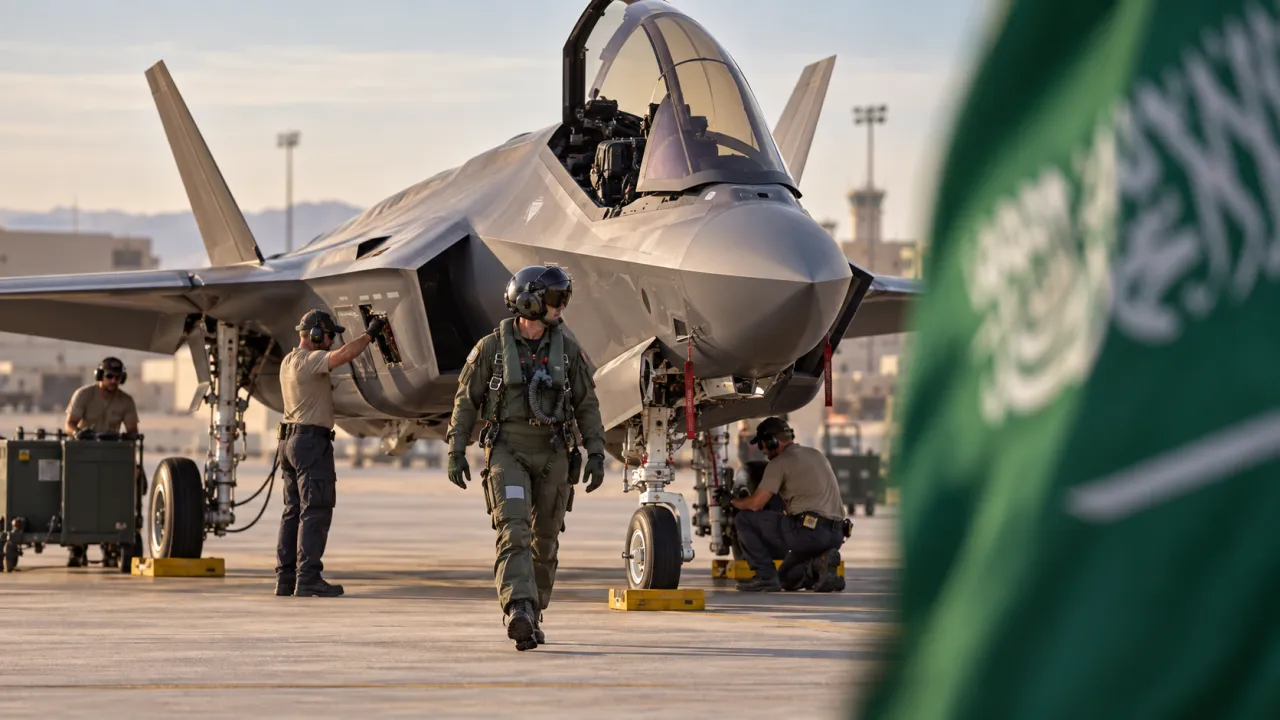
The State Department approved on Thursday, September 17, the possible sale of 48 F-35A jets and 49 Pratt & Whitney F135 engines to Saudi Arabia, for $24.3 billion, subject to Congressional review
- 02
The country is currently the only one in the Middle East operating the F-35
- 03
Netanyahu's office claims agreements with Washington will preserve the Israeli edge, while Israeli defense officials fear exposure of certain Israeli capabilities
ANALYSIS
Jérusalem, Friday, September 18, 2026. The US State Department approved on Thursday the potential sale of 48 F-35A Lightning II stealth fighter jets and 49 Pratt & Whitney F135 engines to Saudi Arabia, for an estimated $24.3 billion. The transaction, which includes equipment, training, and support, is not yet a final contract: it still needs to pass review by the US Congress. Washington asserts that this sale will strengthen Riyadh's ability to deter threats against the kingdom and improve interoperability with American, allied, and NATO forces, while ensuring that it "will not alter the military balance in the region".
For Israel, the only country in the Middle East currently operating the F-35, the announcement revives an old concern. According to Haaretz, the office of Prime Minister Benjamin Netanyahu claims that agreements reached with Washington will preserve Israel's advantage. But Israeli defense officials, cited by the same newspaper, fear that the presence of the aircraft in the Saudi air force may expose certain Israeli capabilities. President Donald Trump had confirmed this sale in November 2025, after a meeting with Crown Prince Mohammed bin Salman on the occasion of the signing of a series of diplomatic agreements.
In the Jerusalem Post, expert Jonathan Ruhe, from the Jewish Institute for National Security of America, estimates that the sale should only move forward once two issues are resolved: Saudi Arabia's integration into a US-led regional security architecture, and the preservation of Israel's qualitative military edge (QME), guaranteed by US law since 2008. "The entire F-35 program is designed to support US-led collective defense," he said, adding that "Israel's qualitative advantage is a key factor in this regional integration, and should be reflected in any potential F-35 sale to the kingdom".
The transaction comes as Riyadh remains engaged in the regional conflict, a factor that Haaretz directly links to US approval. For Israel, the question is no longer whether Saudi Arabia will obtain the aircraft, but under what conditions Washington will guarantee that its technological and operational advantage over its neighbors will survive this first regional delivery.