
DOMINANT ANGLE
Paris sees, in this sale of F-35s to Saudi Arabia, less of an arms contract and more of a potential technological breach towards Beijing, coupled with a risk to Israel's military advantage.
Dominant angle identified — does not reflect unanimity of this country’s media
KEY POINTS
- 01
The contract covers 48 F-35A aircraft and 49 Pratt & Whitney F135 engines, estimated at $24.3 billion, subject to Congressional review for 30 days.
- 02
US intelligence analysts, cited by the New York Times, fear that China may gain access to the F-35's stealth technology through its partnerships with Riyadh.
- 03
Israel, the only Middle Eastern country to operate the F-35, had expressed strong reservations; the State Department asserts that the sale will not alter the regional military balance.
ANALYSIS
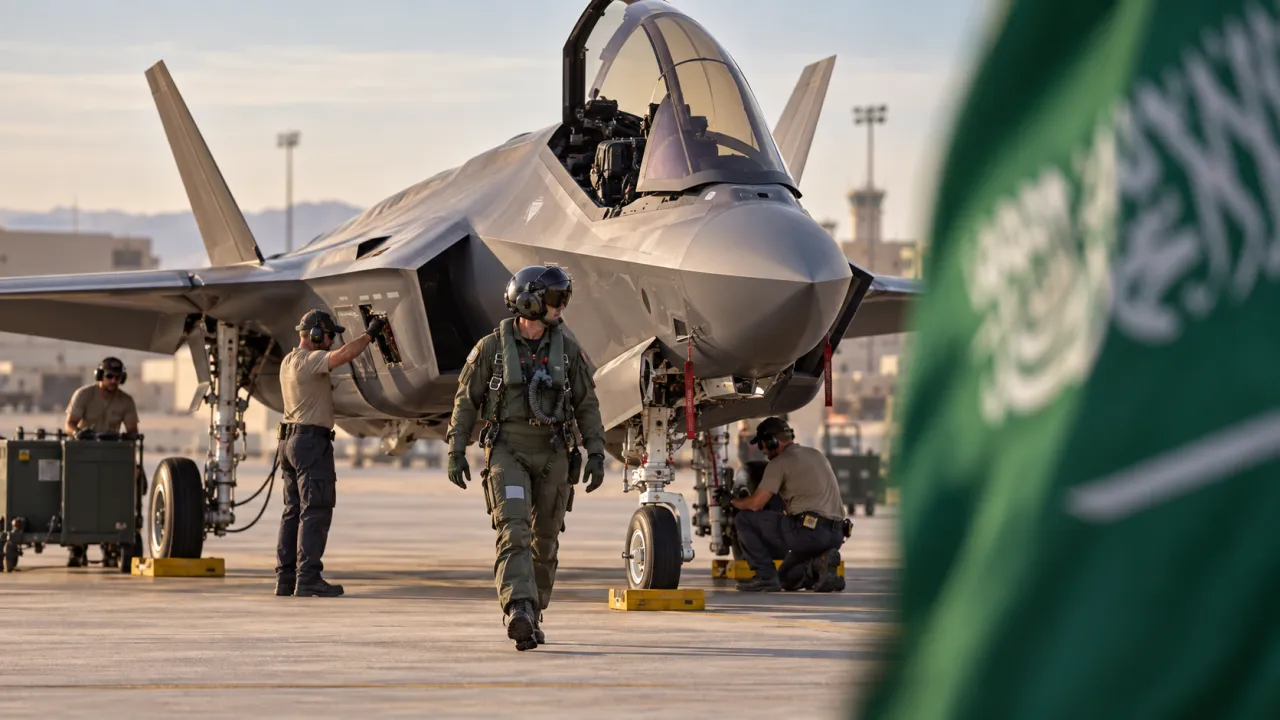
Paris, September 18, 2026. The French press first retains the technological risk more than the amount of the contract. The US State Department gave, on Thursday, September 17, its green light to the sale of 48 stealth F-35A aircraft from Lockheed Martin to Saudi Arabia, as well as 49 Pratt & Whitney F135 engines, for an estimated amount of $24.3 billion, or approximately 21 billion euros. Congress, informed as required by law, now has 30 days to oppose it, but Le Monde and RFI note that the House of Representatives is already on recess before the midterms, which, according to L'Express, makes an objection with very little chance of being adopted in practice.
The common thread of French headlines is the fear of Chinese access to American stealth technology. L'Express recalls that internal reports, consulted by the New York Times, point to the access that Chinese military personnel have to Saudi bases and Riyadh's use of Chinese technology in its telecommunications and defense. Democratic Representative Raja Krishnamoorthi, cited by Le Monde and RFI, warns that Washington could "put the jewels of American military technology within the reach of the Chinese Communist Party".
The State Department justifies the sale by stating that it will strengthen "Saudi Arabia's ability to deter current and future threats" without modifying "the military balance in the region" — a clause intended to preserve Israel's qualitative advantage, the only country in the Middle East to operate the F-35, which had expressed strong reservations. La Tribune emphasizes that only twenty countries in the world pilot the aircraft, a very closed circle where Turkey, excluded from the program in 2019 after the purchase of Russian S-400 systems, would like to be included.
The regional context weighs heavily on this decision: Riyadh, engaged since February in the conflict born of American-Israeli strikes against Iran, is also facing, since July, a Houthi offensive supported by Tehran, which even claims to have shot down a Saudi F-15 over Marib. This sale is part of, according to Le Monde, a series of major Saudi arms purchases in 2026. No French article mentions a European or French alternative to this contract.
SOURCES (4)
- L'ExpressMEDIUM
- La TribuneMEDIUM