DOMINANT ANGLE
Riyadhh is celebrating in this sale less an arms contract than proof, after years of waiting, of the regained solidity of the strategic partnership with Washington.
Dominant angle identified — does not reflect unanimity of this country’s media
KEY POINTS
- 01
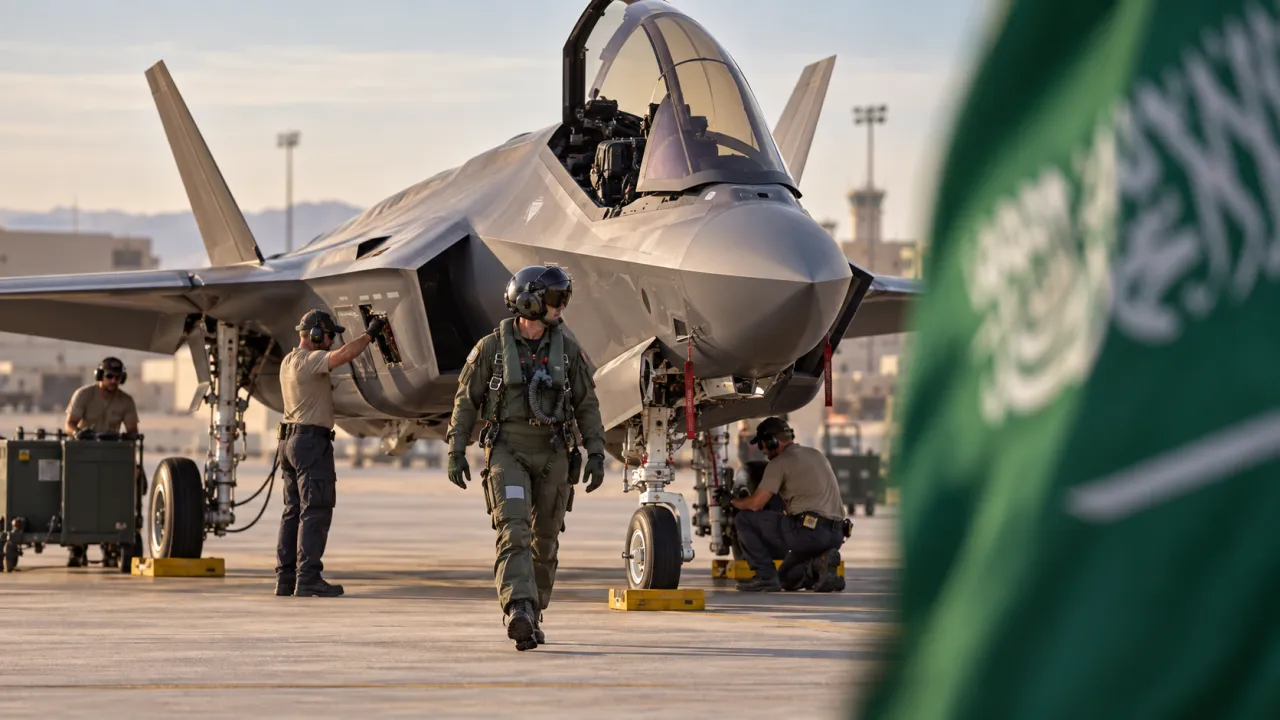
The US State Department approved on Thursday, September 17, the sale of 48 F-35s and 49 Pratt & Whitney F135 engines for $24.3 billion, the first delivery of F-35s to the kingdom.
- 02
The Saudi embassy in Washington stated that the sale "reflects the strength and enduring nature" of the US-Saudi relationship.
- 03
Riyadh had made a direct request to Donald Trump in early 2025; the US president had announced in November 2025 his intention to sell these aircraft to the kingdom.
ANALYSIS
Riyadh, September 18, 2026. The US State Department approved on Thursday, September 17, the potential sale of 48 F-35 Lightning II stealth fighter jets, built by Lockheed Martin, to Saudi Arabia, for an estimated $24.3 billion, according to a notification sent to Congress. The agreement also includes 49 Pratt & Whitney F135 engines, as well as associated equipment, training, and logistical support. This would be the first delivery of F-35s to the kingdom, which has been requesting them for years: Riyadh had made a direct request to Donald Trump in early 2025, and the US president announced in November 2025 Washington's intention to sell these aircraft to Saudi Arabia.
The Saudi embassy in Washington welcomed the transaction, estimating that it "reflects the strength and enduring nature" of the relationship between the two countries. It added that American-Saudi security cooperation has "contributed to regional stability, strengthened our collective defense capabilities, and advanced our common security interests." The Saudi diplomatic statement thus emphasizes the continuity of a bilateral link, more than the military capabilities themselves.
The State Department justifies the sale by explaining that it would strengthen the kingdom's ability to deter current and future threats, consolidate its territorial defense, and improve interoperability with American and allied forces. Washington specifies that the agreement would increase the Saudi operational fleet and strengthen its air-to-air and air-to-ground capabilities, while ensuring that it would not alter the military balance in the region. Neither the Saudi press consulted nor the official statements relayed mention any potential reservations from other regional capitals regarding this sale.
The notification sent to Congress now opens an examination phase before any final signature; the delivery schedule for the aircraft has not been specified at this stage. For Riyadh, this step marks the culmination of years of negotiations and confirms, in its view, the solidity of the renewed link with Washington after the direct request addressed to Donald Trump in early 2025. The Saudi narrative highlights the continuity of this bilateral cooperation and the modernization of its air capabilities, without detailing the debates it sparks about the regional military balance.






