Spain — news through its media
Stories followed in this country, with their framing set against the rest of the world.
160 subjects found

Saudi Arabia shuts its East-West pipeline after drone attacks launched from Iraq
Riyadh temporarily shut the East-West pipeline, its bypass around the Strait of Hormuz, after drone attacks on Friday night. Baghdad admits the drones came from Iraq, dismisses two officials and closes three border crossings with Iran; Donald Trump names Iran as the likely culprit. Twenty countries tell the same night, from crude above $100 to Iraqi militias.


 +16

Anthropic's chief calls for slowing AI development, and Altman and Musk agree
In an essay published on Saturday, Dario Amodei asks AI companies to slow the growth of their models' capabilities so that safety can catch up, and proposes a three-part framework. Sam Altman and Elon Musk say they agree. From Washington to Caracas, thirteen countries read the call according to their place in the race: regulation, jobs, sovereignty, fear of an AI beyond control.


 +9

Donald Trump promises $5,000 to every American adult if Republicans keep Congress
On 9 September, Donald Trump promised a $5,000 "dividend" to every American adult if Republicans keep the House and Senate in November's midterm elections, which renew all 435 House seats and 35 of the 100 Senate seats. With around 270 million adults, the cost would exceed a trillion dollars; media outlets recall two similar promises that went unfulfilled, and legal scholars question the lawfulness of a payment conditioned on an election result.


 +21
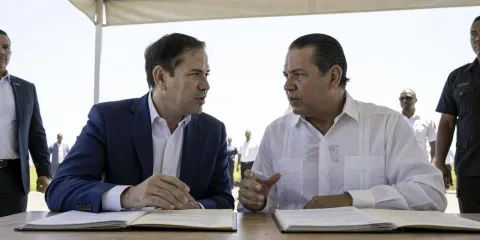
Rubio and De la Espriella seal the Barranquilla accords, and the US tour of Latin America skips Brazil
US Secretary of State Marco Rubio met Colombian President Abelardo de la Espriella in Barranquilla on 8 September, a month into his term. Two memoranda were signed, on civil nuclear energy and on lithium and copper. The tour continues to Ecuador and Peru; Brazil is not on it. Colombia's opposition alleges US interference in the election.


 +6
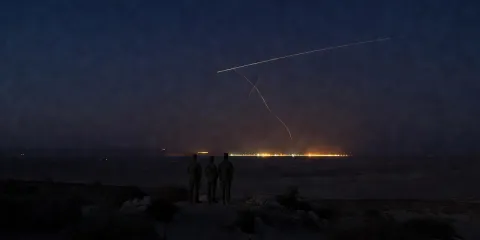
US destroys five Iranian tankers, Tehran strikes Jordan's Al-Azraq base, and Brent crude climbs back above $100
US Central Command destroyed five Iranian oil tankers on 8 September, calling it a response to two ballistic missile attempts against a Navy warship. Iran struck the Al-Azraq base in Jordan, which says it intercepted 18 of 20 missiles, then claimed attacks on shipping in the Strait of Hormuz, where one seafarer was killed and another reported missing. Brent crude passed $100 for the first time since July.


 +25

AfD wins Saxony-Anhalt with 43.8% and falls three seats short of an absolute majority
The AfD won Sunday's regional election in Saxony-Anhalt with 43.8% of the vote, 23 points more than in 2021, on a record turnout of 77.8%. It takes 39 of the Landtag's 83 seats and falls three short of an absolute majority. Sahra Wagenknecht's BSW scraping in at 5.3% makes both an AfD majority and a cordon-sanitaire coalition of all the other parties impossible at once.
+13
Falklands: Milei announces oil sanctions and a naval base, London reasserts sovereignty, Washington leaves doubt hanging
In a national televised address on September 4, Javier Milei announced a package of decrees, a bill and a national security council targeting the Sea Lion offshore oil project, 220 kilometers north of the Falklands, along with a naval base in Tierra del Fuego. He disputes the 3,600 islanders' right to self-determination. The announcement follows remarks by Donald Trump suggesting Washington is reassessing its position; London replied with an "unshakeable commitment".
+10
Ceuta: Sánchez clears Morocco against his own report, and stands alone in Congress
Pedro Sánchez told Congress there is "no solid evidence" that Morocco orchestrated the mass arrival of migrants in Ceuta — even as a Spanish report documents that Moroccan gendarmes let people through for some ten hours. His own allies accuse him of lying, protesters fill the streets, and Vox is carrying the affair as far as Chile.

 +8

Volkswagen cuts 50,000 jobs, four German plants left without work and Seat in limbo
Volkswagen's supervisory board unanimously approved a plan on Thursday 3 September that cuts about 50,000 jobs worldwide by 2030. Four German plants — Emden, Zwickau, Hanover and the Audi site at Neckarsulm — have no guaranteed production after 2031, and the fate of Spain's Seat brand, part of the group for forty years, remains undecided.
 +3

John Ternus takes over from Tim Cook at Apple, as the company races to catch up on AI
On 1 September 2026, John Ternus, 51, took over as chief executive of Apple, ending Tim Cook's fifteen-year tenure, during which the share price rose by roughly 2,300%. A hardware engineer by background, he arrives ahead of a major launch — including a foldable iPhone — and at a time when the company is seen as lagging on artificial intelligence. He opened a Weibo account within hours.

 +3

Iceland rejects resuming EU accession talks, with Reykjavik voting against the rest of the country
On 29 August 2026 Icelanders voted in a referendum on resuming EU accession talks, suspended since 2013. The final figures give 118,040 votes to no against 105,339 to yes — 52.8% against 47.2%, a gap of 12,701 ballots — on the highest turnout since 1944. Yes wins in both Reykjavik constituencies, no passes 60% in the three rural constituencies. The vote does not withdraw the application filed in 2009.
+13Understand global stakes from every perspective.
722 subjects · 75 countries · 8238 perspectives