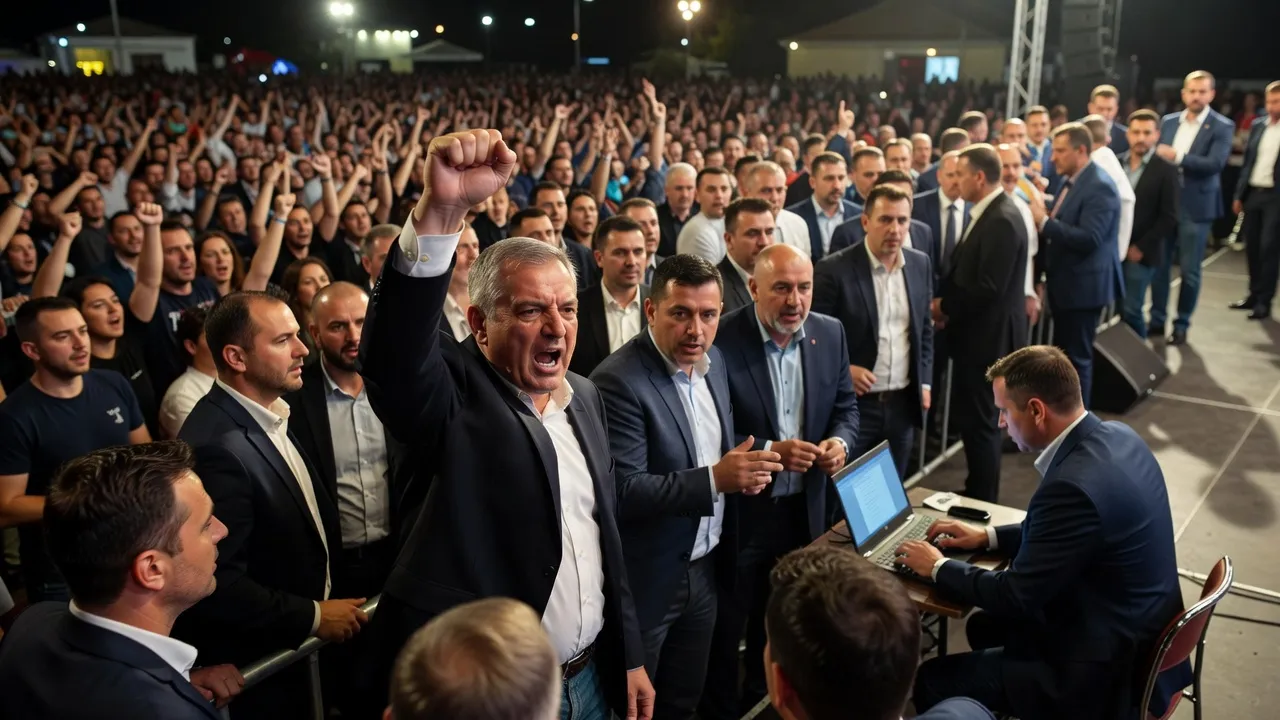
Bosnia and Herzegovina: Bosnian Serb leader Milorad Dodik claims victory in general elections
published on
countries
sources
articles
More divergent than 51% of recent comparable stories (reference: 90 recent stories measured with the same method).
The coverage of the corpus goes beyond the count: it focuses on Milorad Dodik's words in Banja Luka after the vote, the details of the scores in Republika Srpska, and what the election leaves open, this article reviews these elements, media by media.
The results remain preliminary: the Central Election Commission has not released a final count.
Dodik's words in Banja Luka
RFI and Le Temps report the same phrase, spoken in front of his supporters. Verslo žinios quotes it more extensively: thanks to the "new environment", Dodik's supporters would have become "political winners".
« If Donald Trump's magnificent victory had not occurred, we would probably be political corpses today »
The Russian press retains another passage. According to TASS, Dodik said: "I also thank President Vladimir Putin, who received us before the elections". Interfax quotes his message on X, "I proclaim the victory of the SNSD!", and Politika notes his thanks to Aleksandar Vucic as well as the hope for a "wave" in Serbia in the next elections.
Politika and RMF24 report the phrase "I proclaim victory at all levels". Politika adds that he speaks of a result "similar to that of 20 years ago" and a two-thirds majority in the assembly with his partners, which Tagesschau and TASS also mention. According to CBC, he also stated: "No one should ask us to change our policy".
Republika Srpska: the scores
For the presidency of the entity, Blic cites Savo Minic at 52.06% against 41.89% for Branko Blanusa (SDS). TASS gives 52.13% and 41.95%, after counting 90% of the votes. Each media outlet reproduces the count from the Central Election Commission at the time of publication, hence these decimal discrepancies.
The SNSD percentages do not pertain to the same election. ZEIT cites 39% for the entity's Parliament; RMF24 gives 38.93% for the National Assembly of the Republika Srpska and 40.95% among the votes cast in the entity for the House of Representatives. TASS, which counts the entire country for this chamber, indicates 16.44% for the SNSD, 19.89% for the SDA, and 5.99% for Drasko Stanivukovic's movement.
In the Serbian press in the corpus, Stanivukovic congratulates the winners and says his movement has become the second force in the entity. Nebojsa Vukanovic speaks of a "shock" and denounces unequal media treatment. Zeljko Komsic acknowledges an "ethnic homogenization" and deems the election honest.
What each press outlet retains
Four out of eleven perspectives provide a participation figure (Switzerland, Germany, Latvia, Ukraine). This count measures the coverage of the corpus, not public interest. The Lithuanian perspective notes a decrease in participation without providing a figure. According to the Russian perspective, articles from TASS, Interfax, and Vedomosti do not mention either participation or the ban on public office targeting Dodik.
« Either the reform process continues on the path to EU membership, or we are heading towards a new deadlock where ethnonationalism is institutionalized »
The Swedish articles in the corpus date back to the day of the vote and precede the results. Dagens Nyheter raises the stakes through Johanna Mannergren, a professor at Södertörn University. Sveriges Radio describes the rift between Denis Becirovic, who defends national unity, and Dodik, who recently said that Bosnia as a country was dead.
The descriptors for Dodik vary. TVNET calls him "prorusse" and uses the expression "the Russian dictator Vladimir Putin"; TSN Ukraine presents him as a "prorusse politician". CBC and the Globe and Mail broadcast the same wire text, which describes him as "resolutely prorusse". The articles from Blic, N1, Politika, TASS, and Interfax report his statement without such a descriptor.
What the election leaves open
Tagesschau writes that observers believe a pardon for Dodik by the newly elected tripartite presidency is possible. Blic is already discussing the battle for the post of prime minister of the entity, where Dodik would have "an ace up his sleeve" if he were to receive this pardon. Cvijanovic promises to strengthen the international position of Republika Srpska.
Vedomosti quotes Iakov Smirnov, from the Institute of Slavic Studies of the Russian Academy of Sciences, who says that no serious political surprises are expected.
The technical conduct of the vote is being commented on. Blic notes problems related to electronic voting, introduced for the first time. Sveriges Radio reports that the 5,200 polling stations were equipped with fingerprint readers and ballot scanners, and that observers feared insufficient training of the agents. Stanivukovic calls for an analysis of the effect of the new scanners. RFI writes that electoral transparency remains "a constant struggle" in the face of suspicions of fraud.
Becirovic obtains 38.1 % for the Bosniak seat; Filipovic (HDZ BiH) 48.2 % for the Croatian seat.
According to TSN citing Klix.ba, the SNSD coalition could reach 49 of the 83 seats, 43 being necessary.
Candidate country since 2022, with a green light for accession negotiations in 2024, according to Jauns.
Key figures
- 55.6 %Zeljka Cvijanovic's (SNSD) score for the Serbian seat on the presidency1 source · Deutsche Welle
What the comparison reveals
Common ground and differences in coverage across the media analysed.
What the media report in common
Milorad Dodik claims victory for his party, the SNSD, in the Bosnian general election on October 4, although he is not on the ballot.
Reports indicate that Dodik attributes this result to external support: Donald Trump, Vladimir Putin, or both.
Where media coverage diverges
Element highlighted in the election
The perspectives respond differently to the question of what defines this election: the geopolitical alignment of Dodik (Lithuania, Latvia, Poland, Russia, Ukraine), the low turnout and nationalist continuity (Switzerland, Germany), or the choice between European reforms and ethnonational blockage (Sweden).
Qualification of Dodik
The Latvian and Ukrainian press refer to him as pro-Russian and interpret the result through Moscow, the Canadian press speaks of a separatist rhetoric, while the Serbian and Russian press report his victory statement without this qualification.
Possible consequences for Dodik
Tagesschau, cited by the German perspective, mentions according to observers a possible pardon for Dodik by the new tripartite presidency; the other perspectives do not report this hypothesis.
Coverage aligned with this reading
This grouping describes the publications analysed, not the position of these countries’ populations or of their governments.
How each country reads it
Preview: 3 of 11 media perspectives. Syntheses of the media analysed — not direct quotations. Method & limitations
 Canada
Ottawa is deciphering the Bosnian election from the angle of secession: Canadian media notes a Milorad Dodik absent from the ballot but omnipresent, whose separatist rhetoric fuels fears of renewed instability.
2 sources · View sources
 Switzerland
Bern notes the re-election of nationalist parties in Bosnia and Herzegovina, in an election where record-low turnout and youth disillusionment have deprived it of momentum for change.
2 sources · View sources
 Germany
Berlin is first focusing on the dominance of nationalist forces and the historically low turnout, and is questioning a possible pardon for Milorad Dodik by the new three-member presidency.
3 sources · View sources
The full text, country by country
Canada
DOMINANT ANGLE
Ottawa is deciphering the Bosnian election from the angle of secession: Canadian media notes a Milorad Dodik absent from the ballot but omnipresent, whose separatist rhetoric fuels fears of renewed instability.
KEY POINTS
- With nearly 90% of the votes counted, Zeljka Cvijanovic, an ally of Dodik, had secured over 55% for the Serbian seat of the presidency, around 30 points ahead of her closest rival.
- Dodik, barred from public office after his conviction last year for defying the international envoy of the 1995 agreement, attributed the victory to Donald Trump and Vladimir Putin.
- Around 3.4 million voters were able to choose the tripartite presidency, national parliamentarians, and leaders of the two entities.
ANALYSIS
Ottawa, October 5, 2026. Canadian media largely echo the account of a news agency: Bosnian Serb leader Milorad Dodik has claimed victory for his party in Sunday's October 4 elections in Bosnia and Herzegovina, a vote "marked by economic pressures, the prospect of EU membership, and ethnic tensions" that have divided the country since the 1992-1995 war.
The picture is unambiguous. CBC News and the Globe and Mail portray Milorad Dodik as a "resolutely pro-Russian" politician who, although absent from the ballot, dominated the campaign and fueled divisions with separatist rhetoric, a source of fears of renewed instability. Former president of the Republika Srpska, the predominantly Serb entity, he was banned from holding public office after being convicted last year for defying the decisions of the international envoy overseeing the 1995 peace agreement.
The partial results cited are clear: with nearly 90% of the votes counted, his ally Zeljka Cvijanovic, from the Alliance of Independent Social Democrats, garnered over 55% of the vote for one of the three seats on the tripartite presidency, a lead of about 30 points over her closest rival. Approximately 3.4 million voters were called to the polls to elect the three members of the multi-ethnic presidency, national deputies, and officials from the country's two entities.
During a late Sunday press conference, Milorad Dodik asserted that his party would hold a "broad majority" in the Republika Srpska Assembly. He attributed this success to the "magnificent victory" of Donald Trump in 2024 and the support of Vladimir Putin. "No one should ask us to change our policy," he stated, adding: "We will not abandon, but continue for our people."
Canadian coverage remains factual and brief, focusing on the statements of the self-proclaimed winner and the risk posed by his separatist project to the unity of the Bosnian state. It mentions the European context without delving deeper, and leaves little room for Bosnian or Croatian voices, or analysis of the low turnout mentioned in the Globe and Mail's subtitle.
Switzerland
DOMINANT ANGLE
Bern notes the re-election of nationalist parties in Bosnia and Herzegovina, in an election where record-low turnout and youth disillusionment have deprived it of momentum for change.
KEY POINTS
- Turnout reached 41.5%, a record low, ten points less than in 2022 (SRF, according to the Central Electoral Commission).
- Zeljka Cvijanovic (SNSD) wins with 55.6% for the Serbian seat; Denis Becirovic retains the Bosniak seat with 38.1%; Darijana Filipovic (HDZ BiH) takes the Croatian seat with 48.2%.
- Milorad Dodik stated that without Donald Trump's victory, his camp would be "political corpses", and thanked Vladimir Putin (Le Temps).
ANALYSIS
Berne, October 5, 2026. The general elections held last Sunday in Bosnia and Herzegovina confirm, for the Swiss press, the solidity of nationalist parties. SRF headlines with "nationalist forces" that "remain strong" and notes that, according to the Central Election Commission (CIK), based on more than 90% of the polling stations counted, "the changes are barely perceptible".
Voter turnout reached 41.5%, a historic low, down 10 points from 2022, according to SRF. Le Temps talks about elections "marked by a sharp decline in voter turnout" in a "institutional millefeuille" resulting from the 1995 peace agreement, which distributes power among Bosniaks, Croats, and Serbs for some 3.4 million voters.
The Romandy daily focuses on the figure of Milorad Dodik, described as the "former pro-Russian leader" of the Serb entity. It reports his statement in Banja Luka: "If Donald Trump's magnificent victory had not taken place, we would probably be political corpses today." Dodik also thanked Vladimir Putin. Le Temps recalls that he was removed from office in 2025 for failing to respect the authority of the High Representative and was banned for six years, but remains in control thanks to his party, the SNSD. It specifies that the latter campaigned for greater autonomy and a secessionist rhetoric.
SRF details the tripartite presidency. Serb Zeljka Cvijanovic, from the SNSD, wins with 55.6% against Marinko Bozovic (26.8%). Bosnian social democrat Denis Becirovic obtains 38.1% against Bakir Izetbegovic (34%). Croatian nationalist Darijana Filipovic, from the HDZ BiH, wins with 48.2% against social democrat Slaven Kovacevic (28.8%) and succeeds non-nationalist Zeljko Komsic, who did not run for re-election.
The German-speaking channel recalls the weight of history: the 1992-1995 war caused tens of thousands of deaths and over two million displaced people. A second report from Sarajevo gives the floor to a young woman, "Alma", whose father, a loyalist of one of the three major ethno-nationalist parties, offered her a job through a ministry. She sees this as a sign of widespread corruption; Bosnia ranks 109th in Transparency International's index. The job market is "dried up" for young people, who are losing hope for change.
Germany
DOMINANT ANGLE
Berlin is first focusing on the dominance of nationalist forces and the historically low turnout, and is questioning a possible pardon for Milorad Dodik by the new three-member presidency.
KEY POINTS
- Turnout fell to around 41.5% of the 3.4 million voters, nearly ten points below that of 2022 according to ZEIT.
- Cvijanovic (55.6%), Becirovic (38.1%) and Filipovic (48.2%) won the three seats on the tripartite presidency, according to DW.
- Dodik, ineligible for six years, thanked Trump and Putin, and Tagesschau considers it possible for a pardon from the tripartite presidency.
ANALYSIS
Berlin, October 5, 2026. For the German press, the vote on Sunday, October 4, in Bosnia-Herzegovina primarily confirms the weight of nationalist parties. Tagesschau writes that these forces "dominate" the country "in the years to come", given the count of almost all ballots. Deutsche Welle headlines an "divisive" election: out of 3.4 million voters, only 41.5% cast their ballots, a historic low. ZEIT specifies that the turnout, of around 42%, is nearly ten points lower than in 2022.
The three seats of the tripartite presidency go to Zeljka Cvijanovic, a Serbian nationalist supported by Dodik (55.6% according to DW), to Denis Becirovic, a Bosnian social democrat (38.1%), and to the Croatian nationalist Darijana Filipovic (48.2%). ZEIT notes that only the latter is new.
Milorad Dodik, former president of the Republika Srpska, declared to his supporters in Banja Luka: "Ich erkläre, dass wir gewonnen haben". ZEIT reports that the SNSD remains the leading force in the entity's parliament, with 39% of the vote, and that its candidate Savo Minic wins the presidency. According to Tagesschau, Dodik mentions a two-thirds majority with his coalition partners.
The two German titles note the thanks addressed to Donald Trump and Vladimir Putin. ZEIT quotes Dodik's phrase: without the "great victory of Donald Trump", he and his supporters would "probably be political corpses". Tagesschau recalls that the Trump administration unexpectedly lifted sanctions against him in 2025, the year a court barred him from the presidency of the entity.
The question of secession remains. Tagesschau recalls that court decisions followed his efforts to detach the Republika Srpska from the central state. Dodik affirms that his political positions "remain firm and will not be changed". Ineligible for six years, he could be pardoned by the tripartite presidency, which observers cited by the channel now consider capable of doing so.
DW places the vote in the context of economic slowdown, slow progress towards EU membership, and lasting political blockages. The ethnic parties, SDA, SNSD, and HDZ BiH, faced multi-ethnic coalitions led by the social democrats. The institutional framework, inherited from the 1995 Dayton agreements, is presented as a factor of paralysis.
 France
DOMINANT ANGLE
Paris is deciphering an election that reaffirms ethnic fault lines: nationalists are leading, voters are disillusioned, and Milorad Dodik remains in control despite being ineligible.
KEY POINTS
- According to Le Monde, Denis Becirovic is reelected to the Bosniak seat and Darijana Filipovic, from the HDZ, succeeds the outgoing Croatian president.
- Milorad Dodik, 67 years old, banned from office for six years, thanks Donald Trump and Vladimir Putin in Banja Luka after the SNSD's claimed victory (RFI).
- Sud Ouest notes that the average salary has risen from 570 to 885 euros since 2022, when the cost of living increased by more than 50 %.
ANALYSIS
Paris, October 5, 2026. The French press is reporting on the Bosnian general elections, which, according to Le Monde, saw the Sunday, October 4 vote "bring no surprise". The first estimates from the Central Election Commission have consecrated the nationalist parties: in Sarajevo, the newspaper reports that Bosniak Denis Becirovic has been re-elected, the outgoing Croatian president, known for being close to Bosniak positions, has been replaced by Darijana Filipovic from the nationalist HDZ party, and Milorad Dodik's SNSD has been reconfirmed in the presidency and parliament of the Republika Srpska.
The newspaper emphasizes the disillusionment of a large part of the approximately 3.2 million inhabitants: a restaurateur in Sarajevo tells them, "Don't write about the elections, our politicians don't deserve it". RFI, on the other hand, notes a "sharp decline in the turnout rate" and recalls that 3.4 million voters were called to elect the leaders of a "institutional millefeuille" resulting from the 1995 peace agreement, which shares power between Bosniaks, Croats, and Serbs.
The figure of Milorad Dodik takes center stage. RFI describes a 67-year-old leader who has been in power since 2006, removed in 2025 from the presidency of the Republika Srpska for failing to respect the authority of the international High Representative and banned by the judiciary from holding office for six years. Nevertheless, he has continued to lead the entity thanks to the weight of the SNSD. In front of his supporters in Banja Luka, he declared, "If Donald Trump's magnificent victory had not taken place, we would probably be political corpses today", and he thanked Vladimir Putin. Sud Ouest quotes his phrase from Friday evening: "Bosnia-Herzegovina is dead, it's an impossible country, it makes no sense".
Pre-election reports set the social and democratic context. Sud Ouest gives the floor to a 29-year-old environmental activist who says "the situation has never been worse", and notes that the average salary has risen from 570 to 885 euros since 2022, while the cost of living has increased by more than 50%, according to the trade union. RFI, in a special report from Bratunac, judges that the role of extremists "seems to be crumbling" as clientelism and corruption lose ground, while emphasizing that electoral transparency remains "a constant struggle" in the face of suspicions of fraud.
The French narrative thus focuses less on the European candidacy or regional issues than on the reproduction of the ethno-political system and the weariness of voters.
 Lithuania
DOMINANT ANGLE
Vilnius takes away from the Bosnian election Milorad Dodik's thanks to Donald Trump and Vladimir Putin, seen as a signal of geopolitical alignment rather than just a local outcome.
KEY POINTS
- Dodik, absent from the ballots due to being convicted of abuse of power and barred from the presidency for six years, proclaimed the victory of his camp (Verslo žinios).
- He stated: "Without the great victory of Donald Trump, we would probably be political corpses today", and thanked Vladimir Putin (Verslo žinios).
- After counting 95% of the votes, Željka Cvijanović retains the Serbian seat, Denis Bečirović leads for the Bosniak seat, and Darijana Filipović for the Croatian seat.
ANALYSIS
Vilnius, October 5, 2026. Lithuanian media outlets are dedicating brief but focused coverage to Bosnia and Herzegovina, specifically to Milorad Dodik's statement following the Sunday, October 4, election. Verslo žinios and 15min are both headlining Dodik's proclaimed victory and his expressions of gratitude to the presidents of the United States and Russia.
According to 15min, the former president of the Serb entity asserted that his party had retained power in the entity and secured a place in the tripartite presidency. Both media outlets recall the context: the elections took place "after several years of political turmoil and stalled reforms," and the campaigns were dominated by ethnic quarrels inherited from the 1990s war.
Verslo žinios extensively quotes Dodik, who spoke to his supporters in Banja Luka: "Without Donald Trump's great victory, we would probably be political corpses today," he said, before adding that, thanks to the "new environment," his supporters had become "political winners." He also thanked his close ally, Russian President Vladimir Putin.
The economic daily specifies that Dodik, 67, was not on the ballot: convicted of abuse of power, he is barred from the collective presidency for six years. However, he remains a central figure in the Republika Srpska. His party, the article adds, campaigned for greater autonomy with separatist rhetoric.
Partial results, after counting 95% of the votes, indicate that his candidate, Željka Cvijanović, is likely to retain the Serb seat. The Bosniak Denis Bečirović, the incumbent, is in the lead, and the Croatian nationalist Darijana Filipović is ahead for the Croatian seat. Dodik's party is also expected to maintain a large majority in the entity's parliament and its presidency.
The articles mention a lower turnout than in previous elections, without providing a figure. They recall that the complex representation system, resulting from the 1995 Dayton peace agreement, keeps a fragmented country together. The Lithuanian reading remains factual and uncommented, but the choice of quotes highlights the interplay of alliances between Washington, Moscow, and the Serb nationalists in Bosnia.
 Latvia
DOMINANT ANGLE
Riga is deciphering the Bosnian election through the prism of membership in the European Union and Milorad Dodik's external allegiances, portrayed as a pro-Russian leader thanking Trump and Putin.
KEY POINTS
- Dodik thanked Donald Trump and Vladimir Putin in his victory speech, although he was not a candidate, being barred from running for six years (TVNET).
- Turnout reached only 42% out of approximately 3.4 million voters, nearly ten points less than in 2022 (TVNET).
- Bosnia and Herzegovina has been an EU candidate since 2022 and accession negotiations got the green light in 2024, but reforms are being hindered by ethnic tensions (Jauns).
ANALYSIS
Riga, October 5, 2026. Latvian media is following the Bosnian elections from two complementary angles: Milorad Dodik's claim of victory and the country's European future.
The TVNET portal focuses on the Bosnian-Serb leader, whom it describes as "pro-Russian". According to him, Milorad Dodik stated that his party won Sunday's election. In his speech to his supporters, he thanked US President Donald Trump, as well as "Russian dictator Vladimir Putin", a phrase used by the Latvian media. TVNET recalls that Dodik did not run: convicted of exceeding his powers, he is banned from running for six years, but he retains significant influence in Republika Srpska.
The details of the results are given with caution. After counting 95% of the votes, the candidate supported by Dodik, Zeljka Cvijanovic, would retain the position of Serbian leader. Denis Becirovic, a representative of the Bosniak community, also claimed victory, based on results showing him in the lead in a tighter race. Croatian leader Darijana Filipovic also declared herself the winner. Dodik's party is also expected to win a clear majority in the Republika Srpska parliament.
TVNET emphasizes the mobilization: approximately 3.4 million voters were called to the polls, but turnout reached only 42%, about ten points less than in 2022.
The Jauns.lv website, published as soon as the vote closed, places the issue elsewhere: "the country's path to the European Union". Bosnia and Herzegovina obtained candidate status in 2022, and European leaders gave the green light to opening accession negotiations in 2024. However, the necessary reforms have been slowed down by political disagreements and tensions between ethnic communities.
Jauns.lv highlights the attention paid to Bosnian Serb politicians and their calls for more autonomy for Republika Srpska. The site mentions the fear that post-election political tension will further complicate the country's governance and its European path. It finally recalls that, since the 1992-1995 war, the country has been divided into two largely autonomous entities, connected by a complex central system resulting from the Dayton agreement.
For the Latvian press, the vote is therefore less a matter of Bosnian domestic politics than a test of the Western anchorage of a country where Moscow's influence remains visible.
 Poland
DOMINANT ANGLE
Warsaw is taking away from this Bosnian election Milorad Dodik's statement crediting Donald Trump with his party's victory, more than the details of the vote results.
KEY POINTS
- According to the CIK's partial results, Zeljka Cvijanovic (SNSD) is leading for the Serbian seat of the presidency with 55.34% of the vote.
- Milorad Dodik, who has been banned from public office for six years, says: "Ogłaszam zwycięstwo na wszystkich szczeblach" and cites Donald Trump's victory.
- After 80% of polling stations have been counted, Denis Becirovic, Darijana Filipovic and Zeljka Cvijanovic are in the lead for the tripartite presidency; 3,408,517 voters were registered.
ANALYSIS
Warsaw, October 5, 2026. The Polish press is covering the general elections in Bosnia and Herzegovina, held on Sunday, October 4, from two angles: the figures from the Central Election Commission (CIK) and the statement by Milorad Dodik, the leader of the SNSD.
RMF24 headlines this statement: "Gdyby nie wspaniałe zwycięstwo prezydenta USA Donalda Trumpa..." ("Without the magnificent victory of US President Donald Trump..."). The media recalls that Bosnians were electing the three members of the collegiate presidency, representing Bosniaks, Croats, and Serbs, the deputies of the House of Representatives of the Parliamentary Assembly, those of the parliaments of the Federation and Republika Srpska, the president and vice-presidents of the RS, as well as the assemblies of the ten cantons of the Federation.
According to the partial results of the CIK cited by RMF24, the SNSD candidate Zeljka Cvijanovic is leading the race for the Serbian seat on the presidency with 55.34% of the vote. Her party is leading in the House of Representatives among the votes cast in Republika Srpska, with 40.95%, and obtained 38.93% in the elections to the National Assembly of the RS. Dodik states: "Ogłaszam zwycięstwo na wszystkich szczeblach" ("I proclaim victory at all levels").
RMF24 specifies that Dodik, former president of the RS and former member of the presidency, was not running for any position. He is subject to a six-year ban on holding public office, a consequence of a final conviction for not applying a decision of the High Representative, the body responsible for ensuring compliance with the Dayton peace agreement that ended the war in the 1990s. He attributes the success of his party in part to the political situation in the United States.
Gazeta Prawna, which headlines "decisive news from the Balkans", sticks to the data from Sunday evening. After counting 80% of the polling stations, according to the CIK, Denis Becirovic (SDP BiH), Darijana Filipovic (HDZ BiH), and Zeljka Cvijanovic (SNSD) are leading for the tripartite presidency. The polling stations closed at 7 pm and 3,408,517 people were registered.
The two articles stick to the results and Dodik's statement. They do not develop the European candidacy of Bosnia or the question of a possible secession of Republika Srpska.
 Serbia
DOMINANT ANGLE
Belgrade is hailing the SNSD's triumph in Republika Srpska: the Serbian press is reporting the victory proclaimed by Dodik and treating the election as a plebiscite for the entity, with a fragmented opposition.
KEY POINTS
- Savo Minic (SNSD) is leading in the Republika Srpska presidency with 52.06% against 41.89% for Branko Blanusa (Blic, preliminary results from the CEC).
- Dodik claims victory "at all levels" and attributes part of it to Donald Trump: without him, "we would be political corpses" (N1 Serbia).
- The SNSD obtains 40.95% of the vote in Republika Srpska for the state representative chamber, according to N1, ahead of the Republika Srpska Movement of Stanivukovic.
ANALYSIS
Belgrade, October 5, 2026. Serbian media are focusing on the electoral evening of Sunday, October 4, the tenth general election in Bosnia and Herzegovina. Blic recalls that voters were choosing the three members of the presidency, the deputies of the state and federal chambers, the president of Republika Srpska, and its national assembly. The daily notes technical problems related to electronic voting, introduced for the first time, and lower participation compared to 2022 in several cities of the entity.
The central story is that of the SNSD. According to the preliminary results of the Central Election Commission cited by Blic, Savo Minic wins the presidency of Republika Srpska with 52.06% against 41.89% for Branko Blanusa (SDS). Zeljka Cvijanovic becomes the Serbian member of the tripartite presidency, with 55.37% according to N1, ahead of Marinko Bozovic and Nebojsa Vukanovic. Denis Becirovic and Darijana Filipovic complete the body.
Politika quotes Milorad Dodik: "I proclaim victory at all levels", a result "similar to that of 20 years ago", and the promise of a two-thirds majority in the assembly with his partners. N1 headlines his attribution of success in part to Donald Trump: without his victory, "we would be political corpses today". Politika also notes his thanks to Aleksandar Vucic and his hope that a "wave" will reach Serbia in the next elections. Dodik estimates that the result "redefines political relations in Bosnia and Herzegovina".
The losers take a back seat. Draško Stanivukovic congratulates the winners, emphasizes that his Movement Republika Srpska Sure has become the second force in the entity, and asks to analyze the effect of low participation and new scanners. Nebojsa Vukanovic speaks of a "shock" and denounces unequal media treatment. Zeljko Komsic acknowledges an "ethnic homogenization" and judges the election honest.
Blic is already extending the sequence: the battle for the post of prime minister of the entity, where Dodik would have "an ace up his sleeve" if he obtained a pardon. Cvijanovic promises to strengthen the position of Republika Srpska internationally.
 Russia
DOMINANT ANGLE
Moscow is particularly holding onto the thanks from Milorad Dodik to Vladimir Putin: the SNSD's victory in Republika Srpska is being presented as a success for a partner of Russia, with no political surprise.
KEY POINTS
- After 90 % of the votes have been counted, Zeljka Cvijanovic (SNSD) is leading for the Serbian seat of the presidency with 55.34 %, according to TASS
- Dodik says: "I also thank President Vladimir Putin, who received us before the elections"
- The SNSD is leading in all constituencies for the National Assembly of the Republika Srpska with over 35 %
ANALYSIS
Moscow, October 5, 2026. The TASS agency, from Belgrade, and Interfax reported on Sunday, October 4, the preliminary results of the Central Election Commission of Bosnia and Herzegovina. After counting 90% of the votes, Denis Becirovic (Social Democratic Party) is leading for the Bosniak seat with 38.12%, ahead of Bakir Izetbegovic (33.98%). Darjana Filipovic, from the HDZ of Bosnia and Herzegovina, is leading among Croats with 46.56%, against Slaven Kovacevic (30.54%). Zeljka Cvijanovic, from the Alliance of Independent Social Democrats (SNSD), dominates the Serb seat with 55.34%, against 26.55% for Marinko Bozovic, from the opposition.
The Prime Minister of the Republika Srpska, Savo Minic, is declared the winner of the presidency of the entity with 52.13%, against 41.95% for the opponent Branko Blanusa. In the House of Representatives, the Party of Democratic Action collects 19.89% and the SNSD 16.44%; the "Srpska sigurna" movement of the mayor of Banja Luka, Drasko Stanivukovic, obtains 5.99%. The SNSD is leading in all constituencies for the National Assembly of the Republika Srpska, with more than 35%.
The story highlights the statement of Milorad Dodik. TASS reports: he announces the victory of his party and thanks Vladimir Putin. "I announce our victory at all levels," he said at a press conference, referring to two-thirds of the seats for his coalition in the entity's parliament. He added: "I also thank President Vladimir Putin, who received us before the elections." On X, according to Interfax, he wrote "I proclaim the victory of the SNSD!" and congratulated Cvijanovic and Minic.
TASS recalls the 1995 Dayton framework: the Federation of Bosnia and Herzegovina (about 51% of the territory), the Republika Srpska (about 49%), and the Brcko district, with proportional representation of Bosniaks, Serbs, and Croats. Vedomosti quotes Iakov Smirnov, from the Institute of Slavic Studies of the Russian Academy of Sciences: the elections are accompanied by numerous speculations, both in Bosnia and abroad, but no serious political surprise is expected. The articles do not mention either the turnout or the ban on Dodik holding public office.
 Sweden
DOMINANT ANGLE
Stockholm sees the Bosnian election as a "choice of destiny" between pursuing reforms towards the European Union and the entrenchment of institutionalized ethnonationalism.
KEY POINTS
- According to Dagens Nyheter, 75 parties, nearly 30 coalitions, and a handful of independents were vying for votes to elect three presidents on October 4.
- Johanna Mannergren (Södertörn University) sums up the stakes: continued reforms towards EU membership or "institutionalized ethnonationalism".
- Sveriges Radio reports that the 5,200 polling stations were equipped with fingerprint scanners and ballots, touted as the most advanced system in Europe.
ANALYSIS
Stockholm, October 5, 2026. In the Swedish press, the Bosnian general elections on Sunday, October 4, are first presented as a turning point. Dagens Nyheter headlines with "a vote of destiny" (ödesval): three presidents are to be appointed, and 75 parties, nearly 30 coalitions, and a handful of independent candidates are vying for influence.
The newspaper relies on Johanna Mannergren, a professor of political science and international relations at Södertörn University, who has studied peace processes in Western Balkans. According to her, "either the reform process continues on the path to EU membership, or we are heading towards a new deadlock where ethnonationalism is institutionalized." DN recalls that the Dayton Agreement, which ended the 1995 war, is based on a compromise and a complex power-sharing arrangement, with a High Representative appointed by the UN to ensure its implementation.
The political climate is described as deeply polarized: fundamental issues have been relegated behind campaign allegations of illicit campaigning, corruption, and waste of public funds.
Sveriges Radio portrays the divide through two figures. Bosniak Denis Becirovic, one of the three outgoing presidents, is running to preserve national unity. In Republika Srpska, a largely autonomous region, Serb Milorad Dodik recently stated that Bosnia as a country was dead, hence the title "Bosnia is a dead country." The public radio thus opposes candidates in favor of greater autonomy for their community to those who want to maintain a unified country.
Another Sveriges Radio report deals with the electoral technique: the 5,200 polling stations are equipped with fingerprint readers and ballot scanners, which would make the Bosnian system the most advanced in Europe against fraud. However, observers fear that the agents may have received too little training, with the risk of long lines.
The available Swedish articles date back to the day of the vote and precede the results: they pose the challenge, the alternative between Brussels and ethnic lock-in, rather than commenting on the outcome of the election.
 Ukraine
DOMINANT ANGLE
Kyiv is deciphering the Bosnian election through the Russian prism: the progress of Dodik's party is presented as the victory of "Poutine's friends".
KEY POINTS
- According to TSN citing Klix.ba, Dodik's SNSD would obtain 34 seats in Republika Srpska and its coalition could reach 49 of the 83 seats, with 43 needed for a majority.
- TSN reports a turnout of 42% of registered voters, down about 10% from the 2022 elections.
- Kyiv Post recalls that the Dayton agreement divided Bosnia into two entities connected by a weak central government, which often paralyzes decision-making.
ANALYSIS
Kyiv, October 5, 2026. Ukrainian media are reporting on the general elections held on Sunday, October 4, in Bosnia and Herzegovina with an unambiguous headline: TSN Ukraine writes "Перемагають друзі Путіна", "Poutine's friends win". The newspaper presents Milorad Dodik as a "pro-Russian politician" whose party, the Alliance of Independent Social Democrats (SNSD), is leading in Republika Srpska.
According to TSN, citing the Bosnian website Klix.ba, the SNSD would obtain 34 seats in the National Assembly of the entity. The "Serbia Safe" movement of Drasko Stanivukovic would have 12 and the Serbian Democratic Party 11. The coalition led by the SNSD could reach 49 seats out of 83, while 43 are enough to govern. TSN specifies that these results remain preliminary, as the overseas vote has not yet been counted, and that Dodik has claimed victory for his party.
In the Federation of Bosnia and Herzegovina, the other entity, the Party of Democratic Action (SDA) is leading with 30.63% of the vote. The Social Democratic Party (SDP) obtains 15.27% and the coalition around the HDZ BiH 13.89%. TSN notes that participation has decreased by around 10% compared to 2022: 42% of registered voters cast their ballots.
Kyiv Post, which reprints an AFP dispatch published before the polling stations closed, emphasizes the structure of the system. The Dayton Agreement, concluded under American mediation, ended the 1992-1995 war but anchored divisions that often paralyze decision-making. It divided the country between Republika Srpska and a Croat-Muslim federation, connected by a weak central government.
The English-language media also highlights that Dodik's face is displayed on posters in Banja Luka even though he is not a candidate, due to his conviction. It gives the floor to Adi Selman, an activist from the Karton Revolucija group, who believes that the choice is limited to parties that have been present for thirty years and that bet on war and divisions. The presidential election pits, according to the dispatch, a vision of a united country against that of greater autonomy for the Serb entity.
The two articles do not focus on the same ground: one highlights Dodik's supposed alignment with Moscow, the other the institutional blockage inherited from Dayton.
Explore every perspective on this subject across 11 countries.
Compare viewpoints and see where they diverge.