
DOMINANT ANGLE
Paris is deciphering a constrained summit, where the conflict in the Middle East has eclipsed the expansion ambitions of the BRICS and reduced New Delhi to preserving appearances.
Dominant angle identified — does not reflect unanimity of this country’s media
KEY POINTS
- 01
The summit ended without expanding the circle of 11 full members, with the 10 partners being more closely associated with the bloc's work.
- 02
New Delhi announced a logistics cooperation framework for supply chains, an early warning system for infectious diseases, and increased financial cooperation.
- 03
Narendra Modi held multiple bilateral talks with the leaders of the Philippines, Kazakhstan, South Africa, Egypt, Burundi, Uganda, and Nigeria.
ANALYSIS
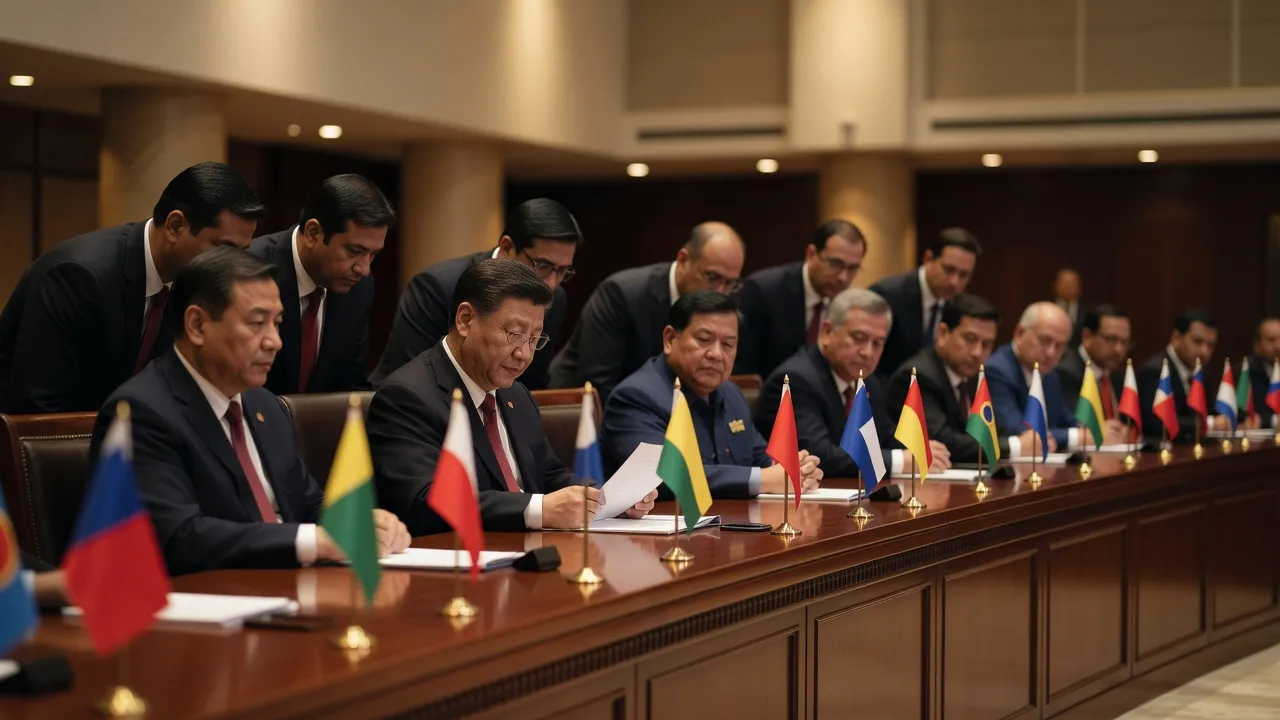
Paris, September 14, 2026. The BRICS summit closed on Sunday, September 13, in New Delhi in an atmosphere that the French press describes as subdued, far from the spectacular announcements sometimes expected from a bloc that claims to represent the global South. France 24 immediately summarizes the tone of the meeting, presented as a summit "dominated by the conflict in the Middle East", where the war between the United States and Iran, and its repercussions on navigation in the Strait of Ormuz, weighed on the debates more than any new initiative.
RFI notes that the Middle Eastern issue was only addressed in a "very vague" way in the joint statement, recalling that several members of the group, Iran and the United Arab Emirates in particular, are directly parties to the conflict, which makes any consensus fragile. In the absence of expansion, New Delhi has chosen to associate the ten partner countries more closely with the bloc's work: "the summit closed this Sunday, September 13, without a new extension of the circle of 11 full members", the agency reports.
In substance, three areas stand out from the announcements reported by the French press: a cooperation framework aimed at securing supply chains deemed vulnerable, a common early warning system for infectious diseases, and strengthened financial cooperation. Indian Prime Minister Narendra Modi, who has held numerous bilateral talks with the leaders of the Philippines, Kazakhstan, South Africa, Egypt, Burundi, Uganda, and Nigeria, summarized the group's ambition by stating that "the BRICS are not just a group of countries, but also an ecosystem of solutions."
For the French press, this summit illustrates the limits of a heterogeneous bloc, constrained to a facade of unanimity on geopolitical crises, while seeking to consolidate, through small institutional touches, a parallel architecture to Western institutions, without disrupting its eleven-member geometry.