Common ground and differences in coverage across the media analysed.
What the media report in common
1
Hundreds of high schools were disrupted or closed on Friday, October 2, according to the Ministry of Education's figures, in a blockade movement that began at the end of September.
2
The blockades are accompanied by clashes with law enforcement and damage, reported by the press in eight of the nine countries.
Where media coverage diverges
Origin of the mobilization
Question: what is fueling the movement? Swiss, German, French, and Australian press report the accusation targeting LFI or 'outsiders'; American and South African press highlight school grievances (absent teachers, buildings, overcrowded classes, budget).
Question: how many people were arrested? Four sources cite around 2,000 arrests (Darmanin on RTL), the German source cites over 5,000 since Monday (Nuñez on TF1), of which around 85% are minors.
Canberra is gauging the French high school crisis in light of Emmanuel Macron's unpopularity, six months out from the 2027 presidential election, amid budget cuts in education.
Brussels sees the French high school movement as a reflection of a suffering youth and school system, while watching for contagion in its own schools in Liège.
Brasilia sees the high school revolt as a test for a very unpopular Emmanuel Macron, six months ahead of the presidential election, with education budget cuts in the background.
Canberra is gauging the French high school crisis in light of Emmanuel Macron's unpopularity, six months out from the 2027 presidential election, amid budget cuts in education.
KEY POINTS
According to Gérald Darmanin on RTL, 2000 people, mostly teenagers, have been arrested since the start of the protests.
Four hundred high schools, about one in ten, were closed on Friday, according to PerthNow.
The Macron government is described as very unpopular six months from the 2027 presidential election, with budget cuts exacerbating the education crisis.
ANALYSIS
Canberra, October 3, 2026. Australian media is treating the French high school mobilization as a test for a weakened power. PerthNow headlines "Clashes as France struggles to quell school protests" and describes a government that "is struggling to contain" increasingly violent protests over teaching conditions and funding.
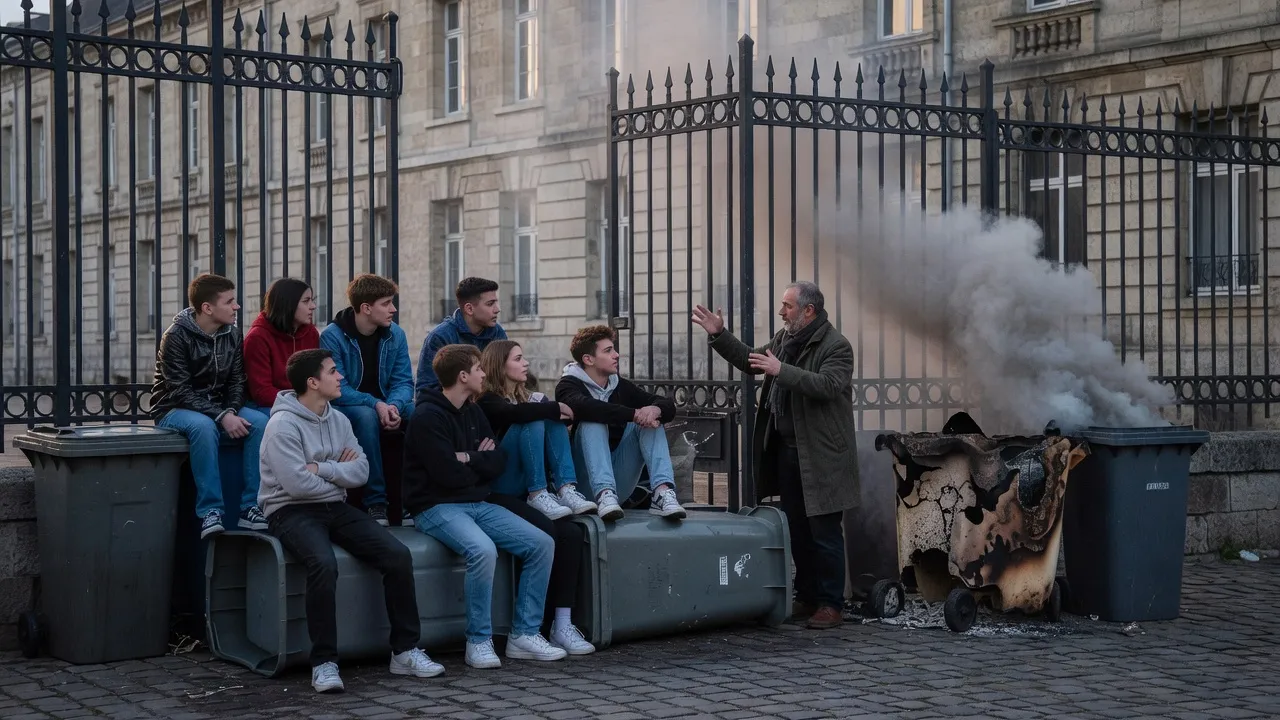
The story opens with street scenes. On Friday, tear gas filled the streets of Strasbourg, fireworks targeted police lines in Marseille, and trash cans were set on fire in Rennes. In Paris, where clashes also took place, high school students held up signs reading: "We have a future to build, not to suffer". Videos from The Age and the Sydney Morning Herald show CRS using tear gas against protesters in Paris, Toulouse, and Strasbourg.
The political context is set from the start: six months ahead of the 2027 presidential election, polls consistently show the strong unpopularity of Emmanuel Macron and his government. The planned budget cuts, which exacerbate the education funding crisis, are presented as the fuel for discontent. The movement, which started in the Paris region the previous week, has spread across the country.
The text gives the floor to the government. Justice Minister Gérald Darmanin states on RTL that 2000 people, mostly adolescents, have been arrested since the start of the protests, and that the parents of those responsible for damage should pay for repairs. He believes the movement has been hijacked by "outside elements". Education Minister Édouard Geffray, on BFM TV, calls on parents to dissuade their children from protesting: "In the street, children are in danger".
The students' demands are reported without filter: overcrowded classes, regular teacher shortages, dilapidated buildings, attributed to years of underinvestment. A high school student cites classes of 35 students and a lack of chairs. Four hundred high schools, or about one in ten, were closed on Friday.
The Australian coverage remains brief and based on a single dispatch, without mentioning the call for a new mobilization, the plan to replace teachers, or the investigations into police violence.
Belgium
DOMINANT ANGLE
Brussels sees the French high school movement as a reflection of a suffering youth and school system, while watching for contagion in its own schools in Liège.
KEY POINTS
Odoxa survey for Le Figaro and Backbone published on October 1: 62% of people consider the high school mobilization "justified", but condemn the violence.
Nearly a thousand actions recorded on October 1 in France, and nearly 400 establishments remain closed, according to La Libre Belgique.
The movement is expanding beyond the province of Liège (Herstal, Waremme, Grâce-Hollogne) and calls are circulating for Namur, Visé, and Brussels, according to Logan Verhoeven of the CEF.
ANALYSIS
Brussels, October 3, 2026. The French-speaking Belgian press is treating the French high school movement more as a reflection of youth and school than as a government crisis, with an added effect of contagion at home. La Libre Belgique cites a survey by Odoxa for Le Figaro and Backbone, published on October 1: 62% of French people consider the mobilization of high school students "justified", while condemning violence and excesses. Support is majority in all age groups and in almost all political families; only supporters of Les Républicains are in the minority, at 41%.
The daily newspaper relays the analysis of researcher Paolo Stuppia (CESSP): "A majority of French people can identify with this schooled youth: they can tell themselves that these are potentially their children." The blockages have been multiplying since September 21 against the degradation of learning conditions: dilapidated buildings, unreplaced teachers, overcrowded classes, pressure from Parcoursup. Nearly a thousand actions were recorded on October 1, with many arrests and several hundred injured among the police; nearly 400 establishments remain closed. The title makes popular support "the government's nightmare", in a context of distrust towards the executive.
La Dernière Heure is looking more towards Belgium. The spontaneous student strike movements are being emulated beyond the province of Liège: gathering in front of the Athénée Royal Liège Atlas, extension to Herstal, Waremme and Grâce-Hollogne. The newspaper reports "a few arrests and some damage", police being stoned, and calls to block schools in Huy that are circulating on TikTok, without knowing if it's "serious, humorous or unconscious".
Brazil
DOMINANT ANGLE
Brasilia sees the high school revolt as a test for a very unpopular Emmanuel Macron, six months ahead of the presidential election, with education budget cuts in the background.
KEY POINTS
According to the Education Ministry, 735 schools were disrupted or closed on Friday, October 2, after an announcement of 400 closures out of 3,700 high schools (Folha).
Official tally since the start of the movement: over 300 police officers and gendarmes, 65 national education officials including 40 principals, and 170 injured students (Folha).
Gérald Darmanin stated on RTL that 2,000 people, mostly teenagers, had been taken into custody and that parents should pay for the damages (Jornal de Brasília).
ANALYSIS
Brasília, October 3, 2026. The two Brazilian texts available, published by the Folha de S.Paulo and reproduced by the Jornal de Brasília, begin with the riot police facing off against high school students "in cities across France" on Friday, October 2, as the government of President Emmanuel Macron attempted to contain increasingly violent protests against classroom conditions and the lack of resources for education.
The account proceeds by scenes: clouds of tear gas in Strasbourg, fireworks fired at police barriers in Marseille, trash cans set on fire in Rennes. In Paris, students hold up a sign: "We have a future to build, not to suffer." The figures come from the authorities: according to the Ministry of Education, more than 560 schools are affected in one version of the text, 735 disrupted or closed in the other; the minister had announced the planned closure of 400 of the country's 3,700 high schools.
The human toll is reported "according to official figures": more than 300 police officers and gendarmes injured, 65 agents from the Ministry of Education, including 40 principals, and 170 students since the beginning of the movement.
The judicial aspect appears under the title "the minister says parents must pay for damages." Gérald Darmanin stated on RTL that the police had arrested 2,000 people, mostly adolescents, and that the parents of those responsible for vandalism should reimburse the damages.
Switzerland
DOMINANT ANGLE
Bern is deciphering the French high school crisis from its political aspect: between Minister Geffray's promise of dialogue and the accusation launched at La France insoumise, the Swiss Romandy and Alemannic press is mainly weighing the battle of responsibilities.
KEY POINTS
According to Édouard Geffray, quoted by SRF News, about 400 high schools were to remain closed on Friday, October 2, with distance learning, and protests were affecting more than 500 establishments.
Matignon mentioned an "organized maneuver by LFI and its ultra-left proxies"; Jean-Luc Mélenchon denies it and Manuel Bompard denounces "conspiracy theories" (Le Temps).
Gérald Darmanin threatens to make parents pay for the damage caused by their children, while Laurent Nuñez announces an investigation for attempted homicide after the assault of a police officer in Belfort (SRF News).
ANALYSIS
Berne, October 3, 2026. The Swiss press is covering the French high school mobilization from two complementary angles: the extent of the disruptions on one hand, and the political quarrel on the other.
SRF News, in its article on Friday, October 2, focuses on the scope of the movement: "Schülerproteste in Frankreich: 400 Schulen geschlossen" ("Student protests in France: 400 schools closed"). The German-speaking media outlet explains that students have been taking to the streets for several days to demand more resources for education, and that the protests have turned violent in some areas. According to Education Minister Édouard Geffray, around 400 establishments were to remain closed on Friday and offer distance learning. According to information reported by SRF, demonstrations were banned near the affected schools, and protests continued in more than 500 establishments.
The Zurich daily also highlights the security dimension: in Belfort, a police officer was violently attacked, and according to Interior Minister Laurent Nuñez, an investigation into attempted homicide is underway. On the government side, SRF distinguishes between two approaches: Geffray wants to meet with representatives of high school and university students to discuss their demands, while Justice Minister Gérald Darmanin threatens to make parents pay for the damage caused by their children during the protests.
Germany
DOMINANT ANGLE
Berlin is deciphering a high school crisis that is eluding a minority government: the German press is focusing on the violence, the shadow of LFI, and the distance taken by the high school representatives.
KEY POINTS
According to Laurent Nuñez on TF1, more than 5,000 people have been arrested since Monday, including about 85% minors (ZEIT/dpa).
Édouard Geffray claims that one in three public high schools is affected by blockages and that 65 teachers have been injured, including 40 school principals (FAZ).
Student representatives disavow the violence but, lacking concrete promises, maintain the mobilization and support Tuesday's day of action (ZEIT).
ANALYSIS
Berlin, October 3, 2026. For the German press, the French high school mobilization is first and foremost a problem of order and political control. The FAZ headlines with "children in danger" and "schools on fire" and writes that the French minority government sees "control slipping away" in the face of violent protests in more than 1,200 high schools. According to Education Minister Édouard Geffray, one in three public high schools is experiencing blockages or other actions. The daily shows him "visibly helpless" on BFM, calling on parents to keep teenagers away from blockages: "I am responsible for twelve million minors."
The newspaper describes a movement born the previous week from peaceful sit-ins in the Paris suburbs, then spreading "like wildfire": fires, damage, teachers and school administrators beaten or targeted with firecrackers. Geffray puts the number of injured teachers at 65, including 40 school administrators. The FAZ also raises the question of whether the "left-wing populists" of LFI are fueling the high school students, and notes that the main unions and LFI are calling for a major day of protest on Tuesday.
The ZEIT, picking up a dpa dispatch, gives the figures from Interior Minister Laurent Nuñez on TF1: more than 5,000 arrests since Monday, 1,747 on Friday and 1,954 on Thursday, about 85% of them minors. On Friday, 735 establishments were affected, 30% fewer than the day before, with disturbances around 158 of them. Nuñez judges the scope to be "considerable and surprising" and attributes it partly to social media and the influence of LFI, while admitting that the violence has "completely escaped" its promoters. The video of a police officer being thrown to the ground and beaten has provoked horror.
France
DOMINANT ANGLE
Paris is deciphering the high school crisis as a political test, less than seven months from the presidential election: between "act 3", government responses, and accusations targeting La France insoumise, the street is weighing on the executive.
KEY POINTS
The Education Ministry reported 735 disrupted institutions on Friday, October 2, out of approximately 3,700, "30% fewer" than on Thursday, with 400 high schools closed.
Student organizations are calling for a "third act" on October 6 after receiving a consultation platform from Geffray but "no concrete commitments".
Darmanin is asking prosecutors for a "firm and immediate" penal response and for the civil liability of parents to be engaged; nearly 2,000 arrests have been made since the start of the movement.
ANALYSIS
Paris, October 3, 2026. After more than a week of blockages, the high school movement is not dying down. Born out of a teachers' strike at the Saint-Exupéry high school in Créteil on September 17, according to L'Obs, it affected 1,027 schools on Thursday, October 1, according to the Ministry of the Interior. On Friday, October 2, the Ministry of Education reported 735 disrupted schools out of approximately 3,700, or "30% fewer" than the day before, with 400 high schools closed.
Received by Édouard Geffray on Friday, three high school unions left disappointed. RFI reports that the minister mainly announced a consultation platform, a first step deemed still too timid. "We didn't get any concrete commitments," summarizes Louis Letoublon, from the Les Lycéens union. The organizations are therefore calling for an "act 3" on October 6, with a large national demonstration; L'Obs also mentions an intersyndical strike of staff on that day. On Thursday evening, according to 20 Minutes, the minister had already abandoned the registration fees for BTS and preparatory classes planned in the 2027 budget project.
The government is taking a tougher stance. Gérald Darmanin sent a circular to prosecutors requesting a firm and immediate penal response and the engagement of parental civil liability, which Sud Ouest relates to article 1242 of the Civil Code. In the Pyrénées-Orientales, the prefect wrote to the parents of minors arrested. RFI reports nearly 2,000 arrests since the beginning of the movement, and in Belfort, two young adults were sentenced to suspended sentences or community service, according to BFMTV. In Nantes, the Nelson-Mandela high school, whose hall was burned, remains closed until the All Saints' vacation.
United Kingdom
DOMINANT ANGLE
London sees the high school protests as a political test for Emmanuel Macron: just a few months ahead of the presidential election, the BBC and The Independent view the government as gripped by "cold sweats" in the face of youth.
KEY POINTS
Friday, about 400 high schools were closed to protect staff and students, after hundreds of high schools were blocked on Thursday (BBC).
The Education Ministry reported on Friday early afternoon that 560 establishments were affected by the protests (The Independent).
The hall of a high school in Nantes was destroyed by a fire, and the cost of the damage is in the millions of euros (BBC).
ANALYSIS
London, 3 October 2026. For the British press, the mobilisation of French high school students is first and foremost a political problem for the executive. The BBC opens with a "wisdom" that all French leaders know: "young people on the street equals trouble". Since the student protests of May 1968, recalls the correspondent, every government has feared an angry youth. Youth movements are unpredictable and lack a clear structure to negotiate with, other groups can join in, public opinion tends to sympathise, and a police blunder would have "incalculable" consequences. With a presidential election just a few months away, the BBC notes that Emmanuel Macron's government is, according to Le Monde on Friday, experiencing "cold sweats".
The chronology is precisely retraced. The movement was born nearly two weeks ago in Seine-Saint-Denis, a popular area in the north of Paris, before spreading across the country. Thursday was the climax, with hundreds of high schools blocked; on Friday, around 400 high schools were closed to protect staff and students, and universities are starting to join the movement. The BBC mentions a high school hall in Nantes destroyed by a fire and estimates the damage at millions of euros. Its tone is one of analysis: the atmosphere is described as more excited than frankly furious.
The Independent, more alarmed, headlines with protests that "are turning into riots" and streets "in turmoil". The daily newspaper mentions thousands of arrests and hundreds of injured, schools set on fire, burning bins, teenagers taunting the police, charges and tear gas. On Friday afternoon, the Ministry of Education reported 560 affected establishments. The newspaper places the episode in the French tradition of street protests, from 1789 to 1968, the 2005 suburban riots and the 2023 protests against the pension reform, and notes that the high school students have the know-how of veterans, with masks and goggles against the gas.
United States
DOMINANT ANGLE
The United States retains above all the street images and the words of the students: a high school revolt that has become national, between degraded classrooms, absent teachers and confrontations with the police.
KEY POINTS
According to the Education Ministry, classes were disrupted in more than 560 high schools out of 3,700 on Friday; more than 1,000 were affected on Thursday, according to the Interior Ministry (CBS News).
Édouard Geffray claims that the high school movement is "held hostage by ultra-violent fringe groups" (CBS News).
Students are denouncing overly long school days, overheated classrooms, deteriorated buildings, and staff shortages, and are accusing the police of excessive use of force (CBS News).
ANALYSIS
The United States is closely following the French high school crisis, which American channels are covering as a student movement that originated in the Paris region and then spread throughout the country, without focusing solely on isolated incidents. On October 3, 2026, in Washington, CBS News, which relies on AFP, reports that high school students lit fires in front of their schools and clashed with police on Friday, October 2, in a movement that forced the closure or disrupted classes in more than 560 schools. According to the Ministry of Education, 560 high schools out of 3,700 are affected; more than 1,000 were affected on Thursday, according to the Ministry of the Interior.
The narrative largely gives voice to the students. In front of the Lycée Turgot, in the center of Paris, Simon, 15, who did not give his last name, says: "For a whole year, we didn't have a science teacher. We don't have any textbooks," and adds that the situation is "even worse" in the suburbs. CBS summarizes the grievances: days that are too long, overheated classrooms, degraded buildings, and too many staff absences.
On the government side, CBS reports that the executive branch considers the demands legitimate but condemns what it calls "urban violence." Education Minister Édouard Geffray claims that the movement is "held hostage by ultra-violent fringe groups." The students, in turn, accuse the police of excessive use of force and regular tear gas firings to disperse gatherings. In Paris on Friday, a fire damaged the entrances of two high schools, according to an AFP photographer; firefighters intervened; the movement shows "no sign of abating," the channel writes.
South Africa
DOMINANT ANGLE
Pretoria takes away from the French high school crisis a deeply rooted educational unease stemming from underinvestment, rather than just a simple street disorder: classes of 35, absent teachers, dilapidated buildings.
KEY POINTS
According to the ministry cited by The Citizen, more than 560 high schools out of 3,700 were disrupted on Friday, October 2, compared to more than 1,000 the day before.
Gérald Darmanin stated on RTL that 2,000 people, mostly teenagers, had been arrested and that the parents of those responsible for the damage should pay for repairs.
Daily Maverick (Reuters) links the high school students' anger to classes of 35 students, teacher shortages, deteriorated buildings, and an education budget increase below inflation.
ANALYSIS
Pretoria, October 3, 2026. The South African press is following the French high school movement through AFP dispatches, reproduced by The Citizen, and Reuters, published by Daily Maverick. Initially, it reports on a youth demanding decent study conditions, before focusing on the violence.
The Citizen describes high school students setting fires in front of their schools and clashing with police, in a movement born the previous week in the Paris region and then spread throughout the country. According to the ministry, teaching is disrupted in more than 560 high schools out of 3,700 on Friday, October 2; more than 1,000 were affected the day before. In Paris, fire damaged the entrance of two high schools, Léonard-de-Vinci and Gaston-Bachelard. The newspaper gives the floor to Simon, 15, in front of the Turgot high school: "For a whole year, we didn't have a science teacher. We don't have any textbooks," before adding that the suburbs are even worse.
The government, the dispatch reports, considers the grievances legitimate but condemns "urban violence." Education Minister Édouard Geffray claims that the movement is "held hostage by ultra-violent marginal groups." The students accuse the police of excessive use of force, with regular tear gas grenade firings.
Explore every perspective on this subject across 9 countries.
France: high school students call for an "act 3" on October 6 as the government promises replacement teachers and targets parents over damage
published on
October 3, 2026
9
countries
24
sources
25
articles
50/100
gap
The press in the nine countries in the corpus describes a movement that the ministries measure with figures that vary by the hour and by source, with specific school demands and a debate over responsibilities, this article reviews these media elements media by media.
The mobilization continues: a "third act" is called for Tuesday, October 6, and the plan to replace absent teachers has just been announced.
Figures that vary depending on the source
The number of affected establishments changes according to the ministry and the time. On Friday, October 2, the Ministry of Education reported 735 disrupted establishments out of approximately 3,700, which is "30% fewer" than the previous day, according to ZEIT and the French press. CBS News and The Independent cite 560 affected high schools; the latter specifies that this was on Friday, early in the afternoon. For Thursday, October 1, L'Obs reports 1,027 establishments, according to the Ministry of the Interior, and FAZ mentions more than 1,200 high schools.
Regarding arrests, two ministers have given two different totals. Gérald Darmanin stated on RTL that 2,000 people have been arrested since the beginning of the protests, a figure reported by the Australian, Brazilian, South African, and French presses. Laurent Nuñez cited on TF1, according to dpa as reported by ZEIT, more than 5,000 arrests since Monday, including 1,954 on Thursday and 1,747 on Friday. Four out of nine media outlets report the first figure, and only one reports the second: this count measures what each media outlet has reported, not the actual number of arrests.
The toll of injured people also comes from official sources. France 24 reports 170 students, 65 national education staff, and 305 police officers, gendarmes, and firefighters on Thursday. Folha publishes similar figures "according to official numbers," and FAZ reports that Édouard Geffray estimates 65 injured teachers, including 40 school principals.
Claims and meeting with the minister
Each media outlet has a different starting point. L'Obs traces the movement back to a teachers' strike at the Saint-Exupéry high school in Créteil on September 17. La Libre Belgique talks about blockages that have been multiplying since September 21, and the BBC situates the birth of the movement in Seine-Saint-Denis.
« For a whole year, we didn't have a science teacher. We don't have any textbooks »
Simon, 15 years old, in front of Turgot high school in Paris, as reported by CBS News (AFP dispatch)
The grievances, however, overlap from one press outlet to another. La Libre Belgique cites dilapidated buildings, unreplaced teachers, overcrowded classes, and the pressure of Parcoursup. Daily Maverick, which publishes a Reuters dispatch, adds classes of 35 students and an education budget increase lower than inflation.
Received by Édouard Geffray on Friday, three high school unions left without satisfaction, according to RFI: the minister primarily announced a consultation platform. Thursday evening, according to 20 Minutes, he had given up on the planned registration fees for BTS and preparatory classes in the 2027 budget project. Die ZEIT reports that Nathanaël Combray, from "Renouveau Lycéen", finds certain scenes "absolutely repugnant" and calls on high school students to take responsibility, while Louis Letoublon asserts that the perpetrators of the violence are outsiders to the institutions.
Law and order and penal response
The Keeper of the Seals has sent a circular to prosecutors, Sud Ouest reports, which links the commitment of parental civil liability to Article 1242 of the Civil Code. In the Pyrénées-Orientales, the prefect has written to the parents of minors arrested, according to the same French press. In Belfort, two young adults have been sentenced to suspended sentences or community service, according to BFMTV.
The maintenance of order is also being examined. HuffPost France cites a 14-year-old high school student seriously injured in Saint-Ouen-l'Aumône by a grenade launcher shot, which the IGPN is investigating, and a 16-year-old high school student injured in the eye in Argenteuil according to LFI MP Paul Vannier. According to CBS News, students accuse the police of excessive use of force; the dpa notes that the government claims the police are acting with restraint.
In Nantes, the BBC reports that a high school hall was destroyed by a fire and estimates the damage at millions of euros.
LFI and views of the foreign press
Le Temps reports that Matignon condemned "urban violence" and mentioned a "maneuver organized by LFI and its ultra-left proxies". According to ZEIT, Laurent Nuñez attributes the scope of the movement partly to social media and LFI's influence, while admitting that the violence has "totally escaped" its promoters. PerthNow reports that Gérald Darmanin talks about a movement hijacked by "external elements".
« We do not allow ourselves to be accused in this manner. »
Jean-Luc Mélenchon, as reported by Le Temps (Geneva)
Jean-Luc Mélenchon denies any responsibility, according to Le Temps. National coordinator Manuel Bompard denounces "conspiracy theories" and "infantilization of high school students". La Libre Belgique notes that nearly two-thirds of the French support the mobilization, according to Odoxa, without supporting its political recovery; only Les Républicains sympathizers are in the minority, at 41%.
The presses have not highlighted the same elements, which does not put them in disagreement. The American and South African corpora are based on student testimonials and teaching conditions. The Swiss and German corpora detail the accusation against LFI and the violence. The Australian, Brazilian, British, and French corpora situate the movement in the context of the 2027 presidential election. This grouping describes what each corpus highlights, not the opinion of their inhabitants.
Share of minors among those arrested
According to Laurent Nuñez, about 85 % of the people arrested are minors.
Belfort investigation
Laurent Nuñez announced an investigation for "attempted voluntary homicide".
Key figures
5,000
Arrests since Monday, according to Interior Minister Laurent Nuñez on TF1
Logan Verhoeven, president of the Comité des élèves francophones (CEF), explains that "everything was done via Snapchat and Instagram" and that calls for mobilization in Namur, Visé and Brussels are circulating for next week. The CEF recommends that the authorities accommodate these mobilizations, which it considers "essentially peaceful", and sees in the movement a warning signal to be taken seriously. The free and communal schools in Liège had decided to keep their doors closed on Friday, without curbing the determination of some students.
The context is above all electoral. The articles recall that the presidential election is set for April 18 and May 2, that polls show "repeatedly" a deep unpopularity of Macron and his center-right government, and that the planned budget cuts, which exacerbate the education funding crisis, have "fueled discontent."
The provided texts do not mention the "act 3" of October 6, nor Mr. Geffray's plan to replace teachers, nor the controversy over La France insoumise, nor the attack on a police officer in Belfort or the young person injured in the eye in Tours. The Brazilian reader therefore receives a chronicle of public order and presidential fragility, without the details of the demands or the partisan debate.
Le Temps, in Geneva, shifts the focus to the partisan arena. Its article asks why La France Insoumise (France Unbowed) is being accused of fueling the violence, while Thursday's events saw clashes escalate. The newspaper reports that Prime Minister Sébastien Lecornu has set up an interministerial crisis unit and that Matignon has condemned "urban violence," citing a "maneuver organized by LFI and its ultra-left proxies."
The daily gives the floor to the defense. Presidential candidate Jean-Luc Mélenchon refutes any responsibility: "We do not allow ourselves to be accused in this way." He adds that the Unbowed movement "does not lead the popular movements," which "lead themselves." National coordinator Manuel Bompard, for his part, denounces "conspiracy theories" and "infantilization of high school students" by the government.
The Swiss perspective thus remains that of a neighbor who tallies the closures, relays ministerial announcements, and exposes the protests, without taking sides between the government's accusations and LFI's denials. The two available articles do not detail the plan to replace teachers or the call for a "third act."
The ZEIT devotes an article to the high school representatives. After their meeting with Geffray, Nathanaël Combray, from "Renouveau Lycéen", judges certain scenes to be "absolutely repugnant" and urges high school students to take responsibility; Louis Letoublon claims that the perpetrators are outsiders to the schools. Due to the lack of concrete promises from the minister, high school students and teacher unions want to continue and support the day of action on Tuesday. The dpa finally mentions criticism of the police, accused of excessive violence, while the government assures that they are acting with restraint.
The maintenance of order is itself being contested. France 24 reported on Thursday 170 students and 65 National Education staff injured, as well as 305 police officers, gendarmes, and firefighters. HuffPost France cites a 14-year-old high school student seriously injured in Saint-Ouen-l'Aumône by a grenade launcher shot, which is being investigated by the IGPN, and a 16-year-old high school student injured in the eye in Argenteuil, according to LFI MP Paul Vannier.
On the political level, Matignon condemns "urban violence" and attributes it to La France insoumise. L'Obs situates the crisis "less than seven months from the presidential election," while 20 Minutes notes that the high school students have invited themselves into the 2027 pre-campaign.
What distinguishes this moment, according to the newspaper, is the calendar: France is engaged in a presidential election race, and the candidates vying to succeed Macron in May have seized on the protests as a hot political issue. The two titles, in the available excerpts, barely touch on the students' demands and the details of the government's announcements; they focus on the dynamics of the movement and its impact on the political balance.
NBC News covers the topic in a video titled "Student protests in France take violent turn." Richard Engel's report, dated October 3, describes protesters clashing with police across the country over what "some students" present as teacher shortages and poor material conditions.
In the provided articles, the American press does not develop the call for a "third act," nor the plan to replace teachers, nor the civil liability of parents, nor the debate about La France insoumise: it sticks to the street scenes, disruption figures, and student testimonies.
Daily Maverick opens with Strasbourg flooded with tear gas, fireworks targeting the police in Marseille, and burning trash cans in Rennes. The Minister of Justice Gérald Darmanin declares on RTL that 2,000 people, mostly adolescents, have been arrested, that the parents of those responsible for damage should pay for repairs, and that the movement has been hijacked by "external elements." About 400 high schools, or one in ten, were closed on Friday; Geffray urges parents to discourage their children from demonstrating.
The article emphasizes the political and budgetary context: six months before the presidential election, polls show persistent unpopularity of Emmanuel Macron and his government, and planned cuts exacerbate the education funding crisis. A section title announces a budget increase for education below inflation. The high school students denounce overcrowded classes, teacher shortages, and dilapidated buildings, which they attribute to years of underinvestment. A sign sums it up: "We have a future to build, not to suffer."
The two articles do not mention the call for a "third act," the plan to replace teachers, or the controversy over La France insoumise.
More divergent than 23% of recent comparable stories (reference: 90 recent stories measured with the same method).