
DOMINANT ANGLE
London sees the high school protests as a political test for Emmanuel Macron: just a few months ahead of the presidential election, the BBC and The Independent view the government as gripped by "cold sweats" in the face of youth.
Dominant angle identified — does not reflect unanimity of this country’s media
KEY POINTS
- 01
Friday, about 400 high schools were closed to protect staff and students, after hundreds of high schools were blocked on Thursday (BBC).
- 02
The Education Ministry reported on Friday early afternoon that 560 establishments were affected by the protests (The Independent).
- 03
The hall of a high school in Nantes was destroyed by a fire, and the cost of the damage is in the millions of euros (BBC).
ANALYSIS
London, 3 October 2026. For the British press, the mobilisation of French high school students is first and foremost a political problem for the executive. The BBC opens with a "wisdom" that all French leaders know: "young people on the street equals trouble". Since the student protests of May 1968, recalls the correspondent, every government has feared an angry youth. Youth movements are unpredictable and lack a clear structure to negotiate with, other groups can join in, public opinion tends to sympathise, and a police blunder would have "incalculable" consequences. With a presidential election just a few months away, the BBC notes that Emmanuel Macron's government is, according to Le Monde on Friday, experiencing "cold sweats".
The chronology is precisely retraced. The movement was born nearly two weeks ago in Seine-Saint-Denis, a popular area in the north of Paris, before spreading across the country. Thursday was the climax, with hundreds of high schools blocked; on Friday, around 400 high schools were closed to protect staff and students, and universities are starting to join the movement. The BBC mentions a high school hall in Nantes destroyed by a fire and estimates the damage at millions of euros. Its tone is one of analysis: the atmosphere is described as more excited than frankly furious.
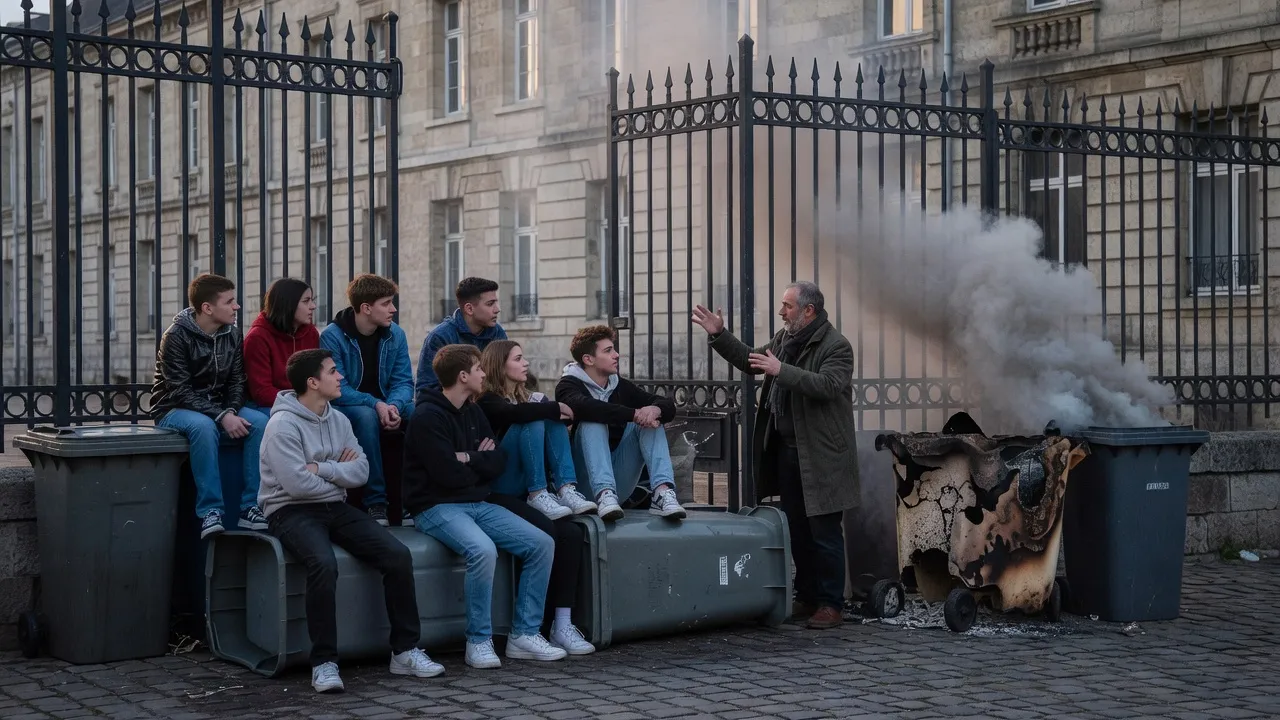
The Independent, more alarmed, headlines with protests that "are turning into riots" and streets "in turmoil". The daily newspaper mentions thousands of arrests and hundreds of injured, schools set on fire, burning bins, teenagers taunting the police, charges and tear gas. On Friday afternoon, the Ministry of Education reported 560 affected establishments. The newspaper places the episode in the French tradition of street protests, from 1789 to 1968, the 2005 suburban riots and the 2023 protests against the pension reform, and notes that the high school students have the know-how of veterans, with masks and goggles against the gas.
What distinguishes this moment, according to the newspaper, is the calendar: France is engaged in a presidential election race, and the candidates vying to succeed Macron in May have seized on the protests as a hot political issue. The two titles, in the available excerpts, barely touch on the students' demands and the details of the government's announcements; they focus on the dynamics of the movement and its impact on the political balance.







