
DOMINANT ANGLE
Brasilia sees the high school revolt as a test for a very unpopular Emmanuel Macron, six months ahead of the presidential election, with education budget cuts in the background.
Dominant angle identified — does not reflect unanimity of this country’s media
KEY POINTS
- 01
According to the Education Ministry, 735 schools were disrupted or closed on Friday, October 2, after an announcement of 400 closures out of 3,700 high schools (Folha).
- 02
Official tally since the start of the movement: over 300 police officers and gendarmes, 65 national education officials including 40 principals, and 170 injured students (Folha).
- 03
Gérald Darmanin stated on RTL that 2,000 people, mostly teenagers, had been taken into custody and that parents should pay for the damages (Jornal de Brasília).
ANALYSIS
Brasília, October 3, 2026. The two Brazilian texts available, published by the Folha de S.Paulo and reproduced by the Jornal de Brasília, begin with the riot police facing off against high school students "in cities across France" on Friday, October 2, as the government of President Emmanuel Macron attempted to contain increasingly violent protests against classroom conditions and the lack of resources for education.
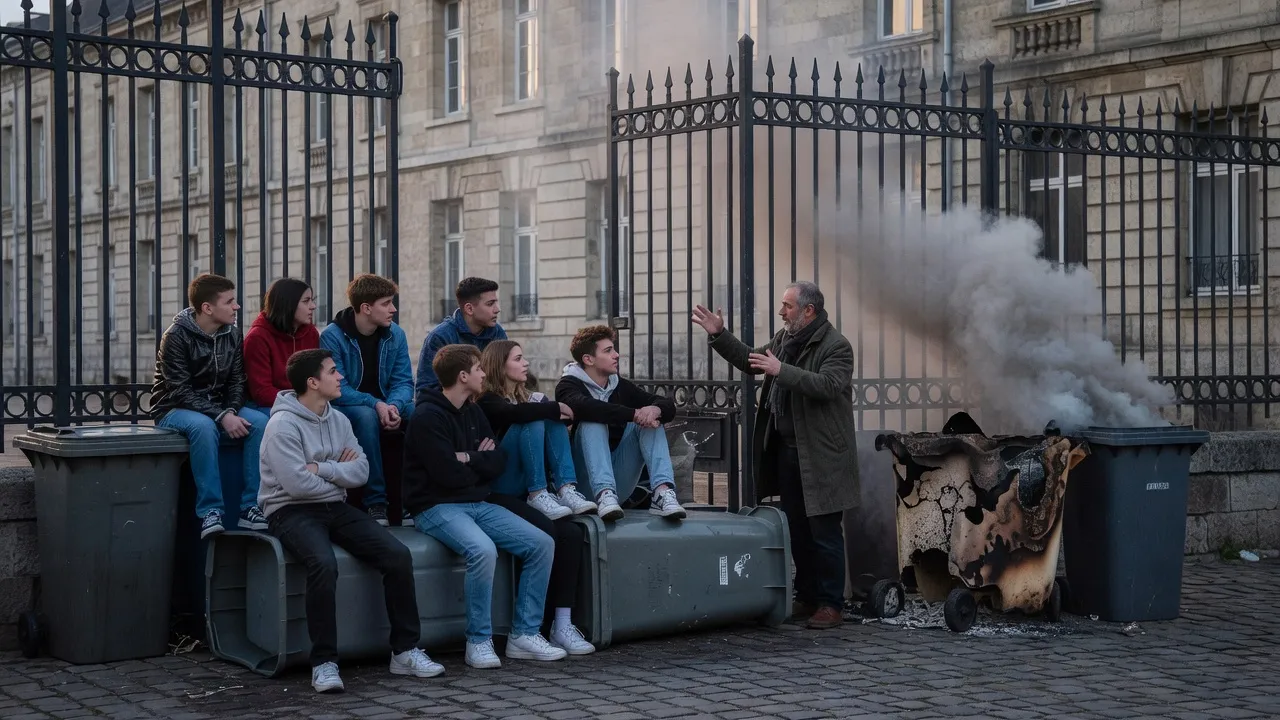
The account proceeds by scenes: clouds of tear gas in Strasbourg, fireworks fired at police barriers in Marseille, trash cans set on fire in Rennes. In Paris, students hold up a sign: "We have a future to build, not to suffer." The figures come from the authorities: according to the Ministry of Education, more than 560 schools are affected in one version of the text, 735 disrupted or closed in the other; the minister had announced the planned closure of 400 of the country's 3,700 high schools.
The human toll is reported "according to official figures": more than 300 police officers and gendarmes injured, 65 agents from the Ministry of Education, including 40 principals, and 170 students since the beginning of the movement.
The judicial aspect appears under the title "the minister says parents must pay for damages." Gérald Darmanin stated on RTL that the police had arrested 2,000 people, mostly adolescents, and that the parents of those responsible for vandalism should reimburse the damages.
The context is above all electoral. The articles recall that the presidential election is set for April 18 and May 2, that polls show "repeatedly" a deep unpopularity of Macron and his center-right government, and that the planned budget cuts, which exacerbate the education funding crisis, have "fueled discontent."
The provided texts do not mention the "act 3" of October 6, nor Mr. Geffray's plan to replace teachers, nor the controversy over La France insoumise, nor the attack on a police officer in Belfort or the young person injured in the eye in Tours. The Brazilian reader therefore receives a chronicle of public order and presidential fragility, without the details of the demands or the partisan debate.







