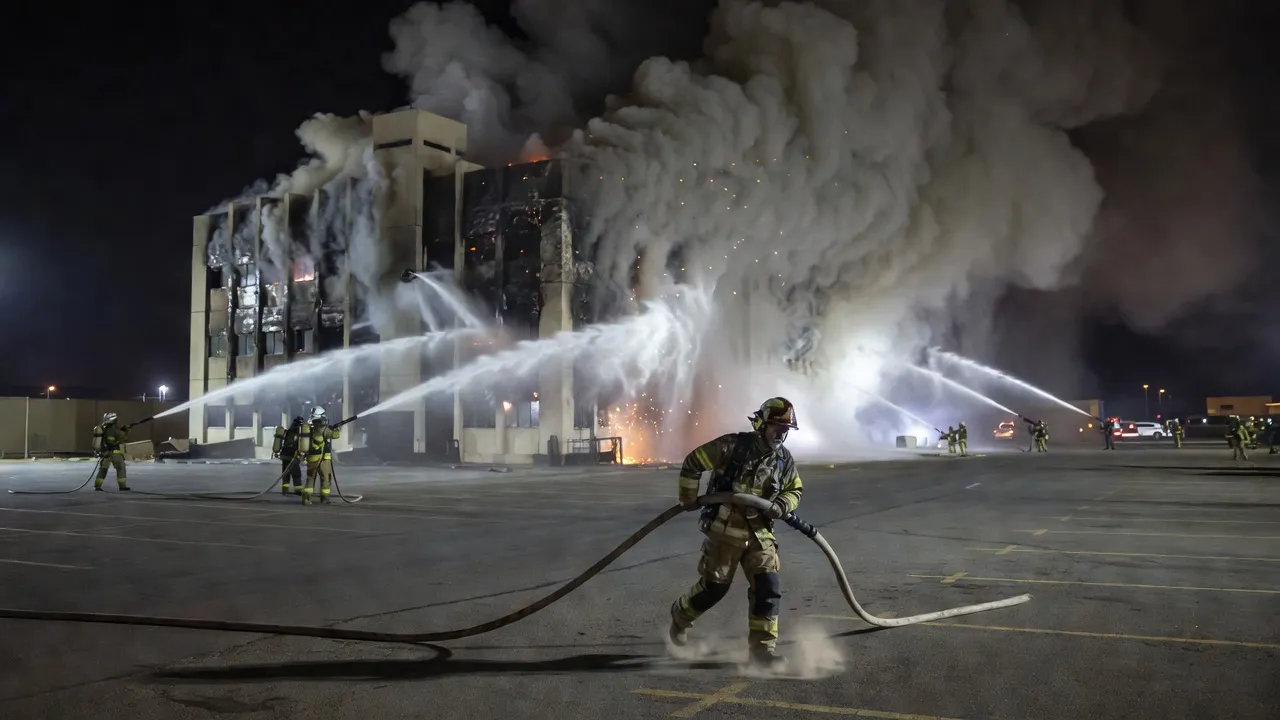
Saudi Arabia and the Houthis: Riyadh strikes oil sites near Sanaa, an Aramco building hit in return
published on
countries
sources
articles
More divergent than 42% of recent comparable stories (reference: 90 recent stories measured with the same method).
Behind the October 13 strikes, the perspectives in the corpus describe a multi-front war: a Yemeni government ground offensive, paralyzed Saudi airports, tense straits, and a pending American decision, with each coverage retaining a part of it.
The exchange of strikes continues between the coalition and the Houthis, and the question of a US intervention remains open.
What was on the al-Sabaha site
The articles agree on the sequence of events: the coalition warned civilians, with a map according to Saudi Gazette, before striking the central station of the Yemen Petroleum Company in Sanaa. They differ on the nature of the site. The coalition's spokesperson, Turki al-Maliki, claims, according to Saudi Gazette, that the joint forces command had established that the Houthis were using these civilian facilities to maintain their arsenal of missiles and drones.
« no stock of petroleum products »
The Yemen Petroleum Company responds differently. According to RFI, The Straits Times, and Business Day, which quote its statements, the station contained no stock of petroleum products and the strike did not affect the reserves or supply chains. ANSA also reports that the tanks were empty.
The affected sites also differ according to the accounts. Saudi Gazette mentions Sanaa, Hodeidah, and Dhamar. Interfax, which relies on Al Jazeera, mentions the port of Ras Issa and an oil station in the Badjil region, in the Hodeida province. Haaretz and ANSA relay the Health Ministry controlled by the Houthis, which reports two deaths in the attack on an oil company in this province and holds Riyadh responsible.
A Yemeni terrain in motion
Al Jazeera is covering the government operation "Dawn of Yemen". According to the channel, Rashad al-Alimi, president of the Presidential Council, has set the goal of retaking all Houthi territories, including Sanaa. An Arabic editorial cited by the channel sees the recapture of Dhubab and positions on Bab al-Mandeb, with around 100 coalition hunters in support. The Straits Times, on the other hand, recalls that the Houthis control at least a third of the territory and govern around two-thirds of a population of 34 million inhabitants.
Yemeni casualty reports come from partisan sources. TASS and Le Monde attribute to Yahya Saree, Houthi military spokesman, 104 Saudi strikes in twenty-four hours; TASS adds the figure of 2,281 since the beginning of the escalation. CGTN reports that the Houthis say they have suffered 119 strikes in 24 hours, with at least nine dead in the province of al-Jawf, and that the spokesman for the Yemeni army, Majid al-Nuzaili, announces 1,879 government attacks on Houthi targets.
On the civilian side, Pakistan and Qatar provide elements that few others pick up. The Express Tribune cites the local office of the Ministry of Human Rights: six civilians, including a little girl, killed on Sunday, October 11, by Houthi gunfire, and 17 injured in 24 hours. Al Jazeera reports Houthi bombings in Taiz that have caused dozens of civilian casualties and a UN warning of a possible shortage of wheat and flour in less than three weeks.
According to RIA Novosti, hostilities intensified in August after an attack on Sanaa airport, at the time of the landing of an Iranian plane carrying a Houthi delegation. The agency adds that the Houthis declared the Saudi airspace a military operations zone on October 5.
The Saudi defense examined
Several newsrooms are questioning how the missiles reached their target. The Daily Star, which quotes the Wall Street Journal, the Independent, and the AP, reports that Riyadh has opened an investigation. According to initial reports cited, the Houthis first launched drones to pave the way for a mix of cruise and ballistic missiles, which traveled more than 1,000 kilometers. The newspaper adds, citing the same media outlets, that the crown prince has been moved from palace to palace and has not been seen in public since the previous Tuesday.
« With their low-cost missiles, the cost of their attacks is lower than the cost of the Saudi defense. »
NBC notes that Saudi Arabia is, according to SIPRI, the largest buyer of American arms, and wonders why its defenses seem powerless. The Los Angeles Times quotes experts who are surprised that the Houthis struck at a distance of 800 kilometers. The Express Tribune refers to an article about an alert system that remained silent before the deadly strikes. Reuters, as reported by HuffPost, indicates that Riyadh's airport canceled 82% of its flights on Monday, October 12.
On BFM Business, analyst Mathieu Jolivet judges Riyadh to be "overwhelmed". He highlights the cost: the Houthis' cheap missiles make their attacks less expensive than Saudi defense.
The circulation of information is a separate issue. VRT NWS reports that Saudi Arabia prohibits filming or sharing images of the attacks and mentions potential prosecution for "unauthorized information". According to the Flemish editorial team, few authentic images are circulating, and several widely relayed videos, including one of a Saudia plane exploding, are old or generated by artificial intelligence.
Washington, Hormuz and the barrel
For the US press, the issue is one for the White House. CBS reports, according to two sources, that the president gave up a week after refusing to order raids himself. The Jerusalem Post notes that Donald Trump is leaving the media to guess whether he will do more, and the BBC, cited by the newspaper, mentions US support in intelligence and targeting. According to the same source, the Houthis promise a "rapid and painful" response against the US in the event of intervention.
« I'll be there after the elections, and I will never forget! »
In his message on Truth Social, reported by several media outlets, Trump attributes to the Houthis, "probably at Iran's request", the desire to drive up oil prices before the November 3 midterm elections. He also raises the idea of asking Turkish President Recep Tayyip Erdogan to support Saudi interests. No official response from Tehran is cited in the corpus texts. Iran International also reports his statement that a decision on Iran would come "very soon".
Economic media place the price of a barrel in a broader context. ProtoThema attributes the rise largely to Iranian attacks on tankers in the Strait of Hormuz, then to Houthi strikes. Free Press Journal notes that Brent has gained more than 70% this year. The Hindu Business Line cites Reuters, which relies on two unnamed Iranian officials: Tehran would deploy new tactics against ships to keep prices high. Aramco's CEO, Amin Nasser, judged on October 12, according to Jiemian, that global crude stocks were approaching a "extremely dangerous" level.
CNBC cites manager Paul Tudor Jones, who thinks a $20 to $25 rise in the barrel is possible. The Straits Times notes that the rise in fuel prices is weighing on American households as Republicans defend their majority in Congress.
The toll of October 10 varies: 12 dead according to Vedomosti and 13 according to Al Jazeera, with more than 300 injured.
Donald Trump refused Mohammed bin Salman's request in September, then said: "We may. We're gonna look at it".
The coalition reports the interception of Houthi missiles fired towards Dammam, Dahran and Kharj, cities housing Aramco facilities.
Key figures
- 107 $Price of a barrel of Brent after the attack on the Aramco building in Dhahran1 source · Free Press Journal
- 15 habitationsDamaged homes in Riyadh due to missile debris, according to civil defense1 source · ABC News
- 10 attacksTargeting five Saudi airports since October 5, according to Al Jazeera1 source · Al Jazeera
What the comparison reveals
Common ground and differences in coverage across the media analysed.
What the media report in common
The press in the seventeen countries is following the escalation between Riyadh and the Houthis through the Saudi targets hit: King Khalid Airport in Riyadh (Saturday, October 10) and an administrative building of Aramco in Dhahran (Tuesday, October 13 in the evening).
A large majority of the perspectives report that the coalition struck oil or fuel facilities near Sanaa on Tuesday, October 13, with a prior call to evacuate the central station of the Yemen Petroleum Company.
Where media coverage diverges
Role of al-Sabaha site
Regarding the question of whether the targeted site near Sanaa served the Houthi war effort, the coalition responds yes, while the Yemen Oil Company, cited by Singapore and South Africa, indicates that it contained no stock.
Coverage aligned with this reading
Coverage that diverges
Toll of Riyadh airport
For the October 10 attack, the published tolls vary: 12 dead (India, Iran, Vedomosti), 13 dead (Tunisia, Bangladesh, Pakistan, Qatar), 14 dead (RIA Novosti), at least 18 dead over the week (VRT).
Designation of Houthis
Saudi, Pakistani (ARY) and Israeli (Jerusalem Post) media use 'terrorist militia' or 'terrorists'; Mehr News refers to 'Ansarullah' and describes a Saudi strategic impasse.
Coverage aligned with this reading
Coverage that diverges
This grouping describes the publications analysed, not the position of these countries’ populations or of their governments.
Blind spots
What the coverage of each country leaves aside, while others put it forward.
 India
India- oil sites targeted in Sanaa, Saada and Dhamar
- justification of the coalition by the Houthi war effort
 United States
- evacuation order of the central station of the Yemen Petroleum Company in Sanaa
Understand the context
- OCT 5, 2026Start of a series of attacks on Saudi airports, according to Al Jazeera
- OCT 10, 2026Houthi attack on King Khalid Airport in Riyadh: 13 dead according to Al Jazeera
- OCT 13, 2026Coalition strikes on Yemeni oil sites, Houthi retaliation on Dhahran
How each country reads it
Preview: 3 of 17 media perspectives. Syntheses of the media analysed — not direct quotations. Method & limitations
 China
ChinaBeijing weighs the Saudi-Houthi escalation in light of the fragility of the oil market: Aramco facilities threatened, global stocks at a level deemed dangerous and the Strait of Hormuz in the background.
3 sources · View sources
 Bangladesh
Dhaka is first concerned about the security vulnerability of the Saudi kingdom: airport struck, crown prince taken to safety, air defense called into question, amid the regional US-Iran war.
2 sources · View sources
 Belgium
Brussels is deciphering the Saudi-Houthi escalation through its consequences on Saudi soil: wounded in Riyadh, Aramco site hit, and a flood of fake images despite a filming ban.
2 sources · View sources
The full text, country by country
China
DOMINANT ANGLE
Beijing weighs the Saudi-Houthi escalation in light of the fragility of the oil market: Aramco facilities threatened, global stocks at a level deemed dangerous and the Strait of Hormuz in the background.
KEY POINTS
- According to the Saudi Ministry of Energy, an administrative building of Aramco in Dhahran was hit on Tuesday evening, with a "limited fire" (SCMP).
- Amin Nasser, head of Aramco, believes global crude stocks are near an "extremely dangerous" level and cites diesel at around $200 a barrel (Jiemian, October 12).
- Tehran has reiterated its willingness to facilitate a dialogue between Saudi Arabia and the Houthis (CGTN).
ANALYSIS
Beijing, October 14, 2026. The Chinese press is following the escalation between Riyadh and the Houthis from the angle of energy flows and the risk to oil infrastructure. According to the Hong Kong South China Morning Post, Riyadh indicated on Wednesday, October 14, that an attack on an Aramco administrative building in Dhahran on Tuesday evening had caused a "limited fire", and that debris from intercepted Houthi missiles had injured four people in the capital.
The Jiemian website, which reprints a dispatch from the central television CCTV, reports that the Houthis warned all employees and civilians near Aramco facilities on Tuesday, October 13, in the afternoon, to move away, as these facilities were becoming "legitimate targets" in their view. The CGTN channel, for its part, focuses on the worsening humanitarian crisis in Yemen and details the exchange of strikes: the Houthis claim to have targeted King Khalid Airport in Riyadh and an airbase in Khamis Mushait on Monday evening, while the coalition claims to have intercepted the missile. The Houthis report 119 Saudi strikes in 24 hours and at least nine deaths in the province of al-Jawf.
The energy aspect is treated separately. Jiemian relays the remarks of Aramco's boss, Amin Nasser, made on October 12 at the World Petroleum Congress: global crude oil stocks are approaching a "extremely dangerous" level, their replenishment could take two years even if the Strait of Hormuz were to reopen, and diesel is trading around $200 a barrel. Nasser sees the need for international cooperation to protect infrastructure and supply routes.
The diplomatic and industrial dimension appears in the background. CGTN notes that Tehran has reiterated its willingness to facilitate a dialogue between Saudi Arabia and the Houthis. The SCMP wonders whether the Sino-Pakistani fighter jets and the Chinese-made air defense system, which are reportedly deployed in Saudi Arabia, could be used after the renewed commitment of Pakistani Prime Minister Shehbaz Sharif on Sunday, October 11, to cooperate with Riyadh "in all possible ways". The strikes on Riyadh airport on Saturday, October 10, are reported to have killed at least 13 people.
The articles in the corpus do not mention the Saudi strikes on al-Sabaha or Washington's position: attention is focused on the security of Aramco facilities and the state of the oil market.
Bangladesh
DOMINANT ANGLE
Dhaka is first concerned about the security vulnerability of the Saudi kingdom: airport struck, crown prince taken to safety, air defense called into question, amid the regional US-Iran war.
KEY POINTS
- Saturday, October 10, attack on Riyadh's airport: 13 dead and at least 300 injured, the worst for Saudi Arabia in a decade (The Daily Star).
- An Aramco administrative building in Dhahran was hit Tuesday evening: "limited fire", no casualties; four injured and 15 homes damaged in Riyadh by missile debris.
- The coalition called on civilians to evacuate the central station of the Yemen Petroleum Company in Sanaa before the operation; the Houthis promised a "harsh and painful" response (TBS News).
ANALYSIS
Dhaka, October 14, 2026. In the Bangladeshi press, the escalation between Riyadh and the Houthis is first reported as a matter of the kingdom's security. The Daily Star recalls that Saudi Arabia suffered its worst attack in a decade on Saturday, October 10: 13 dead and at least 300 injured at Riyadh's international airport. The newspaper quotes information from the Independent, the Wall Street Journal, and the AP, according to which Crown Prince Mohammed bin Salman has been moving from palace to palace, equipped with bunkers, and has not been seen in public since the previous Tuesday.
The daily also details the investigation opened by Riyadh into the failure of its air defense. The first elements indicate that the Houthis first launched several drones to pave the way for a mix of cruise and ballistic missiles, which traveled more than 1,000 kilometers. These missiles, capable of changing trajectory in flight, pose a challenge to Patriot interceptors. Donald Trump says he is considering joining Saudi strikes, and the allies of the "Makkah Pact" have expressed their support.
For Tuesday, October 13, The Daily Star reports that the coalition struck oil sites in western Yemen, in Sanaa, and in the provinces of Dhamar and Saada. Spokesman Turki al-Maliki claims they were fueling the Houthis' "war effort" against the kingdom and the Red Sea. In the evening, an administrative building of Aramco in Dhahran was hit, with a "limited fire" and no casualties, according to the Ministry of Energy. The debris of two intercepted cruise missiles injured four people in Riyadh and damaged 15 homes, according to civil defense.
TBS News focuses on the warning that preceded the strikes: the coalition called on civilians to evacuate the central station of the Yemen Petroleum Company in Sanaa. Houthi military spokesman Yahya Saree promised a "tough and painful" response to Riyadh. The Houthis, in turn, summoned employees near Aramco facilities to leave, calling them legitimate targets.
TBS situates the confrontation within a broader regional conflict between the United States and Iran, of which it is presented as an overflow. It notes that Riyadh has struck the Houthis in recent weeks and supports a counter-offensive by the Yemeni government after the group's capture of a strategic territory on the Red Sea coast. Riyadh's airport remains closed, disrupting Saudi air traffic. Both media outlets primarily cover the consequences for the kingdom; the fate of Yemeni civilians remains in the background.
Belgium
DOMINANT ANGLE
Brussels is deciphering the Saudi-Houthi escalation through its consequences on Saudi soil: wounded in Riyadh, Aramco site hit, and a flood of fake images despite a filming ban.
KEY POINTS
- Four people were injured in Riyadh by debris from two intercepted Houthi missiles and 15 homes were damaged, according to the Saudi civil defense.
- An Aramco administrative site in Dhahran was hit "Tuesday evening", with a limited fire and no casualties, according to the Saudi Ministry of Energy.
- According to VRT NWS, the attacks on King Khalid Airport this week have killed at least 18 people and Saudi Arabia has prohibited filming or sharing images of the attacks, which fosters fake news.
ANALYSIS
Brussels, October 14, 2026. The Belgian press is primarily interested in the Saudi aspect of the escalation: the consequences of the Houthi retaliation and the reliability of what the public sees. La Libre Belgique reports, on Wednesday, that four people, "two women, one man, and one child," were injured in Riyadh by debris from two intercepted Houthi missiles, fired on Tuesday according to the Saudi civil defense, and that 15 homes were damaged. The Ministry of Energy, for its part, reported that a Saudi Aramco administrative site in Dhahran, in the Dammam metropolitan area, was hit "Tuesday evening" by an attack that caused a limited fire, with no casualties. The ministry did not indicate the nature or origin of the attack, the daily newspaper notes, emphasizing that the country is targeted daily by Houthi fighters from neighboring Yemen.
VRT NWS, for its part, devotes a fact-checking article to images of the attacks on Riyadh's King Khalid International Airport. According to the Flemish editorial team, the Houthis fired missiles at the airport last week, resulting in at least 18 deaths. Since Saudi Arabia prohibits its citizens from filming or sharing these images, and threatens judicial action for spreading "unauthorized information," few authentic documents are circulating. This shortage favors the spread of false information: a spectacular video of a Saudia Airlines plane exploding and certain images from inside the airport are old, generated by artificial intelligence, or both, and have nonetheless been widely relayed, including by news media. VRT acknowledges that it itself was able to show few images in recent days.
The Belgian corpus does not describe the coalition's strikes on oil facilities near Sanaa, nor the price of Brent crude, nor Washington's position. The focus is on the territory of the kingdom: human toll, energy and airport facilities hit, and the circulation of information under constraint. The common thread is that of an escalation documented from official Saudi sources, with the limitations that this imposes: announcements from the civil defense on X, ministry statements, lack of precision on the origin of the attack on Aramco, and images locked at the source. For the Belgian reader, the immediate issue is therefore as much about knowing what happened as it is about distinguishing truth from falsehood in what is circulating.
 France
DOMINANT ANGLE
Paris is deciphering an escalation where the Houthis, with low-cost missiles, are testing Saudi defense and Aramco's infrastructure.
KEY POINTS
- The coalition struck al-Sabaha site near Sanaa on Tuesday, October 13, as well as sites in Saada and Dhamar, in the name of the Houthi "war effort" (RFI).
- An Aramco administrative site in Dhahran was hit, with a limited fire and no casualties, and four people were injured in Riyadh by missile debris (France 24).
- The embassy strictly advises its nationals to avoid the airports of Riyadh, Jeddah, and Dammam (France 24).
ANALYSIS
Paris, October 14, 2026. The French press is covering the escalation between Riyadh and the Houthis from a military and security angle. On Tuesday, October 13, the coalition led by Saudi Arabia bombed the al-Sabaha site of the Yemen Petroleum Company, west of Sanaa, as well as installations in the provinces of Saada and Dhamar. According to RFI, its spokesperson Turki al-Maliki claims that these sites supported the "war effort" of the Houthis. The coalition had called for the site to be evacuated, which pushed many Yemenis towards gas stations. The Yemen Petroleum Company assures that it contained "no stock of petroleum products".
Le Monde details the response: intercepted missiles and drones, a strong explosion heard by AFP journalists in Riyadh, a ballistic missile shot down heading towards Dhahran, the headquarters of Aramco, and a second missile targeting Harad, which hosts petroleum installations. The Houthis, through the voice of Yahya Saree, accuse the Saudi aviation of 104 strikes in twenty-four hours and report civilian deaths; the newspaper attributes these figures to their sole spokesperson.
France 24 reports on Wednesday, October 14, that an administrative site of Aramco in Dhahran was hit, with a limited fire and no casualties according to the Ministry of Energy, and that four people were injured in Riyadh by missile debris, according to the SPA agency. The channel also broadens the scope: the director of the IMF, Kristalina Georgieva, mentions potential negative repercussions for everyone, and two Iranian officials tell Reuters that Tehran is seeking to maintain high oil prices before the US midterm elections.
The national dimension is concrete: the French embassy in Riyadh "strongly" advises its citizens not to pass through the airports of Riyadh, Jeddah, and Dammam, and not to travel to these cities unless necessary. The airport in Riyadh remains closed after a deadly strike on Saturday, October 10, claimed by the Houthis.
On BFM Business, Mathieu Jolivet judges that Riyadh is "overwhelmed" and speaks of a "fiasco": the Houthis have "a true warrior culture" and their low-cost missiles make their attacks less expensive than the Saudi defense. The French narrative thus emphasizes the asymmetry of means and the security of infrastructure, more than the fate of Yemeni civilians.
 Greece
DOMINANT ANGLE
Athens gauges the Saudi-Houthi escalation by the barrel: Brent near $107, Aramco targeted and pressure on Washington, with no regard for the Yemeni terrain.
KEY POINTS
- Brent climbs towards $107 a barrel after a 0.9% drop on Tuesday, with WTI trading near $95 (ProtoThema).
- Trump said he could ask Erdoğan to join the response to the Houthis (ProtoThema).
- According to AFP cited by Naftemporiki, a loud blast was heard in Riyadh on Tuesday after a "hostile aerial threat" alert, and explosions were heard near an Aramco facility.
ANALYSIS
Athens, October 14, 2026. The Greek press is following the Saudi-Houthi escalation primarily through the price of a barrel. ProtoThema (English edition) leads with Brent, which is rising towards $107 a barrel after a 0.9% decline on Tuesday, while American WTI is trading near $95. The newspaper attributes the increase largely to the intensification of Iranian attacks on tankers in the Strait of Hormuz, as well as to the ongoing Houthi strikes against Saudi Arabia.
The title emphasizes the fragility of the return to normal: energy flows in the Persian Gulf have begun to recover, but recent events show that the path to pre-war levels remains uncertain. The new attacks "threaten to derail" efforts to resume exports, according to this reading, which places the global market at the center of the story.
The military aspect comes second. ProtoThema recalls that the Houthis targeted Riyadh's main airport last week, while forces backed by Riyadh launched an operation to retake territories held by the rebels in Yemen. The newspaper notes that Riyadh has intercepted new missiles and drones launched from Yemen and that Saudi Aramco is among the targets.
On the diplomatic front, the newspaper notes the growing pressure on Washington to strengthen its support for the kingdom, "one of the most important US allies in the Middle East". Donald Trump said he could ask Turkish President Recep Tayyip Erdoğan to join the response against the Houthis, a mention that the title emphasizes given Turkey's sensitive status as a neighbor for Athens.
Naftemporiki, an economic newspaper, remains focused on the events of Tuesday, October 13. According to AFP journalists present in the Saudi capital, a loud explosion was heard in Riyadh shortly after a security message was sent to residents: "the city of Riyadh is facing a hostile aerial threat". The coalition led by Saudi Arabia announced that it had destroyed a Houthi missile heading towards the east of the kingdom, and witnesses reported explosions near a Saudi Aramco facility in the east of the country.
The newspaper specifies, however, that no additional details were known and that it had not been established whether the explosion in Riyadh was related to the air alert. As a result, both media outlets are treating the attacks as a risk to energy supply more than as a Yemeni crisis.
 Israel
DOMINANT ANGLE
Israel is watching the Saudi-Houthi duel through its own southern border: Jerusalem sees a risk of a surprise attack by land or sea from Yemen and is preparing Eilat and the Edom division.
KEY POINTS
- Houthi strikes on Riyadh's airport killed 13 people and injured over 300 on Saturday, October 10, and one more person on Sunday, October 11 (Jerusalem Post).
- An Aramco administrative building in Dhahran was hit, with a "limited fire", according to the Saudi Ministry of Energy (Haaretz).
- The military plans a fire coordination center in the Edom division and is reinforcing Eilat in anticipation of a possible Houthi attack by land or sea (Jerusalem Post).
ANALYSIS
Jérusalem, October 14, 2026. The Israeli press is following the escalation between Riyadh and the Houthis from the angle of its own exposure. The Jerusalem Post recalls that the deadly attacks of the week, on Riyadh's airport on Saturday, October 10 (13 dead, over 300 injured) and then on Sunday, October 11 (one dead), have put Riyadh under pressure. The newspaper notes, however, that the kingdom "seemed reluctant to respond massively" and wonders if Saudi Arabia really has no good options.
On Tuesday, October 13, Haaretz relayed the rare statement from the Saudi coalition calling on civilians to leave the site of the Yemeni Petroleum Company and its storage areas before a possible strike. According to the Houthi-controlled Ministry of Health, two people were killed in an attack on an oil company in the province of Hodeidah, and it holds Riyadh responsible. The Houthis, for their part, declare Aramco's facilities "legitimate targets" and urge employees and civilians to stay away.
The response is being closely followed. The Jerusalem Post cites Reuters: three missiles and two drones intercepted towards Riyadh and Aramco's headquarters in Dhahran, detonations heard, an evacuation order for the building. Haaretz on Wednesday, October 14, reported the statement from the Saudi Ministry of Energy: an Aramco administrative building was hit, with a "limited fire".
The common thread remains Washington. The Jerusalem Post notes that Donald Trump is leaving the media to guess whether he will do more, that the BBC mentions American support in intelligence and targeting, and that the Houthis promise a "rapid and painful" response against the United States in case of intervention. Arutz Sheva summarizes Trump's message: "I will never forget!", the president accusing the Houthis of attacking Saudi Arabia to drive up oil prices before the American elections.
But the essence of the Israeli treatment is security and national. According to defense officials cited by the Jerusalem Post, the Houthi threat has increased with the fighting against Saudi Arabia. Israel is on high alert for a surprise attack by land or sea. The IDF must create a fire coordination center within the Edom division, maintain reserve and rapid intervention troops in the Eilat region, and conduct joint exercises with the police and border police. These officials do not rule out a chain reaction if the Houthis strike deeper into Saudi territory.
India
DOMINANT ANGLE
New Delhi is gauging the Saudi-Houthi escalation in dollars per barrel: Brent at 107 dollars, tankers avoiding the Gulf, and the US elections carry more weight than the details of the strikes.
KEY POINTS
- Brent is up 1.25% at $107 a barrel and WTI at $95.34, according to Free Press Journal.
- The Houthis struck the main Saudi airport on Saturday, October 10: 12 dead and more than 300 injured, according to The Hindu Business Line.
- An Aramco administrative building in Dhahran was hit on Tuesday, October 13, with a small fire and no injuries, according to Free Press Journal.
ANALYSIS
New Delhi, October 14, 2026. The Indian economic press is covering the escalation between Saudi Arabia and the Houthis through the lens of the oil barrel. On Wednesday, October 14, Brent climbed 1.25% to $107, according to the Free Press Journal, while WTI gained over 1% to $95.34. The Hindu Business Line quoted the December contract at $106.25 at 10:03, up 0.53%, and noted the oil contracts on the Indian MCX exchange at 8,992 rupees for October.
The sequence of events is summarized in a few lines. On Saturday, October 10, the Houthis struck the main airport in Saudi Arabia, with 12 dead and over 300 injured, according to The Hindu Business Line, and again on Sunday, October 11. On Tuesday, October 13, an Aramco administrative building in Dhahran was hit; according to the Free Press Journal, the incident caused a small fire with no injuries, and Riyadh claims to have intercepted other missiles. The Saudi response is limited to a single sentence: forces backed by Riyadh launched operations against Houthi-controlled territory.
The second area of concern is the Strait of Hormuz. The Free Press Journal links the price increase to Iranian attacks on commercial ships and tankers, and notes that several supertankers are avoiding entry into the Persian Gulf. It highlights that Brent has gained over 70% this year. The Hindu Business Line cites a Reuters dispatch, based on two unnamed senior Iranian officials, according to which Tehran would deploy new tactics against ships to maintain high prices and influence the US midterm elections.
The American dimension appears through a quote. Donald Trump wrote on Truth Social that the Houthis "are behaving very badly", that he believed they were taught a lesson by the bombings a year ago, and that they are "probably acting at the request of Iran". Both articles focus on the markets and supply; neither the evacuations in Sanaa nor the strikes on Yemeni oil sites are mentioned, and neither article discusses what this price increase would cost India, an oil importer.
 Iran
Iran
DOMINANT ANGLE
Tehran sees the escalation as Riyadh's strategic deadlock, whose vital infrastructure and Vision 2030 program are paying the price for over a decade of intervention in Yemen, while Trump's accusations target Iran.
KEY POINTS
- According to Mehr News, the Saturday, October 10 attack on Riyadh's King Khalid Airport reportedly left at least 12 dead and over 300 injured.
- Trump stated on Tuesday that he would decide "very soon" and estimated that the Houthi attacks were "probably at the request" of Iran.
- Mehr emphasizes that the attack calls into question Mohammed bin Salman's Vision 2030, which aims to reduce dependence on oil and attract investors and tourists.
ANALYSIS
Tehran, October 14, 2026. Iranian media are covering the escalation between Saudi Arabia and the Houthis from two opposing angles. Mehr News English, an agency close to official institutions, speaks of a "strategic impasse" for Riyadh in the face of Ansarullah, the name given to the Houthis by the Iranian press. After more than ten years of military intervention in Yemen, the agency writes, the crisis "goes beyond the battlefields" and affects the security of vital infrastructure, the international credibility of the kingdom, and Mohammed bin Salman's economic programs.
Mehr relies on the attack on Riyadh's King Khalid International Airport on Saturday, October 10, which reportedly killed at least 12 people and injured over 300, according to "published information". Another attack on Sunday reportedly killed one person and injured 11. The airport's traffic was disrupted, and several airlines canceled their flights. The agency sees this as a question about Saudi Arabia's defensive capabilities against missiles and drones and recalls that a hub that hosts investors, leaders, and tourists is crucial for an economy that wants to reduce its dependence on oil with Vision 2030. Its thesis is that buying advanced arms and relying on foreign powers is not enough to create lasting security.
Mehr's account does not dwell on the coalition's strikes near Sanaa or their effects on Yemenis. It focuses on the cost borne by Riyadh.
Iran International, an opposition media outlet based abroad, puts the American reaction at the forefront. On Tuesday, October 13, Donald Trump stated that he would make a decision about Iran "very soon", while new attacks hit commercial navigation in the Strait of Hormuz. He called Iran a "failed country" with "300 percent inflation". In a message on Truth Social, he estimated that the Houthis had returned "probably at Iran's request" and were seeking to drive up oil prices before the US elections on November 3.
Trump also mentioned the idea of asking Turkish President Recep Tayyip Erdogan to help Saudi Arabia against the Houthis and said he was considering American participation in the Saudi campaign. The media reports these comments without an official response from Tehran in the available excerpt.
The dominant Iranian reading thus remains that of a kingdom weakened by its own war, while Washington seeks to link the crisis to Iran.
 Italy
Italy
DOMINANT ANGLE
Rome is deciphering a Saudi monarchy caught in an escalation it is unable to contain: airports targeted, Aramco facilities threatened, crossed warnings to civilians.
KEY POINTS
- According to Internazionale, Houthi gunfire at Riyadh airport killed thirteen people and injured three hundred, and the kingdom suspended its air links.
- According to ANSA, the coalition intercepted four cruise missiles and two drones over Riyadh, in a declared Houthi response to Saudi strikes on an oil depot near Sanaa.
- According to Adnkronos, Houthi spokesman Yahya Saree stated that Saudi Aramco sites are "legitimate targets" after the coalition announced a "special operation" in Sanaa.
ANALYSIS
Rome, October 14, 2026. The Italian press describes a monarchy caught in a spiral it no longer controls. In Internazionale, Pierre Haski writes that Crown Prince Mohammed bin Salman lives in palaces full of bunkers, that the kingdom had to interrupt its air links, and that the oil conference opened in Riyadh on October 12 was held without the leaders of the largest companies in the sector. The Houthi attacks on Riyadh airport reportedly killed thirteen people and injured three hundred; an empty Airbus had been targeted earlier. Haski speaks of a "strategic dilemma": Saudi Arabia is facing a threat it cannot contain. He recalls that the war launched in 2015 by Mohammed bin Salman was "ruthless and without outcome", ended by the Saudi withdrawal from Yemen in 2022, and he sees the resumption of hostilities as part of the war against Iran triggered in February by the United States and Israel.
ANSA reports on the events of October 13. The Houthis "terrorized the kingdom" by targeting Riyadh, where a loud explosion due to air defense was heard, as well as the surroundings of an Aramco facility in the east. The coalition led by Riyadh claims to have intercepted four cruise missiles, then two drones. The rebels present these attacks as a response to Saudi strikes against a strategic oil depot on the outskirts of Sanaa. The agency notes that the Yemeni oil company claims its tanks were empty, and that the Health Ministry, controlled by the Houthis, reports two deaths in an attack against an oil company in the province of Hodeida. The Ras Isa depot was reportedly hit in ten waves, aimed, according to the agency, at stopping the Houthi advance south towards Taiz.
Adnkronos reports on the sequence of warnings. The coalition's spokesman, Turki al-Malki, asked civilians to leave the site of the Yemeni Oil Company in al-Sabaha, Sanaa, announcing a "special operation". Houthi spokesman Yahya Saree responded that any attack on Sanaa would receive a "incisive and painful" response in Riyadh, and declared Saudi Aramco sites "legitimate targets". The French embassy advised its citizens against traveling to the airports of Jeddah, Dammam, and Riyadh, "unless absolutely necessary".
The Italian perspective is thus primarily security-focused: airports hit, energy facilities targeted, crossed ultimatums addressed to civilians, and an escalation seen as an extension of the regional conflict with Iran. The price of a barrel and Washington's position do not appear in these three texts.
 Pakistan
DOMINANT ANGLE
Islamabad gauges the escalation in terms of Saudi vulnerability: Riyadh airport, Aramco headquarters in Dhahran, a silent alert, as the Gulf falls in behind Riyadh.
KEY POINTS
- An Aramco administrative building in Dhahran was hit Tuesday evening, with a limited fire and no casualties according to the Saudi Ministry of Energy.
- Riyadh airport received four strikes, including one on Saturday that killed 13 people, the deadliest in Saudi Arabia in ten years.
- The coalition called Tuesday to evacuate the central station of the Yemen Petroleum Company in Sanaa before a planned operation.
ANALYSIS
Islamabad, October 14, 2026. The Pakistani press describes a war that stretches from Yemen to the heart of the Saudi kingdom. According to Reuters, as reported by ARY News, an administrative building of Aramco in Dhahran was targeted on Tuesday evening, causing a "limited fire"; the Saudi Ministry of Energy mentions a limited fire, with no injuries or fatalities. A source from the company told Reuters that a ballistic missile struck the headquarters of the complex and that the last three floors of an office tower were damaged. The site houses a major Aramco operations center, which oversees wells, pipelines, refineries, and export terminals.
The report recalls that the Houthis have been firing ballistic missiles and drones at key Saudi sites for a week, in retaliation for Riyadh's support for the government forces in the relaunched Yemeni civil war. Riyadh's airport received four strikes, including one on Saturday that killed 13 people, the deadliest in Saudi Arabia in ten years; other attacks have grounded flights across the country. The Express Tribune refers to an article about a Saudi alert system that remained silent before these deadly strikes.
Business Recorder reports that the coalition called on civilians on Tuesday to evacuate the central station of the Yemen Petroleum Company in Sanaa before a planned operation, with a map of the site attached to the statement. Houthi spokesman Yahya Saree promised a "harsh and painful" response to Riyadh, and the Houthis asked employees near Aramco facilities to move away, declaring them legitimate targets. The media outlet frames the episode as a "spillover" of the regional conflict between the United States and Iran, after the group's capture of a strategic territory on the Red Sea coast last month.
On the Yemeni side, the Express Tribune reports nine airstrikes by the government army on Tuesday in the province of Taiz. The local office of the Ministry of Human Rights reports six civilians, including a little girl, killed on Sunday by Houthi gunfire, and 17 injured in 24 hours. ARY News also publishes the appeal by the Qatari Prime Minister and the Kuwaiti Foreign Minister to Prince Fayçal ben Farhane, condemning "heinous" attacks by the "Houthi terrorist militia" against Saudi civilian installations.
The narrative remains focused on the protection of the kingdom, its airports, and its energy infrastructure; the effects of the strikes on Sanaa and on the Yemenis occupy little space.
 Qatar
Qatar
DOMINANT ANGLE
Doha views the escalation between Riyadh and the Houthis as a security tipping point: deadly airports, strikes on Sanaa, retaliation on Aramco, with the Yemeni government's offensive in the background.
KEY POINTS
- Since October 5, five Saudi airports have suffered ten attacks, with 20 dead and hundreds injured (Al Jazeera Arabic).
- The Saudi Ministry of Energy reports a small fire with no injuries in an Aramco building in Dhahran (Al Jazeera).
- On October 10, the attack on Riyadh's King Khalid Airport killed 13 people, the deadliest against Saudi Arabia in over ten years (Al Jazeera).
ANALYSIS
Doha, October 14, 2026. Qatar's primary voice, Al Jazeera, frames the Saudi-Houthi escalation from a security angle. On Tuesday, October 13, the Saudi-led coalition asked civilians to evacuate the site of the Yemen Petroleum Company and the central station of al-Sabaha in Sanaa, ahead of a "qualitative operation". Houthi spokesman Yahya Saree retorted that any strike on the capital would be met with a "tough and painful response to Riyadh" and called on employees to leave Aramco facilities.
Al Jazeera's live report on October 14 states that the Saudi Ministry of Energy reported a small fire with no injuries in an Aramco building in Dhahran. The coalition claims to have struck Houthi energy terminals and fuel reserves, with its spokesman Turki al-Maliki saying precautions were taken to avoid "collateral damage" among civilians. A cruise missile was intercepted over Al-Kharj, and debris injured at least four people in Riyadh.
The context is one of a bleak series: since October 5, five Saudi airports have suffered ten attacks, resulting in 20 deaths and hundreds of injuries, according to the channel. It also devoted a segment to the funeral of Azza Ramzy, a 28-year-old Egyptian flight attendant killed on October 10 at King Khalid Airport, in an attack described as the deadliest against the kingdom in over a decade.
On the ground, the channel is following the government's "Yemen Dawn" operation. Rashad al-Alimi, president of the Presidential Council, sets the objective: to retake all Houthi territories, including Sanaa. An Arabic-language editorial sees the recapture of Dhubab and positions on Bab al-Mandeb, with around 100 coalition fighters in support, but judges that military support is insufficient. The human aspect is evident in Taiz, where Houthi bombings have killed dozens of civilians, and the UN warns that wheat and flour could run out in less than three weeks.
The diplomatic aspect involves Washington and the Gulf capitals. Donald Trump accuses the Houthis, "probably at Iran's request", of trying to drive up oil prices before the midterm elections, and promises to "never forget" these attacks. Gulf Times relays the call between Saudi Foreign Minister Prince Faisal bin Farhan and his Emirati counterpart, Sheikh Abdullah bin Zayed, who expressed Abu Dhabi's "full solidarity". Al Jazeera also cites Recep Tayyip Erdoğan, who condemned the attack to Mohammed bin Salman, and the US embassy, which advises its citizens to reconsider any travel to the kingdom.
 Russia
DOMINANT ANGLE
Moscow is relaying the escalation between Riyadh and the Houthis in the form of news agency dispatches, giving ample voice to Houthi spokesman Yahya Saree and coalition spokesman Turki al-Maliki.
KEY POINTS
- TASS quotes Yahya Saree: 104 Saudi airstrikes and missile strikes in 24 hours, 2,281 since the start of the escalation.
- Interfax: the coalition reports intercepting Houthi missiles launched towards Dammam, Dahran, and Kharj, cities hosting Aramco facilities.
- Vedomosti: 12 dead and 309 injured at Riyadh airport on October 10, according to Saudi authorities; Kadyrov condemns these strikes.
ANALYSIS
Moscow, October 14, 2026. The Russian press is covering the escalation between Saudi Arabia and the Houthis with brief dispatches dated Tuesday, October 13, from Moscow or Doha, which align the statements of the two camps more than they comment on them.
Interfax reports that the Houthis have announced "repelling Saudi strikes" targeting Sanaa, according to their spokesman Yahya Saree on Telegram, and that, according to Al Jazeera, the port of Ras Issa and an oil station in the Badjil region, in the province of Hodeida, were hit. The Houthi health services report two dead and two injured in Hodeida. TASS quotes Saree, who mentions "104 air and missile strikes" in twenty-four hours and a total of 2,281 since the beginning of the escalation, and specifies that the coalition had invited civilians to leave the area around an oil site west of Sanaa before the strike.
On the Saudi side, Interfax relays General Turki al-Maliki, who says a ballistic missile launched towards Dammam was intercepted, as well as missiles fired towards Dahran and Kharj, cities where Aramco installations are located, including its headquarters in Dahran. TASS uses the coalition's term, "Houthi terrorist units," and notes that missile fragments fell on a residential area.
RIA Novosti puts the conflict in time: hostilities would have intensified in August after an attack on Sanaa airport, at the time of the landing of an Iranian plane carrying a Houthi delegation. According to the agency, the Houthis declared the Saudi airspace a military operations zone on October 5. Vedomosti quotes Saree calling on civilians and Aramco employees to move away from oil sites, "legitimate targets" for his forces.
The only political commentary in the selection is from the head of Chechnya, Ramzan Kadyrov, who condemns the shelling of Riyadh airport on Telegram: "Deliberate strikes against civilian targets cannot be justified by any argument." Vedomosti reports the Saudi toll of October 10, 12 dead and 309 injured, while RIA Novosti speaks of 14 dead and more than 300 injured.
The selected texts do not mention the Brent price, Donald Trump's position, or the situation of Yemeni civilians outside of the Hodeida tolls.
 Saudi Arabia
DOMINANT ANGLE
Riyadhh draws a line in terms of national security: the strikes on Houthi fuel sites are in response to attacks on its airports and energy facilities, and the kingdom asserts that it will not tolerate any threat.
KEY POINTS
- Coalition spokesman Turki al-Maliki cited the al-Sabaha station in Sanaa and fuel facilities in Hodeidah and Dhamar, accusing the Houthis of diverting their use for their missiles and drones.
- An Aramco administrative building in Dhahran was hit Tuesday evening: limited fire, no casualties, according to the Energy Ministry.
- Debris from two intercepted cruise missiles injured four people and damaged 15 homes in Riyadh, according to civil defense.
ANALYSIS
Riyadh, October 14, 2026. On Tuesday, October 13, the coalition for the restoration of legitimacy in Yemen announced an operation targeting Houthi fuel capabilities in Sanaa, Hodeidah, and Dhamar. The spokesperson, Major General Turki al-Maliki, cited the central al-Sabaha station in Sanaa, underground reserves, tanks, and supply infrastructure. According to him, the joint forces command had established that the Houthis were using these civilian facilities to maintain their arsenal of missiles and drones, which threatens the kingdom, its airports, and ships in the Red Sea. He assured that the coalition remains committed to international humanitarian law and had taken all possible precautions. An evacuation warning had been issued for the al-Sabaha station, with a map of the perimeter.
On the same day, the Council of Ministers, chaired by Crown Prince Mohammed bin Salman, warned that the "terrorist" Houthi militia would be held accountable for its repeated attacks on airports, Mecca, Medina, visitors to the Two Holy Mosques, and civilian and economic infrastructure. It presented the coalition's operations as aimed at neutralizing threats to the Yemeni people, global trade, and maritime supply chains, and welcomed the rapid restoration of crude oil flows through the East-West pipeline.
In the evening, the Houthi retaliation targeted Dhahran. The Ministry of Energy indicated on Wednesday, October 14, that an Aramco administrative building had been hit on Tuesday evening, with a limited fire and no casualties. The coalition specified that it had intercepted a ballistic missile launched towards Dhahran, with fragments falling on a residential area, another targeting Haradh in the al-Ahsa province, and three drones north of Riyadh. The civil defense reported four injured, including two women, a man, and a child, and minor damage to 15 homes after the fall of debris from two intercepted cruise missiles.
The Saudi press also emphasizes regional support: calls from Qatar, Kuwait, the UAE, and Malaysia to Prince Faisal bin Farhan, condemning the attacks and reaffirming their solidarity. Saudi Gazette relays the testimony of taekwondo athlete Sabah Asiri, injured in the hand during the attack on King Khalid Airport, who promises to return to competition. The coverage thus puts the defense of the territory, the protection of Saudi civilians, and the unity of allies in the spotlight.
 Singapore
DOMINANT ANGLE
Singapore gauges the Saudi-Houthi escalation in terms of straits and energy prices: Hormuz restricted to the east, Bab al-Mandeb threatened to the south, and oil that Washington says is being driven up ahead of the elections.
KEY POINTS
- The Saudi coalition struck the Sabah station of the Yemeni Petroleum Company near Sanaa on October 13, as well as sites in Hodeidah and Dhamar; the company says the site had no inventory.
- According to an Aramco source cited by Reuters, a ballistic missile hit the Dhahran complex on the night of October 13, damaging the top three floors of an office tower.
- Donald Trump accused the Houthis, "probably at Iran's request", of trying to drive up oil prices before the US elections.
ANALYSIS
Singapour, 14 October 2026. The Straits Times, which largely reprints Reuters, and Mothership are treating the escalation between Saudi Arabia and the Houthis as a shock to the maritime and energy arteries that the city-state depends on.
On Tuesday, 13 October, the coalition led by Riyadh asked civilians to leave the central Sabah station of the Yemeni Oil Company, on the outskirts of Sanaa, before an announced operation. In the evening, it declared that it had struck this site and others in Sanaa, Hodeidah, and Dhamar in order to "neutralize the capabilities" of the Houthis to threaten the kingdom and international shipping lanes. It claims that they were used to supply their arsenal of missiles and drones. The Yemeni company specifies that the station did not contain any stock at the time and that the strike did not affect the reserves or supply chains.
The retaliation is reported based on a source from the company cited by Reuters: a ballistic missile hit the Aramco complex in Dhahran on the night of 13 October, damaging the last three floors of an office tower, which caught fire. Aramco has made no official comment. The daily recalls that this is the headquarters of the company, "the backbone of the kingdom's economy". The Houthis had threatened a "tough and painful" response and warned oil sector employees to stay away from targeted sites.
Mothership, in an explanatory article, presents the kingdom facing a two-front situation: to the east, the American war against Iran has restricted the Strait of Hormuz; to the south, the Houthi advances threaten Bab al-Mandeb, which connects the Indian Ocean to the Red Sea and the Suez Canal. The media sees a cascading effect on the transport of global energy supplies. It recalls that the Houthis control at least a third of Yemeni territory and govern about two-thirds of a population of 34 million inhabitants.
The American aspect is viewed from the angle of prices. Donald Trump accused the Houthis, "probably at Iran's request", of seeking to "deliberately" drive up oil prices before the midterm elections, while saying he would never forget their attacks. He also mentioned the idea of asking Turkish President Erdogan to support Saudi interests, after saying he was considering joining the strikes. The Straits Times notes that the rise in fuel prices is weighing on American households as Republicans defend their majority in Congress.
 Tunisia
DOMINANT ANGLE
Tunisia gauges the Houthi escalation in terms of its consequences for Riyadh's image and economic diversification project, which Kapitalis deems threatened due to the lack of an outcome to the conflict.
KEY POINTS
- The Saturday, October 10, 2026 attack on Riyadh's King Khaled Airport killed 13 people and injured 309, according to Kapitalis; the airport is closed until further notice.
- Kapitalis, citing The Economist, believes the kingdom has few options and that the strikes may compromise the economic diversification sought by Mohammed bin Salman.
- Donald Trump condemned the Houthi attacks on Monday evening, saying the group is "behaving badly" and calling the Riyadh attack a "terrible thing", according to Alchourouk.
ANALYSIS
Tunis, October 14, 2026. The two Tunisian media outlets, Kapitalis and Alchourouk, are covering the surge in Houthi attacks against the Saudi kingdom, particularly focusing on the effects on Riyadh's image and economy. Kapitalis headlines with Houthi attacks "sowing panic in Saudi Arabia". The website reports that a series of drone, ballistic missile, and cruise missile attacks hit Riyadh's King Khaled International Airport on Saturday, October 10, 2026, killing 13 people and injuring 309. The airport remains closed until further notice, schools in the capital have switched to remote learning, and several businesses in the financial district have put their staff on telework. The Dammam airport and Aramco's energy facilities were also targeted.
The article, signed by Imed Bahri, relies on an analysis by the British magazine The Economist, "Saudi Arabia is increasingly under siege". According to it, the kingdom has few options in the face of attacks coming from Yemen and seems trapped. Witnesses described missiles hitting Terminal 3, reserved for domestic flights, with part of the roof collapsing; the next day, Sunday, a new attack targeted Terminal 4. Kapitalis estimates that these strikes are tarnishing Saudi Arabia's image and may compromise the diversification and modernization objectives of the economy, a priority for Crown Prince Mohammed bin Salman, especially since no end to the conflict is in sight.
Alchourouk, on the other hand, reports on the American reaction. President Donald Trump again condemned the Houthi attacks on Monday evening, stating that the group is "behaving badly" and that the attack on Riyadh's airport is "a terrible thing". He was responding to a journalist from Al Arabiya and Al Hadath channels. The newspaper links these comments to the attacks on King Khaled Airport and King Fahd Airport in Dammam.
The newspaper also relays statements from the coalition supporting legitimacy in Yemen. Its spokesperson, General Turki al-Maliki, announced the interception of a ballistic missile fired towards Riyadh, then two others launched towards Khamis Mushait, referring to the "Houthi terrorist militia". In the available passages, neither of the two sources provides details on the situation of Yemeni civilians.
United States
DOMINANT ANGLE
The United States is scrutinizing the dilemma of Donald Trump: should the US commit to backing Riyadh against the Houthis, less than a month before the midterm elections?
KEY POINTS
- Trump last month refused Mohammed bin Salman's request to join the strikes, then stated: "We may. We're gonna look at it" (CBS News).
- An Aramco administrative building caught fire in the Eastern Province, with no injuries, and debris from two missiles injured four people and damaged 15 homes in Riyadh (ABC News).
- Brent was trading at $106.33 on Wednesday, with Paul Tudor Jones seeing potential for a $20 to $25 increase (CNBC).
ANALYSIS
Washington, October 14, 2026. For the American press, the Saudi-Houthi war is first and foremost seen through a question posed to the White House: will Donald Trump engage the United States? CBS News talks about "a difficult dilemma for President Trump": the Houthis, allies of Iran, have killed at least 20 people, including an American, in strikes on Saudi airports in one week. According to two sources cited by the channel, the president refused last month the request of Crown Prince Mohammed bin Salman to join the strikes, then gave up a week later ordering his own raids. Questioned on Sunday, he replied: "We may. We're gonna look at it." CBS recalls that he campaigned on ending wars and that opening a front less than a month before the midterm elections would be politically perilous, while potentially being justified by the protection of an ally and the Red Sea.
The account of Tuesday's events, October 13, comes from ABC: the coalition struck the Subaha fuel facility, west of Sanaa, after calling on civilians to evacuate the site of the Yemen Petroleum Company. In response, an administrative building of Aramco caught fire in the Eastern Province, a "limited fire" with no injuries according to the Saudi Ministry of Energy; debris from two intercepted missiles injured four people and damaged 15 houses in Riyadh. Bloomberg specifies that Aramco's headquarters in Dhahran was hit.
The military aspect is fueling the debate. NBC wonders about the failure of American arms: Saudi Arabia is, according to SIPRI, the largest buyer of American arms, and yet its defenses seem powerless. The Los Angeles Times mentions a cruel choice for Riyadh, with 13 dead and over 300 injured at King Khalid Airport, and experts surprised that the Houthis are hitting at 800 kilometers. Reuters, as reported by HuffPost, notes that Riyadh Airport canceled 82% of its flights on Monday.
In the market, CNBC reports a Brent price of $106.33 on Wednesday and quotes manager Paul Tudor Jones, who believes a $20 to $25 increase is possible. On the Bloomberg side, analyst Rachel Ziemba mentions the lack of immediate American role. The fate of Yemeni civilians remains in the background: only ABC mentions the explosions heard in Sanaa.
 South Africa
DOMINANT ANGLE
Pretoria is gauging the Saudi-Houthi escalation in terms of the oil market: the South African economic press is prioritizing energy prices and maritime routes over the Yemeni battlefield.
KEY POINTS
- The Yemen Oil Company claims its Sabah site, near Sanaa, had no stock of oil products at the time of the strike (Business Day, TimesLIVE).
- Saturday's Houthi strike on Riyadh airport killed 13 people, the deadliest in Saudi Arabia in ten years, according to the report (Business Day).
- Donald Trump accuses the Houthis of trying to drive up oil prices before the November 3 midterm elections (TimesLIVE, Reuters).
ANALYSIS
Pretoria, October 14, 2026. The two South African daily newspapers, Business Day and TimesLIVE, are reporting the same agency dispatches and view the Saudi-Houthi war as a risk to global energy.
On Tuesday, October 13, according to the dispatch by Timour Azhari and Menna AlaaElDin, the Houthis claim that Saudi Arabia attacked Sanaa, after a coalition led by Riyadh warned civilians to stay away from a petroleum depot on the outskirts of the city. Houthi television Al-Masirah mentions the central Sabah station of the Yemen Petroleum Company, which specifies that the site did not contain any petroleum products at the time and that the strike did not affect reserves or supply chains.
The article recalls that the Houthis have been targeting Saudi airports for a week. The strike on Saturday on Riyadh, which killed 13 people, is described as the deadliest in Saudi Arabia in ten years, with attacks grounding flights while the kingdom hosts a major energy conference. Houthi spokesman Yahya Saree had threatened a "tough and painful" response, citing possible targets including the Aramco headquarters in Dhahran and a refinery in Riyadh. The Saudi Council of Ministers, chaired by Crown Prince Mohammed bin Salman, promises that the Houthis will face consequences.
The second dispatch, from Reuters, concerns Washington. Donald Trump accuses the Houthis on Truth Social of deliberately trying to drive up oil prices before the November 3 midterm elections, and of acting on behalf of Iran. He writes: "I'll be there after the elections, and I will never forget!" He also says he could ask Recep Tayyip Erdogan to intervene in support of Saudi interests.
The background context, as presented in the articles, is that of a regional conflict fueled by the eight-month-old American-Iranian war. The Houthis are intensifying their attacks on navigation in the Red Sea and the Bab al-Mandab Strait. South African media conclude by noting "concerns" about disruptions to the global supply and maritime routes, which threaten to drive energy prices up.
The Saudi human losses are precisely quantified: 13 dead, over 300 injured, and the closure of King Khalid Airport. On the Yemeni side, the articles provide no casualty toll and only quote the statement from the petroleum company.
Explore every perspective on this subject across 17 countries.
Compare viewpoints and see where they diverge.