
DOMINANT ANGLE
The United States government is gauging the agreement on Russian diesel in light of the midterms: a move to impact pump prices, contested in Congress as contrary to the sanctions law signed three weeks earlier.
Dominant angle identified — does not reflect unanimity of this country’s media
KEY POINTS
- 01
The Treasury (OFAC) has issued a temporary general license authorizing the importation of Russian diesel, including in the United States, until April 7, 2027 (NBC News, CNBC).
- 02
Trump announces more than 300,000 tonnes immediately, 500,000 in November, 1 million thereafter, and then 3 million, on Truth Social (Axios, CNBC).
- 03
Senator Richard Blumenthal judges the agreement "directly contrary to the intention of Congress", three weeks after the signing of the sanctions law (CNBC).
ANALYSIS
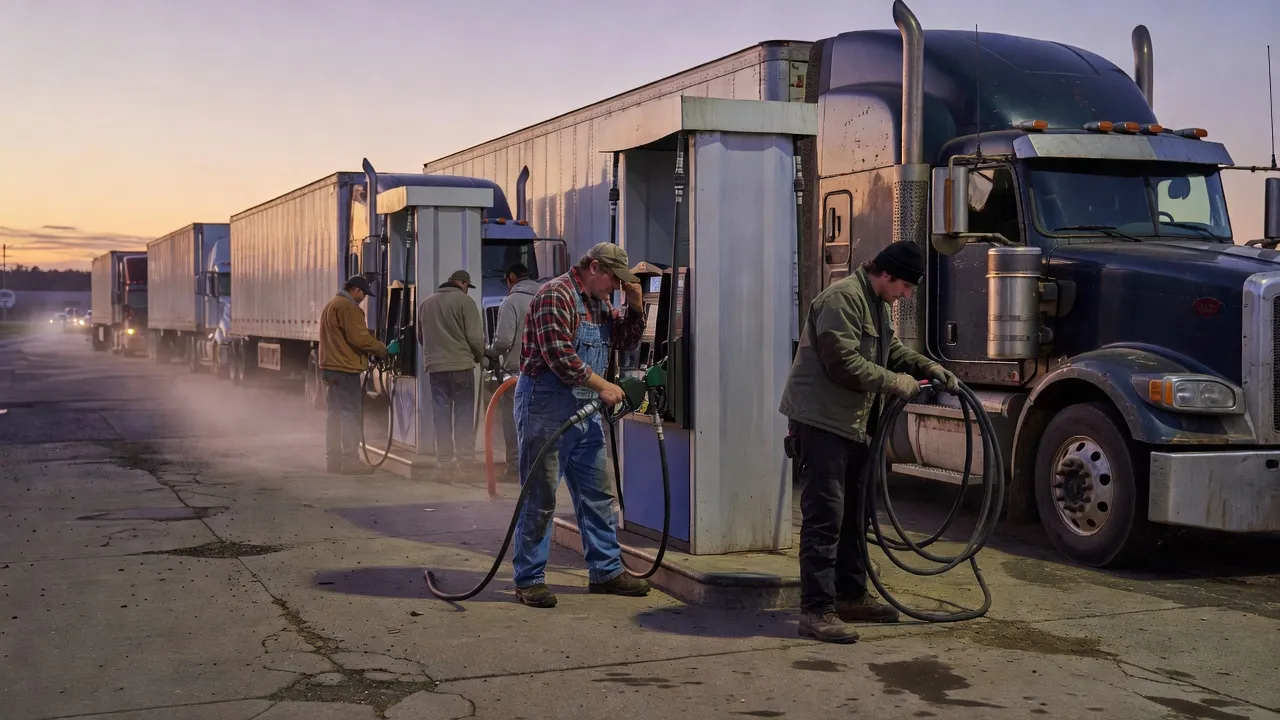
Washington, October 10, 2026. The announcement made on Friday, October 9, by Donald Trump on Truth Social, after a call with Vladimir Putin, is first seen by the American press as a power play to boost purchasing power less than a month before the November 3 election. NPR, quoting the AP, speaks of a "stunning reversal" after years of pressure on Moscow, coupled with an attempt to calm fuel prices. The Hill recalls that the surge in energy prices dominates the concerns of voters.
The figures cited by the president are detailed: more than 300,000 tonnes immediately, 500,000 in November, one million thereafter, and three million "in a short period". CNBC specifies that this last volume depends on the state of Russian refineries. The Treasury has published a temporary general license via the OFAC authorizing the sale and importation of Russian diesel, including in the United States, until April 7, 2027. NBC notes that Putin, on his part, has given neither a calendar nor a quantity, only mentioning his "disposition" to provide oil and petroleum products. Diesel has jumped by about 70% since the start of the war with Iran in February.
The second angle is Congress. CNBC quotes Democratic Senator Richard Blumenthal, who judges the measure "directly contrary to the intention of Congress" in the bipartisan law signed three weeks ago. Scott Lincicome, from the Cato Institute, ironizes: "Can America tariff America?" Peter Harrell, from Georgetown, sees proof that the law would not force the administration to increase pressure. At Bloomberg, Democrat Debbie Wasserman Schultz qualifies the agreement as a "desperate political measure" intended to help Republicans. CNBC notes that they are facing tight elections, particularly in Iowa where farmers are suffering from diesel prices.
The third angle is the rift with Kiev. Zelensky, quoted by Axios and CNBC, denounces "gifts to Putin" and a decision that is "not fair or honest", and judges that his team, received in Miami by Steve Witkoff and Jared Kushner, served as a "facade". Axios then publishes the version of an anonymous American official: Trump would have acted after Zelensky ignored six requests to stop strikes on Russian refineries, which weigh on American prices. The press notes that the president has few levers to face the destruction of refining capacities in Eastern Europe and the Middle East.