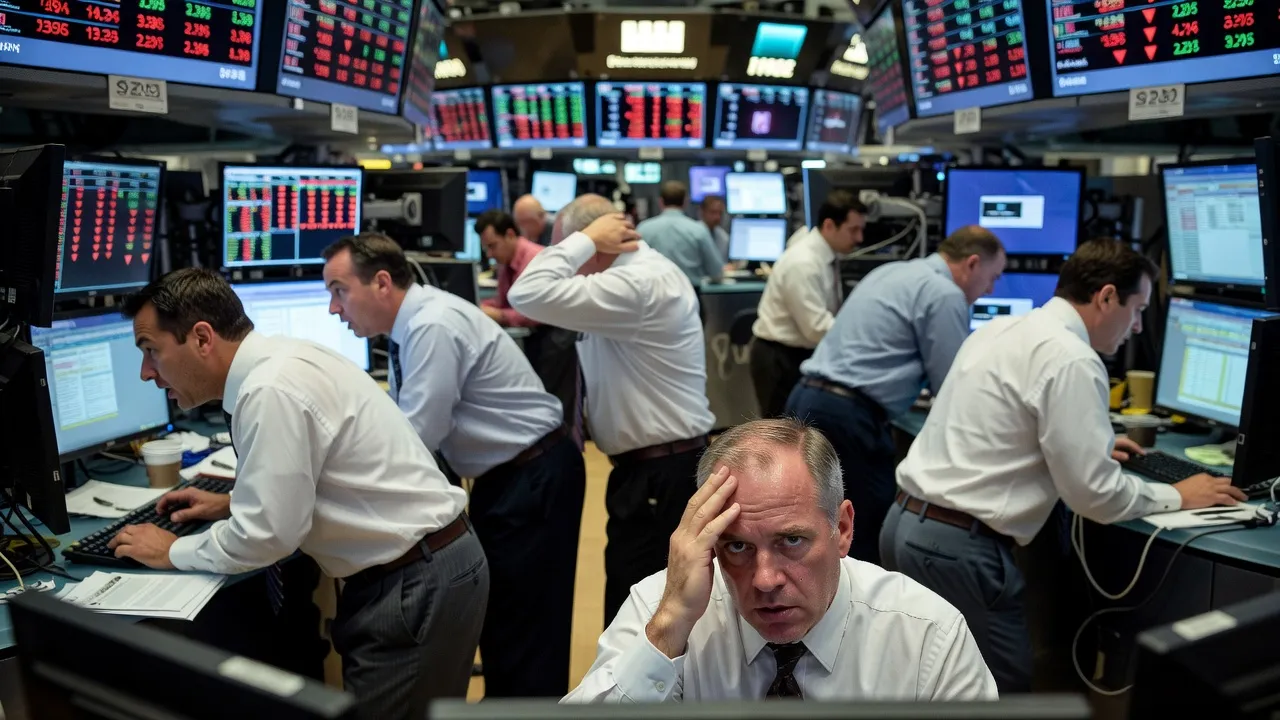
United States: inflation climbs to 3.7% on the Iran war, Wall Street and AI stocks tumble
published on
countries
sources
articles
More divergent than 98% of recent comparable stories (reference: 90 recent stories measured with the same method).
The ten covers of the corpus agree on the figure, but each one opens up a different aspect of the session: the pump, the electoral calendar, the Fed, the AI debt, or the local stock market, this synthesis takes up these entries one by one, with the sources that support them.
Inflation is the last major measure before the November 3 elections; the Fed meets on October 27 and 28, with a possible rate hike.
In the details of the index
CNBC provides details that key figures do not carry. The energy index advances 5.2% on the month, gasoline 34.2% over a year, and fuel 74.2%. Underlying inflation reaches 0.3% on the month and 2.6% over a year, versus 2.5% expected, according to the channel.
« It's the figure with the most impact in terms of domestic policy, and it's very bad. »
Le Monde provides benchmarks at the pump: a gallon of gasoline at 4.30 dollars versus 2.90 before the war, diesel at 6.51 dollars, a record according to the daily. BFM Business adds that food has seen no increase in September and that the cost of transportation rises 0.6% over a year.
One point is not settled in the corpus. The Folhapress, cited by Jornal de Brasília, reports a 7.1% increase in gasoline in September according to the EIA, while the AFP, picked up by the same title, writes 9.1%. The two figures come from different sources, and nothing indicates that they measure the same thing.
Estadão, in Brazil, adds Donald Trump's customs duties to the causes of the increase, alongside energy. CNBC notes, on its part, that clothing, sensitive to these duties, gains 3.4% over a year.
The cost of living, a campaign issue
In the corpus, the British, Argentine, and South African presses open with the political stakes. This count measures the analyzed coverage, not the opinion of their readers. The Independent headlines about Donald Trump's "inflationist nightmare" and cites an Associated Press-NORC poll: 17% of American adults approve of his handling of the cost of living, 26% his economic record.
Ámbito reprints this poll and reports Donald Trump's remarks in Wasilla, Alaska, on Tuesday, October 13: according to him, every time someone wants to attack him, they talk about "affordability". The newspaper contrasts these remarks with the official data published the next day.
Business Day and TimesLIVE relay a Reuters dispatch signed by Lucia Mutikani. She cites a Reuters/Ipsos poll: about 78% of Americans attribute the price increase to the president's policy, including tariffs and the conflict in the Middle East.
The Australian, Indian, Japanese, and South Korean articles in the corpus do not deal with this aspect, according to the analyzed perspectives.
The Fed and the rise in yields
The likelihood of a rate hike varies by source and time. CNBC, based on the CME FedWatch, retains around 54% for the October 27-28 meeting and over 96% by the end of the year. Business Day, citing the same tool, gives 37% versus 22% the previous day. Veja writes that the probability has gone from 20% to 50%.
« They're starting to accept high inflation as just a fact of life. »
Ámbito recalls that the first rate hike in over three years took place in September, bringing rates to a range of 3.75% to 4%. The Korea Times and Clarín report that the 10-year Treasury yield briefly exceeded 5.32%.
CNBC quotes Beth Hammack, president of the Cleveland Fed, and notes around 65 months of annual readings above 2%. It also mentions a one-year inflation expectation of 3.9% according to the New York Fed.
Ámbito indicates that an expected increase in wholesale prices on Thursday could tip the balance, according to analyst Bill Adams.
The debt of IA and the Asian markets
The Indian and South Korean presses are highlighting the expenses and debt of AI in their account of the Wednesday, October 14 session. Again, this count measures the coverage of the corpus. The Economic Times attributes the declines to a tightening of financial conditions and very high gains for beneficiaries of the boom. It indicates that Barclays has lowered its recommendation on Dell and that, according to Reuters, 16 tech values in the S&P 500 have at least doubled in 2026.
« A rise in interest rates is weighing on the economy and tends to be unfavorable to stocks. »
CoreWeave's figures vary depending on the dispatches: 15.5% for CNBC, 16% for The Economic Times, 15% for The Hindu Business Line, which gives a course of $65.78. Its leader, Mike Intrator, writes in an internal note seen by Bloomberg that the market is acting irrationally and that the order book covers the debt.
In Tokyo, the Asahi Shimbun links the decline of the Nikkei to the American figure and expectations of a rate hike. The newspaper also quotes Wataru Akiyama, from Nomura Securities, who mentions the fall of corporate bonds from the AI boom. The Nikkei had regained 70,000 points on October 6, according to the newspaper.
In Seoul, Yonhap and the Korea Herald report that the KOSPI lost 0.44% at 6,008.81 points on Wednesday, after a decline of 5.46% the previous day. Seo Sang-young, from Mirae Asset Securities, attributes the erasure of session gains to the ASML report. Moneyweb, on the other hand, notes a copper price down 1.1% in London for a third session.
Operators give about 54% chance of a rate hike on October 27 and 28 (CME FedWatch).
The yield on its 2032 bond reached 14.8%; the company issued $2.2 billion in bonds and $2.6 billion in loans.
The Nikkei 225 lost more than 3,200 yen in the morning session on October 15; the KOSPI retreated for the sixth consecutive session.
Key figures
- 3.7 %Increase in the US CPI year-over-year in September, compared to 3.4% in August
What the comparison reveals
Common ground and differences in coverage across the media analysed.
What the media report in common
The US consumer price index rose 3.7% year-over-year in September, compared to 3.4% in August, above the 3.6% expected by economists.
The increase in energy prices linked to the war with Iran, with gasoline and fuels leading the way, is cited as the driver of the acceleration.
The figure is reigniting expectations of a rate hike by the Federal Reserve, with a rise in US yields.
Where media coverage diverges
Cause of the market decline
Some of the press links the drop in stocks to inflation and Fed rates; South Korean and Indian press highlights concerns over spending and debt in the AI sector.
Coverage aligned with this reading
Coverage that diverges
Election or energy interpretation
Some coverage reads the figure first as an issue for Donald Trump before the November 3 elections; others detail first the share of energy and gasoline in the increase.
Coverage aligned with this reading
Coverage that diverges
This grouping describes the publications analysed, not the position of these countries’ populations or of their governments.
Blind spots
What the coverage of each country leaves aside, while others put it forward.
 Argentina
- CoreWeave and AI sector bond debt
 Australia
- November 3 midterm elections
- approval of Donald Trump's handling of the cost of living
 Brazil
- decline in AI values (CoreWeave, Oracle, Dell)
 France
- probability of Fed rate hike
- decline in AI values
How each country reads it
Preview: 3 of 10 media perspectives. Syntheses of the media analysed — not direct quotations. Method & limitations
 United States
The United States is dissecting an energy shock that reopens the door to a rate hike and undermines AI financing, just three weeks before the midterms.
3 sources · View sources
- Argentina
Buenos Aires first notes the political setback for Donald Trump: an inflation rate of 3.7% that undermines his discourse on purchasing power just three weeks before the legislative elections.
2 sources · View sources
- Australia
Sydney is measuring the American shock in terms of its own market: the ASX opening lower, a weakened Australian dollar, and the risk of a Fed rate hike.
2 sources · View sources
The full text, country by country
United States
DOMINANT ANGLE
The United States is dissecting an energy shock that reopens the door to a rate hike and undermines AI financing, just three weeks before the midterms.
KEY POINTS
- The September CPI is up 0.6% month-over-month and 3.7% year-over-year (3.4% in August); gasoline gains 9.1%, roughly half of the increase, according to the BLS as cited by CNBC.
- Operators give about 54% odds of a rate hike by the Fed at its October 27-28 meeting, and over 96% by year-end (CME FedWatch).
- CoreWeave drops 15.5% as the yield on its 2032 bond reaches 14.8%, amid concerns over excessive debt in AI.
ANALYSIS
Washington, October 15, 2026. The US economic press, led by CNBC, is treating the September figure as an energy shock that is setting in. The Consumer Price Index rose 0.6% month-over-month and 3.7% year-over-year, the Bureau of Labor Statistics reported on Wednesday, October 14, up from 3.4% in August. Economists polled by Dow Jones had expected 0.6% and 3.6%.
Energy is being cited as the "primary culprit": the energy index jumped 5.2% in a war against Iran launched at the end of February and "shows no signs of ending anytime soon". Gasoline prices rose 9.1% for the month, accounting for about half of the overall increase, and 34.2% year-over-year; fuel oil rose 74.2%. Underlying inflation reached 0.3% for the month and 2.6% year-over-year, compared to the 2.5% expected. Housing (+0.4%) and used cars (+0.7%) also rose; clothing, which is sensitive to tariffs, rose 3.4% year-over-year.
The focus immediately shifted to the Federal Reserve. According to the CME's FedWatch tool, operators are giving about 54% odds of a rate hike at the October 27-28 meeting, and more than 96% by the end of the year. CNBC is emphasizing the duration: about 65 months of annual readings above 2%, and a one-year inflation expectation of 3.9% according to the New York Fed. Beth Hammack, president of the Cleveland Fed, is concerned: "They're starting to accept high inflation as just a fact of life." Bloomberg notes that the pressure on household budgets is coming ahead of the November midterm elections.
The second aspect is stock market-related. CoreWeave fell 15.5% on Wednesday, the yield on its 2032 bond reaching 9.625% and 14.8%. Operators bought nearly 200,000 put options on the stock, compared to 106,000 call options; Scott Bauer, of Prosper Trading Academy, talks about "bubble puts". A Wells Fargo Investment Institute executive believes that the "era of easy money" is fading. CoreWeave CEO Mike Intrator responded in a note that the market can act irrationally and that the order book covers the debt.
The fallout reached Asia on Thursday, October 15: SK Hynix lost over 10%, Samsung Electronics 8.73%, SoftBank 7.9%, and Advantest nearly 14%. CNBC is linking this decline to fears of new rate hikes and the financing of investments in AI, with the CEOs of Broadcom and Intel warning on Monday that financing could become a major obstacle.
Argentina
DOMINANT ANGLE
Buenos Aires first notes the political setback for Donald Trump: an inflation rate of 3.7% that undermines his discourse on purchasing power just three weeks before the legislative elections.
KEY POINTS
- The US CPI rose 3.7% year-over-year in September (3.4% in August), exceeding the 3.6% forecast by economists according to Clarín/AP.
- Gasoline jumped 9.1% for the month, accounting for more than half of the 0.6% monthly increase, according to Ámbito.
- Only 17% of adults approve of Trump's handling of the cost of living (AP-NORC poll cited by Clarín), ahead of the November 3 elections.
ANALYSIS
Buenos Aires, October 15, 2026. For the Argentine press, the US inflation figure is first and foremost bad news for the White House. Clarín headlines with a "mal dato para Trump en la previa de las elecciones" (bad data for Trump ahead of the elections): the consumer price index rose 3.7% over the past year in September, compared to 3.4% in August, according to data released on Wednesday, October 14. On a monthly basis, the increase is 0.6%, the largest in five months, according to the AP agency, as reported by the daily.
Ámbito emphasizes the energy driver: gasoline prices jumped 9.1% over the month, accounting for more than half of the overall increase, in the wake of the war between the US and Iran. Energy prices gained 5.2% after a 2.1% increase in August. Excluding food and energy, underlying inflation stands at 2.6% over the past year. AP adds that the growth of data centers and AI is also driving up the cost of chips and consumer electronics.
The political aspect dominates Ámbito's narrative. Trump stated on Tuesday in Wasilla, Alaska, that "every time they want to attack me, they talk about affordability," before the official data tells "a very different story." The newspaper notes stagnant real wages and cites an AP-NORC poll according to which only 17% of adults approve of his handling of the cost of living. Republicans are playing their slim control of Congress on November 3.
The second axis is monetary. After a first increase in more than three years in September, which brought rates to a range of 3.75% to 4%, the Fed could tighten again at its meeting on October 28. Analyst Bill Adams believes that an expected increase in wholesale prices on Thursday could tip the balance.
Clarín finally relays the Wall Street session: the S&P 500 lost 1.1%, the Nasdaq around 1.9%, with AI values leading the losses. The 10-year Treasury yield briefly exceeded 5.32%, and Brent was trading around $106. For Angelo Kourkafas, of Edward Jones, it's a "doble golpe" (double blow) for the market. Investors are becoming aware, according to AFP, that the cost of credit is rising and that AI infrastructure is very expensive. The fallout for emerging economies, including Argentina, is not addressed in these texts.
Australia
DOMINANT ANGLE
Sydney is measuring the American shock in terms of its own market: the ASX opening lower, a weakened Australian dollar, and the risk of a Fed rate hike.
KEY POINTS
- September US prices are 3.7% higher than a year ago, compared to 3.4% in August and 3.6% expected (The Age).
- ASX200 futures contracts fall 0.3% to 8,716 points and the Australian dollar is worth 69.71 US cents (ABC News).
- The Nasdaq loses 2.1% according to ABC (1.6% during the session according to The Age), with Brent crude trading around $106.
ANALYSIS
Sydney, October 15, 2026. The Australian press reads American inflation first through the opening of its own stock market. ABC News opens its live broadcast with this observation: "The Australian share market is set to open lower following losses on Wall Street." Futures contracts on the ASX200 fell 0.3% to 8,716 points, and the Australian dollar lost 0.1% to 69.71 US cents at 7:05 am (Sydney time).
The figure that triggers the decline is that of September: according to The Age, American consumer prices are 3.7% higher than last year, compared to 3.4% in August, while economists expected 3.6%. The newspaper links the acceleration to "jumps in fuel prices caused by the war with Iran." Brent crude gained 1% on Wednesday to $106.71 per barrel and stood around $106 according to ABC on Thursday morning.
On Wall Street, the two media outlets describe a market that is moving away from its record. According to The Age, the S&P 500 lost 1.1% and posted a fifth decline in six sessions since its historic peak; the Dow Jones fell 0.3% and the Nasdaq 1.6%. ABC reported the closing at -1.2% for the S&P 500, -0.1% for the Dow, and -2.1% for the Nasdaq. Neither of them details the losses of the artificial intelligence values mentioned elsewhere.
The retained mechanism is that of rates. The Age explains that stocks are under pressure from the rise in bond yields, fueled by concerns about public debt and signals of still solid American growth, which are driving yields to their highest levels "in years or even decades" on global markets. ABC headlines with figures higher than expected, which suggest a possible rate hike by the Federal Reserve.
The rest of the market picture, on the Australian side, is mixed: gold lost 1.3% to $4,101 per ounce, iron ore, a pillar of the country's exports, remained almost stable at $90.45 per ton, and bitcoin fell 1.9%. In Europe, the Dax gained 0.2% and the FTSE 0.7%. The ASX had already lost 0.6% on Wednesday.
The coverage remains factual and focused on investors. The Age adds layoffs at Netflix, around 6% of the workforce, nearly 1,000 jobs, and ABC's live broadcast follows up with an internal debate on the 30% minimum tax targeting discretionary trusts. The US midterm elections are not mentioned in the provided excerpts.
Brazil
DOMINANT ANGLE
Brasília is gauging the shockwave of US inflation on its own markets: the dollar above 5 reais, Ibovespa in decline, and the fear of a new tightening by the Fed for emerging economies.
KEY POINTS
- The US CPI rose 0.6% in September and 3.7% over twelve months, compared to 3.4% in August, above the expected 3.6% annual rate (Jornal de Brasília, Veja).
- Treasuries climbed to 5.30% and the likelihood of another Fed rate hike increased from 20% to 50% according to FedWatch (Veja).
- The dollar closed at 5.02 reais and the Ibovespa fell 0.18% to 206,500 points, with Bradesco losing 2.48% (Veja).
ANALYSIS
Brasília, October 15, 2026. In Brazil, Wednesday's American figure is first seen on the quotes screen. Jornal de Brasília, quoting Folhapress, notes that the dollar rose 0.22% by 2:40 pm, to 5.034 reais, while the DXY index gained 0.55%. The Ibovespa opened 1.03% lower, according to Veja, before finishing the session with a 0.18% decline, around 206,500 points.
American facts are reported with precision. The price index advanced 0.6% in September and 3.7% over twelve months, compared to 3.4% in August. The Reuters consensus expected 3.6% at an annual rate. Underlying inflation gained 0.3% over the month and reached 2.6% over a year, compared to 2.4% in August. Estadão attributes the increase to energy made more expensive by the war with Iran, with gasoline close to $4.50 per gallon at the end of September, and adds Donald Trump's tariffs among the causes. Sources diverge on gasoline: 7.1% in September according to the EIA quoted by Folhapress, 9.1% according to AFP reprinted by Jornal de Brasília, which attributes more than half of the increase to it.
The dominant reading is the Fed. Veja notes that Treasuries rose to 5.30% and that the probability of another rate hike in the US has gone from 20% to 50% according to FedWatch. Estadão specifies that the next Fed meeting will take place in October, with an expected increase in December, and quotes John C. Williams, from the New York Fed, who forecasts another increase this year, with no further adjustment afterwards.
Local analysts link this signal to the emerging risk. Fábio Murad, from Wiser Asset, judges that "pressure has not been limited to fuels" and that the risk of a new tightening is increasing. Nicolas Gass, from GT Capital, estimates that the US rate at this level "weighs on every emerging stock exchange" and adds that the Ibovespa was coming out of a nearly 9% increase in one week, hence the profit-taking.
The domestic context is invited into each article: expected presidential poll after closing, possible Senate vote on the end of the 6x1 scale, August services weaker than expected. Banks led the losses, with Bradesco at the top at -2.48%. The fate of Wall Street and AI values does not appear in these articles: the prism is that of the cost of capital for Brazil.
France
DOMINANT ANGLE
Paris sees the US inflation rate of 3.7% as the direct bill for the oil shock linked to the war against Iran, with Hormuz and the pump in the foreground and the midterms in the background.
KEY POINTS
- US inflation reaches 3.7% over one year in September (3.4% in August), with +0.6% over one month, according to the BLS published on Wednesday, October 14.
- Energy increases by more than 20% over one year, gasoline by 34%, and fuel oil by 74%; a gallon of gasoline is at $4.30, compared to $2.90 before the war.
- Food has seen no increase in September, while the cost of transportation rises by 0.6% over one year, the largest increase since March.
ANALYSIS
Paris, October 15, 2026. The French press is reading the American inflation figure for September through the lens of the oil shock. According to the data published on Wednesday, October 14, by the Bureau of Labor Statistics (BLS), consumer prices have risen by 3.7% over one year, compared to 3.4% in August.
BFM Business notes that the 0.6% increase over one month, compared to 0.4% the previous month, is "in line" with analysts' expectations, according to the consensus published by MarketWatch. The consensus forecast was 3.6% in annual terms: the observed increase is therefore slightly stronger than expected. The media outlet attributes the surge to energy, which has risen by 5.2% over one month and more than 20% over one year. Fuel has increased by 15.3% over one month and nearly 75% over one year. It explains these increases by the war launched by Israel and the United States against Iran, and by the prolonged closure of the Strait of Ormuz, through which 20% of the world's hydrocarbons transit.
Le Monde focuses on the political stakes: it's "the figure that has the most impact, in terms of domestic policy, and it's very bad," just three weeks before the midterm elections. The daily newspaper recalls that inflation was 2.7% when Donald Trump was elected, on the promise of lowering prices. It provides concrete benchmarks: the barrel around $100, the gallon of gasoline at $4.30 versus $2.90 before the war, and diesel at $6.51, a historic record. Gasoline has increased by 34% in one year and fuel oil by 74%, which the newspaper describes as "a hole in household finances."
The two articles converge on the cause: the energy crisis linked to the conflict in Iran. BFM Business adds nuance from the consumer side: food prices have not risen in September, while the price of labels is one of the themes of the campaign. The cost of transportation has increased by 0.6% over one year, its strongest increase since March, shortly after the start of the conflict.
In these two texts, the reading remains focused on the real American economy, from the pump to household budgets, and then on its electoral translation. The provided corpora do not deal with the Federal Reserve or the decline in AI values on Wall Street.
 India
India
DOMINANT ANGLE
New Delhi sees the slump in AI values as a test of the cost of money on a debt-financed boom, with CoreWeave at the forefront.
KEY POINTS
- CoreWeave lost 16%, Nebius 11%, Oracle 9%, and Dell 11%, wiping out around $80 billion in market value (Economic Times).
- CoreWeave issued $22 billion in bonds and $26 billion in loans; a June bond with a 9.625% yield now trades at around 15% (Economic Times, citing LSEG).
- CoreWeave CEO Mike Intrator called the market "irrational" in an internal note; the stock fell 15% to $65.78 (The Hindu Business Line).
ANALYSIS
New Delhi, October 15, 2026. In the Indian economic press, the Wall Street session of Wednesday, October 14, is first and foremost a story of artificial intelligence and credit, more than a price index. The Economic Times headlines with AI values "plummeting up to 16%", wiping out around $80 billion in market value, as high American inflation fuels fears over rates.
The daily details the losers: data center manager CoreWeave falls 16%, Nebius 11%, Oracle 9%, and server manufacturer Dell Technologies 11%. It explains these declines by a tightening of financial conditions, but also by the "excessive" gains of the main beneficiaries of the AI boom. Barclays has downgraded its recommendation for Dell, whose stock has quadrupled this year, and, according to Reuters calculations, 16 technology sector values in the S&P 500 have at least doubled in 2026.
Debt is the common thread. CoreWeave has issued $22 billion in bonds and $26 billion in loans, according to LSEG, and a bond issued in June at 9.625% now yields around 15%. The Economic Times quotes Kim Forrest, of Bokeh Capital Partners, who mentions information suggesting that the largest AI companies "may not generate the expected profits or revenue".
The Hindu Business Line focuses on the company's response. Its leader, Mike Intrator, judges in an internal note, reported by Bloomberg, that the market is acting "irrationally" and asserts that the order book largely covers the debt. The stock has fallen 15% to $65.78, its worst session since February, and the newspaper recalls that the delayed IPOs of competitors, including data center manager AirTrunk, weigh on the narrative.
The link to the war against Iran and the midterm election campaign remains outside the scope of the two articles in the corpus. What the Indian press retains is a market struggling, according to The Economic Times, to measure the effects of high inflation at a time when the debt of AI companies is contributing to rising global rates.
 Japan
Japan
DOMINANT ANGLE
Tokyo is measuring the impact of US inflation on its own market: the Nikkei, boosted by AI and chips, dropped at the opening on Thursday, driven by expectations of a rate hike by the Fed and the yen around 158.
KEY POINTS
- The Nikkei 225 closed the morning session on October 15 in the 64,400-point range, more than 3,200 yen below the previous day's close (Asahi Shimbun).
- The US CPI for September rose 3.7% year-over-year, compared to the 3.6% expected, reigniting expectations of a rate hike by the Fed (Asahi Shimbun).
- The yen was trading around 158 per dollar on October 14, with about a 22% chance of a rate hike in October, according to Reuters (News On Japan).
ANALYSIS
Tokyo, October 15, 2026. In Japan, US inflation is first reflected on the stock market board. On Thursday, October 15, the Nikkei 225 closed the morning session at over 3,200 yen below the previous day's close, at around 64,400 points, according to the Asahi Shimbun. It fell below 65,000 for the first time since September 29, or about two weeks. The index had opened at 66,880, down 863 points, before the decline accelerated.
The newspaper links this decline to the US consumer price index for September, published on Wednesday, October 14: +3.7% over one year, versus 3.6% expected by the market. Asahi notes that expectations of a rate hike by the Federal Reserve, which had fallen after job creation was well below forecasts, have resumed. It summarizes: "A rate hike weighs on the economy and tends to be unfavorable to stocks."
The artificial intelligence and semiconductor sector is concentrated with sales. Advantest, SoftBank Group, and Tokyo Electron are among the most affected stocks. The Nikkei had regained the 70,000-point threshold on October 6, a first in three months, before losing nearly 3,000 points in five consecutive declining sessions until October 14.
Asahi also quotes Wataru Akiyama, from Nomura Securities. According to him, the fall in corporate bonds at the heart of the AI boom has revived fears about their financial situation. Doubts about the continuation of investments and profitability then pulled US indices down.
News On Japan had described the previous day a feverish market before the publication. The Nikkei had finished at 67,744 points, down 33. According to the article, 57.4% of Prime Market stocks declined and 38.9% progressed. The morning rebound in chips, concentrated on a few heavyweights in the index, had disappeared by the end of the session. The site cited Reuters: about 22% probability of a rate hike in October before the figures.
For Japan, it explained, US inflation matters through the dollar-yen rate, US Treasury yields, and global risk appetite. The yen was oscillating around 158 per dollar. The rise in US yields supports the dollar and can weaken the yen, but it also increases the discount rate of future profits and penalizes tech stocks. The oil and coal sectors were among the strongest.
 South Korea
DOMINANT ANGLE
Seoul is deciphering the Wall Street slump through the prism of AI: the rise in US yields is first hitting tech stocks, which the South Korean stock market also depends on.
KEY POINTS
- US inflation reached 3.7% over one year in September, compared to 3.4% in August and 3.6% expected (Korea Times).
- CoreWeave fell by around 15%, Oracle by 7.3%, and Dell by 12%; the Philadelphia semiconductor index declined for a sixth session (Korea Times).
- The KOSPI lost 0.44% to 6,008.81 points on Wednesday, its sixth consecutive decline, after a 5.46% plunge the previous day (Yonhap, Korea Herald).
ANALYSIS
Seoul, October 15, 2026. Seoul's financial scene is closely watching the US market, where American stocks had their worst session since July on Wednesday, October 14. Consumer prices rose 3.7% over the past year in September, compared to 3.4% in August and the 3.6% expected by economists. The S&P 500 fell 1.1% (1.35% according to a second report), the Nasdaq around 2%, and the yield on the 10-year Treasury briefly exceeded 5.32%, compared to less than 5.17% before the release.
The report emphasizes the sensitivity of artificial intelligence values to the cost of money. CoreWeave lost 15 to 15.5% according to reports, Nebius 10%, Oracle 7.3%, Nvidia 3.2%, and AMD 5.7%. Dell fell 12% and Hewlett Packard Enterprise 7.6% after a downgrade by Barclays. The Philadelphia semiconductor index fell nearly 4% for a sixth consecutive session, its longest streak of losses since May 2025.
Operators now see around 35 to 37% chances of a rate hike by the Federal Reserve at its next meeting, compared to 22% the previous day. The Korea Times also links the rise in oil prices, with Brent at $106.06, to the war with Iran.
In Seoul, Wednesday's session had already been marked by nervousness. Yonhap and the Korea Herald note that the KOSPI lost 0.44% to 6,008.81 points, its sixth consecutive decline, after a 5.46% plunge the previous day. The index had gained 2.57% at the start of the session after an interview with John Williams, president of the New York Fed, who saw "no need" for further tightening next year, before erasing all gains following disappointing sales prospects from ASML, a supplier of machines for Samsung Electronics.
Local analysts cited are focusing on investments deemed excessive in AI. "The KOSPI erased all its gains after ASML's report," says Seo Sang-young, of Mirae Asset Securities. SK hynix fell 1.66% to 1.42 million won, Hanmi Semiconductor 5.02%. Foreigners sold a net 1.18 trillion won in stocks, while the won appreciated against the dollar. The articles provided deal with US inflation mainly as a trigger for markets, without addressing the midterm elections.
 United Kingdom
DOMINANT ANGLE
London sees the rise in US inflation as an electoral handicap for Donald Trump, three weeks from the midterm elections, more than just a price shock.
KEY POINTS
- American inflation reached 3.7% over one year in September, compared to 3.4% in August, above expectations (BBC).
- FactSet economists expected 3.6% over one year and a monthly increase of 0.6%, the strongest since April (The Independent).
- According to an AP-NORC poll, 17% of Americans approve of Trump's handling of the cost of living and 26% his economic action (The Independent).
ANALYSIS
London, 15 October 2026. For both the BBC and The Independent, the figure released on Wednesday, 14 October by the Bureau of Labor Statistics is first and foremost viewed through the lens of the US political calendar. Annual inflation rose to 3.7% in September, compared to 3.4% in August, which is "more than expected" according to the BBC. This is the last major reading before next month's midterm elections.
The BBC sets the scene in an explanatory manner. It attributes the surge in prices to the cost of petrol, which has "spiked following disruption to Middle East energy supplies due to the US-Israel conflict with Iran". The public broadcaster also dedicates part of its article to a educational reminder: what inflation is, how the consumer price index is calculated by the Bureau of Labor Statistics, and why a reduced supply of crude oil increases the cost of petrol and diesel. It recalls that the elections are being played out against the backdrop of tensions related to the cost of living across the country.
The Independent adopts a distinctly more political tone, right from its title: "Trump's inflation nightmare worsens". The daily newspaper indicates that economists polled by FactSet were expecting 3.6% over one year, and that they were forecasting a monthly increase of 0.6%, the strongest since April, after 0.4% the previous month. It notes that inflation, which had fallen from its peak of 9.1% in 2022, "has drifted upward since the conflict began in late February".
The newspaper emphasizes the electoral impact. According to an Associated Press-NORC poll, only 17% of American adults approve of Donald Trump's handling of the cost of living, and 26% his overall economic record, a low. It speaks of a political challenge for Congressional Republicans.
The Independent also mentions the Federal Reserve, which is legally required to maintain price stability, for which this inflation represents an obstacle. Neither of the two articles, however, discusses stock markets, artificial intelligence values, or emerging currencies: the British prism remains focused on petrol prices, American voters, and the president's stance.
 South Africa
DOMINANT ANGLE
Pretoria gauges the shock as a matter of rates and raw materials: the US inflation in September, driven by gasoline, revives the prospect of a Fed hike and weighs on copper as well as tech stocks.
KEY POINTS
- The US price index rose 0,6 % in September, with more than half of that due to a 9,1 % increase in fuel prices (Business Day, TimesLIVE).
- Operators see a 37 % chance of a Fed rate hike this month, up from 22 % the previous day, according to the CME's FedWatch tool (Business Day).
- Copper fell 1,1 % to $14 338 a tonne in London, its third consecutive daily decline (Moneyweb, Bloomberg).
ANALYSIS
Johannesburg, October 15, 2026. South Africa's economic titles, Business Day, TimesLIVE, and Moneyweb, are covering US inflation in September through agency dispatches, focusing on energy prices and the cost of money.
According to the report from the US Department of Labor, published on Wednesday, October 14, the consumer price index rose 0.6% over the month, after 0.4% in August, in line with economists' expectations. A 9.1% increase in fuel prices explains more than half of the increase. Business Day and TimesLIVE relay a Reuters dispatch: "the US-Israeli war against Iran is driving up energy prices," with diesel reaching record levels, and fears of a rapid impact on supermarkets. The text also notes an expansion of price tensions beyond energy, which raises fears of persistent underlying inflation.
The US political dimension is present but secondary: the dispatch talks about a new blow to Donald Trump and the Republicans before the November 3 midterm elections, and cites a Reuters/Ipsos poll according to which about 78% of Americans blame the price increase on the president's policies, including tariffs and conflict in the Middle East.
The focus is mainly on the Federal Reserve. Operators now give a 37% chance of a rate hike this month, compared to 22% the day before, according to the FedWatch tool from CME. Economist Jeffrey Roach, from LPL Financial, judges that "the last mile to the goal could remain chaotic and maintain high rates."
In the markets, Business Day describes a Wall Street in decline: the Nasdaq fell 2.02% and the S&P 500 1.35%. Oracle lost 7.3%, CoreWeave 15%, Nebius 10%, and Dell 12%. The Philadelphia semiconductor index fell nearly 4%, its sixth consecutive decline. Brent was trading around $106.56 a barrel after a Houthi attack on the Saudi Aramco headquarters.
Moneyweb, via Bloomberg, extends the analysis to metals, which the South African economy closely follows: copper fell 1.1% to $14,338 a ton in London, for a third daily decline, with aluminum hitting its lowest level since last year. The South Korean index plummeted 8% on Thursday, as investors doubt the sustainability of AI spending. None of the provided articles directly address the rand or the policy of the South African central bank.
Explore every perspective on this subject across 10 countries.
Compare viewpoints and see where they diverge.