France — news through its media
Stories followed in this country, with their framing set against the rest of the world.
575 subjects found
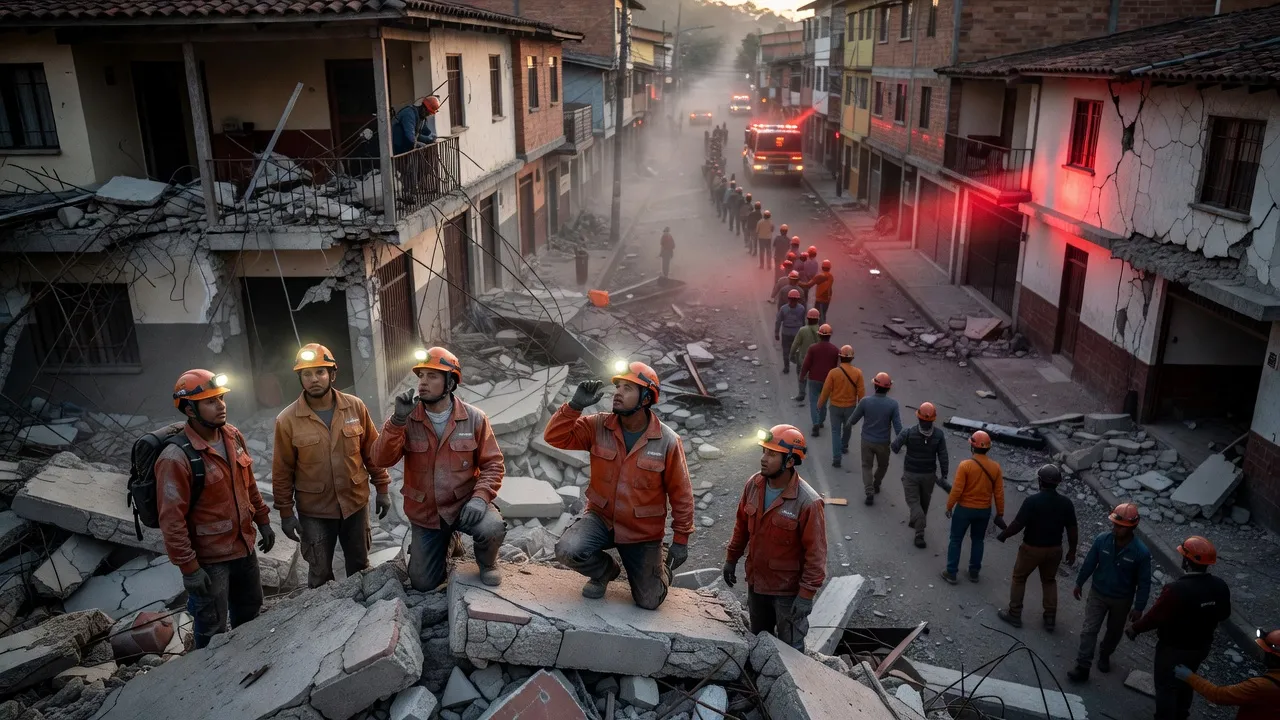
Magnitude 7.4 Earthquake in Colombia: National Disaster Declared Three Days After Espriella's Inauguration
At 7:34 a.m. on Monday, a magnitude 7.4 earthquake struck western Colombia, with its epicentre in Chocó. Felt as far as Quito, Panama and Caracas, it collapsed Pereira's airport and damaged hundreds of buildings. The president, in office for three days, declared a national disaster. Depending on the newsroom, the toll runs from 111 to 138 dead — and more than 2,000 people are registered as missing.


 +16
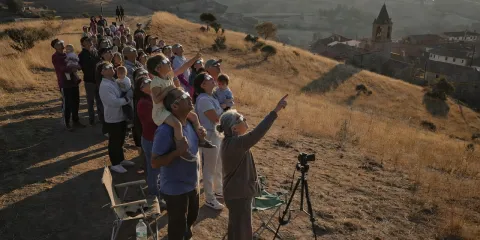
The 12 August Total Eclipse Puts Spain in the Shadow — and Under the Strain of 446,000 Visitors
On Wednesday the path of totality crosses Greenland, Iceland and northern Spain, where no total eclipse has been seen since 1905. Madrid expects 446,000 extra visitors; small towns fear wildfires and Ibiza fears saturation. France will top out at 99% obscuration, Algeria at 98.6%. Elsewhere the same event becomes a timetable, an eye-safety warning or a horoscope.


 +5
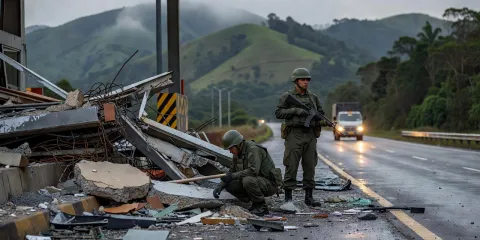
Explosive Attacks Mark Abelardo de la Espriella's First Day Leading Colombia
Sworn in on Friday at an army barracks in Cali, Colombia's new president saw his first day in office marked by two explosive attacks: a police officer killed by drones in Cesar, a toll booth destroyed in Cauca. By Sunday the Defensoría del Pueblo was counting attacks across eleven departments. Washington is pledging a billion dollars; Caracas reads it as a sign of its own turn to come.
 +3

Netanyahu Rejects Trump's 15-Point Gaza Plan and Ties Any Withdrawal to Hamas Disarming
"Israel rejects the 15-point document." At a cabinet meeting on Sunday, Benjamin Netanyahu formally refused the roadmap published on 31 July by Donald Trump's Board of Peace and accepted by Hamas. No withdrawal before "genuine" disarmament, and no Palestinian state while he is in office. On the ground, though, Israel has scaled back its strikes since 3 August. Elections fall on 27 October.


 +12

Infantino Faces Favouritism Allegations from His UEFA Years as FIFA Denounces a 'Concerted Effort' to Weaken Him
The Telegraph reports that UEFA paid a six-figure settlement to a former employee with whom Gianni Infantino is said to have had a relationship while he was its general secretary. UEFA confirms the payment, Infantino denies the claims 'categorically', and FIFA denounces a 'concerted and ongoing effort'. Northern Europe wants him gone; Africa and South America back him.

 +13
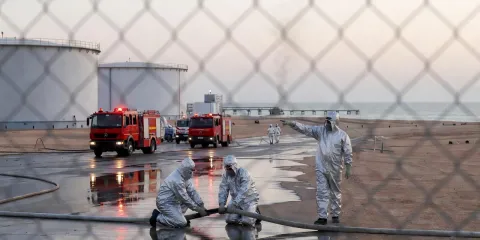
Houthis Strike an Aramco Refinery in Saudi Arabia as the UN Condemns and Yemen's War Reignites
On Sunday, Houthi forces claimed a drone strike on the Aramco refinery at Jazan on the Red Sea; Riyadh said the fire was out with no casualties. The same day, shelling of the port of Mokha killed at least seven people. Two days earlier the UN Security Council had condemned Houthi fire on the kingdom since 13 July. A conflict frozen since the 2022 truce is reigniting, two days after the Riyadh-Ankara-Islamabad defence pact.
 +10

Iran Sets Six Conditions for Reopening Hormuz as the Revolutionary Guards Call the Strait a 'Theatre of War'
On Saturday the secretary of Iran's Supreme National Security Council published six preconditions for reopening the Strait of Hormuz: an end to the war, the lifting of the naval blockade and of sanctions, the withdrawal of US forces, compensation for war damage and the release of frozen assets. On Sunday the Revolutionary Guards hardened the line while Oman negotiated a temporary shipping corridor and Washington spoke of 'some progress'. A fifth of the world's oil is waiting.
 +19
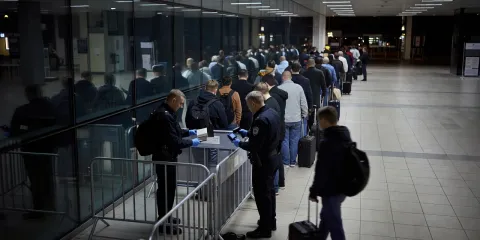
Spain imposes its own border checks on Italy, which refuses to back down
Madrid gave Rome until 9 August to lift the checks imposed on 1 August, then acted: controls on travellers from Italy until 7 September. Italy extended its own. Behind the quarrel lie at least 141 dead at Ceuta, 1,342 unaccompanied minors, and an investigation into Russia-linked accounts. Twenty-two countries order these three threads differently.


 +18

Abelardo de la Espriella sworn in as Colombia's president, in Cali not Bogotá
On 7 August 2026, millionaire lawyer Abelardo de la Espriella was sworn in for 2026-2030 before Milei, Kast, Noboa, Felipe VI and Infantino — but not Gustavo Petro. The ceremony was moved to Cali, the first speech delivered in a barracks, 11,000 personnel deployed. Fifteen countries describe the same man under fifteen different names: Trump ally, far-right president, anti-establishment outsider.
 +11
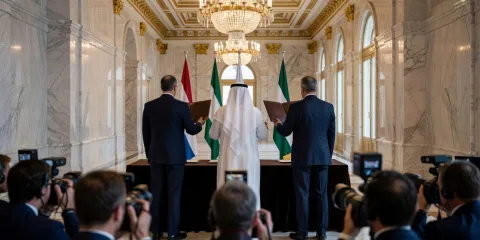
Saudi Arabia, Turkey and Pakistan sign the Mecca defence pact
On 7 August 2026, Mohammed bin Salman, Recep Tayyip Erdoğan and Shehbaz Sharif signed an agreement at Al-Safa Palace stating that an armed attack on any one of the three countries will be treated as an attack on them all. Riyadh insists it is 'neither a military axis nor a sectarian bloc'; thirteen countries read it differently, and Iran, its implicit target, is absent from the account.
 +9
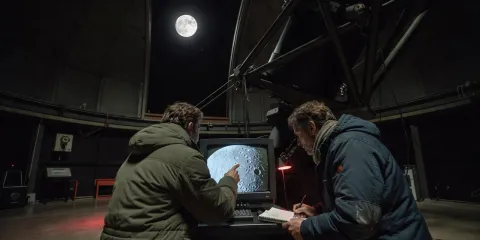
A SpaceX rocket stage crashes into the Moon and leaves a crater
On 5 August 2026 at 06:35 GMT, the upper stage of a Falcon 9 launched in January 2025 struck the Moon at 8,690 km/h after eighteen months adrift. The object is the same everywhere; its meaning is not. Twelve countries read it in turn as a scientific windfall, a space-debris problem, or a chance to prove their own capabilities — and the United States, where the rocket came from, is absent from the account.
 +8
Understand global stakes from every perspective.
725 subjects · 75 countries · 8262 perspectives