
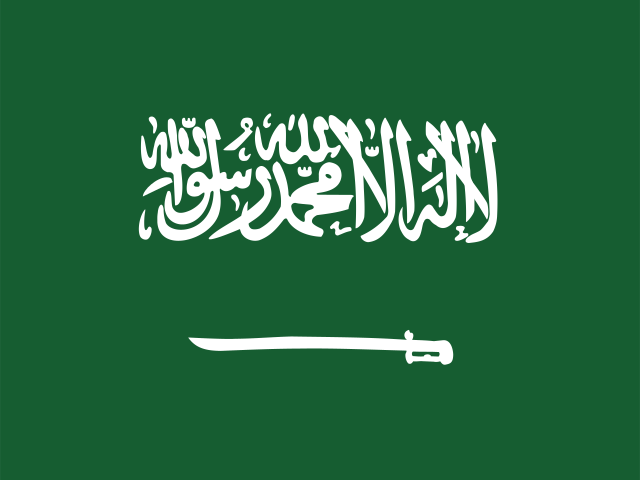
DOMINANT ANGLE
Riyadhh has rallied a broad coalition of diplomatic condemnations against the Houthists, as its air defenses intercept drones and debris targeting Mecca and Taif.
Dominant angle identified — does not reflect unanimity of this country’s media
KEY POINTS
- 01
On Tuesday, September 15 at 18:50, the royal defense forces intercepted and destroyed a Houthi drone south of Mecca before it entered the restricted airspace of the holy city, according to the Arab Coalition.
- 02
On Thursday, September 17, debris from an intercepted drone in Taif killed a Yemeni resident and injured a Saudi woman and a Pakistani resident, according to Civil Defense.
- 03
The Organisation of Islamic Cooperation (57 countries), the Arab League, the GCC, the Council of Arab Interior Ministers, the European Union, Turkey, Tunisia, Uzbekistan, and Oman have all condemned the Houthi attacks targeting the kingdom.
ANALYSIS
Riyadh, September 19, 2026. In the Saudi press, the weekend's narrative is written less as a defeat than as a mobilization. On Tuesday, September 15 at 6:50 p.m., the royal defense forces intercepted and destroyed a Houthi drone south of Mecca, before it reached the restricted airspace of the holy city — a second targeting of Makkah after a ballistic missile in July 2017, according to the spokesperson for the Arab Coalition, General Turki al-Malki. The Coalition described the incident as a "shameful act" aimed at "terrorizing pilgrims" and reaffirmed that "the security of the Two Holy Mosques is a red line." On Thursday, September 17, debris from an intercepted drone in Taif killed a Yemeni resident and injured a Saudi woman and a Pakistani resident, according to the Civil Defense — the first recorded death on the Saudi side in this escalation. On Friday, the imams of the Grand Mosque and the Prophet's Mosque denounced a "heinous crime," stating that "the kingdom will remain the qibla of Muslims, impenetrable to hate." However, the dominant thread in the kingdom's press is not only defensive; it is one of international isolation of the Houthists. The Organization of Islamic Cooperation, which brings together 57 countries, the Arab League, the Gulf Cooperation Council, and the Arab Interior Ministers Council have condemned the strikes; on Friday, the European Union, Tunisia, Uzbekistan, and Oman did the same, joined by Turkey, which warned that the threat in the Red Sea and at Bab al-Mandeb "negatively affects regional security and international maritime trade." This displayed solidarity counts all the more for Riyadh, as the strait, of which the Houthists have taken control of several points since their offensive from September 3 to 11, accounts for 12% of global trade. The Yemeni Interior Minister warned Asharq Al-Awsat that Iran was seeking, through the Revolutionary Guards, to "militarize" Bab al-Mandeb permanently. Washington, for its part, made it known through "security channels" that it was not negotiating with the Houthists, without announcing direct military engagement — a restraint that the Saudi press notes without commenting on it directly, preferring to highlight the diplomatic front it has managed to rally around itself.
SOURCES (2)
- US Warns Houthis Through Security Channels: We Are Not Negotiating with You
- Yemen Interior Minister to Asharq Al-Awsat: Iran Seeking to Militarize Bab al-Mandeb Through the Houthis
- Houthis Continue Targeting Islamic Holy Sites, Arab Coalition Says Security of Two Holy Mosques Is a 'Red Line'
- Civil Defense: One Killed, Two Injured by Intercepted Houthi Drone Debris in Taif
- EU, Tunisia, Uzbekistan and Oman Condemn Houthi Attacks on Saudi Arabia
- Arab, Regional Officials Condemn Houthi Attacks on Taif
- Turkish Defense Ministry: Ongoing Houthi Threat in Red Sea and Bab al-Mandab Jeopardize Regional Security