12 perspectives, each in the voice of that country's press.
Bangkok is orchestrating an emergency command chain, from Governor Chadchart Sittipunt to Prime Minister Anutin Charnvirakul, who is piloting it by video conference from London, to justify the unprecedented declaration of the 50 affected districts.
2 sources
Canberra links the floods in Bangkok to the storm that hit New York and Boston the same weekend, seeing it as a sign of a global meteorological season out of the norm rather than an isolated Thai crisis.
4 sources
Dhaka takes away from the flooding of Bangkok a familiar warning: a delta capital submerged by the monsoon despite pumping stations pushed to their maximum capacity.
2 sources
Berlin sees the flooding of Bangkok as the consequence of a city built on former marshland, caught between extreme monsoon and a saturated network of canals.
2 sources
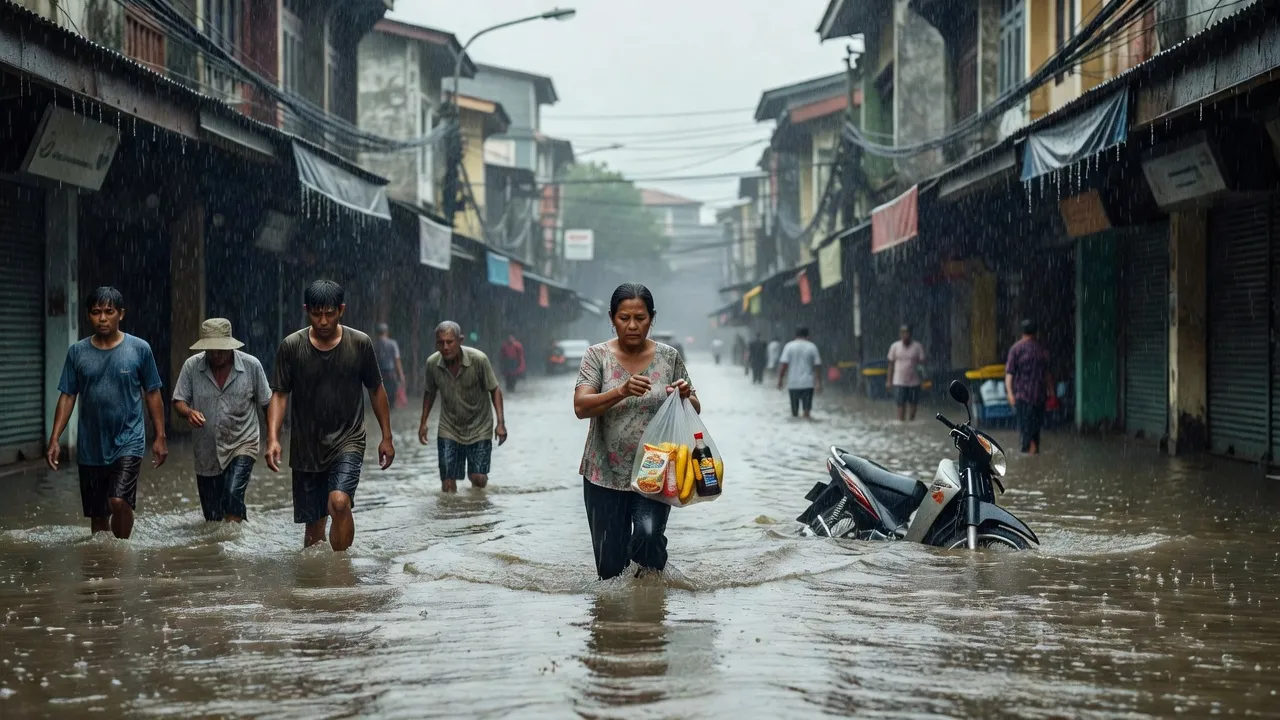
Tallinn first remembers the human face of the disaster: the testimonies of residents wading through the water, makeshift shelters, and the army providing backup, more than the national figures or political responsibilities.
2 sources
Paris first remembers the faces of the catastrophe: the inhabitants of Bangkok, with water up to their waists, rather than just the administrative mechanics of the state of natural disaster.
Sweden is first concerned about the fate of its citizens caught in the Bangkok floods, before gauging the extent of the disaster through the accounts of residents wading through water up to their waist.
Budapest is first taking note of the testimony of a Bangkok resident comparing the current crisis to the devastating floods of 2011, rather than an immediate numerical toll.
Belgrade is taking note of flooded Bangkok's crisis management mechanism: official proclamation, reception centers and SMS alerts, rather than a still unclear human toll.
Moscow is gauging the flooding of Bangkok in terms of its own tourists, between cancelled excursions and an expected decrease by the end of the week.
2 sources
Cross-media analysis
What the comparison reveals
Common ground and differences in coverage across the media analysed.
What the media report in common
1
The Thai authorities have declared all 50 districts of Bangkok a disaster zone, after flooding submerged roads, neighborhoods and canal systems.
2
About 300 millimeters of rain (nearly 30 centimeters) fell on Bangkok in 48 hours, from Thursday to Saturday morning, saturating the city's drainage network.
3
The Governor of Bangkok, Chadchart Sittipunt, is the central official voice cited in nearly all accounts, notably designating neighborhoods close to canals as the most exposed.
Where media coverage diverges
Global or Local Perspective
In response to the same sequence of severe weather, part of the coverage links the Bangkok floods to the storm that hit the American Northeast the same weekend, placing it in a global meteorological context, while the majority of national media treats the event as a standalone Thai crisis, without comparing it to other simultaneous weather episodes.
Coverage aligned with this reading
Coverage that diverges
This grouping describes the publications analysed, not the position of these countries’ populations or of their governments.
Bangkok is orchestrating an emergency command chain, from Governor Chadchart Sittipunt to Prime Minister Anutin Charnvirakul, who is piloting it by video conference from London, to justify the unprecedented declaration of the 50 affected districts.
KEY POINTS
Governor Chadchart Sittipunt has extended the disaster zone to all 50 districts of Bangkok, up from three initially, after nearly 300 mm of rain in 48 hours.
Pumping stations are draining around 1,200 cubic meters of water per second; the Bangkok Metropolitan Administration reported 31 impassable roads on Sunday, September 27.
The Ministry of Interior and the Ministry of Defense have deployed machinery and military personnel, under the remote coordination of Prime Minister Anutin Charnvirakul, who is currently in the United Kingdom.
ANALYSIS
Bangkok, September 27, 2026. Chadchart Sittipunt has extended the disaster zone to all 50 districts of the capital, compared to just three a few days ago, after continuous rainfall since Thursday, September 24, in the evening. Nearly 300 millimeters of rain have fallen in 48 hours, saturating the canals: a cellular alert system warned the population on Saturday, September 26, at 9:22 am, that "water levels in the canals are at a critical level and continue to rise," inviting residents to elevate their belongings.
The Thai response is being organized through a cascade of administrative measures. The Ministry of Interior and the Ministry of Defense have assembled their staff at the emergency command center, mobilizing equipment and troops from Army Region 1 as well as relief centers from Suphan Buri and Chai Nat to reinforce Bangkok. Prime Minister and Minister of Interior Anutin Charnvirakul, who is currently on a trip to the United Kingdom, has been following and directing the coordination via video conference, asking each agency to mobilize its resources to full capacity.
On the ground, pumping stations are evacuating approximately 1,200 cubic meters of water per second, a rate deemed necessary by the governor to hope for a decrease in water levels within two to three days once the rain stops. On Sunday, September 27, in the morning, the Bangkok Metropolitan Administration was still reporting 31 impassable roads, with water heights reaching 20 centimeters on axes such as Ram Inthra, Ramkhamhaeng, or Chaeng Watthana.
The pollution control department has joined the response chain, monitoring gas stations and chemical storage sites to prevent any leaks into the stagnant water — a precaution drawn, according to its director, from the lessons of the 2011 floods. The embassies of Malaysia and the United States, on their part, have recommended that their nationals avoid flooded areas and postpone non-essential travel until Sunday.
The governor wants to believe in a stabilization: according to the weather department's forecasts, the rain was expected to subside on Saturday afternoon. However, as an analysis published by The Standard notes, there remains the difficulty of turning a meteorological probability into an individual decision: a 70% chance of rain does not mean that it will rain over 70% of the territory. This is a way for the Thai press to put the institutional mobilization into the long-term context of preparing for floods.
Australia
DOMINANT ANGLE
Canberra links the floods in Bangkok to the storm that hit New York and Boston the same weekend, seeing it as a sign of a global meteorological season out of the norm rather than an isolated Thai crisis.
KEY POINTS
Nearly 300 mm of rain fell on Bangkok in 48 hours, equivalent to 30 million cubic meters of water, according to Governor Chadchart Sittipunt.
Prime Minister Anutin Charnvirakul cut short a trip to London to return to Thailand after the disaster zone declaration.
More than 200 shelters have been opened in Bangkok, accommodating around 4,200 people, according to figures given by the governor.
ANALYSIS
Canberra, September 27, 2026. From the other side of the Pacific, the Australian press is reading the floods in Bangkok as one episode among others of a planet subjected to simultaneous downpours: the same weekend, its headlines place side by side the Thai capital and the Northeast American region, where a storm cut off electricity to thousands of homes and grounded hundreds of flights near Boston, even forcing the cancellation of two Ed Sheeran concerts.
In Bangkok, Governor Chadchart Sittipunt declared the 50 districts of the capital a disaster zone on Saturday, after nearly 300 millimeters of rain fell in 48 hours, equivalent to 30 million cubic meters of water poured since Thursday afternoon, according to him. The municipal pumps are operating at full capacity, 1,200 cubic meters per second, and one million sandbags have been prepared. Prime Minister Anutin Charnvirakul cut short a trip to London to return to the country, promising on Facebook to visit the affected areas.
The Australian press is dwelling at length on the experience of the inhabitants. "The water continues to rise. It's difficult to go out now. It's up to my waist," says Somkid Pheuk-ngam, a 67-year-old merchant living near a canal, quoted by SBS via AFP: "I've been closing my shop for two days." Anutin Meechamnan, 63, says he has "never seen anything like it" in his entire life in the capital. More than 200 shelters have been opened, accommodating around 4,200 people, according to the governor, while supermarkets have been emptied due to precautionary purchases.
Bangladesh
DOMINANT ANGLE
Dhaka takes away from the flooding of Bangkok a familiar warning: a delta capital submerged by the monsoon despite pumping stations pushed to their maximum capacity.
KEY POINTS
Nearly 300 mm of rain fell between Thursday afternoon and Saturday morning, saturating Bangkok's canals and forcing pumping stations to their combined maximum capacity of 1,200 m3/s.
Prime Minister Anutin Charnvirakul cut short a trip to London to return to Bangkok, refusing to let Governor Chadchart Sittipunt bear sole responsibility for the crisis.
Governor Chadchart deemed the situation "stabilized" on Saturday afternoon and estimated it would take two to three days to drain the water once the rain stopped.
ANALYSIS
Dacca, September 27, 2026. Almost a year to the day since the floods that killed at least 170 people in southern Thailand, the Bangladeshi press is closely following the disaster declaration that is now affecting Bangkok. On Friday, Governor Chadchart Sittipunt classified the 50 districts of the Thai capital as a disaster zone, after nearly 300 millimeters of rain fell between Thursday afternoon and Saturday morning. The city's canals, reports The Daily Star, have reached their capacity and the pumping stations have been pushed to their maximum combined capacity, with 1,200 cubic meters per second being evacuated. The floods have spread to neighboring provinces - Pathum Thani, Samut Sakhon, Samut Prakan, Nakhon Pathom, and Nonthaburi.
For Bangladeshi readers, familiar with the monsoon floods that hit Dacca and the Ganges-Brahmaputra delta every year, the picture painted by Bangkok - residents wading through waist-deep water, shops closed for two days, lines in front of supermarkets emptied by panic buying - resonates like a familiar scenario. A vendor set up near a canal in the north of the city center, Somkid Pheuk-ngam, 67, told AFP: "The water keeps coming in. It's hard to go out now. It's like at my waist level now." A 63-year-old resident, Anutin Meechamnan, estimated that he had "never encountered" such continuous rain in all his years living in the city.
Germany
DOMINANT ANGLE
Berlin sees the flooding of Bangkok as the consequence of a city built on former marshland, caught between extreme monsoon and a saturated network of canals.
KEY POINTS
Authorities have declared a state of catastrophe for Bangkok's 50 districts after approximately 300 mm of rain fell since Thursday (DW, Tagesschau).
Governor Chadchart Sittipunt estimates that the waters could recede in two to three days if the heavy rainfall does not resume.
Civil protection warns of new depressions until Sunday over the east, northeast, and center of Thailand, with a risk of sudden flooding and mudslides.
ANALYSIS
Berlin, September 27, 2026. The German press is covering the declaration of a natural disaster announced on Saturday, September 26, by the Thai authorities for the 50 districts of Bangkok, a measure that grants local agencies exceptional emergency powers. According to Deutsche Welle (DW), since Thursday afternoon, the metropolis of some 15 million inhabitants has been hit by almost uninterrupted rains: the canal network can no longer absorb the masses of water, which are pouring into houses, restaurants, shops, and surrounding alleys.
The Governor of Bangkok, Chadchart Sittipunt, quoted by DW and Tagesschau, mentions around 300 millimeters of rain since Thursday, equivalent to 300 liters per square meter. He called on residents to move their belongings to higher ground. On Saturday afternoon, he announced on social media that the situation had stabilized: without major new precipitation, "the problem" should be resolved in two to three days, the time it takes for the water to drain.
Tagesschau, which relies on reporters from the AFP agency, reports that many streets remain submerged and that water is stagnating in homes near the canals. A merchant based near a canal in the north of the city center testifies: "The water continues to rise. It is now difficult to get out. It's now up to my hips." Her shop, she specifies, has been closed for two days.
Estonia
DOMINANT ANGLE
Tallinn first remembers the human face of the disaster: the testimonies of residents wading through the water, makeshift shelters, and the army providing backup, more than the national figures or political responsibilities.
KEY POINTS
Nearly 300 millimeters of rain have fallen on Bangkok in 48 hours, flooding major streets and forcing residents to wade through water that reaches their waist, according to ERR citing Reuters.
Governor Chadchart Sittipunti has described the situation as dangerous for human life, singling out neighborhoods near canals as the most exposed.
Merchant Somkid Pheuk-ngam, 67, who has been forced to close his shop for two days, estimates the water level is higher than that of the 2011 floods, according to Õhtuleht citing AFP.
ANALYSIS
Tallinn, September 27, 2026. Bangkok at knee-deep level: this is the image that the Estonian press retains of the climate disaster that is hitting the Thai capital. According to ERR, citing Reuters, the municipal authorities declared the 50 districts of the city a disaster zone on Saturday, after nearly 300 millimeters of rain fell in 48 hours. The main streets are flooded and residents are forced to wade through water that reaches their waist.
The governor, Chadchart Sittipunti, has described the situation as dangerous for human life, designating the neighborhoods near the canals as the most exposed, with more heavy rain announced for the coming days. The army has been mobilized to build shelters and field kitchens, while the municipality has converted schools into temporary accommodation centers. Residents have been called to stay at home; in shops, panic has led many Bangkok residents to stock up.
Õhtuleht, through a series of photos from readers, puts a face to the disaster: that of Somkid Pheuk-ngam, 67, a merchant living near a canal north of the city center. "The water keeps coming in. It's already very difficult to get out. It's now reaching my waist. I can't go anywhere. I've had to keep my shop closed for two days," he told AFP. According to him, the water level seemed to even exceed that of the 2011 floods, which had affected a large part of the country.
France
DOMINANT ANGLE
Paris first remembers the faces of the catastrophe: the inhabitants of Bangkok, with water up to their waists, rather than just the administrative mechanics of the state of natural disaster.
KEY POINTS
Authorities in Bangkok declared a state of natural disaster in all 50 of its districts on Saturday, September 26, after nearly 300 mm of rain fell between Thursday afternoon and Saturday morning.
Pumping stations were evacuating around 1,200 cubic meters of water per second at full capacity, according to the BMA, which prepared one million sandbags and opened temporary shelters in schools.
The capital recorded 487 mm of rain between September 1 and 25, compared to an average of 269 mm over the 1991-2020 period, a discrepancy attributed by cited scientists to the intensification of extreme phenomena.
ANALYSIS
Paris, September 27, 2026. Paris is first remembering the faces of this catastrophe rather than just the administrative mechanics of the crisis. The authorities in Bangkok declared a state of natural disaster in all 50 districts on Saturday, September 26, after nearly 300 millimeters of rain fell between Thursday afternoon and Saturday morning. "The water just won't stop rising. It's hard to get out now. It's up to my waist," Somkid Pheuk-ngam, a 67-year-old vendor posted by a canal, told AFP, saying she hadn't "seen such flooding in the city in fifteen years." Motorcyclist Samruay Nakkamnueng described waking up to find "the street in front of my house flooded."
The governor of Bangkok, Chadchart Sittipunt, judged the situation "stabilized" on Saturday afternoon, while acknowledging considerable damage and mentioning two to three days needed to evacuate the water once the rain stops. Prime Minister Anutin Charnvirakul cut short a trip to London to return urgently. The pumping stations were operating at full capacity, evacuating around 1,200 cubic meters of water per second, according to the Bangkok Metropolitan Administration, which prepared one million sandbags and opened several temporary shelters in schools. In the On Nut neighborhood, residents were seen filling these sandbags to protect homes and businesses, while the governor encouraged bedridden patients and those dependent on vital medical equipment to consider a temporary stay in the hospital. Flooding also affected 21 other provinces in the country, with one reported death.
Sweden
DOMINANT ANGLE
Sweden is first concerned about the fate of its citizens caught in the Bangkok floods, before gauging the extent of the disaster through the accounts of residents wading through water up to their waist.
KEY POINTS
Nearly 300 millimetres of rain have fallen on Bangkok since Thursday, a total that meteorologist Lasse Rydqvist compares to an entire semester of precipitation in some regions of Sweden (Aftonbladet).
The 50 districts of Bangkok have been declared disaster zones by Governor Chadchart Sittipunt, and more than 84,000 people in 21 Thai provinces are affected by the severe weather (Dagens Nyheter, via AP).
More than 200 shelters have been opened in the city, accommodating between 900 and approximately 4,200 people, according to sources (Dagens Nyheter and Svenska Dagbladet).
ANALYSIS
Stockholm, Sunday, September 27, 2026. The Swedish press tells the story of the flooding that is submerging the 50 districts of Bangkok, first and foremost through the voices of its own citizens. Svenska Dagbladet interviews Olof Olsson, a Swede who has been living in Khlong Toei, in the center of the Thai capital, for nine years: "It's precisely that the rain won't stop as usual that makes the situation catastrophic." He describes a relatively spared neighborhood but cut off from car travel. Sveriges Radio collects the testimony of the same Olof Olsson, this time presented as a pastor of the Church of Sweden in Bangkok, who mentions "catastrophic consequences" and emphasizes that the slums near the river, with low-lying homes, have no escape route for the water.
The official figures, relayed by Dagens Nyheter via the AP agency, give an idea of the extent of the phenomenon: nearly 300 millimeters of rain have fallen since Thursday, the 50 districts declared disaster zones by Governor Chadchart Sittipunt, and more than 84,000 people affected in 21 provinces of the country. Svenska Dagbladet mentions more than 200 shelters opened in the city, where around 4,200 people are said to have found refuge, while Dagens Nyheter reports the figure of 900 people taking refuge in these same centers — a discrepancy that the Swedish press does not attempt to resolve.
Hungary
DOMINANT ANGLE
Budapest is first taking note of the testimony of a Bangkok resident comparing the current crisis to the devastating floods of 2011, rather than an immediate numerical toll.
KEY POINTS
Bangkok's 50 districts have been declared a disaster zone after more than 30 centimeters of rain fell in 48 hours (444.hu, Telex).
Governor Chadchart Sittipunt stated: "The areas at risk are those where people live near canals. Now, all canals are full" (444.hu).
Telex recalls that the deadliest floods in the country's recent history, which occurred last November in southern Thailand, killed 145 people.
ANALYSIS
Budapest, September 27, 2026. The Hungarian press first highlights the human face of the catastrophe that is affecting Bangkok. Citing the BBC, 444.hu reports that the 50 districts of the Thai capital have been declared a disaster zone after two days of torrential rains that have saturated the city's drainage system, already notorious for its traffic jams. Governor Chadchart Sittipunt, quoted by the site, describes a situation that is worsening by the hour: "The water continues to fall, we are doing everything we can. We are trying to pump the water, but the canals are already full... The areas at risk are where people live near the canals. Now, all the canals are full." According to him, it is the east of the city that has been the most severely affected.
Telex, which relies on Reuters and the AP, specifies that more than 30 centimeters of rain have fallen in 48 hours between Thursday and Saturday, turning streets into rivers and forcing the evacuation of several thousand inhabitants. Businesses have been stormed by customers stocking up, while meteorologists announce more heavy rainfall for Saturday and beyond, including in other regions of the country. The authorities have urged residents of the canals to move to higher ground. Bangkok's airport continues to operate normally, Reuters notes, even if entry formalities for tourists may be longer.
It is, however, the testimony collected by the AFP and reproduced by 444.hu that has the most impact on the Hungarian reading: Somkid Pheuk-ngam, 67, a resident near a canal in the north of the city, recounts having water up to his waist for two days, preventing him from opening his business. He judges the situation to be worse than in 2011, when floods had affected the entire country for three months and caused several hundred deaths. Hungarian articles emphasize that at this stage, no deaths have been recorded in Bangkok itself.
Malaysia
DOMINANT ANGLE
Kuala Lumpur has activated its consular device in Bangkok, placing the security of its nationals before Thailand's flood assessment.
KEY POINTS
Governor Chadchart Sittipunt has declared Bangkok's 50 districts disaster zones; the flooding has affected 93 neighborhoods, 350 sub-districts, and 1,425 villages, with 44 road points submerged.
The Malaysian Embassy in Bangkok published a notice on Saturday, September 26, inviting Malaysians to check road conditions via the BMA system, the Traffy Fondue app, or the 1555 hotline.
The Malaysian Ministry of Foreign Affairs confirmed on Sunday, September 27, that several Malaysian nationals were affected by the flooding and urged registration via e-Konsular.
ANALYSIS
Kuala Lumpur, September 27, 2026. For the Malaysian press, the Bangkok event is first and foremost seen through the fate of its own citizens. After the declaration, on Friday, September 25, of the 50 districts of the Thai capital as disaster zones by Governor Chadchart Sittipunt, the Malaysian Embassy in Bangkok published a notice on Saturday, September 26, calling on Malaysians residing or traveling in the area to "exercise caution and remain vigilant" in the face of persistent rains that are disrupting roads and daily activities. The text, relayed by The Sun and Malay Mail, recommends checking the condition of roads and floods before any travel, planning for extra travel time, avoiding affected areas, and considering alternative routes. The embassy notes that the Bangkok Metropolitan Administration has an online flood monitoring system, as well as an emergency hotline, 1555, which is active continuously; reports can also be made through the Traffy Fondue app. For travel-related inquiries, Malaysians are referred to the Tourism Authority of Thailand's contact center (1672) or the tourist police (1155).
On Sunday, September 27, the Malaysian Ministry of Foreign Affairs took a tougher stance: several Malaysian citizens have been affected by the floods, the notice states, and the embassy "is extending the necessary support and assistance." Individuals in need of consular assistance, or with information about other affected Malaysians, are invited to contact the embassy in Bangkok via three phone numbers or by email, and to register immediately through the e-Konsular system. The ministry also reminds travelers that access roads to Suvarnabhumi Airport may experience delays and advises allowing plenty of time for departures.
Qatar
DOMINANT ANGLE
Doha views the declaration of a disaster zone in Bangkok as the trigger for an administrative emergency mechanism, before any quantified human toll.
KEY POINTS
Governor Chadchart Sittipunt has declared Bangkok's 50 districts a disaster zone, allowing for accelerated pumping, the opening of temporary shelters, and the registration of bedridden patients and vulnerable individuals (Gulf Times).
Nearly 300 millimeters of rain have fallen on Bangkok since Thursday, flooding canals and the city's drainage system in some areas, according to Gulf Times and Al Jazeera.
The governor warned that the situation poses risks to residents' lives and has caused damage to public and private property, calling for rapid coordination between agencies (Gulf Times).
ANALYSIS
Doha, September 27, 2026. The governor of Bangkok, Chadchart Sittipunt, has declared the 50 districts of the Thai capital a disaster zone after several days of heavy rain, reports Gulf Times. This declaration, according to the Qatari title, paves the way for emergency measures: accelerated pumping operations, opening of temporary shelters, counting of bedridden patients and other vulnerable individuals, and assessment of damage for aid and compensation purposes.
According to Chadchart, cited by Gulf Times, nearly 300 millimeters of rain have fallen on the city since Thursday. Al Jazeera, which reports a similar threshold, specifies that these precipitation levels have reached up to 300 millimeters in some areas, flooding the canals and drainage system of the capital. The two Qatari titles converge on the same observation: a city flooded by sustained rain, submerged roads, and stalled traffic in several neighborhoods.
The governor warned that the situation poses risks to the lives of residents and has already caused damage to public and private property, according to statements reported by Gulf Times. He called for rapid implementation of protection measures and close coordination between concerned agencies, so that aid can reach affected communities quickly and on a large scale.
Serbia
DOMINANT ANGLE
Belgrade is taking note of flooded Bangkok's crisis management mechanism: official proclamation, reception centers and SMS alerts, rather than a still unclear human toll.
KEY POINTS
More than 30 centimeters of rain have fallen on Bangkok since Thursday, according to the Thai meteorological service cited by Beta and N1.
More than 200 reception centers have been opened for residents of flooded areas.
Air traffic continues to operate normally for now, even if some flights may be delayed, according to the authorities.
ANALYSIS
Belgrade, September 27, 2026. Serbian reports on Bangkok are brief, largely based on the Beta-AP agency: the Thai capital has been declared an "elementary disaster zone" by local authorities, who hope to accelerate their response to the crisis. The Thai meteorological service warned that the rain, uninterrupted since Thursday, September 24, would continue to affect most of the country until Sunday, September 27.
The figure retained by the Serbian press is that of precipitation: over 30 centimeters of water have fallen on Bangkok since Thursday. The immediate consequence described by the two consulted reports, from N1 and Beta, is that flooding is gaining ground, blocking roads and interrupting all traffic, while most businesses remain closed that day.
In the face of this paralysis, the Thai authorities have opened more than 200 reception centers for inhabitants of flooded areas, according to the same sources. The government has also announced that it is sending emergency alerts directly to citizens' mobile phones, a measure presented as an official communication from Bangkok rather than a last-minute improvisation.
In terms of transportation, the Serbian press notes that air traffic continues to function normally, for the time being, even if some flights may experience delays. This detail, repeated identically in the two articles, contrasts with the darker picture painted for roads and commerce: Bangkok remains connected to the world by air when it is submerged on the ground.
Russia
DOMINANT ANGLE
Moscow is gauging the flooding of Bangkok in terms of its own tourists, between cancelled excursions and an expected decrease by the end of the week.
KEY POINTS
Nearly 300 mm of rain fell over Bangkok in two days, according to Governor Chadchart Sittipunt, as cited by Vedomosti, prompting a state of catastrophe in the city's 50 districts on Saturday, September 26.
Two deaths were reported in Chanthaburi province — a monk in a landslide and a person in the sinking of a fishing boat — and an additional death reported in Bangkok by the daily Matichon, according to RT.
The Russian Association of Tour Operators announced on September 26 the cancellation of some excursions to Bangkok, while Vedomosti expects the water to recede around September 28 and 29.
ANALYSIS
Moscow, September 27, 2026. The Russian press is following the catastrophe that has struck Bangkok from a practical angle. Vedomosti reports that the governor of the Thai capital, Chadchart Sittipunt, mentioned nearly 300 millimeters of rain in two days, before a state of catastrophe was declared on Saturday, September 26, in the 50 districts of the city. According to the statement cited by the newspaper, despite continuous pumping, the flooding has affected homes and roads, particularly near the Lat Phrao, Prawet, and Saen Saep canals.
RT provides details on the human toll: two deaths in the province of Chanthaburi — a monk swept away by a landslide, another person in the sinking of a fishing boat — according to the Thai department of disaster prevention, to which is added a death reported in Bangkok by the daily Matichon. The Royal Thai Army has deployed troops, set up temporary shelters, and installed field kitchens. The Thai meteorological service is still warning of heavy rainfall, with the southwest monsoon strengthening, and a risk of flash floods and landslides.
What the Russian press is highlighting is first and foremost the concrete impact on Russian citizens present on the spot. The Russian Association of Tour Operators indicated on September 26 that some planned excursions to Bangkok had been canceled due to the rains. Vedomosti specifies that the water is expected to recede on September 28 and 29, a deadline being closely followed by the tourism sector.
Explore every perspective on this subject across 12 countries.
Bangkok declared a disaster zone: all 50 districts flooded after nearly 300 mm of rain in two days
published on
September 27, 2026
12
countries
33
sources
43
articles
68%
gap
From an emergency command center, the Interior and Defense ministries are coordinating relief efforts, while Prime Minister Anutin Charnvirakul is overseeing the response via video conference from the United Kingdom, as embassies and tour operators monitor the status of their nationals, and regional media links the incident to other weather disasters that occurred earlier in the week.
Waters have been receding since Sunday without being fully drained: the governor estimates it will take two or three days to evacuate them once the rain stops.
A tightened chain of command
The Ministry of Interior and the Ministry of Defense have assembled their general staffs in an emergency command center, mobilizing equipment and military personnel from Army Region 1, as well as rescue centers from Suphan Buri and Chai Nat to reinforce Bangkok, reports The Standard Thailand.
« Bangkok. Be aware that the water level in the canals is critical and continues to rise. Residents of canals and low-lying areas must move their belongings to higher ground, secure their valuables, and avoid traveling. Check your routes. For any assistance, contact your district office. »
Cellular alert from the Bangkok Metropolitan Administration, broadcast on Saturday, September 26 at 9:22 am, as reported by Khaosod English
Prime Minister Anutin Charnvirakul, on an official visit to the United Kingdom, monitored and directed this coordination via video conference, asking each agency to mobilize its resources to full capacity, according to the same source.
The Pollution Control Department, meanwhile, has strengthened surveillance of gas stations and chemical storage sites to prevent any leaks into stagnant water, a precaution that its director links to lessons learned from the 2011 floods, The Standard Thailand specifies.
The fate of foreign nationals
The Malaysian embassy in Bangkok called on its citizens to exercise caution on Saturday, September 26, inviting them to check road conditions via the Bangkok Metropolitan Administration's surveillance system, the Traffy Fondue app, or the 1555 emergency hotline, according to The Sun Malaysia and Malay Mail.
On Sunday, September 27, the Malaysian Ministry of Foreign Affairs specified that several Malaysian citizens had been affected by the floods and invited them to register immediately via the e-Konsular system.
In Sweden, Sveriges Radio and Svenska Dagbladet collected testimony from Olof Olsson, a pastor of the Church of Sweden who has been living in the Khlong Toei district for nine years, who mentions catastrophic consequences and emphasizes that low-lying homes near the river have no escape route for the water; meteorologist Lasse Rydqvist, cited by Aftonbladet, compares the amount of rain that fell in two days to an entire semester of precipitation in some regions of Sweden.
In Russia, the Association of Tour Operators announced on September 26 the cancellation of some planned excursions to Bangkok; the newspaper Vedomosti reports that the authorities expect the water to recede around September 28 and 29.
Rain deemed abnormal
According to data cited by the French press, the capital recorded 487 millimeters of rain between September 1 and 25, compared to an average of 269 millimeters over the 1991-2020 period; scientists quoted by this press estimate that the intensity of such episodes should increase with global warming.
Deutsche Welle recalls that Bangkok, once nicknamed "the Venice of the East", was built on former marshland. Governor Chadchart Sittipunt indicated that he is coordinating with neighboring provinces to divert some of the water and limit what flows into the capital, according to the same source.
The Standard Thailand notes the difficulty in turning a meteorological probability into an individual decision: a 70% chance of rain does not mean that it will rain over 70% of the territory, the Thai title emphasizes, resituating the mobilization within the long-term preparation for flooding.
A global meteorological sequence
The same weekend, a separate storm hit the Northeast United States: it cut power to thousands of homes, grounded hundreds of flights near Boston, and forced the cancellation of two Ed Sheeran concerts, reports the Australian press, which notes that states of emergency were also declared in New York and New Jersey.
Without an established causal link between the two phenomena, this simultaneity led part of the Australian press to view the Bangkok floods as one episode among others in a global meteorological sequence, while the majority of national corpora consulted treat the event as a standalone Thai crisis.
The Russian daily Vedomosti, on the other hand, links Bangkok to another regional disaster: late August saw flooding in Nepal destroy entire villages, with a death toll of 1,403 according to the latest figures cited by the newspaper.
The Prime Minister
Anutin Charnvirakul cut short a trip to London and dismissed the idea that the responsibility lies solely with the governor.
The 2025 precedent
The November 2025 floods in the southern part of the country killed at least 145 people, according to local media.
Monday, September 28
Schools in Bangkok will remain closed and telecommuting will be recommended to limit traffic.
Suvarnabhumi Airport
Flight delays and baggage congestion have been reported there due to the flooding.
The Thai meteorological service was still forecasting storms until Sunday; the governor, however, judged the situation "stabilized" on Saturday and mentioned two to three days to evacuate the water once the rain stops. The army has deployed field kitchens and shelters, and municipal schools are serving as emergency housing.
By linking Bangkok to New York and New Jersey, where states of emergency have also been declared, the Australian headlines are telling less of an isolated Thai catastrophe than a simultaneous global meteorological sequence, where tropical monsoon and temperate storm hit two distinct continents on the same weekend.
The political management of the crisis occupies a significant place in the articles relayed to Dacca. Prime Minister Anutin Charnvirakul cut short an official trip - after visits to Japan and the United States - to chair an emergency teleconference from London on Saturday, before a planned return on Sunday morning. He ordered the ministries, provincial governors, and relief agencies to work under a single coordinated framework, refusing to let responsibility rest solely on Governor Chadchart. The latter judged the situation "stabilized" on Saturday afternoon, estimating that if the rain stops, it will take two to three days to evacuate the accumulated water. However, the Thai meteorological service announced that heavy precipitation would continue until Sunday.
According to the Governor, the east of the city is the most affected, due to saturated canals. "Our problem is that the canals are full," he explained, adding that Bangkok is coordinating with neighboring provinces to divert some of the water and limit what flows into the capital. The civil protection agency is warning of new depressions expected in the east, northeast, and center of the country until Sunday, with a risk of sudden flooding and mudslides.
DW recalls that Bangkok, once nicknamed "the Venice of the East", was built on former marshland - a reminder, in the German account, of the city's structural fragility in the face of the monsoon. DW also specifies that nearly a thousand inhabitants have been evacuated to emergency shelters.
The capital's drainage system, already known for its chronic congestion, has been overwhelmed by these exceptional rains for the season. The Thai meteorological service forecasts more heavy precipitation until Sunday, raising fears that more canals will overflow. The two Estonian media outlets recall that in 2011, hundreds of people died in Thailand after three months of extreme weather; for now, no deaths have been reported in Bangkok in the current floods.
The Estonian account, built from BBC, Reuters, and AFP dispatches relayed by the local press, focuses on the lived experience rather than the national toll or political responsibilities: a capital at a standstill, seen from the street rather than from the ministries.
Some of the French press is linking this episode to the region's climate trajectory: the capital recorded 487 millimeters of rain between September 1 and 25, compared to an average of 269 millimeters over the 1991-2020 period, and cited scientists warn that the intensity of such episodes should increase with warming. The 2011 precedent, where flooding killed over 500 people throughout the kingdom, serves as an implicit reference point for several accounts, without the current toll approaching its scale.
Daily life experiences take up a large place in the accounts: vendor Somkid Pheuk-ngam, quoted by AFP and taken up by Dagens Nyheter and Aftonbladet, tells that the water reaches "up to her waist" and that she had to keep her business closed for two days. Aftonbladet adds the warning from the governor: the canals have reached "critical" levels, residents must move their vehicles, and patients dependent on medical equipment at home are invited to consider temporary hospitalization.
The meteorological dimension is developed by Aftonbladet, which quotes meteorologist Lasse Rydqvist: the rain that has fallen in two days is equivalent, in certain regions of Sweden, to an entire semester of precipitation, with an active low-pressure system combining with a strengthening of the monsoon. Sveriges Radio reports, via its correspondent on the spot, that the pumping stations are operating at full capacity and that the authorities say they are stabilizing the water levels. There is no report of casualties or comment on the Thai political response in these accounts, which focus on the ordeal experienced and the fate of Swedish citizens.
Telex finally recalls that the deadliest catastrophe in the country's recent history dates back to last November, when 145 people perished in southern Thailand, with floods sweeping away several thousand homes. The Hungarian press thus constructs its narrative around a memory of past catastrophes rather than an immediate numerical toll.
According to the notices, relayed by the Bernama agency, the heavy and continuous rains since Thursday, September 24, have caused flooding in the 50 districts of Bangkok, affecting 93 neighborhoods, 350 sub-districts, and 1,425 villages, with 44 points of roadways submerged in the capital. The Malaysian coverage does not elaborate on the Thai human toll or the political response of the governor or central government: it remains focused on the security of the diaspora and the consular assistance channel.
Qatari coverage of this episode remains primarily descriptive and institutional: it reports the official declaration, its expectations, and the measures it authorizes, without detailing a human toll or operations conducted in surrounding provinces at this stage. Al Jazeera, in a brief newsfeed format, limits itself to the observation of the rain and the declaration, while Gulf Times develops the administrative framework triggered by the governor.
For the Qatari press, this episode illustrates the vulnerability of an Asian megacity to concentrated precipitation over a few days, and the need for local authorities to have a legal framework that allows for rapid mobilization of human and material resources. Neither of the two articles provides a numerical toll of victims or a precise schedule for the decline of the floodwaters at this stage, with both titles focusing on the governor's announcement and the volume of rain recorded since Thursday.
Neither N1 nor Beta mentions a human toll, a precise number of victims outside the capital, or a timeline for the water to recede. The emphasis is on the mechanics of the crisis — rain, blockages, reception centers, alerts — rather than its consequences for the people already affected. This reading, very close to the agency text from which it is derived, restores a catastrophe seen from the instruments of crisis management rather than from the field: official proclamation, opening of centers, sending of SMS. For the Serbian press, the event is read above all as a test of Thailand's administrative capacity to absorb a brutal meteorological shock, without any element allowing for the moment to measure the real human cost.
The newspaper broadens the scope by recalling that at the end of August, Nepal had experienced a devastating flood: a flow of water, stones, and mud had erased entire villages from the map, destroying homes, roads, bridges, and power plants, with a death toll of 1,403 according to the latest figures cited. This comparison situates Bangkok in a series of regional disasters linked to the monsoon, without an established causal link.
On a strictly Thai level, Russian coverage remains subdued: there is no analysis of the crisis management by the authorities in Bangkok, nor any criticism of the urban planning of a capital built on a delta crossed by canals that are now overflowing. The emphasis is on the figures — millimeters of rain, deaths, cubic meters pumped — and on the more immediate question for the Russian readership of when the city will become practicable for travelers again.