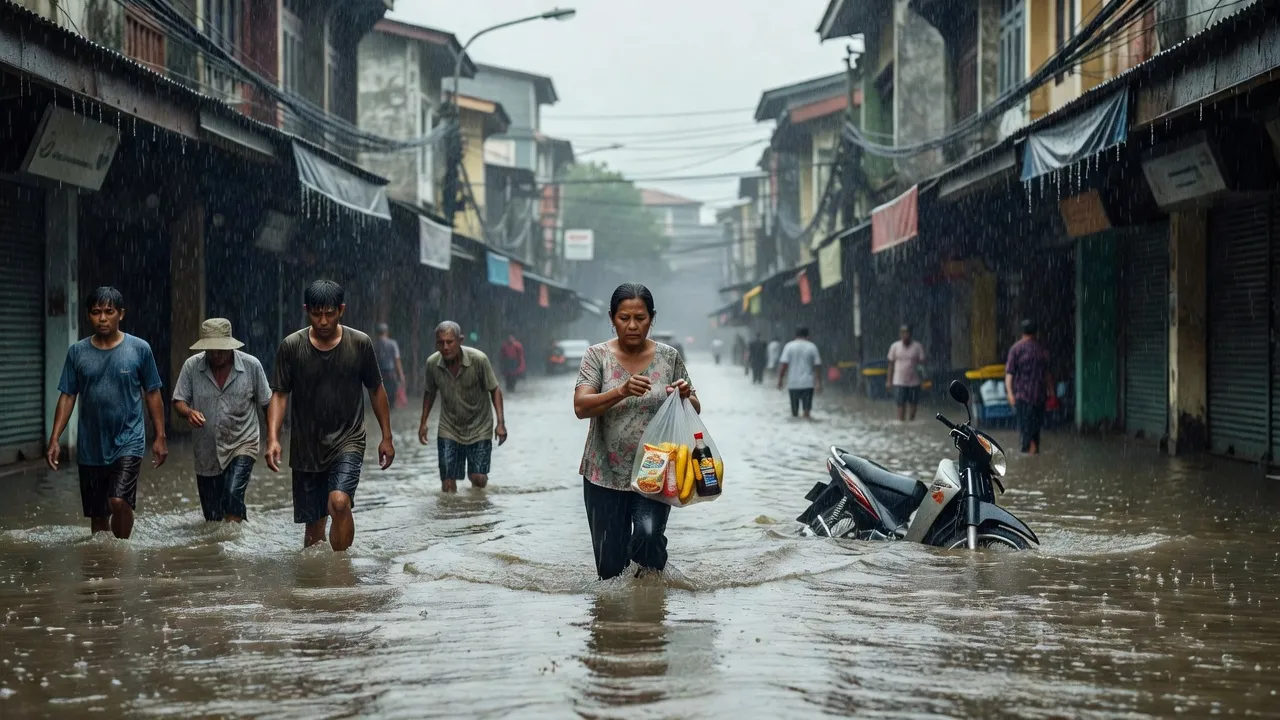

DOMINANT ANGLE
Paris first remembers the faces of the catastrophe: the inhabitants of Bangkok, with water up to their waists, rather than just the administrative mechanics of the state of natural disaster.
Dominant angle identified — does not reflect unanimity of this country’s media
KEY POINTS
- 01
Authorities in Bangkok declared a state of natural disaster in all 50 of its districts on Saturday, September 26, after nearly 300 mm of rain fell between Thursday afternoon and Saturday morning.
- 02
Pumping stations were evacuating around 1,200 cubic meters of water per second at full capacity, according to the BMA, which prepared one million sandbags and opened temporary shelters in schools.
- 03
The capital recorded 487 mm of rain between September 1 and 25, compared to an average of 269 mm over the 1991-2020 period, a discrepancy attributed by cited scientists to the intensification of extreme phenomena.
ANALYSIS
Paris, September 27, 2026. Paris is first remembering the faces of this catastrophe rather than just the administrative mechanics of the crisis. The authorities in Bangkok declared a state of natural disaster in all 50 districts on Saturday, September 26, after nearly 300 millimeters of rain fell between Thursday afternoon and Saturday morning. "The water just won't stop rising. It's hard to get out now. It's up to my waist," Somkid Pheuk-ngam, a 67-year-old vendor posted by a canal, told AFP, saying she hadn't "seen such flooding in the city in fifteen years." Motorcyclist Samruay Nakkamnueng described waking up to find "the street in front of my house flooded."
The governor of Bangkok, Chadchart Sittipunt, judged the situation "stabilized" on Saturday afternoon, while acknowledging considerable damage and mentioning two to three days needed to evacuate the water once the rain stops. Prime Minister Anutin Charnvirakul cut short a trip to London to return urgently. The pumping stations were operating at full capacity, evacuating around 1,200 cubic meters of water per second, according to the Bangkok Metropolitan Administration, which prepared one million sandbags and opened several temporary shelters in schools. In the On Nut neighborhood, residents were seen filling these sandbags to protect homes and businesses, while the governor encouraged bedridden patients and those dependent on vital medical equipment to consider a temporary stay in the hospital. Flooding also affected 21 other provinces in the country, with one reported death.
Some of the French press is linking this episode to the region's climate trajectory: the capital recorded 487 millimeters of rain between September 1 and 25, compared to an average of 269 millimeters over the 1991-2020 period, and cited scientists warn that the intensity of such episodes should increase with warming. The 2011 precedent, where flooding killed over 500 people throughout the kingdom, serves as an implicit reference point for several accounts, without the current toll approaching its scale.
SOURCES (7)
- 20 MinutesMEDIUM
- Sud OuestMEDIUM
- HuffPost FranceMEDIUM
- BFMTVMEDIUM