
DOMINANT ANGLE
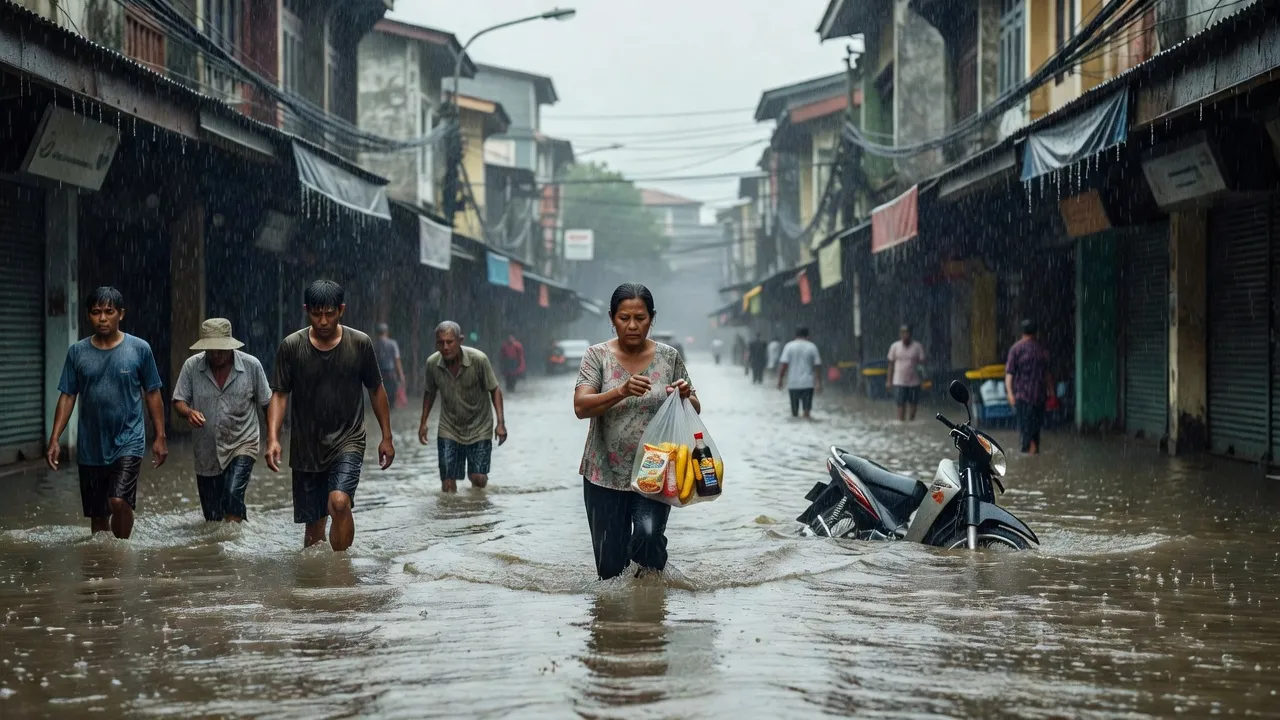
Bangkok is orchestrating an emergency command chain, from Governor Chadchart Sittipunt to Prime Minister Anutin Charnvirakul, who is piloting it by video conference from London, to justify the unprecedented declaration of the 50 affected districts.
Dominant angle identified — does not reflect unanimity of this country’s media
KEY POINTS
- 01
Governor Chadchart Sittipunt has extended the disaster zone to all 50 districts of Bangkok, up from three initially, after nearly 300 mm of rain in 48 hours.
- 02
Pumping stations are draining around 1,200 cubic meters of water per second; the Bangkok Metropolitan Administration reported 31 impassable roads on Sunday, September 27.
- 03
The Ministry of Interior and the Ministry of Defense have deployed machinery and military personnel, under the remote coordination of Prime Minister Anutin Charnvirakul, who is currently in the United Kingdom.
ANALYSIS
Bangkok, September 27, 2026. Chadchart Sittipunt has extended the disaster zone to all 50 districts of the capital, compared to just three a few days ago, after continuous rainfall since Thursday, September 24, in the evening. Nearly 300 millimeters of rain have fallen in 48 hours, saturating the canals: a cellular alert system warned the population on Saturday, September 26, at 9:22 am, that "water levels in the canals are at a critical level and continue to rise," inviting residents to elevate their belongings.
The Thai response is being organized through a cascade of administrative measures. The Ministry of Interior and the Ministry of Defense have assembled their staff at the emergency command center, mobilizing equipment and troops from Army Region 1 as well as relief centers from Suphan Buri and Chai Nat to reinforce Bangkok. Prime Minister and Minister of Interior Anutin Charnvirakul, who is currently on a trip to the United Kingdom, has been following and directing the coordination via video conference, asking each agency to mobilize its resources to full capacity.
On the ground, pumping stations are evacuating approximately 1,200 cubic meters of water per second, a rate deemed necessary by the governor to hope for a decrease in water levels within two to three days once the rain stops. On Sunday, September 27, in the morning, the Bangkok Metropolitan Administration was still reporting 31 impassable roads, with water heights reaching 20 centimeters on axes such as Ram Inthra, Ramkhamhaeng, or Chaeng Watthana.
The pollution control department has joined the response chain, monitoring gas stations and chemical storage sites to prevent any leaks into the stagnant water — a precaution drawn, according to its director, from the lessons of the 2011 floods. The embassies of Malaysia and the United States, on their part, have recommended that their nationals avoid flooded areas and postpone non-essential travel until Sunday.
The governor wants to believe in a stabilization: according to the weather department's forecasts, the rain was expected to subside on Saturday afternoon. However, as an analysis published by The Standard notes, there remains the difficulty of turning a meteorological probability into an individual decision: a 70% chance of rain does not mean that it will rain over 70% of the territory. This is a way for the Thai press to put the institutional mobilization into the long-term context of preparing for floods.
SOURCES (2)
- Khaosod EnglishMEDIUM
- The Standard ThailandMEDIUM
- All 50 Districts in Bangkok Declared Disaster Areas as Rainfall Continues Across the Capital
- มท. ผนึกกลาโหม ระดมเครื่องจักร-กำลังพลเสริมกรุงเทพฯ รับมือฝนหนัก-น้ำท่วม
- คพ. เฝ้าระวังปั๊มน้ำมัน-สถานที่เก็บสารเคมีช่วงน้ำท่วม กทม. ป้องกันการรั่วไหลปนเปื้อนสิ่งแวดล้อม
- สถานทูตมาเลเซีย-สหรัฐฯ ประกาศเตือนฝนตก-น้ำท่วม กรุงเทพฯ และหลายพื้นที่ในไทย แนะพลเรือนหลีกเลี่ยงพื้นที่น้ำท่วม ติดตามข้อมูลสภาพอากาศ