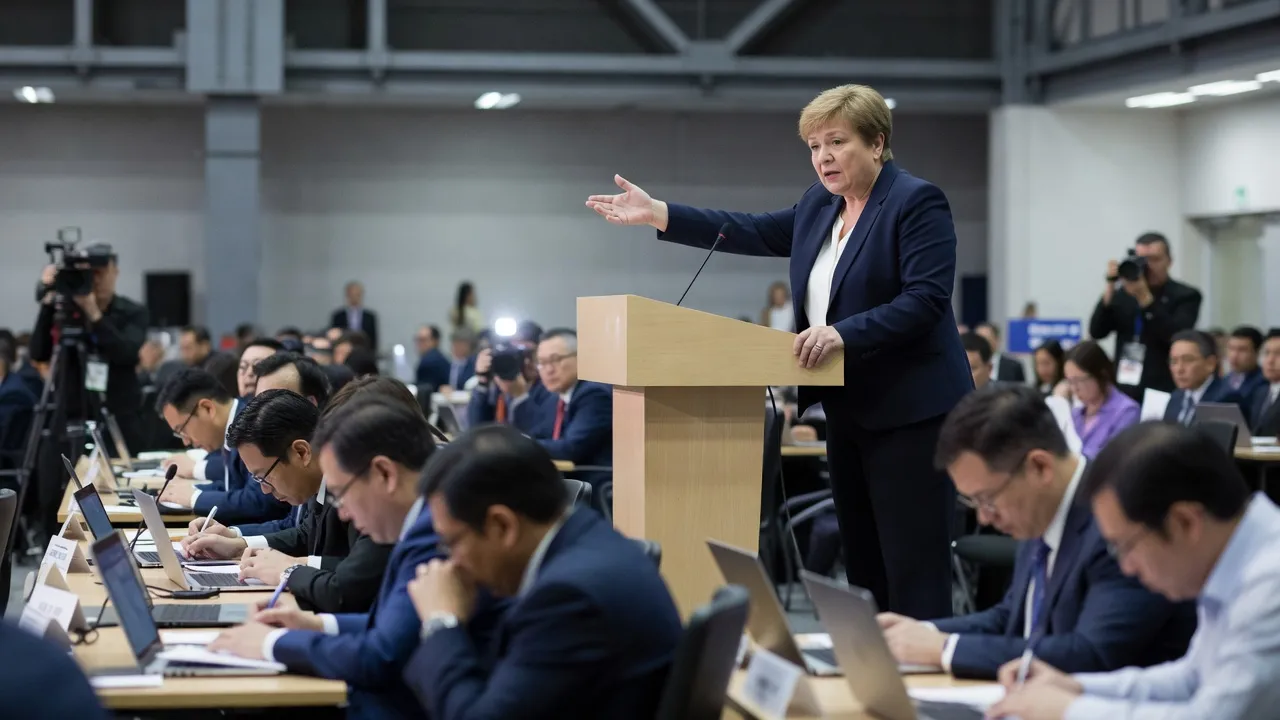
IMF raises 2026 global growth forecast to 3.1%, but warns of a 'highly uneven' outlook between AI winners and energy importers
published on
countries
sources
articles
More divergent than 49% of recent comparable stories (reference: 90 recent stories measured with the same method).
The fifteen covers of the corpus read the same report through their own line of figures: downward revisions in Latin America, increases in Ghana, Nigeria, and the Netherlands, budget discipline in France and Pakistan, here's what each highlights.
The forecasts remain conditional on a resumption of flows through the Strait of Hormuz by March; the IMF warns of risks related to AI, bond yields, and debt.
Latin America revised downward
Agência Brasil reports on the region: 2.3% growth in 2026 for Latin America and the Caribbean, down from 2.4% in the July forecast, and 2.5% in 2027, compared to 2.7% previously. According to the Brazilian media outlet, the Fund judges that the impact of the shock depends on the ability of gains from exporters of raw materials to offset the losses of energy importers.
« Artificial intelligence has not been a very strong driving factor in the region so far »
La Tercera dedicates most of its coverage to Chile: 0.6% in 2026, down from 1.8% in July and 2.4% in April. The newspaper draws up a ranking, with Chile being the second weakest economy in the region, ahead of only Bolivia, which is expected to contract by 3%. BioBioChile, on the other hand, notes that unemployment remains high.
In Argentina, El Cronista and the Buenos Aires Herald report a forecast revised downward from 3.5% to 2.1%. El Cronista adds that Minister Luis Caputo reports praise from Kristalina Georgieva on fiscal discipline, but that the third review of the program with the Fund remains open, with around $900 million pending. Veja gives 2.2% for Brazil, and La República 2.2% for Colombia, down from 2.3% previously.
Energy exporters and importers
In Nigeria, Nigerian Eye reports the comments of Deniz Igan, from the IMF's research department: growth has been partly due to the country's energy exports, but poverty risks remain very high. The 2026 forecast is now 4.2%, up from 4.1% in July. Vanguard Nigeria headlines the cost of living. The IMF recommends, according to the newspaper, targeted monetary transfers.
In Ghana, GBC Ghana Online and 3News note a forecast of 5.7% for 2026, up from 4.6% in April, and year-end inflation at 4.8%. They cite gold and budget consolidation. 3News also reports that sources close to the Fund advise against excessive dependence on gold.
In the Netherlands, DutchNews reports growth of 1.5%, up from 1% in July, which it links to the upward revision of the German forecast from 0.7% to 1.3% and global investments in AI. The same media outlet provides CBS data: fuel costs have risen by 27.2% in one year.
In South Africa, Business Day writes that the Fund is maintaining its forecast at 1%, down from 1.1% in July, and describes other African economies as "largely absent" from the technology-driven growth led by AI. In Ethiopia, Capital Ethiopia reports 9.2% growth in 2026 and estimated inflation at 11.7%.
Public debt and budget discipline
The French press focuses on France, with Sud Ouest and 20 Minutes, the latter with AFP, reporting Kristalina Georgieva's statement at a press conference: it will take time to bring debt back to levels that inspire "complete confidence" in investors. The French coverage recalls the context: the examination of the 2027 budget and a ten-year rate close to 5%.
« The longer countries wait, the more painful the adjustment becomes »
Rodrigo Valdes, from the budget affairs department, estimates that the average public debt is approaching 100% of GDP, according to Business Day and TimesLIVE. Business Recorder in Pakistan reprises his remarks from Reuters. The Daily Times reports 3.5% growth for Pakistan in 2026-27, below the government's 4% target, and 9.9% inflation.
El Cronista draws an Argentine lesson from the yield alert: it can, in his view, close the emerging markets window. In Thai coverage, Ms. Georgieva sees sustainably high yields and rising borrowing costs for emerging economies.
Bangkok, on the side of the delegations
Certain coverage focuses on the assemblies by their participants. The Kathmandu Post and Khabarhub follow Nepalese Finance Minister Swarnim Wagle, who has more than 16 meetings on reconstruction financing on his agenda. Nepal and Thailand appear through their delegations, not through forecasts.
Khaosod English relays the estimate from the Thai Ministry of Finance: between 1.05 and 2.25 billion baht in revenue, for more than 15,000 participants. Fana BC describes exchanges between the Ethiopian delegation and two departments of the Fund on technical assistance.
In Venezuela, Descifrado and Contrapunto VE reiterate the central bank's statement on its participation. El Nacional and Analitica provide the IMF's forecast for the country: 5% in 2026, then 7% in 2027, with inflation of 467.9% by the end of 2026.
The forecasts assume a resumption of oil and gas deliveries through the Ormuz Strait by March.
Oil above $130 until the first quarter of 2027 would cut half a point of growth in 2027.
It cites three possible triggers: withdrawal of investments in AI, rise in sovereign yields, major cyberattack.
Key figures
- 3.1 %Global growth forecast for 2026 by the IMF, compared to 3.0% in July1 source · The Express Tribune
- 10 %Share of hyperscalers in investment-grade bond emissions, compared to less than 1% in 20241 source · The Vibes
What the comparison reveals
Common ground and differences in coverage across the media analysed.
What the media report in common
Most corpora first retain the 2026 growth forecast that the IMF publishes for their own country or region.
The IMF and World Bank annual meetings in Bangkok serve as the framework for coverage in the majority of corpora, which report either the published forecasts or the presence of ministers and central banks.
Where media coverage diverges
Place of the global figure of 3.1%
What place does the coverage give to the global forecast of 3.1%? France, Pakistan, and Colombia cite it; Venezuela, Ghana, and Nepal do not repeat it.
Financial risks of AI
How much importance should be given to the stock market correction related to AI and cyber threats? The Malaysian press makes it their central subject; Dutch and Nigerian articles mention them little or not at all.
Coverage aligned with this reading
Coverage that diverges
Meaning of national revision
Is the IMF forecast for the country raised or lowered? Raised for Ghana, Nigeria, and the Netherlands; lowered for Argentina, Chile, and Colombia.
This grouping describes the publications analysed, not the position of these countries’ populations or of their governments.
Blind spots
What the coverage of each country leaves aside, while others put it forward.
 Netherlands
- IMF warnings on public debt
- risk of stock market correction related to AI
 Ghana
Ghana- global forecast of 3.1 %
- gap between AI winners and energy importers
 Nepal
Nepal- IMF's World Economic Outlook
How each country reads it
Preview: 3 of 15 media perspectives. Syntheses of the media analysed — not direct quotations. Method & limitations
 Chile
ChileSantiago is deciphering the IMF's perspectives through its own economy: the global increase of 3.1 percent takes a back seat to Chile's third decline in 2026, which has been reduced to 0.6 percent, one of the lowest in South America.
3 sources · View sources
 Argentina
Buenos Aires is weighing the IMF's verdict based on its own case: the national growth forecast cut to 2.1% and the third review of the program remaining open carry more weight than the global figure of 3.1%.
4 sources · View sources
 Brazil
Brasília takes a regional lesson from the IMF report: Latin America, revised downward to 2.3%, is barely benefiting from the AI boom that is supporting global growth at 3.1%.
2 sources · View sources
The full text, country by country
Chile
DOMINANT ANGLE
Santiago is deciphering the IMF's perspectives through its own economy: the global increase of 3.1 percent takes a back seat to Chile's third decline in 2026, which has been reduced to 0.6 percent, one of the lowest in South America.
KEY POINTS
- The IMF is lowering Chile's 2026 growth to 0.6%, compared to 2.4% in April and 1.8% in July, with 2.6% maintained for 2027.
- According to the IMF's tables, the unemployment rate would rise from 8.5% in 2025 to 9.5% in 2026 and then 9.6% in 2027.
- The second weakest economy in Latin America in 2026 would be that with the only exception of Bolivia (-3%), while the region is at 2.3%.
ANALYSIS
Santiago, October 14, 2026. Chilean media are treating the IMF's World Economic Outlook, published on Tuesday, October 13, under the title "Resilience under pressure, urgent decisions", first and foremost as a verdict on the national economy. La Tercera opens with a straightforward assessment: "The prospects for the Chilean economy are not good for the rest of 2026".
The Fund has lowered Chile's GDP growth to 0.6% this year, compared to 1.8% in July and 2.4% in April, marking the third downward revision of the year. The figure is slightly lower than the 0.7% forecast by the Ministry of Finance just a week earlier. The Central Bank's monthly survey is even more pessimistic: the median forecast of economists has fallen from 0.7% to 0.2%, within a range of -0.2% to 0.6%. BioBioChile adds that the World Bank is expecting 0.8%.
The regional comparison weighs heavily in the narrative. According to La Tercera, Chile is set to become the second-weakest economy in Latin America in 2026, ahead of only Bolivia, which is expected to contract by 3%. The IMF is projecting 4.6% growth for Paraguay, 3% for Peru, 2.7% for Ecuador, and 2.2% for Brazil and Colombia, while Publimetro cites 1.5% for Mexico. The region as a whole has been revised downward from 2.4% to 2.3%.
The labor market is a major concern: according to the Fund's tables, unemployment would rise from 8.5% in 2025 to 9.5% in 2026 and 9.6% in 2027. Average inflation would be 3.7% this year and 3.5% next year, and the current account deficit would narrow to 0.3% of GDP before widening to 1.5% in 2027. A rebound to 2.6% is still expected for 2027.
The global context is reported in the background: 3.1% growth in 2026 (one-tenth of a percentage point higher than in July) and 3.4% in 2027, with the war in Iran and rising oil prices weighing on the economy, and investment in artificial intelligence cushioning the shock. Publimetro links this context to the Chilean case: the IMF mentions the energy shock, still-restrictive monetary conditions, and "a smaller contribution from the global AI boom" to growth in much of Latin America.
A more reassuring note comes from La Tercera: GDP per capita in purchasing power parity would remain close to $37,000, with Chile remaining the second-highest in the region behind Uruguay and exceeding $40,000 in 2028.
Argentina
DOMINANT ANGLE
Buenos Aires is weighing the IMF's verdict based on its own case: the national growth forecast cut to 2.1% and the third review of the program remaining open carry more weight than the global figure of 3.1%.
KEY POINTS
- The IMF lowers Argentina's 2026 growth from 3.5% to 2.1% and 2027's from 4% to 3.5%; 2026 inflation rises from 30.4% to 32.5% (Buenos Aires Herald, MercoPress).
- Caputo claims Georgieva deemed fiscal discipline "exemplary worldwide", but the third review remains open, with around $900 million at stake (El Cronista).
- The IMF projects a net deficit of advanced economies of 5.2% of GDP in 2026, the highest since 2021, and calls for rebuilding fiscal space (El Cronista, Financial Times).
ANALYSIS
Buenos Aires, October 14, 2026. The IMF's global figure, 3.1% growth in 2026 and 3.4% in 2027, is just the backdrop. In Argentine media, the headline is national: the Fund has lowered the country's growth from 3.5% to 2.1% this year, a 1.4 percentage point decrease, and from 4% to 3.5% for 2027. The Buenos Aires Herald notes that Argentina is thus falling below regional (2.3%) and global (3.1%) averages. The Buenos Aires Times emphasizes that the new projection remains above the 1.5% expected by analysts in the Central Bank's REM survey, but about one point below the 3% that the government of Javier Milei retains in its 2027 budget plan.
The IMF is also revising its inflation estimate for 2026, from 30.4% to 32.5%, and for 2027, from 15.7% to 21.2%. Unemployment would rise from 7.2% to 7.6%. Petya Koeva Brooks, from the research department, attributes the revision to weaker activity in the third quarter, weakened domestic demand, and still restrictive financial conditions. El Cronista notes that a Tucumana, Silvana Tenreyro, is presenting the WEO for the first time as chief economist, and lends her a message focused on the need to "recompose the budget space".
The second thread is the meeting, on Tuesday, October 13, in Bangkok, between Economy Minister Luis Caputo and Kristalina Georgieva. Caputo reports that she was "very praising of fiscal discipline", deemed exemplary in the world. El Cronista nuances: he leaves without the approval of the third review of the $20 billion program signed in April 2025, without a closing date, with about $900 million pending. The primary surplus for the first half of the year (0.6% of GDP) remains below the target of 0.7%, hence the need for a waiver from the Board of Directors. The country still owes about $850 million in November and $340 million in December.
Third angle, financing. According to El Cronista, the Fund's alert on the rise in sovereign yields of advanced economies may close the window of emerging markets, while the IMF was expecting Argentina's return to the markets in 2026. The government has preferred multilateral banks, judging that the country risk does not reflect the fundamentals.
The contrast between AI winners and energy importers only appears in the background, except in energy: MercoPress and the Herald recall a barrel at $96, about 40% more than in 2025, which benefits raw material exporters, including the Argentine energy sector.
Brazil
DOMINANT ANGLE
Brasília takes a regional lesson from the IMF report: Latin America, revised downward to 2.3%, is barely benefiting from the AI boom that is supporting global growth at 3.1%.
KEY POINTS
- The IMF forecasts 2.3% growth for Latin America and the Caribbean in 2026, down from 2.4% in July, and 2.5% for 2027, down from 2.7% previously (Agência Brasil).
- For Brazil, the IMF's forecast is 2.2% growth in 2026 (Veja).
- Argentina's forecast drops from 3.5% to 2.1% for 2026 and from 4% to 3.5% for 2027 (Veja).
ANALYSIS
Brasília, October 14, 2026. The Brazilian press is treating the IMF report published on Tuesday, October 13, in Bangkok, more through a regional than a global prism. Agência Brasil is headlining the downward revision for Latin America and the Caribbean: 2.3% growth in 2026, compared to 2.4% in the July forecast and 2.5% in 2025, and 2027 reduced from 2.7% to 2.5%.
This decline contrasts with the global forecast, which has been revised upward from 3% to 3.1%. The Fund attributes this to the "divided global economy", supported by the re-routing of energy supplies and investments related to artificial intelligence. Agência Brasil recalls that the war in the Middle East has made energy a global inflationary shock, with Brent around 45% above its pre-war level, and that global financing costs are reaching unprecedented levels in several decades.
For the region, the IMF believes that the impact of the shock depends on the ability of the gains of raw material exporters to offset the losses of energy importers, as well as the credibility of the inflation targets of central banks. It notes that there is little compensation from the recovery of the technology sector in most countries: Latin America is benefiting little from the AI boom. Veja adds that regional inflation would be 4.2% in 2026 and 4.1% in 2027.
Regarding Brazil, Veja notes in one sentence that the IMF is forecasting 2.2% growth in 2026. Attention is focused more on Argentina: according to Veja, the Fund has reduced its forecast from 3.5% to 2.1% for 2026 and from 4% to 3.5% for 2027, which "amplia a pressão sobre o presidente Javier Milei". Petya Koeva Brooks, deputy director of the studies department, cites weaker domestic demand and still restrictive financial conditions. Veja adds that a Reuters survey of 32 economists is expecting 1.9% this year, and that the Argentine economy contracted by 0.6% in the second quarter, with a risk of technical recession.
The Brazilian reader thus retains a map of winners and losers where South America is on the side of relative losers, and where Brazil, at 2.2%, is slightly below the regional average.
 Colombia
DOMINANT ANGLE
Bogotá takes away from the IMF report a primarily national reading: the downward revision of Colombian growth, tempered by a regional comparison that remains favourable.
KEY POINTS
- The IMF forecasts 2.2% growth in 2026 and 2.3% in 2027, compared to 2.3% and 2.5% previously (La República).
- For Latin America and the Caribbean, inflation would rise to 4.2% in 2026 and 4.1% in 2027, with growth of 2.3% and then 2.5% (Semana).
- Silvana Tenreyro estimates that AI "has not been a very strong driving factor" in the region so far (Semana).
ANALYSIS
Bogotá, October 14, 2026. In the Colombian press, the global growth rate increase to 3.1% in 2026 takes a back seat to the revision of the country's figures. La República reports that the IMF "has reduced its growth projections for Colombia in 2026 and 2027": 2.2% this year and 2.3% next year, compared to 2.3% and 2.5% in the previous estimate, which represents decreases of 0.1 and 0.2 percentage points. The newspaper notes that the 2026 performance would still be lower than the 2.6% recorded in 2025, and that the 2027 recovery would only surpass that of 2026 by 0.1 percentage point. It also cites an average inflation rate of 6% and an unemployment rate of 9%.
The newspaper, however, tempers this decline by comparing it to the regional situation. With 2.2% in 2026, Colombia would perform better than Argentina (2.1%), Mexico (1.5%), Uruguay (1.3%), and Chile (0.6%), and would be on par with Brazil. The situation changes in 2027: Argentina, with 3.5%, and Peru would surpass Colombia. La República recalls that the IMF still expects Colombian growth in the two years, but at a slower pace than announced.
Semana focuses on the region. According to the Fund's chief economist, Silvana Tenreyro, who spoke on Tuesday at a press conference in Bangkok, inflation in Latin America and the Caribbean will rise to 4.2% this year and then to 4.1% in 2027. Regional growth is estimated at 2.3% in 2026, which is 0.1 percentage point less than in July, and then at 2.5% in 2027. "The Fund's advice is to keep an eye on inflation," Ms. Tenreyro said, asking authorities to avoid any secondary effects of the energy and raw materials shock, for both exporters and importers.
The weekly magazine reiterates the idea of a "fairly heterogeneous" impact of the war in the Middle East, according to each country's exposure to raw materials. It also notes the observation of the official: "Artificial intelligence has not been a very strong driving factor in the region so far," unlike in Asia or advanced economies. The reminder of the region's chronic inflation, from Argentina to Venezuela, frames the warning.
The two texts therefore treat the report as a barometer of the Latin American situation, where the rise in oil prices and the growth of AI, drivers of the IMF's global narrative, are read through their effect on local prices and growth.
 Ethiopia
DOMINANT ANGLE
Addis Ababa retains from the IMF its national projection, a growth of 9.2% in 2026, and immediately nuances it with inflation and the current deficit, more than with the global map of AI winners.
KEY POINTS
- The IMF projects a 9.2% growth in real GDP in 2026, then 7.8% in 2027 (Capital Ethiopia).
- Inflation is estimated at 16% in 2025, 11.7% in 2026 and 12.3% in 2027; the current deficit would rise from 0.8% to 2.5% of GDP in 2026.
- The delegation met with two IMF departments in Bangkok for technical assistance to the Ministry of Finance and the National Bank (Fana BC).
ANALYSIS
Addis-Abeba, 14 October 2026. In the Ethiopian press, the IMF's World Economic Outlook is read first on a national scale, and not through the world map of AI winners and energy importers. Capital Ethiopia reports that the Fund, in its October 2026 report, projects for Ethiopia a real GDP growth of 9.2% in 2026, identical to the 2025 estimate, before slowing down to 7.8% in 2027. The newspaper sees "potential challenges" for maintaining this momentum.
Inflation is a major focus. According to the report, consumer prices rose by 16% in 2025; the IMF expects 11.7% in 2026, then a rebound to 12.3% in 2027. Capital Ethiopia believes that, even in decline, this level remains high and continues to weigh on household purchasing power and business costs: inflation can erode the real value of income, particularly for low-income families, and complicate the translation of growth into improved living standards.
The second point of vigilance is the external balance. The current account deficit would rise from around 0.8% of GDP in 2025 to 2.5% in 2026, before returning to 1.3% in 2027. The daily newspaper presents this deterioration as a sign of pressure on the country's external balance, while noting that the expected improvement in 2027 would suggest some easing. The article also mentions the Fund's warnings about the vulnerability of the global economy, without detailing the mechanism: neither the $96 barrel nor the Strait of Ormuz nor the concentration of growth in 32 countries appears in the available excerpts.
Fana Media Corporation, on its part, treats the sequence from an institutional angle. In Bangkok, on the sidelines of the 2026 IMF-World Bank annual meetings, the Ethiopian delegation met separately with the Fund's budget affairs department and its monetary and capital markets department. The discussions focused on ongoing technical assistance and additional support to the Ministry of Finance and the National Bank of Ethiopia, in line with their reform priorities. Fana sees this as a reflection of "continued cooperation" with the institution and the strengthening of the necessary capacities to implement these reforms.
The contrast is clear between the two readings: one highlights a flattering growth figure accompanied by reservations about prices and external accounts, the other the pursuit of a technical partnership with the Fund.
 France
DOMINANT ANGLE
Paris takes away from the IMF less the growth revision than the lesson of budgetary discipline addressed to advanced economies, and to France in particular, on the eve of the 2027 budget review.
KEY POINTS
- The IMF forecasts global growth of 3.1% in 2026 (+0.1 percentage point compared to July), compared to 3.5% in 2025 and 3.4% in 2027.
- Kristalina Georgieva believes it will "take time" to inspire "complete trust" in investors; the 10-year rate is approaching 5%.
- The IMF is urging advanced economies to "urgently" restore their budget discipline, describing them as the "worst students".
ANALYSIS
Paris, October 14, 2026. The French press has taken note of the IMF report, presented in Bangkok at the opening of the annual assemblies, focusing less on the global map than on the budgetary warning that accompanies it. RFI details the figures: a global growth rate of 3.1% in 2026, i.e., 0.1 percentage point more than in the July forecasts, compared to 3.5% in 2025, and then 3.4% in 2027, a figure that remains unchanged. The revision comes from advanced economies, particularly Asian ones, driven by the boom in artificial intelligence investments. In contrast, emerging countries are suffering from the surge in hydrocarbons linked to the conflict in the Middle East and are trying to mitigate it with subsidies that absorb their already limited budget margins.
The Fund describes a "fragmented" economy and a "two-speed trajectory": energy importers not exposed to the rise of AI remain the most vulnerable. Silvana Tenreyro, quoted by RFI, warns that "this resilience is being put to the test, with risks oriented downwards".
But the essence of national coverage focuses on France itself. Sud Ouest and 20 Minutes, the latter with AFP, report the comments of IMF Managing Director Kristalina Georgieva during a press conference on the sidelines of the assembly: "However, it will take time to bring them back to levels that can inspire confidence, complete confidence, both for the population and for investors". She acknowledges that France is seeking to adopt a budget that puts the deficit and debt on a downward trajectory.
The domestic context weighs on the reading. The examination of the 2027 budget in the National Assembly aims for a deficit of 5% of GDP, but its adoption remains very uncertain, due to a lack of majority and the approach of the presidential election. On the bond market, the 10-year borrowing rate is approaching 5%. 20 Minutes judges the warning to be "particularly severe for the tricolor finances".
More broadly, Ms. Georgieva calls on developed economies to restore their budgetary discipline "urgently": "Too many countries have not taken advantage of the post-pandemic recovery to rebuild their budgetary maneuvering margins". This time, it is the advanced economies that are "the worst students". She advocates for increasing revenue, rationalizing expenditure, and improving public finance management. The yields on government bonds, at their highest in over twenty years in the United States and Europe, are also weighing on the debt of developing countries.
Ghana
DOMINANT ANGLE
Accra is savoring the IMF's endorsement: the revision to 5.7% of 2026 growth is presented as validation of the economic stabilization undertaken since the 2022 crisis.
KEY POINTS
- The IMF is raising Ghana's 2026 growth to 5.7% (from 4.6% in April), above the government's target of 4.8%, then 5.2% in 2027.
- Year-end inflation is expected to be 4.8% compared to 7.9% previously, after 5.2% in September 2026.
- Finance Minister Cassiel Ato Forson is leading the delegation to the assemblies in Bangkok (12-18 October), ahead of the 2027 budget scheduled for November.
ANALYSIS
Accra, October 14, 2026. In the Ghanaian press, the World Economic Outlook published on Tuesday, October 13, in Bangkok is first read as a national endorsement. The IMF has revised its growth forecast for Ghana in 2026 to 5.7%, up from 4.6% in April, an increase of 1.1 percentage points, and above the government's target of 4.8% set in the 2026 budget. GBC Ghana Online and 3News also report a year-end inflation rate of 4.8%, down from 7.9% previously, after 5.2% in September. This would be the second consecutive year of single-digit inflation at the end of the year, after 2025.
The media attribute this result to budget consolidation, growth-oriented spending, and strong export revenues, led by gold, which have improved the trade balance and served as a buffer against external shocks. 3News adds the achievement of the policy coordination instrument (PCI) targets and recalls that the Ghana Statistical Service measured growth of 6.0% in the second quarter, or 6.2% in the first half of the year.
Reservations exist, but remain measured. The IMF forecasts a slowdown to 5.2% in 2027, a sign that the current pace may not be sustainable, and sources close to the Fund, cited by 3News, advise against excessive dependence on gold and advocate for diversification of exports.
Graphic Online places the publication in the political calendar. Finance Minister Cassiel Ato Forson is leading the delegation to the IMF and World Bank annual meetings, scheduled from October 12 to 18. He is expected to reassure investors about the prospects and commitment to reforms, following the end of the $3 billion aid program, and meet with the IMF management and World Bank officials. The meeting precedes the 2027 budget and economic statement, expected in Parliament in November, where he is to present the "New Economy" program. These meetings are the first to be held outside of Washington since his entry into office in 2025.
The global context remains in the background: the three articles only retain the phrase "despite global uncertainty" and treat the revision as confirmation of the recovery following the 2022 crisis.
 Malaysia
DOMINANT ANGLE
Kuala Lumpur has taken note of Bangkok's warning of a brutal correction in the AI market, relayed by the Malaysian press as the main risk to global financial stability.
KEY POINTS
- The IMF released its Global Financial Stability Report on Tuesday, October 13, in Bangkok, which judges the risks as "elevated" (Malay Mail).
- Hyperscalers account for 10% of investment-grade bond emissions worldwide, compared to less than 1% in 2024 (The Vibes).
- Three plausible triggers: correction in AI investments, surge in sovereign yields, major cyberattack (The Vibes).
ANALYSIS
Kuala Lumpur, October 14, 2026. The Malaysian press is taking note of the annual meetings of the IMF and the World Bank, held in Bangkok, focusing less on the growth forecast and more on the warning about financial stability. The Report on Global Financial Stability was published on Tuesday, October 13, the second day of these meetings held in the Thai capital, neighboring Malaysia.
Malay Mail, reporting from Bangkok, highlights that the IMF considers the risks to be "elevated" and that a correction in a market related to AI, such as cyber threats, could have "severe" consequences. The cited report is direct: "These risks are plausible near-term catalysts for a sharp tightening of financial conditions and market turmoil." The newspaper recalls that the boom in artificial intelligence, with the rush to semiconductors and data centers, has supported global growth despite the war in the Middle East.
The IMF notes, however, according to the same article, that "growing evidence suggests that AI capabilities can be delivered at lower investment levels," or that the economic gains could be lower than expected. Less sustainable or less profitable investments would be enough to trigger a correction.
The Vibes emphasizes three triggers identified by the Fund: a decline in investments in AI, a surge in sovereign bond yields, and a major cyberattack. Athanasios Vamvakidis, Deputy Director of the Monetary and Capital Markets Department, said during a press briefing in Bangkok: "An AI market correction will affect the real economy." He warned that market resilience does not mean they are safe. The newspaper quantifies the extent of exposure: the hyperscalers now account for 10% of investment-grade bond issuances worldwide, compared to less than 1% in 2024, and the growing debt of the sector could amplify a slowdown by forcing asset sales.
In terms of recommendations, Malay Mail reiterates Vamvakidis' line: "The policy priority should be to strengthen resilience before new shocks hit the economy." The cyber risks are described as "known and very much unknown."
The two articles in the corpus do not address the global growth forecast of 3.1% or the inequality between AI winners and energy importers, and they do not examine the exposure of the Malaysian economy to a technological correction.
 Nigeria
DOMINANT ANGLE
Abuja weighs in on the forecast of 4.2% in light of the cost of living: growth exists, but Nigerian households do not feel its effects.
KEY POINTS
- The IMF raises its growth forecast for 2026 to 4.2%, up from 4.1% in July (Vanguard, Nigerian Eye).
- Deniz Igan, of the IMF: "While the growth held up, given energy exporter, poverty risks are still very high" (Nigerian Eye).
- The IMF recommends monetary transfers and temporary targeted support to vulnerable households, and forecasts 4.5% growth in Sub-Saharan Africa in 2026 (Vanguard).
ANALYSIS
Abuja, October 14, 2026. Nigeria's press has taken note of the IMF report, published on Tuesday, October 13, during the annual meetings in Bangkok, particularly the forecast concerning the country: Nigeria's growth in 2026 has been revised upward to 4.2%, compared to 4.1% in the July edition. However, Vanguard Nigeria highlights the other side of the observation: despite growth and its status as an energy exporter, the cost of living remains high and many Nigerians struggle to meet their basic needs.
The Fund attributes the economy's stability to improved macroeconomic stability and favorable effects on trade terms. Nigerian Eye reiterates its warning: "Higher prices for essentials are expected to further aggravate poverty and food insecurity." The rise in energy and food prices, geopolitical tensions, and a possible correction in markets related to artificial intelligence are presented as threats to global prospects.
During the press conference, Deniz Igan, head of global economic studies at the IMF's research department, cited Nigeria as an example. According to her, growth has been sustained in part because the country exports energy, but poverty risks remain very high. She recommends monetary transfers and targeted temporary support for the income of the most vulnerable households, consistent with the government's medium-term budget framework. Vanguard adds that the IMF is urging the federal state to reduce its debt without exacerbating household difficulties.
The two publications thus highlight the trade-off formulated by Ms. Igan: reconciling the population's immediate needs, food and energy security, and medium-term budget stability. The global framework, titled "Resilience Under Strain, Urgent Choices", serves as a backdrop rather than a subject.
Regarding sub-Saharan Africa, Vanguard quotes the IMF as anticipating stable growth of 4.5% in 2026, while noting significant differences between countries depending on their policy leeway, reforms, exposure to raw materials, climate shocks, and access to external financing. Nigeria thus appears both as a beneficiary of the energy shock, through its export revenues, and as an economy whose households bear the cost.
Netherlands
DOMINANT ANGLE
The Netherlands takes from the IMF report what affects its economy: Dutch growth revised up to 1.5% thanks to the German rebound and AI, but inflation that energy keeps high.
KEY POINTS
- The IMF forecasts Dutch growth of 1.5% in 2026, compared to 1% in July, then 1.3% in 2027.
- The German forecast increases from 0.7% to 1.3% for 2026, which supports the Netherlands, according to DutchNews and Welingelichte Kringen.
- Dutch inflation reaches 3.4% in September according to the CBS, with fuels rising 27.2% over a year; the IMF forecasts 2.9% for 2026.
ANALYSIS
Amsterdam, October 14, 2026. The Dutch media are addressing the IMF's Global Economic Perspectives, published on Tuesday, October 13, from a national perspective. DutchNews headlines the increase in the forecast for the Netherlands: the gross domestic product is expected to grow by 1.5% this year, compared to 1% in the July assessment, and then by 1.3% in 2027. Welingelichte Kringen, under the title "Het gaat best goed met de Nederlandse economie" (the Dutch economy is doing quite well), reports the same figures and specifies that, for 2027, the fund was already counting on 1.3% in July.
The two texts explain this revision from the outside. The IMF is raising its forecast for Germany, the country's main trading partner, from 0.7% to 1.3% for 2026. Welingelichte Kringen recalls that the Bundesbank has also been more optimistic recently, thanks to strong public investments, particularly in defense, and a resurgence in demand for German exports. DutchNews adds that the Dutch economy is also benefiting from "large global investments in AI technology".
The less favorable aspect is that of prices. The IMF is expecting inflation of 2.9% in the Netherlands in 2026, and then 2.8% in 2027, which, according to Welingelichte Kringen, suggests an inflation that will remain "vrij hoog" (quite high) for some time. DutchNews compares these figures to the data from the CBS institute, published on Tuesday: inflation rose to 3.4% in September, continuing a rise that began in July. Fuel costs have increased by 27.2% in one year, and the liter of diesel is approaching 2.50 euros, while food products have fallen by 1.9%.
The global context occupies a limited place. Welingelichte Kringen quotes Silvana Tenreyro, who sees resilience in the global economy after the strong disruption of energy markets caused by the war against Iran, and reports global growth of 3.1% this year and 3.4% in 2027, on the occasion of the annual meeting in Bangkok. DutchNews notes that the IMF believes the effect of the conflict on fuel prices has been mitigated by several countries' use of other oil and gas suppliers.
Neither of the two articles takes up the concentration of AI gains in a few economies, nor the fund's warnings about a stock market correction or public debt: the Dutch reading remains that of an exporting country, dependent on its German neighbor, which benefits from the cycle but suffers from the energy bill.
Nepal
DOMINANT ANGLE
Kathmandu is approaching the IMF and World Bank assemblies from a financing perspective: for the Nepalese press, the issue is the agenda of its Finance Minister in Bangkok, not the global growth figure.
KEY POINTS
- Finance Minister Swarnim Wagle is heading to Bangkok to attend the World Bank Group and IMF's annual meetings, with over 16 bilateral and multilateral meetings scheduled.
- The delegation includes Finance Secretary Ghanshyam Upadhyaya and Joint Secretary Amrit Lamsal; they are expected to return on October 21.
- Discussions are expected to focus on development financing, post-disaster reconstruction, and economic recovery, according to The Kathmandu Post.
ANALYSIS
Katmandou, 14 October 2026. In Nepal, the annual assemblies of the International Monetary Fund and the World Bank Group, opened in Bangkok, are told through the journey of Finance Minister Swarnim Wagle. The two articles in the corpus, published on 13 October by The Kathmandu Post and Khabarhub, do not take up the IMF's growth forecasts or its warnings: they describe the delegation and its program.
According to The Kathmandu Post, which quotes the Ministry of Finance, Swarnim Wagle leaves Tribhuvan International Airport at 13:30 on a Thai Airways flight, with "more than 16" bilateral and multilateral meetings on his agenda. Khabarhub gives the same figure and specifies that the minister left Katmandou for Thailand. He is accompanied by Finance Secretary Ghanshyam Upadhyaya, Deputy Secretary Amrit Lamsal, head of the international economic relations division, as well as two colleagues, Madhav Bhandari and Gajendra Bhattarai. The return is scheduled for Nepal on 21 October.
The Katmandou daily presents these meetings as a place where ministers and high officials discuss global economic prospects, development financing, poverty reduction, and financial stability. It also sees it as a forum where governments exchange with international financial institutions and development partners on economic policy, investment, and financing.
Attention is focused on national priorities. According to The Kathmandu Post, Mr. Wagle's exchanges should focus on Nepal's economic priorities and its cooperation with international financial institutions, particularly development financing, post-disaster reconstruction, and economic recovery. The newspaper links the trip to the country's search for funding for reconstruction and recovery, in addition to support for infrastructure, investment, and macroeconomic stability.
The Nepalese reading is therefore that of a country seeking resources, which comes to Bangkok to negotiate rather than comment on the ranking of winners and losers in the global recovery. Neither of the two texts mentions the $96 barrel, the rise of artificial intelligence, the Strait of Ormuz, or the risks of a stock market correction.
 Pakistan
DOMINANT ANGLE
Islamabad gauges the IMF's verdict in light of its own trajectory: 3.5% growth in 2026-27, below the government's 4% target, and a Finance Minister who promises to pursue reforms.
KEY POINTS
- The IMF forecasts 3.1% global growth in 2026 and 3.4% in 2027, assuming the Strait of Hormuz reopens by March (Express Tribune).
- For the country, the IMF projects 3.5% growth in 2026-27, below the government's 4% target, with 9.9% inflation (Daily Times).
- Muhammad Aurangzeb reaffirmed in Bangkok the commitment to fiscal, energy, state-owned enterprise, and pension reforms (Business Recorder).
ANALYSIS
Islamabad, October 14, 2026. Pakistani media are covering the Global Economic Prospects, published on Tuesday, October 13, in Bangkok during the IMF and World Bank annual meetings, from two angles: global risk and then the national bill.
The Express Tribune details the perils. The Fund forecasts growth of 3.1% in 2026, compared to 3.0% in July, and then 3.4% in 2027, an assumption that supposes the reopening of the Strait of Ormuz by March. A longer war, with oil above $130 until the first quarter of 2027, would subtract half a point of growth next year. The daily newspaper quotes Kristalina Georgieva's phrase: an economy "standing on one leg, the leg of AI". A collapse of investments in AI would reduce the global GDP by 1.1% by 2028. It also highlights the IMF's warning to poor countries affected by the energy shock of the war with Iran: they may have to reduce their spending or restructure their debt.
The Daily Times takes it down to the country's scale. The IMF is counting on Pakistani growth of 3.5% for the 2026-27 fiscal year, below the government's target of 4% and the World Bank's 3.8%. Inflation would rise from 7.1% to 9.9%, and the current account would go from a surplus to a deficit of 1% of GDP. The newspaper notes that unemployment should nonetheless decrease to 6.5%, without the report explaining this improvement.
Business Recorder extends the budget message. Rodrigo Valdes, from the IMF's Fiscal Affairs Department, told Reuters that "the longer countries wait, the more painful the adjustment becomes", the average public debt approaching 100% of GDP. The Fund invites low-income countries to strengthen their tax system. The same newspaper reports that Finance Minister Muhammad Aurangzeb reaffirmed on Tuesday, during a roundtable on sovereign risks, the national ownership of tax, energy, public enterprise, and pension reforms under the IMF program. He highlights budget consolidation, inflation reduction, and the rebuilding of foreign exchange reserves, as well as debt management aimed at lengthening maturities.
The Pakistani narrative therefore treats the report less as a map of AI winners than as a test of the discipline that the country is already imposing on itself under the IMF program.
 Thailand
DOMINANT ANGLE
Bangkok is deciphering the IMF's verdict in light of its own economy: 2.1% growth, imported energy, debt cost, and showcase of a host country.
KEY POINTS
- The IMF forecasts 2.1% growth for 2026 and 2027, with inflation of 2.1% and then 1.7% (The Standard).
- The 10-year Thai yield has gained 60 basis points in eight months, compared to 120 for US bonds, according to Minister Ekniti Nitithanprapas.
- The Finance Ministry estimates the economic impact of the assemblies at between 1.05 and 2.25 billion baht for over 15,000 participants (Khaosod English).
ANALYSIS
Bangkok, October 14, 2026. As the host country of the IMF and World Bank's annual meetings, held from October 12 to 18 at the Queen Sirikit National Convention Center, Thailand is viewing the Global Economic Prospects as a reflection of its own situation. Released on Tuesday, October 13, in the capital, they indicate a global growth rate of 3.1% in 2026, up from 3.0% in July, thanks to reoriented energy flows and investments in AI, according to Channel NewsAsia.
The Thai press is focusing on the national figure. Interviewed by The Standard, the IMF's chief economist, Silvana Tenreyro, forecasts 2.1% growth for Thailand this year and next, and inflation of 2.1% and then 1.7%, the country having exited last year's deflationary cycle. Without the AI engine, she says, the global economy would be significantly weaker: global trade is progressing by 8.6%, with nearly 30% for AI-related exchanges, compared to 4.6% excluding AI. A regional comparison by the same media, however, places Thailand at the bottom of the ASEAN, excluding Brunei: the IMF sees Vietnam at 8.4% in 2026, and Thailand at 2.1%.
Deputy Prime Minister and Finance Minister Ekniti Nitithanprapas defended the "Trusted Connector" strategy at the "Building Resilience in a Fragmented World" forum. As a net energy importer, long dependent on over 50% of Middle Eastern oil, Thailand has diversified its purchases to West Africa and Latin America. The yield on 10-year bonds has gained 60 basis points in eight months, compared to 120 for US Treasury bonds, and foreign investment promotion requests have increased by 47% in the first half.
IMF Managing Director Kristalina Georgieva tempers this narrative: yields will remain high for longer, the borrowing cost for emerging countries like Thailand is rising, and she urges Bangkok to stimulate its growth and trade more with ASEAN. On October 14, the IMF, World Bank, and Bank of Thailand launched the "Bangkok Blueprint" against digital fraud, in 12 points, presented by Governor Vitai Ratanakorn.
The event is also being seen in terms of spin-offs: the Ministry of Finance is expecting 1.05 to 2.25 billion baht in activity, with over 15,000 participants, according to Khaosod English.
 Venezuela
DOMINANT ANGLE
Caracas is deciphering the IMF's perspectives through its own set of figures: 5% growth in 2026, 7% in 2027, and the country's return to the Fund's forums after seven years of rupture.
KEY POINTS
- The IMF projects 5% growth in 2026 and 7% in 2027, with inflation of 467.9% by the end of 2026 and 174% in 2027 (El Nacional, Analitica).
- The IMF and the country resumed relations on April 16, 2026, after a seven-year suspension that began in March 2019; Caracas has not requested any financing program (Descifrado, Analitica).
- The BCV is attending the Bangkok assemblies from October 12 to 18, 2026, and has been welcomed to the CEMLA, which brings together 52 central banks (Descifrado, Contrapunto VE).
ANALYSIS
Caracas, October 14, 2026. In the Venezuelan press, the Global Economic Prospects published on Tuesday, October 13, are summarized in almost a single line: that of Venezuela. El Nacional and Analitica report that the IMF projects a GDP growth of 5% for the country this year, followed by 7% in 2027. The same report estimates the annual inflation rate at 467.9% by the end of 2026, before slowing down to 174% in 2027. The two media outlets relay the explanation of economists: the continued rise of the dollar, a reference for price setting, a legacy of the hyperinflation experienced between 2017 and 2021.
The global narrative of the Fund, with a growth rate of 3.1%, a barrel at $96, and the concentration of AI gains, is not mentioned in the articles of the corpus. The framework is national and institutional: the country's return to the fold of the Fund. El Nacional recalls that after Nicolás Maduro's ousting in January, the IMF and Caracas resumed contact in April, after a seven-year suspension, and that the country has regained access to certain resources related to the Fund to support reconstruction after the June earthquakes. On September 21, Kristalina Georgieva met with interim president Delcy Rodríguez on the sidelines of the UN General Assembly.
On October 1, the Fund's spokesperson, Julie Kozack, indicated in Washington that the institution is exploring a return with an office in Caracas, with formats and schedules still to be defined, and that the government has not requested any financing program. Analitica specifies that the current priority is the collection of macroeconomic data to assess the country's financial situation.
A second line of coverage follows the central bank to Bangkok, where the assemblies are being held from October 12 to 18. Descifrado and Contrapunto VE reproduce the BCV's statement: Venezuela was welcomed as a member of the 121st meeting of the CEMLA governors, which brings together 52 central banks, and sits on the G24. According to the central bank, these presences allow the country to "align with the best international practices in monetary and exchange rate policy" and to "project macroeconomic stability". Descifrado notes that the BCV had been isolated since the March 2019 rupture, linked to the dispute over Maduro's recognition. The presence in Bangkok is presented as "a monetary policy action to open up spaces for technical cooperation".
 South Africa
DOMINANT ANGLE
Pretoria is measuring the IMF's verdict against its own trajectory: stable South African growth at 1%, far from the AI boom, and a call for budget discipline that resonates with its debt.
KEY POINTS
- The IMF is maintaining its 2026 forecast for a 1% growth rate, down from 1.1% in July (Business Day).
- Sub-Saharan African growth is revised upward to 4.5% from 4.3% in July, with significant disparities between countries.
- Rodrigo Valdes, from the IMF, states that the average public debt is approaching 100% of GDP, a record since World War II.
ANALYSIS
Pretoria, October 14, 2026. In South Africa's economic press, the IMF's World Economic Outlook, published on Tuesday, October 13, on the eve of the annual assemblies in Bangkok, is first read through its national line. Business Day reports that the Fund "is keeping its growth forecast for South Africa largely stable" at 1% in 2026, compared to 1.1% in July. The IMF believes that the country's prospects should remain stable in the short term, then gradually improve in the medium term, "supported by strengthened policy frameworks and ongoing structural reforms".
The newspaper places this figure in the continental table. Sub-Saharan Africa's growth is slightly revised upwards, to 4.5% compared to 4.3% in July, but the Fund specifies that this average "masks strong divergences between countries", depending on the budgetary leeway, reforms, exposure to raw materials, climate shocks, and access to external financing. Oil-importing and resource-poor economies are suffering more from the rise in energy and food prices. Other major economies are benefiting from past stabilizations, while remaining, the IMF writes, "largely absent" from the technological boom driven by AI and facing a decline in public development aid. Nigeria is cited as a beneficiary of favorable trade terms, while the high cost of essential products would exacerbate poverty and food insecurity.
The IMF also recalls that in less than seven years, the global economy has experienced the pandemic, supply chain disruptions, and wars in Ukraine and the Middle East, shocks that have put households, businesses, markets, and states to the test.
On Wednesday, October 14, Business Day and TimesLIVE relayed the second part: the IMF's urgent call to advanced and other economies to reduce public spending, deficits, and debt. Rodrigo Valdes, director of the budget affairs department, estimates that the average public debt is approaching 100% of GDP, a record since World War II. "We have raised the level of urgency in our message," he says, judging that "the longer countries wait, the more painful the adjustment becomes". He notes that most countries are considering increasing their spending rather than tightening their belts. The financing conditions of emerging markets remain favorable, but may not last.
The financial radio of Moneyweb, on the other hand, devotes its bulletins to a live reading from Bangkok, and mentions in a title a global economy that is showing adaptability despite geopolitical events.
Explore every perspective on this subject across 15 countries.
Compare viewpoints and see where they diverge.