Nepal glacier collapse: the missing rise to 6,150 as a study attributes the disaster to warming
published on
countries
sources
articles
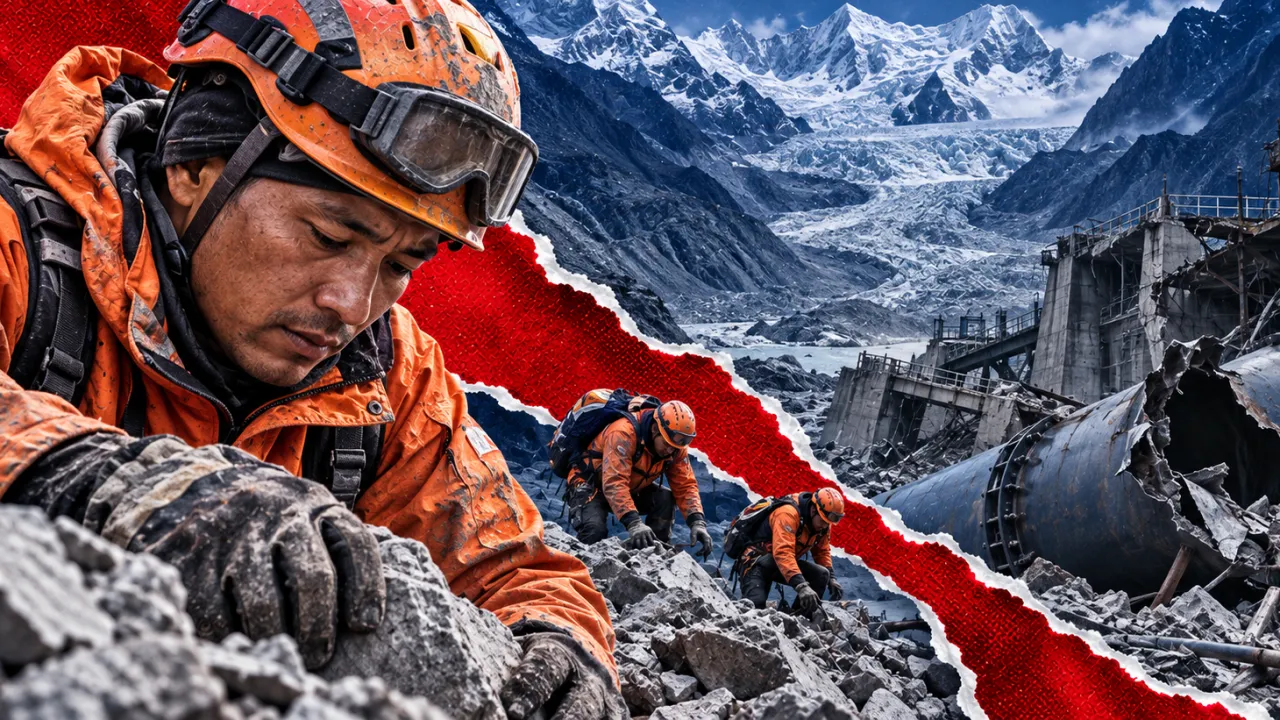
According to the reconstruction reported by Le Monde, the August 26 collapse took seven minutes to travel the 22 kilometres separating the summit of Langtang Lirung from the Rasuwagadhi border post: two square kilometres of ice and rock, detached at 5,150 metres altitude, fell 1,400 metres before transforming into a wall of water and sediment.
The toll remains provisional: authorities are revising the number of missing people as they cross-check district information, and most of the recovered bodies have not yet been identified.
Seven minutes of falling
On August 26, on the north face of Langtang Lirung, about two square kilometers of rocks and ice broke off at 5,150 meters altitude and fell over 1,400 meters, according to the reconstruction reported by Le Monde. Seven minutes later, a wall of water, ice, rocks, and sediments hit the Rasuwagadhi border post, 22 kilometers downstream, before continuing its course over dozens of kilometers in Nepal and Tibet.
« It is essential to note that there was no single triggering event. The rupture occurred at an altitude of approximately 5,150 meters, and several processes acted together over timescales ranging from years to decades, rather than a single isolated factor. This also makes direct climate attribution particularly challenging. »
Walter Immerzeel, from the University of Utrecht and co-author of the World Weather Attribution study, emphasizes this point to Folha de S.Paulo: this precise chronology should not lead to the belief that it was an isolated accident.
The study, relayed by the Swiss and Philippine press, adds other pieces to the geological puzzle: the 7.8-magnitude earthquake that hit the region in 2015 may have weakened the rock face; July and August 2026 were the hottest months ever recorded locally; and heavy snowfall at the end of 2025 had increased the volume of available meltwater.
Aid deemed late
A delegation of 35 representatives of Nepalese civil society has traveled to the disaster zone, on the Chinese border, reports Swiss television SRF. Gopal Krishna Siwakoti, who heads the International Institute for Human Rights, Environment and Development, praises the commitment of the army and police, who, according to him, risked their lives day and night in the field.
« The government should have immediately requested foreign aid. »
But he criticizes the government of Balendra Shah for wanting to manage the disaster alone in the early days. Jagat Deuja, from the Community Self Reliance Center, adds that the distribution of aid, initially organized by the central government alone, lacked effectiveness, as did coordination with provincial authorities and early warning in low-lying areas along the rivers.
The power cut, diplomacy activated
The Bhotekoshi floods damaged the Trishuli and Chilime power plants, which previously supplied power to India and Bangladesh, according to The Daily Star. New Delhi has just renewed, until December 31 and for eighteen hours a day, the authorization to import up to 654 megawatts for the Nepal Electricity Authority, but has not renewed the export permits for three other projects, including Upper Chameliya, as the deficit caused by the floods reaches 350 to 400 megawatts.
« the sincere sympathy and solidarity of the people of Bangladesh »
Kathmandu is now seeking New Delhi's approval to sell electricity from the Kabeli B-1 and Solu Khola power plants to Bangladesh, pending the resumption of direct exports. On the diplomatic front, Nepalese Prime Minister Balendra Shah thanked his Bangladeshi counterpart Tarique Rahman for the $1 million contribution to the relief fund and for the condolence motion adopted by the Bangladesh Parliament; the Nepalese ambassador to Dhaka also met with the president of the Bangladesh Cricket Board to dedicate the upcoming T20 series to the flood victims.
Kathmandu takes the case to the UN
Gathered on Wednesday, September 16, at the call of Rabi Lamichhane, leader of the ruling Rastriya Swatantra Party, Nepalese political parties have decided to create a special parliamentary committee to oversee reconstruction and to finalize the points that Kathmandu will raise on climate justice before the 81st session of the United Nations General Assembly, according to Ratopati.
« I don't know where to go or how to search. No one has helped us. »
Le Monde estimates the reconstruction cost advanced by Kathmandu at $4.78 billion. Prime Minister Balendra Shah is to address the General Assembly next week, a trip that will be his first abroad since taking office, to argue the case of a rural country of 30 million inhabitants accounting for only a fraction of global greenhouse gas emissions.
The concern has spread to other valleys: gathered in Jomsom, in the Mustang, local elected officials have warned that a similar flood to the one in Rasuwa would also sweep away their own riverbanks, according to Ratopati; a resident there questioned experts about the ban, due to the Annapurna conservation area, on removing the sediment accumulating in the Kaligandaki riverbed. In Kathmandu, some foreign families are still waiting for an answer: Vichitra Jain, from India, has been searching for her Russian friend Kirill Tretiakov, who disappeared during the flood, since September 7, according to the Philippine Inquirer.
Ten bodies have been retrieved from the Chilime and Upper Trishuli-1 hydroelectric construction sites in Rasuwa.
In Rasuwa, families are practicing symbolic funeral rites due to a lack of legal framework to declare unconfirmed deaths.
Nepal has not been exporting electricity to Bangladesh for nearly a month, after damage to the Trishuli and Chilime power plants.
Nepalese NGOs estimate that the government requested international aid only four to five days after the collapse.
How each country reads it
7 perspectives, each in the voice of that country's press.
 Brazil
Brazil first notes the scientific validation: according to Folha de S.Paulo, the World Weather Attribution study confirms that warming exacerbated the combination of climate and geological factors that caused the collapse of Langtang Lirung, while the human toll — more than 6,000 missing, barely 7% of bodies identified — takes a back seat.
3 sources
 Switzerland
Bern highlights the flaws in Nepal's disaster management, as revealed by civil society itself, while a study confirms the role of climate warming in the collapse of Langtang Lirung.
2 sources
 Bangladesh
Dhaka is first measuring the energy bill of the Nepalese catastrophe: electricity exports to Bangladesh have been cut off for nearly a month, even before the human toll or climate study occupied the same space in the local press.
3 sources
 France
Paris interprets the World Weather Attribution study as proof that the collapse of Langtang Lirung is due to a combination of climate and geological factors, and not just warming, while the death toll climbs to 6,150.
2 sources
 Nepal
NepalKathmandu is gauging the human scale of the disaster: Nepalese and foreign families without news, a legal vacuum preventing the registration of the dead, and climate diplomacy taken all the way to the UN.
3 sources
 Philippines
Manila is first concerned about the fate of foreign families left without answers by Kathmandu, even before the scientific confirmation of the role of warming in the Langtang Lirung disaster.
2 sources
 Sweden
Stockholm is scrutinizing the mechanics of the disaster more than its human toll: the Swedish press is devoting most of its coverage to the climate attribution study by the World Weather Attribution, treating the revision of the number of missing people in Nepal as a figure to be updated rather than a story to be told.
4 sources
What the comparison reveals
Common ground and differences in coverage across the media analysed.
What the media report in common
Three weeks after the collapse of Langtang Lirung on August 26, the human toll remains uncertain: each national perspective mentions several thousand people still missing, with a low rate of identification of the recovered bodies.
The Nepalese authorities have revised upwards the number of missing people after cross-checking information from district offices, bringing the total to over 6,000 people by mid-September.
A study by the World Weather Attribution, published on Thursday, September 17, concludes that regional climate warming amplified a pre-existing geological instability, in a combination of factors that led to the collapse of Langtang Lirung.
Where media coverage diverges
Nepalese response to the crisis
Is the response of the Nepalese authorities to the disaster considered adequate? Some coverage relays the official measures announced (international aid received, multi-party mechanism on reconstruction) without questioning them, while others report criticism from civil society or families of victims about the slowness of the government's reaction and the lack of responses provided.
Coverage aligned with this reading
Coverage that diverges
This grouping describes the publications analysed, not the position of these countries’ populations or of their governments.
The full text, country by country
Brazil
DOMINANT ANGLE
Brazil first notes the scientific validation: according to Folha de S.Paulo, the World Weather Attribution study confirms that warming exacerbated the combination of climate and geological factors that caused the collapse of Langtang Lirung, while the human toll — more than 6,000 missing, barely 7% of bodies identified — takes a back seat.
KEY POINTS
- The World Weather Attribution study, published on Thursday, September 17, by a group led by London's Imperial College, attributes the collapse of Langtang Lirung to a combination of climate and geological factors exacerbated by warming.
- The number of missing people in Nepal rose from 5,179 to 6,150 between Tuesday, September 15, and Wednesday, September 16, while only 7% of the 1,403 recovered bodies have been identified despite 1,206 DNA samples.
- The cumulative Nepal-China toll stands at 1,446 dead and at least 6,669 missing, including at least 636 foreigners on the Nepalese side and 519 reported missing on the Chinese side.
ANALYSIS
Brasília, Thursday, September 17, 2026. The Brazilian press is re-examining the Langtang Lirung catastrophe through two complementary prisms: the scientific evidence that has just been published and the human toll that continues to worsen, three weeks after the tragedy. Folha de S.Paulo and UOL Notícias are reporting on the study published this Thursday by the World Weather Attribution, a group led by researchers from London's Imperial College. According to their conclusions, the August 26 collapse — when part of the ice and rocks from an outcrop broke off from the summit of Langtang Lirung, flooding the Lendi River valley and sweeping away entire communities — resulted from a combination of climate and geological events, exacerbated by warming. "It's essential to emphasize that there was no single trigger event," explains Walter Immerzeel, a professor at the University of Utrecht, quoted by Folha. "The rupture occurred at an altitude of around 5,150 meters, and several processes acted together over timescales ranging from years to decades, rather than a single isolated factor. This also makes direct climate attribution particularly difficult." Friederike Otto, from Imperial College, who leads the initiative, specifies that she brought together glaciologists and mountain region specialists "to gather in one place what we know to date" and "to identify the factors behind the catastrophe and the role of climate change."
The other thread being followed by Folha Mundo is that of the human toll, revised on Wednesday, September 16, by Nepalese authorities: the number of missing people has risen to 6,150, compared to 5,179 announced on Tuesday, September 15. Spokeswoman Shanti Mahat explains to AFP that the data is collected from district offices and then revised after verification. Only 7% of the 1,403 bodies found have been identified, despite 1,206 DNA samples taken from the bodies and 1,889 from families; only 105 bodies have been returned to their loved ones. At least 636 foreigners are among the missing on the Nepalese side. On the Chinese side, the official press reports 43 deaths and 519 missing, bringing the cumulative toll from both countries to 1,446 dead and at least 6,669 missing.
Switzerland
DOMINANT ANGLE
Bern highlights the flaws in Nepal's disaster management, as revealed by civil society itself, while a study confirms the role of climate warming in the collapse of Langtang Lirung.
KEY POINTS
- The authorities have updated the number of missing people from 5,179 to 6,150 after cross-checking data from district offices; ten bodies were extracted from the Chilime and Upper Trishuli-1 hydroelectric construction sites in Rasuwa district.
- Gopal Krishna Siwakoti (International Institute for Human Rights, Environment and Development) claims that Balendra Shah's government requested international aid only after four to five days, when it should have done so immediately.
- A study by World Weather Attribution, citing hydrologist Walter Immerzeel (Utrecht University), concludes that the retreat of the glacier and permafrost amplified a pre-existing geological vulnerability, in a region that experienced its hottest July and August on record.
ANALYSIS
Berne, September 17, 2026. The two aspects of the Langtang Lirung disaster are coming together in the Swiss press this week: a increasingly heavy human toll and a scientific explanation that rules out the hypothesis of a simple natural accident. The number of people reported missing has been revised from 5,179 to 6,150 by the Nepalese authorities, after cross-checking data from district offices; ten additional bodies have just been extracted from two hydroelectric sites in the Rasuwa district, at Chilime and Upper Trishuli-1, three weeks after the August 26 collapse.
It is the crisis management by Kathmandu that is holding the attention of the Swiss press. A delegation of 35 representatives of Nepalese civil society, who toured the disaster zone on the Chinese border, draws a severe assessment. Gopal Krishna Siwakoti, head of the International Institute for Human Rights, Environment and Development, acknowledges the commitment of the army and police, who risked their lives day and night, but denounces the initial choice of Balendra Shah's government to manage the disaster alone. "The government should have immediately asked for foreign aid," he asserts, estimating that the international appeal came only after four to five days, when many lives had already been lost. Jagat Deuja, from the Community Self Reliance Center, confirms that the distribution of aid, initially organized alone by the central government, lacked efficiency, as did the coordination with provincial authorities and early warning in low-lying areas along the rivers.
This critical analysis is in line with the publication, on Thursday, of the World Weather Attribution study. According to hydrologist Walter Immerzeel, from Utrecht University, the region has undergone "fundamental and irreversible changes": the retreat of the glacier and permafrost has weakened a slope already made vulnerable, perhaps in part by the 7.8-magnitude earthquake in 2015. The study confirms that July and August 2026 were the hottest months ever recorded in the region, and that the heavy snowfall at the end of 2025 had increased the volume of available meltwater.
For the Swiss press, the two findings complement each other: the scientific attribution establishes that warming has amplified a pre-existing geological risk, while the situation on the ground shows that the Nepalese institutional response was unable to follow the scale of the event.
Bangladesh
DOMINANT ANGLE
Dhaka is first measuring the energy bill of the Nepalese catastrophe: electricity exports to Bangladesh have been cut off for nearly a month, even before the human toll or climate study occupied the same space in the local press.
KEY POINTS
- Nepalese electricity exports are halted for nearly a month after floods on the Bhotekoshi damaged the Trishuli and Chilime power plants.
- Nepalese Prime Minister Balendra Shah thanked the contribution of $1 million to the relief fund and for the condolence motion passed by the Bangladeshi Parliament.
- According to authorities cited on September 16, around 5,200 people remain missing (including 636 foreigners); a report cited on September 17 mentions at least 6,600 missing, and only 7% of the recovered bodies have been identified.
ANALYSIS
Dhaka, September 17, 2026. Three weeks after the glacial collapse of Langtang Lirung, the Bangladeshi press places the energy shockwave on the same level as the human toll. According to Nepalese authorities cited on Wednesday, September 16, around 5,200 people remain missing, including 636 foreigners; another count cited on Thursday, September 17, mentions at least 6,600 missing, with a death toll exceeding 1,400 confirmed. Only 7% of the recovered bodies have been identified: out of 1,206 DNA samples collected and 1,889 taken from families, only 105 bodies have been returned.
Bangladesh has its own equation to solve. The floods of the Bhotekoshi have damaged the Trishuli and Chilime power plants, authorized to export to India and Bangladesh: deliveries to Dhaka have been interrupted for nearly a month. India has just renewed the authorization to import up to 654 megawatts for the Nepal Electricity Authority, eighteen hours a day until December 31, but has not renewed the export permits for three projects, including Upper Chameliya (38.8 MW), while the deficit caused by the floods reaches 350 to 400 MW. Kathmandu is now seeking New Delhi's approval to sell electricity from the Kabeli B-1 and Solu Khola power plants to Bangladesh.
At the bilateral level, Nepalese Prime Minister Balendra Shah thanked his Bangladeshi counterpart Tarique Rahman for the contribution of one million dollars paid into the relief fund and for the motion of condolences adopted by the Parliament of Bangladesh, a gesture he described as a reflection of "the sincere sympathy and solidarity of the people of Bangladesh". Cooperation is following the same trend elsewhere: the Nepalese ambassador to Dhaka met with the president of the Bangladesh Cricket Board to dedicate the next T20 series to the flood victims.
The attribution study by the World Weather Attribution, published on Thursday, remains secondary in this treatment: climatologist Friederike Otto asserts that there is "absolutely no doubt" about the role of warming in the permafrost thaw. But for the Bangladeshi press, the Nepalese catastrophe is first and foremost an interruption of the electricity supply to be repaired before winter.
France
DOMINANT ANGLE
Paris interprets the World Weather Attribution study as proof that the collapse of Langtang Lirung is due to a combination of climate and geological factors, and not just warming, while the death toll climbs to 6,150.
KEY POINTS
- The Nepalese disaster authority revised the number of missing people from 5,179 to 6,150 on Wednesday, September 16, after verification with district offices (spokesperson Shanti Mahat).
- The World Weather Attribution study published on Thursday, September 17, concludes that the collapse results from a combination of climate and geological factors, and deems it impossible to prepare for an event of this magnitude.
- Nepal estimates the reconstruction cost at $4.78 billion; Prime Minister Balendra Shah is to address the United Nations General Assembly next week, during his first official trip abroad.
ANALYSIS
Paris, September 17, 2026. The French press first takes note of the scientists' word: "a combination of factors." Published on Thursday, September 17, by the World Weather Attribution and reported by Le Monde, the study on the collapse of Langtang Lirung does not reduce the August 26 catastrophe to a single climate warming, but rather inscribes it in a complex of climatic and geological causes that mutually reinforce each other at high altitude. The researchers insist on a point that breaks with the reflex of seeking a single culprit: it is, according to them, impossible to prepare for an event of such magnitude. The technical account is precise. On August 26, on the north face of the massif, approximately two square kilometers of rocks and ice located at 5,150 meters altitude detached and fell 1,400 meters lower. Seven minutes later, a wall of water, ice, rocks, and sediments hit the Rasuwagadhi border post, 22 kilometers downstream, before continuing its course over dozens of kilometers in Nepal and Tibet.
In addition to this scientific framework, the French press also reports, in the same columns, an update on the human toll. On Wednesday, September 16, the Nepalese authority in charge of disasters raised the number of missing people to 6,150, compared to 5,179 the day before, after cross-checking with district offices. Its spokesperson, Shanti Mahat, explained that they had "revised the data after verification." The number of bodies found has reached 1,403, of which only 105 have been identified. Adding the Chinese toll - 43 dead and 519 missing on the Tibetan side -, the French press now estimates the total at 1,446 dead and at least 6,669 missing, a total that includes several hundred foreigners, tourists, and pilgrims.
The third thread followed by the French press is that of the bill: $4.78 billion in estimated reconstruction costs by Katmandu, an amount that Nepal, a rural country of 30 million inhabitants representing only a fraction of global greenhouse gas emissions, intends to bring before the United Nations General Assembly, where Prime Minister Balendra Shah will make his first official foreign trip next week.
Nepal
DOMINANT ANGLE
Kathmandu is gauging the human scale of the disaster: Nepalese and foreign families without news, a legal vacuum preventing the registration of the dead, and climate diplomacy taken all the way to the UN.
KEY POINTS
- 795 tourists remain missing according to tourist police records, including 607 foreigners and 188 nationals.
- Families in Rasuwa are performing symbolic funeral rites with kusha grass, due to a lack of legal framework to register the deaths of unrecovered loved ones.
- The multi-party meeting on September 16 decided to prepare the points to be raised on climate justice at the 81st session of the UN General Assembly.
ANALYSIS
Katmandou, September 17, 2026. Three weeks after the glacial collapse of Langtang Lirung, Nepal is discovering the extent of the void it has left behind, both administratively and humanly. The records of the tourist police list 795 tourists still missing after the floods of the Bhotekoshi and Trishuli, including 607 foreigners and 188 Nepalis, reports the Kathmandu Post. In front of the Nepal Tourism Board offices in Bhrikutimandap, families from India, Russia, and Ukraine are still waiting for a response. Vichitra Jain, from India, is searching for her Russian friend Kirill Tretiakov, who has been missing since August 26: "I don't know where to go or how to search. No one has helped us," she confides.
Inside the country, another obstacle is adding to the grief: the law. In the Rasuwa district, families have begun to perform Hindu funeral rites with symbolic bodies made of kusha grass, as they are unable to legally confirm the death of loved ones who were never found. The district offices, seized by the Rasuwa risk management committee, are demanding from the Ministry of Interior an accelerated registration mechanism, essential for insurance and official recognition of deaths.
Fear is spreading beyond the affected valleys. Local officials, who met on Tuesday in Jomsom, in the Mustang region, have measured how similar their own riverbanks are: "We are currently on the riverbanks. If a flood like the one in Rasuwa occurs, we will not survive either," warned a municipal official quoted by Ratopati. A resident asked experts about the ban, in the name of the Annapurna conservation area, on removing the sediments that accumulate in the bed of the Kaligandaki.
On the political front, the multiparty meeting convened on Wednesday by Rabi Lamichhane, the leader of the ruling Rastriya Swatantra Party, decided in favor of a special parliamentary committee for reconstruction, estimated to cost around 500 billion rupees, and set the points that Kathmandu will bring to the 81st session of the United Nations General Assembly on climate justice, according to Ratopati.
A study published on Thursday by World Weather Attribution comes to support this diplomatic line: warming has probably contributed to the collapse, in a Himalayan region that is warming at about twice the global average, recalls an editorial in Online Khabar. For Kathmandu, the argument is now documented: a country that emits almost nothing is bearing the weight of a disorder it did not cause.
Philippines
DOMINANT ANGLE
Manila is first concerned about the fate of foreign families left without answers by Kathmandu, even before the scientific confirmation of the role of warming in the Langtang Lirung disaster.
KEY POINTS
- The World Weather Attribution study, published on Thursday, September 17, concludes that there is "no doubt" about the role of climate change in the collapse of Langtang Lirung, combined with prior geological instability before the 2015 earthquake.
- The toll cited by GMA News reports more than 1,400 dead and at least 6,600 missing since the August 26 flood.
- According to the Inquirer, families of foreign nationals - including that of Russian Kirill Tretiakov, being searched for by his Indian friend Vichitra Jain - remain without a response from Nepalese authorities three weeks after the tragedy.
ANALYSIS
Manille, September 17, 2026. The Philippine press presents two distinct versions of the catastrophe that occurred on August 26 on the Langtang Lirung massif, on the Sino-Nepalese border. On one hand, GMA News relays the study by the World Weather Attribution (WWA), published on Thursday, which concludes that there is "no doubt" about the role of climate change in the glacial collapse that killed more than 1,400 people and left at least 6,600 missing. The scientists specify that the disaster was not triggered by a single extreme weather episode, but by a "compound crisis" combining long-term warming, glacier retreat, permafrost thaw, and geological instability. Climatologist Walter Immerzeel, from the University of Utrecht, describes a region undergoing "fundamental, irreversible shifts", where glacial retreat and permafrost degradation are weakening the mountain; he recalls that the 7.8-magnitude earthquake in 2015 had already weakened the slope, before July and August 2026, the hottest months ever recorded locally, and a heavy snowfall in late 2025, further destabilized the area due to excess meltwater. The study also notes that Nepal, a rural nation of 30 million inhabitants, accounts for only a tiny fraction of global emissions.
On the other hand, the Inquirer puts a face to this numerical toll. On September 7, Vichitra Jain, from India, stood in front of the Nepalese tourism office in Kathmandu, holding a photo of her Russian friend Kirill Tretiakov, who disappeared during the flood; she still does not know if he is alive. The official ceremony to honor the victims has ended, the officials have left, the gate has closed — she remains without an answer. Two other foreigners were waiting in the same place for news of loved ones who are still unaccounted for, three weeks after the event.
For the Philippine press, these two accounts do not overlap: one measures a climate phenomenon on the scale of the Himalayas, the other describes the wait of families that Kathmandu has failed to inform. Neither of the two articles mentions a Filipino national among the missing, nor the economic stakes related to the hydroelectric dams affected by the flood.
Sweden
DOMINANT ANGLE
Stockholm is scrutinizing the mechanics of the disaster more than its human toll: the Swedish press is devoting most of its coverage to the climate attribution study by the World Weather Attribution, treating the revision of the number of missing people in Nepal as a figure to be updated rather than a story to be told.
KEY POINTS
- The World Weather Attribution attributes the collapse to a combination of factors: permafrost thaw, the 2015 earthquake, and a regional temperature increase of around 2°C
- The glacier near the collapsed area has retreated more than 300 meters between 2010 and 2026, in a region where glaciers have lost about half a meter of thickness per year since 2000
- The number of missing people was revised from 5,179 to 6,150 on Wednesday; 1,403 bodies have been found, including 105 identified, according to Nepalese spokesperson Shanti Mahat
ANALYSIS
Stockholm, September 17, 2026. On Thursday, several Swedish newspapers highlighted the publication of the World Weather Attribution (WWA) on the causes of the "lervåg" — the mudslide — that hit Nepal at the end of August. Svenska Dagbladet, Aftonbladet, and Expressen reproduced, almost word for word, the analysis of the researchers: the catastrophe did not result from a single meteorological event, but from a combination of factors. The 2015 earthquake would have weakened the rock face, without its exact role being able to be quantified, according to glaciologist Walter Immerzeel, cited in the three publications: "We cannot precisely evaluate the role played by the earthquake, but it may have weakened the rock mass."
The articles detail the geophysical mechanism retained by the scientists: the thawing of permafrost in a particularly sensitive transition zone to warming, the widening of rock fissures, increased water infiltration, and the multiplication of freeze-thaw cycles. The neighboring glacier of the collapsed area has retreated by more than 300 meters between 2010 and 2026, while the glaciers in the region have lost approximately half a meter of thickness per year since 2000. Local annual temperatures would have risen by about two degrees, a rate considered significantly higher than the average global warming.
Sveriges Radio puts this scientific finding into the human toll: more than 5,000 people were still missing at the time of publication, a figure attributed to both warming and a particularly hot summer in the region that accelerated glacial melting. Aftonbladet, in a separate article published on Wednesday, reports the official Nepalese revision: the number of missing people has risen from 5,179 to 6,150 after verification of the data transmitted by the district offices, according to Shanti Mahat, spokesperson for the relief authority cited by the media. 1,403 bodies have been found, of which only 105 have been identified.
None of the Swedish articles mention the research being conducted for the missing foreign nationals, nor the Nepalese announcement to bring the climate issue before the United Nations General Assembly.
Explore every perspective on this subject across 7 countries.
Compare viewpoints and see where they diverge.