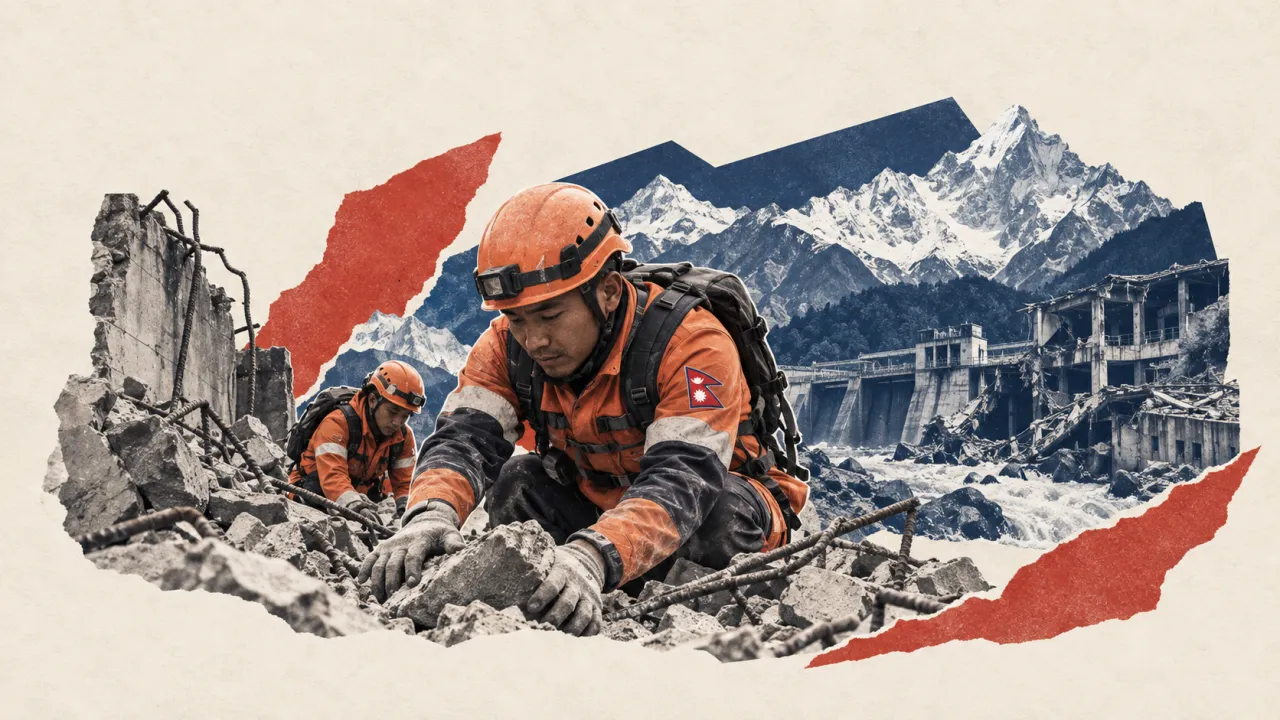

DOMINANT ANGLE
Paris interprets the World Weather Attribution study as proof that the collapse of Langtang Lirung is due to a combination of climate and geological factors, and not just warming, while the death toll climbs to 6,150.
Dominant angle identified — does not reflect unanimity of this country’s media
KEY POINTS
- 01
The Nepalese disaster authority revised the number of missing people from 5,179 to 6,150 on Wednesday, September 16, after verification with district offices (spokesperson Shanti Mahat).
- 02
The World Weather Attribution study published on Thursday, September 17, concludes that the collapse results from a combination of climate and geological factors, and deems it impossible to prepare for an event of this magnitude.
- 03
Nepal estimates the reconstruction cost at $4.78 billion; Prime Minister Balendra Shah is to address the United Nations General Assembly next week, during his first official trip abroad.
ANALYSIS
Paris, September 17, 2026. The French press first takes note of the scientists' word: "a combination of factors." Published on Thursday, September 17, by the World Weather Attribution and reported by Le Monde, the study on the collapse of Langtang Lirung does not reduce the August 26 catastrophe to a single climate warming, but rather inscribes it in a complex of climatic and geological causes that mutually reinforce each other at high altitude. The researchers insist on a point that breaks with the reflex of seeking a single culprit: it is, according to them, impossible to prepare for an event of such magnitude. The technical account is precise. On August 26, on the north face of the massif, approximately two square kilometers of rocks and ice located at 5,150 meters altitude detached and fell 1,400 meters lower. Seven minutes later, a wall of water, ice, rocks, and sediments hit the Rasuwagadhi border post, 22 kilometers downstream, before continuing its course over dozens of kilometers in Nepal and Tibet.
In addition to this scientific framework, the French press also reports, in the same columns, an update on the human toll. On Wednesday, September 16, the Nepalese authority in charge of disasters raised the number of missing people to 6,150, compared to 5,179 the day before, after cross-checking with district offices. Its spokesperson, Shanti Mahat, explained that they had "revised the data after verification." The number of bodies found has reached 1,403, of which only 105 have been identified. Adding the Chinese toll - 43 dead and 519 missing on the Tibetan side -, the French press now estimates the total at 1,446 dead and at least 6,669 missing, a total that includes several hundred foreigners, tourists, and pilgrims.
The third thread followed by the French press is that of the bill: $4.78 billion in estimated reconstruction costs by Katmandu, an amount that Nepal, a rural country of 30 million inhabitants representing only a fraction of global greenhouse gas emissions, intends to bring before the United Nations General Assembly, where Prime Minister Balendra Shah will make his first official foreign trip next week.
SOURCES (2)
- BFMTVMEDIUM