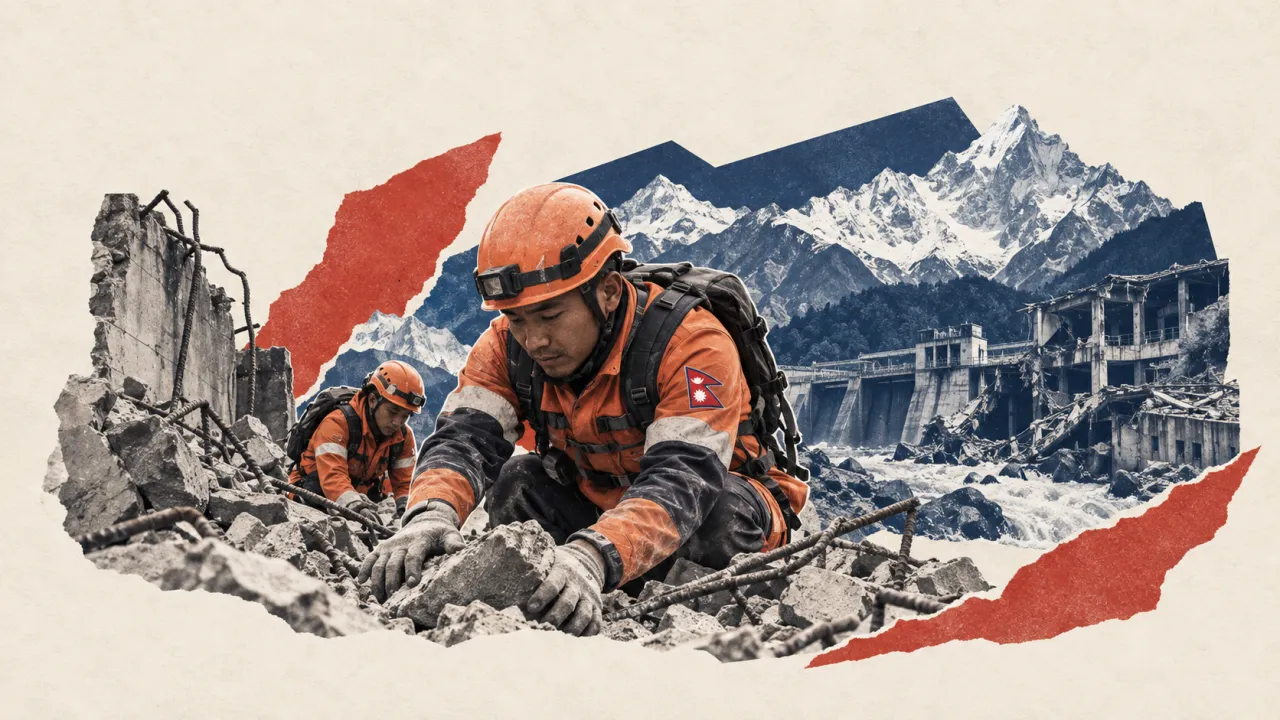

DOMINANT ANGLE
Manila is first concerned about the fate of foreign families left without answers by Kathmandu, even before the scientific confirmation of the role of warming in the Langtang Lirung disaster.
Dominant angle identified — does not reflect unanimity of this country’s media
KEY POINTS
- 01
The World Weather Attribution study, published on Thursday, September 17, concludes that there is "no doubt" about the role of climate change in the collapse of Langtang Lirung, combined with prior geological instability before the 2015 earthquake.
- 02
The toll cited by GMA News reports more than 1,400 dead and at least 6,600 missing since the August 26 flood.
- 03
According to the Inquirer, families of foreign nationals - including that of Russian Kirill Tretiakov, being searched for by his Indian friend Vichitra Jain - remain without a response from Nepalese authorities three weeks after the tragedy.
ANALYSIS
Manille, September 17, 2026. The Philippine press presents two distinct versions of the catastrophe that occurred on August 26 on the Langtang Lirung massif, on the Sino-Nepalese border. On one hand, GMA News relays the study by the World Weather Attribution (WWA), published on Thursday, which concludes that there is "no doubt" about the role of climate change in the glacial collapse that killed more than 1,400 people and left at least 6,600 missing. The scientists specify that the disaster was not triggered by a single extreme weather episode, but by a "compound crisis" combining long-term warming, glacier retreat, permafrost thaw, and geological instability. Climatologist Walter Immerzeel, from the University of Utrecht, describes a region undergoing "fundamental, irreversible shifts", where glacial retreat and permafrost degradation are weakening the mountain; he recalls that the 7.8-magnitude earthquake in 2015 had already weakened the slope, before July and August 2026, the hottest months ever recorded locally, and a heavy snowfall in late 2025, further destabilized the area due to excess meltwater. The study also notes that Nepal, a rural nation of 30 million inhabitants, accounts for only a tiny fraction of global emissions.
On the other hand, the Inquirer puts a face to this numerical toll. On September 7, Vichitra Jain, from India, stood in front of the Nepalese tourism office in Kathmandu, holding a photo of her Russian friend Kirill Tretiakov, who disappeared during the flood; she still does not know if he is alive. The official ceremony to honor the victims has ended, the officials have left, the gate has closed — she remains without an answer. Two other foreigners were waiting in the same place for news of loved ones who are still unaccounted for, three weeks after the event.
For the Philippine press, these two accounts do not overlap: one measures a climate phenomenon on the scale of the Himalayas, the other describes the wait of families that Kathmandu has failed to inform. Neither of the two articles mentions a Filipino national among the missing, nor the economic stakes related to the hydroelectric dams affected by the flood.