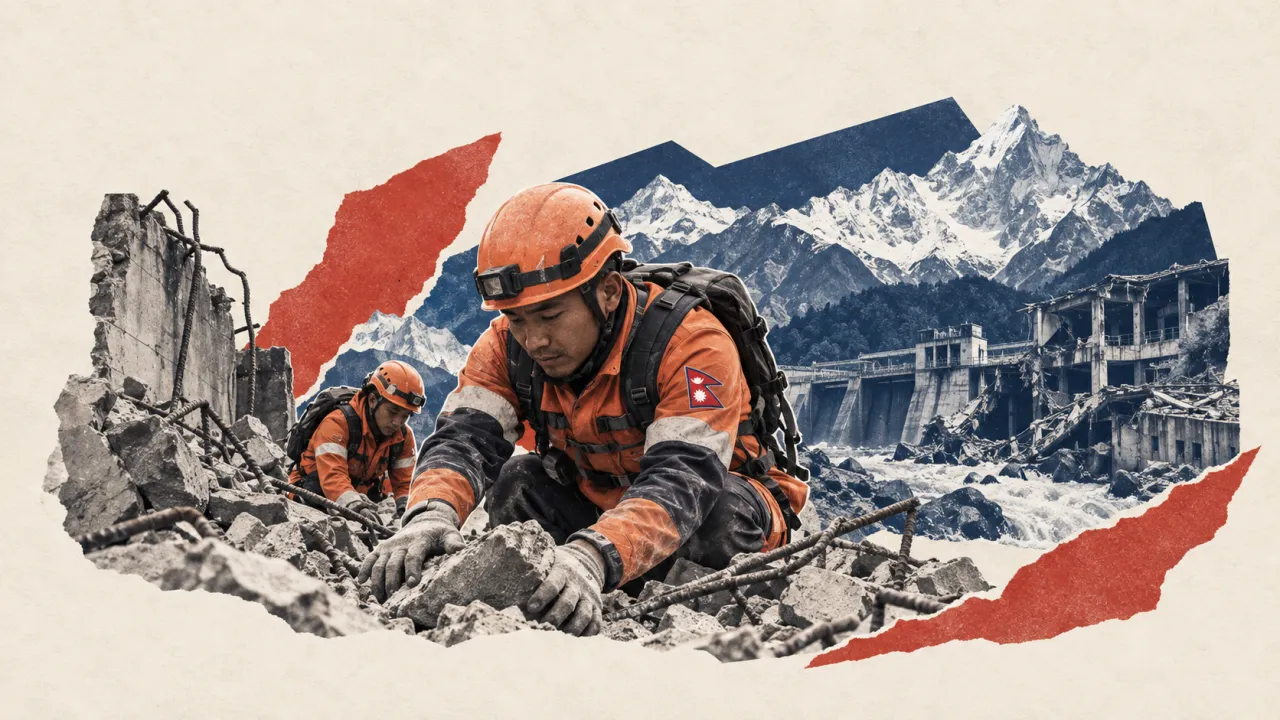

DOMINANT ANGLE
Bern highlights the flaws in Nepal's disaster management, as revealed by civil society itself, while a study confirms the role of climate warming in the collapse of Langtang Lirung.
Dominant angle identified — does not reflect unanimity of this country’s media
KEY POINTS
- 01
The authorities have updated the number of missing people from 5,179 to 6,150 after cross-checking data from district offices; ten bodies were extracted from the Chilime and Upper Trishuli-1 hydroelectric construction sites in Rasuwa district.
- 02
Gopal Krishna Siwakoti (International Institute for Human Rights, Environment and Development) claims that Balendra Shah's government requested international aid only after four to five days, when it should have done so immediately.
- 03
A study by World Weather Attribution, citing hydrologist Walter Immerzeel (Utrecht University), concludes that the retreat of the glacier and permafrost amplified a pre-existing geological vulnerability, in a region that experienced its hottest July and August on record.
ANALYSIS
Berne, September 17, 2026. The two aspects of the Langtang Lirung disaster are coming together in the Swiss press this week: a increasingly heavy human toll and a scientific explanation that rules out the hypothesis of a simple natural accident. The number of people reported missing has been revised from 5,179 to 6,150 by the Nepalese authorities, after cross-checking data from district offices; ten additional bodies have just been extracted from two hydroelectric sites in the Rasuwa district, at Chilime and Upper Trishuli-1, three weeks after the August 26 collapse.
It is the crisis management by Kathmandu that is holding the attention of the Swiss press. A delegation of 35 representatives of Nepalese civil society, who toured the disaster zone on the Chinese border, draws a severe assessment. Gopal Krishna Siwakoti, head of the International Institute for Human Rights, Environment and Development, acknowledges the commitment of the army and police, who risked their lives day and night, but denounces the initial choice of Balendra Shah's government to manage the disaster alone. "The government should have immediately asked for foreign aid," he asserts, estimating that the international appeal came only after four to five days, when many lives had already been lost. Jagat Deuja, from the Community Self Reliance Center, confirms that the distribution of aid, initially organized alone by the central government, lacked efficiency, as did the coordination with provincial authorities and early warning in low-lying areas along the rivers.
This critical analysis is in line with the publication, on Thursday, of the World Weather Attribution study. According to hydrologist Walter Immerzeel, from Utrecht University, the region has undergone "fundamental and irreversible changes": the retreat of the glacier and permafrost has weakened a slope already made vulnerable, perhaps in part by the 7.8-magnitude earthquake in 2015. The study confirms that July and August 2026 were the hottest months ever recorded in the region, and that the heavy snowfall at the end of 2025 had increased the volume of available meltwater.
For the Swiss press, the two findings complement each other: the scientific attribution establishes that warming has amplified a pre-existing geological risk, while the situation on the ground shows that the Nepalese institutional response was unable to follow the scale of the event.