Common ground and differences in coverage across the media analysed.
What the media report in common
1
According to the Saudi General Authority of Civil Aviation (GACA), the attack on Riyadh's King Khalid Airport resulted in twelve deaths, including four Saudis and two Bangladeshis, a large majority of reports citing this toll.
2
The same official toll reports 309 injured, some in critical condition, a figure repeated by a large majority of accounts.
3
The Saturday, October 10 attack is attributed to Yemen's Houthis, backed by Iran, by the Saudi-led coalition and by the vast majority of reports.
Where media coverage diverges
Author of Saturday's strike
Question: who fired the missile on October 10? Saudi, Pakistani, and Western media attribute it to the Houthis; German media deem it 'unclear', and Colombian, Egyptian, and Malaysian reports do not name an author or note the lack of a claim.
Question: how many injured? Reports citing GACA state 309 injured; Brazilian and Swedish reports relay an initial version from the New York Times with 50 injured, Sweden adding a figure of two deaths from AFP.
Question: which conflict does the attack belong to? Brazilian and Indian media attribute it to the Iran war opened in February; British, Singaporean, and Mexican media situate it in the Saudi campaign in Yemen.
Canberra is gauging the attack on Riyadh in terms of the traveler and air transport: advisories against traveling to the Saudi capital, hundreds of flights canceled, business conferences maintained.
Dhaka is first counting its two dead: the Bangladeshi press is reading the attack on Riyadh airport through the national victims, official condemnation, and cancelled Biman flights.
Buenos Aires relays the UN's condemnation and warnings of escalation, based on Reuters and AFP dispatches, without its own national angle.
KEY POINTS
Twelve people were killed after the attack on Riyadh's King Khalid Airport, according to sources cited by Reuters and AFP, as Saudi authorities have not released an official toll (Ámbito).
Guterres said he is "profoundly shocked" and recalled that attacks on civilians violate international law (Infobae).
Hans Grundberg judged that these strikes "represent a serious escalation" and cited the airports of Riyadh and Abha (Infobae).
ANALYSIS
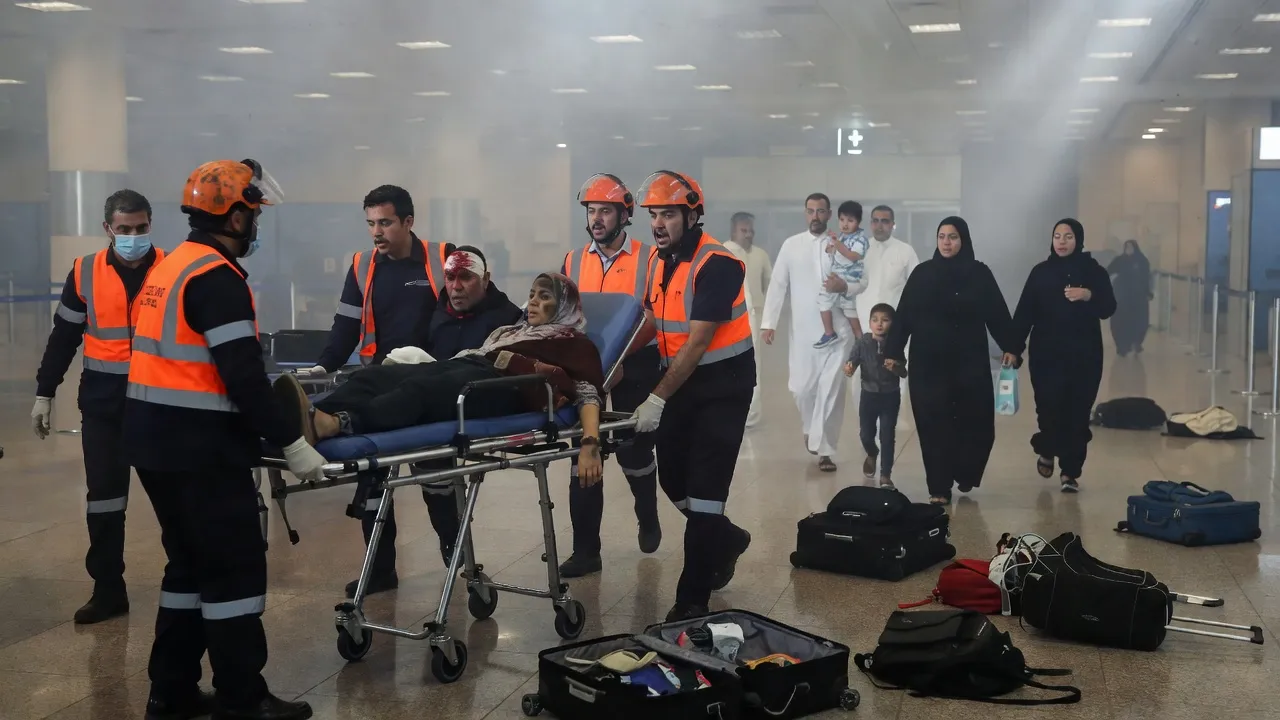
Buenos Aires, October 11, 2026. The Argentine press is covering the attack on Riyadh's King Khalid International Airport through the lens of international agencies and the United Nations' reaction. Ámbito headlines "12 dead" and describes an attack that occurred on Saturday, with "explosion, scenes of panic" and injured people in the terminal. The media specifies that these figures come from sources cited by Reuters and AFP, "because the Saudi authorities did not release an official report".
According to a diplomatic source cited by AFP, the site was hit by a missile launched by the Houthis at around 3 pm local time, or 9 am in Argentina. Ámbito notes that the pro-Iranian group had not claimed responsibility for this strike, but had claimed the two previous ones that week against the same airport. Its military spokesman re-released a message stating that only authorized humanitarian flights could land in Riyadh, presented as "a reminder". An injured traveler told Reuters he saw something cross the sky before a part of the roof near a boarding gate collapsed. Five injured people were in intensive care according to a hospital source cited by AFP, and Reuters indicates that the Saudi alert system had not issued any warning.
Infobae, via a news agency dispatch, emphasizes the institutional response. UN Secretary-General Antonio Guterres said he was "deeply shocked" and condemned the attack "energetically", which killed at least twelve people and injured over three hundred. He recalled that "attacks against civilians and civilian infrastructure are a violation of International Law" and demanded that they cease immediately.
The UN envoy for Yemen, Hans Grundberg, joined the condemnation from Amman. He recalled that the bombings that week had targeted the airports of the capital and Abha, with civilian casualties, and judged that these attacks "represent a serious escalation" that threatens regional security and complicates peace efforts in Yemen. He called on the Houthis to respect international humanitarian law.
The account also takes up the position of the coalition led by Saudi Arabia, which qualifies the attack as a "war crime" and announces retaliation against the rebels in Yemen. In both texts, the reading is that of a risk of regional escalation, seen from afar and without a direct Argentine angle: neither Argentine nationals nor local consequences are mentioned.
Australia
DOMINANT ANGLE
Canberra is gauging the attack on Riyadh in terms of the traveler and air transport: advisories against traveling to the Saudi capital, hundreds of flights canceled, business conferences maintained.
KEY POINTS
Three attacks in one week at Riyadh's airport have killed twelve people and injured over 300, according to ABC News Australia.
The government advises against traveling to Riyadh and the embassy recommends avoiding King Khalid Airport (ABC, SBS).
Etihad and Qatar Airways have canceled several flights to Riyadh, while energy and investment conferences are being maintained (PerthNow).
ANALYSIS
Canberra, October 11, 2026. For ABC News Australia, the first lesson is in an instruction: the Australian government "tells travelers not to go" to Riyadh after three attacks on airports, which have killed twelve people and injured over 300 in one week. The media recalls that King Khalid Airport and other infrastructure have been targeted by drones and missiles since the Saudi-led coalition launched an offensive against the Houthis in Yemen. Operations are suspended "for security reasons," and hundreds of flights are canceled.
The account follows the chronology. On Wednesday, the Houthis, backed by Iran, said they had struck King Khalid and Abha airports with ballistic missiles and drones in retaliation for strikes on Sanaa Airport. A Sudanese national died in Riyadh, two foreigners in Abha. On Thursday, the Saudi civil aviation authority reported three Saudis killed, including a pilot, and a plane hit on the tarmac. On Saturday, the third attack killed four Saudis, one Palestinian, two Bangladeshis, and one national from the United States, Jordan, Syria, Sudan, and Egypt.
SBS News relays the Australian embassy, which invites people to "reconsider" any travel and avoid the airport and its surroundings. The channel also cites AFP: a wave of strikes "of unprecedented scale" has targeted airports, oil facilities, and tankers since the collapse of the truce in Yemen in July. It reports an exceptional call to mobilize doctors in the face of a "grave emergency".
Bangladesh
DOMINANT ANGLE
Dhaka is first counting its two dead: the Bangladeshi press is reading the attack on Riyadh airport through the national victims, official condemnation, and cancelled Biman flights.
KEY POINTS
Twelve people were killed, including two Bangladeshis, and 309 injured in the October 10 attack on King Khalid Airport, according to the Saudi civil aviation authority.
The Ministry of Foreign Affairs condemns the attack and deems targeting civilian infrastructure "unacceptable", while calling for an immediate cessation of hostilities.
Five flights departing from Dhaka were cancelled, including Biman's BG 339, after the closure of Riyadh Airport, according to the Civil Aviation Authority of Bangladesh.
ANALYSIS
Dacca, 11 October 2026. For The Daily Star and The Business Standard (TBS), the attack on Riyadh's King Khalid international airport is first and foremost a Bangladeshi affair. The Sunday, 11 October headlines announce it straightforwardly: "Two Bangladeshis among 12 killed in Riyadh airport attack". The toll given by the Saudi civil aviation authority is reproduced in full: twelve dead, including four Saudis and two Bangladeshis, as well as one American, Egyptian, Jordanian, Syrian, Palestinian, and Sudanese national, and 309 injured, some of whom are in critical condition.
The account of the attack comes from the agencies. The Daily Star cites AFP and a witness at the domestic terminal: "I saw 401 hit, I saw injured in front of my eyes. Everyone was running." TBS reprints Reuters: the Saudi early warning system issued no warning, and the airport had already been hit twice in the week, with four dead, which "exposes the vulnerabilities" of the kingdom. Both newspapers note that the Saudi authorities do not mention the Houthis, while a diplomatic source speaks of a Houthi missile.
On the official level, the Bangladeshi Ministry of Foreign Affairs has "firmly and unequivocally" condemned the attack. It writes that attacks targeting civilians and civilian infrastructure "are unacceptable and must cease immediately", expresses its solidarity with the "brotherly people" of Saudi Arabia, and calls for an end to hostilities and a peaceful solution through dialogue. The Dacca mission in Riyadh is in contact with the Saudi authorities to identify the Bangladeshi dead and injured and provide them with assistance.
Belgium
DOMINANT ANGLE
Brussels relays Riyadh's attack via the AFP wire and brings it back to an infrastructure issue: a closed airport, a second one targeted in Dammam, backup platforms threatened.
KEY POINTS
At least 12 people were killed and 309 injured in the Saturday, October 10 attack on Riyadh's airport, according to a medical source cited by AFP
An Egyptian crew member and a Palestinian with Egyptian travel documents are among the victims
The Saudi-led coalition reported a projectile fell near King Fahd Airport in Dammam, an alternative to Riyadh along with Jeddah
ANALYSIS
Brussels, October 11, 2026. The French-speaking Belgian press is reporting on the attack on Riyadh's airport in the form of a dispatch, following the AFP's lead. La Libre Belgique and La DH have published the same article, titled "At least 12 dead and 309 injured in Saturday's attack on Riyadh's airport", which was posted online on Saturday, October 10 at 10:47 PM and 10:49 PM, and then updated at 11:55 PM.
The death toll is attributed to the AFP: "At least 12 people were killed on Saturday in an attack on Riyadh's airport", a medical source from a local hospital told the agency. The first reported deaths concern an Egyptian crew member working for a Saudi airline and a Palestinian with Egyptian travel documents. Another informed source confirmed the deaths and nationalities of the victims, on condition of anonymity.
La DH had sounded the alarm earlier in the afternoon, at 3:46 PM, under the title "Conflict in the Middle East: Riyadh airport evacuated, what's happening?". Three sources had told the AFP that an evacuation was underway, while local authorities were urging passengers to check the status of their flights before heading to the airport. A witness said he had heard an explosion while waiting to board; the other two could not confirm what incident had triggered the measure. The authorities had not officially confirmed the evacuation at the time.
The second part of the story broadens the focus to another site. The military coalition led by Saudi Arabia in support of the internationally recognized government of Yemen announced on Saturday evening that a projectile had fallen near the King Fahd International Airport in Dammam, in the oil-rich east of the kingdom, just hours after the deadly strike on Riyadh, attributed to the pro-Iranian Houthis. Its spokesperson wrote on X: "Projectile fell near King Fahd International Airport in Dammam".
Brazil
DOMINANT ANGLE
Brasilia sees the Riyadh attack as a new front in the war between the United States, Israel, and Iran, where the Saudi defense was caught off guard.
KEY POINTS
According to Estadão, citing the New York Times, the Saturday, October 10 attack left at least 12 dead and 50 injured at Riyadh airport.
G1, citing Reuters, reports that the explosion occurred around 15:00 without alert from the Saudi threat system, and that the toll has not been officially confirmed.
Mohammed al-Bukhaiti, Houthi leader, presented the attack as a response to Saudi bombings in Yemen, according to G1 citing the New York Times.
ANALYSIS
Brasília, October 11, 2026. The Brazilian press is treating the attack on King Khalid International Airport as an episode in the war triggered in February by the United States and Israel against Iran, rather than as an isolated incident in the Yemeni conflict.
The Estadão reports that the Riyadh airport "was attacked again this Saturday, 10th", with at least 12 dead and 50 injured, according to the New York Times. The newspaper specifies that the attack is the deadliest in a Gulf Arab country since the start of this war, that a missile hit a passenger terminal, and that flights were diverted, according to the Flightradar24 platform. Kuwait Airways canceled flights due to the airport closure, and the Canadian embassy advised against traveling to the site, citing "ongoing military activities".
The G1 relies on three sources interviewed by Reuters, including two Western officials, to report the same toll of 12 dead and dozens injured, emphasizing that the figure has not been officially confirmed by the Saudi government and could increase. The site notes that the explosion occurred around 3 pm local time, without the Saudi alert system issuing a warning. An injured passenger recounts having seen something cross the sky before a part of the ceiling collapsed near a boarding gate. Operations were suspended while the damage was being assessed, according to the Saudi civil aviation authority.
Canada
DOMINANT ANGLE
Ottawa sees the attack on Riyadh as evidence of a breach in Saudi Arabia's air defense, following three strikes on the same airport in one week.
KEY POINTS
According to Saudi civil aviation cited by CBC, the Saturday, October 10 attack left at least 12 dead from seven nationalities and 309 injured, some in critical condition.
Third attack of the week on King Khalid Airport in Riyadh, which occurred without alert from the Saudi warning system, according to CBC and the Globe and Mail.
The two previous strikes of the week had killed four and severely damaged a Saudi commercial plane, which the Houthis had claimed.
ANALYSIS
Ottawa, October 11, 2026. Canada's coverage, based on Reuters dispatches, highlights the repetition of strikes: King Khalid International Airport in Riyadh was targeted for the third time this week, on Saturday, October 10. According to the Saudi civil aviation authority cited by CBC News, the attack killed at least twelve people, including four Saudis, two Bangladeshis, and one person from each of the following countries: the United States, Jordan, Palestine, Syria, Sudan, and Egypt. The latest count reports 309 injured.
The Globe and Mail initially published a more cautious toll: twelve dead and "dozens" injured, according to three people familiar with the file, including two Western officials, who specified that the figure was not final. The newspaper notes that no official toll had been given yet and that Western governments were asking their citizens to avoid the area. Operations were suspended at what is presented as the busiest airport in the kingdom, which serves a city of approximately eight million inhabitants.
The common thread is security. Both media outlets emphasize that the strike occurred without warning, with the Saudi alert system not reporting anything. CBC writes that the deadly strikes "exposed vulnerabilities" in the kingdom's defense capabilities, which are conducting an air campaign against the Houthis to support the Yemeni government's ground offensive. The two previous attacks this week had killed four people and severely damaged a Saudi commercial plane on the ground.
Colombia
DOMINANT ANGLE
Bogotá takes away from the attack on Riyadh's airport a security flaw: a silent early warning system and an escalating situation with the Houthis.
KEY POINTS
Semana, according to AFP: at least 12 dead and 309 injured in the Saturday, October 10 attack on Riyadh airport, including four Saudis and eight foreigners, among them one American.
La República: the Saudi early warning system issued no alert before the incident, which follows other strikes this week that killed four.
Donald Trump, asked about potential US involvement in Saudi strikes against the Houthis: "Es posible. Lo vamos a estudiar".
ANALYSIS
Bogotá, October 11, 2026. The Colombian press is treating the attack on Riyadh's King Khalid International Airport as a regional security event, relayed through international agencies AFP and Reuters.
Semana leads with the toll: "at least 12 people dead and 309 injured" in the attack on Saturday, October 10. Citing AFP, the magazine specifies that the victims include four Saudis and eight foreigners, including one American, according to the kingdom's civil aviation authority. Operations were suspended to assess the damage, and health authorities ordered an extraordinary mobilization of medical personnel. The account lingers on the panic in the terminal: one witness claims to have seen an impact near the boarding gates, and another sums up the scene as "Everyone was running".
Semana then reports that the Saudi-led military coalition, which supports the recognized Yemeni government, has attributed the attack to the Houthis, an armed movement backed by Iran. The text refers to AFP's report for the group's reaction.
La República, an economic daily, is more cautious about the perpetrator: "no one has claimed responsibility for the attack so far". The newspaper places the event in an escalation of Houthi missile strikes against the kingdom, after other strikes this week against Riyadh's airport, which had killed four people, injured several, and damaged a plane. It highlights a defense point: the Saudi early warning system issued no alert before the incident.
Germany
DOMINANT ANGLE
Berlin tempers the attribution to the Houthis and highlights its government's warning, while Washington, Ankara and Islamabad redraw the alliances around Riyadh.
KEY POINTS
Twelve dead and at least 309 injured, including four Saudis, two Bangladeshis, and one national from each of six other countries, according to the Saudi civil aviation authority (Tagesschau)
The Auswärtiges Amt strongly advises against using Riyadh airport and expects further airstrikes
Trump says the United States is considering participating in Saudi strikes against the Houthis; Rubio confirms the death of an American (Handelsblatt)
ANALYSIS
Berlin, October 11, 2026. The German press is covering the attack on Riyadh's King Khalid Airport from two angles: the toll and the warning from the federal government. According to Handelsblatt, at least twelve people were killed and more than 300 injured on Saturday evening, during the third attack on the site this week and the deadliest. Tagesschau, citing the Saudi civil aviation authority, details the victims: four Saudis, two Bangladeshis, and one person from the United States, Egypt, Jordan, Syria, Sudan, and the Palestinian territories. At least 309 injured are reported, some in critical condition.
The account remains cautious about attribution. The coalition led by Saudi Arabia accuses the Houthis, supported by Iran, of a "war crime" and promises to respond "with determination to this terrorist attack". But Tagesschau writes: "Ob sie auch hinter der neuerlichen Attacke steckt, ist unklar", meaning: it is unclear if the Houthis are also behind this latest strike. In an initial report, the channel noted that the aviation authority had not officially designated the Houthis and that diplomatic sources mentioned a rocket fired in the afternoon. Handelsblatt reports that the head of the Houthi media office wrote on X that the group had "stillgelegt", put out of service, the airport.
The human angle comes from witnesses: a man, from gate 403, told AFP he saw gate 401 hit, injured people in front of him, and "everyone running". A hospital official mentions five patients in intensive care, some evacuated by helicopter.
Egypt
DOMINANT ANGLE
Cairo denounces the attack on Riyadh airport as a blatant violation of international law and expresses its total solidarity with the kingdom, while the Egyptian press follows the fate of its national killed.
KEY POINTS
The foreign ministry has denounced a blatant violation of international law and expressed full solidarity with Saudi Arabia (Daily News Egypt).
An Egyptian woman is among the twelve dead; Egyptian media, citing Cairo24, identify her as Azza Ramzy, 28, a Flynas flight attendant, without official confirmation.
According to the GACA, the attack killed twelve people of seven nationalities and injured 309; the authority has not named a perpetrator (Egyptian Streets).
ANALYSIS
Cairo, October 11, 2026. Two Egyptian media outlets, Daily News Egypt and Egyptian Streets, are covering the attack on Riyadh's King Khalid International Airport from two complementary angles: the official reaction of the state and the mourning of a citizen.
On Saturday, October 10, the Egyptian Ministry of Foreign Affairs and Emigration issued a statement condemning the strikes "in the strongest terms". According to Daily News Egypt, Cairo affirms its "total rejection" of attacks that constitute a flagrant violation of international law, expresses its full solidarity with Saudi Arabia for all measures taken to preserve its security, sovereignty, and the security of its citizens, and warns that targeting air navigation threatens regional and international stability. The ministry presents its condolences to the Saudi government and wishes a speedy recovery to the injured. The media outlet specifies that this statement concerned attacks that had killed three Saudi nationals, and coincided with reports of a new explosion that prompted the evacuation of the airport, citing Reuters and AFP.
Egyptian Streets, on Sunday, October 11, provides the updated toll from the Saudi General Authority of Civil Aviation (GACA): twelve dead, including four Saudis and eight residents, among them two Bangladeshis and one national from each of the following countries: Egypt, the United States, Jordan, Syria, Palestine, and Sudan. There are 309 injured, some in critical condition. The site reports that a medical source at a Riyadh hospital told AFP that the Egyptian victim worked as a flight attendant for a Saudi airline. Egyptian media, according to Cairo24, identify her as Azza Ramzy, 28, an employee of Flynas; neither the Saudi nor Egyptian authorities have publicly named her.
France
DOMINANT ANGLE
Paris is tallying the victims of the Riyadh airport incident by nationality, based on Saudi sources and AFP dispatches, before relaying American and Pakistani reactions.
KEY POINTS
Twelve dead (four Saudis, two Bangladeshis, one American, one Egyptian, one Argentine, one Syrian, one Palestinian, one Sudanese) and 309 injured, according to the Saudi civil aviation authority.
Deadliest attack in the kingdom since August 2015 and the Abha bombing (15 dead), recall Le Monde and France 24.
Donald Trump deems the attack "not acceptable"; the Saudi coalition calls it a "war crime" and promises to respond.
ANALYSIS
Paris, October 11, 2026. The French press reports on the attack on Riyadh's King Khalid Airport, first focusing on the human toll, then on the international repercussions. According to the Saudi civil aviation authority, cited by Le Monde and France 24, the attack on Saturday, October 10, resulted in twelve deaths and 309 injuries, including some serious cases. The victims include four Saudis, two Bangladeshis, one American, one Egyptian, one Argentine, one Syrian, one Palestinian, and one Sudanese. The two outlets recall that this is the deadliest attack in the kingdom since August 2015, when an Islamic State attack killed fifteen people in a mosque in Abha.
The account follows the thread of AFP dispatches. On Saturday afternoon, RFI, BFMTV, and 20 Minutes relayed a diplomatic source stating that a missile struck the airport "around 3 pm". A medical source initially mentioned at least two deaths and five serious injuries in intensive care, with some evacuated by helicopter. Doctors in Riyadh were called in urgently, a fact that Le Monde describes as rare. A passenger recounted: "I saw injured people. Everyone was running."
The press notes that the attack was not confirmed initially. Sud Ouest and 20 Minutes recall that Saudi Arabia, the world's largest crude oil exporter, rarely acknowledges strikes on civilian targets. The Houthis had not claimed responsibility for this attack, although they had claimed those on Thursday, October 8, which killed three people, including a pilot. BFMTV also recalls that the airport was targeted on Wednesday, October 7, resulting in traffic disruptions.
Israel
DOMINANT ANGLE
Jerusalem sees the Riyadh attack as a turning point in alignments: Washington is weighing entry into war against the Houthis and Damascus is sounding out the Saudi alliance, while the toll remains secondary.
KEY POINTS
King Khalid Airport in Riyadh was closed after an attack attributed to the Houthis, on Saturday, October 10, according to Cursorinfo citing The Times of Israel.
Haaretz recalls that two earlier strikes in the week had killed four people and that Trump says Washington will "look at" participating in Saudi strikes.
According to Al-Modon as cited by Cursorinfo, Syria is considering sending soldiers to Yemen and joining the alliance that includes Saudi Arabia, Turkey, and Pakistan.
ANALYSIS
Jérusalem, October 11, 2026. The Israeli press reports on the attack on Riyadh's King Khalid Airport based on initial partial reports, and immediately links it to the issue of the United States entering the Yemeni conflict.
Cursorinfo, a Russian-language Israeli site, reports according to The Times of Israel that the airport of the Saudi capital was temporarily closed after a Houthi-attributed strike "on Saturday, October 10." The kingdom's civil aviation authority reports injuries, the number of which "is being established," and specifies that the evaluation of the consequences is ongoing. The site notes that the strike is part of a series of attacks targeting Saudi civil aviation installations.
Haaretz, in its English edition, headlines "several injured" and suspended flights, while featuring Donald Trump in the headline itself. The newspaper recalls that two earlier strikes in the week had killed four people, and that Riyadh is set to host major conferences on energy and investment. Trump said that Washington would "look at" participating in Saudi strikes against the Houthis. The newspaper indicates that the Saudi authority speaks of an attack that occurred on Sunday night, a formulation that differs from the date given by Cursorinfo.
India
DOMINANT ANGLE
New Delhi sees the attack on Riyadh as a new front in Iran's war, where the possibility of the United States entering on the side of the Saudis is focusing attention.
KEY POINTS
The Saudi Civil Aviation Authority reports at least 12 dead (four Saudis, two Bangladeshis, one US, Jordanian, Palestinian, Syrian, Sudanese, and Egyptian national) and 309 injured (Swarajya).
A missile struck terminals 3 and 4, reserved for domestic flights, at King Khalid Airport; the attack would be the deadliest in the kingdom in over ten years (Swarajya, Hindu Business Line).
Donald Trump says he is evaluating potential US participation in Saudi strikes against the Houthis: "We may. We're going to look at it" (The Hindu Business Line).
ANALYSIS
New Delhi, October 11, 2026. The two Indian media outlets, The Hindu Business Line and Swarajya, are treating the attack on Riyadh's King Khalid International Airport as an episode in a regional escalation. The first describes it as an "extraordinary series of assaults" on the kingdom, "a new front in the Iran war". The second portrays it as a campaign by Yemen's Houthis, backed by Iran, against Saudi Arabia.
The toll is reported by Swarajya, citing the Saudi General Authority for Civil Aviation: at least twelve dead, including four Saudis, two Bangladeshis, and one person from each of the following nationalities: the United States, Jordan, Palestine, Syria, Sudan, and Egypt. There are 309 injured, several in critical condition. A missile hit terminals 3 and 4, reserved for domestic flights, according to regional officials. Swarajya writes that the attack occurred "without warning" from the Saudi alert system and is the deadliest in the kingdom in over ten years. The airport serves a city of approximately eight million inhabitants. All flights have been diverted.
The Hindu Business Line, which dates the attack to Saturday, October 10, places it in the context of the past week. It comes a few days after the death of three Saudis, including a pilot, and after the offensive launched by the coalition led by Riyadh against the Houthis. The newspaper notes that the rebels claimed responsibility for the strikes against the airport, other airports, military sites, and oil facilities earlier in the week, and that no Houthi statement had followed this latest attack. Swarajya adds that the Houthis have declared Saudi airspace a "military operations zone".
Italy
DOMINANT ANGLE
Rome is particularly reeling from the diplomatic fallout of the attack on Riyadh: the Farnesina's alert to its nationals, the alignment of Western capitals, and the decision that Donald Trump says he wants to take.
KEY POINTS
According to the Saudi Civil Aviation Authority cited by ANSA, the attack killed 12 people, including four Saudis and eight foreigners, among them one American, and injured 309.
The Farnesina recommended that Italians avoid non-essential travel to Riyadh Airport, as did Germany, Spain, and Canada.
Donald Trump reopened the possibility of intervening alongside the Saudis: "We will make a decision".
ANALYSIS
Rome, October 11, 2026. For ANSA, the Houthi offensive "hits hard" Riyadh airport. The agency describes "the loud boom of the explosion, the evacuation alarm, the back-and-forth of ambulances and helicopters". According to a diplomatic source cited by AFP, the device is identified as a missile.
The toll, as reported by the Italian agency based on the Saudi Civil Aviation Authority, is twelve dead and 309 injured, some seriously. Among the victims are four Saudis and eight foreigners, including one American. In the October 10 edition, ANSA only mentioned five injured and a closed airport; the October 11 update dramatically increases the figure.
ANSA highlights the initial silence of the Saudi authorities. "It was only after several hours of silence" that the civil aviation authority confirmed the attack, initially only mentioning "a number of injured" and a temporary suspension of operations pending an assessment of the damage. Saudi officials cited by the Wall Street Journal indicate that Terminal 3 was directly hit, then evacuated; the injured were taken to King Fahad Hospital. The account of a passenger present at gate 403, on the domestic flights side, anchors the scene in the experience of travelers.
The specifically Italian thread is contained in one sentence: the Farnesina recommended that compatriots avoid non-essential travel to the airport area and use the airport itself with caution, in a move similar to that of Germany, Spain, and Canada. Rome thus places itself in the group of Western capitals that adapt their travel guidelines rather than announcing a military position.
Mexico
DOMINANT ANGLE
Mexico City measures Riyadh's attack in terms of a possible US entry into war: the Mexican press puts the human toll and the hypothesis of American intervention at the forefront.
KEY POINTS
According to the Saudi civil aviation authority, the attack on Saturday, October 10, against Riyadh's King Khalid Airport left 12 dead, including 4 Saudis, and 309 injured.
A missile hit the terminal 3 and 4 complex, reserved for domestic flights, according to a regional official quoted by El Financiero.
According to Flightradar24, around 260 flights to or from Riyadh were cancelled on Saturday and 219 delayed.
ANALYSIS
Mexico, October 11, 2026. The Mexican press is treating the attack on Riyadh's King Khalid International Airport as a regional escalation, with the US aspect drawing attention. El Financiero headlines "12 dead and 309 injured" and reports that Donald Trump "evaluates intervening in conflict with Yemen", placing Washington at the center of the narrative from the start.
The toll comes from the Saudi civil aviation authority. El Siglo de Torreón quotes its statement, which speaks of a "brutal aggression" that occurred on the afternoon of Saturday, October 10, and caused twelve deaths, including four Saudis. El Financiero details the list of nationalities: two Bangladeshis, one Palestinian, one American, one Egyptian, one Jordanian, one Syrian, and one Sudanese. Some of the injured are in critical condition, the newspaper specifies, and hospitals in the capital are taking care of them.
Regarding the mechanics of the attack, the newspaper relies on an anonymous regional official: a missile hit the complex housing terminals 3 and 4, reserved for domestic flights. El Siglo de Torreón reports an attack "attributed to the Shia Houthi insurgents from Yemen", a phrase that marks the attribution without presenting it as established by independent evidence.
The air aspect is quantified by El Financiero based on Flightradar24: around 260 flights to or from Riyadh were canceled on Saturday and 219 others delayed. The newspaper also notes that Washington has asked its citizens to avoid the airport, that the United Kingdom has deemed the incident "serious", and that several companies, including the national carrier of Kuwait, have canceled connections. The airport has invited passengers to contact their carrier before traveling.
Malaysia
DOMINANT ANGLE
Kuala Lumpur condemns without reserve the attack on Riyadh airport, shows its solidarity with the kingdom, and relies on diplomacy to avoid the expansion of the conflict, while also looking out for its citizens.
KEY POINTS
Anwar Ibrahim condemned the attack and stated: "There can be no justification for attacks against civilians and civilian infrastructure".
Wisma Putra reported no Malaysian casualties and the embassy in Riyadh is assisting several Malaysians stranded by air disruptions.
Zambry Abd Kadir deemed the evacuation of Malaysian students in Saudi Arabia unnecessary for now, with monitoring in Medina and Mecca.
ANALYSIS
Kuala Lumpur, October 11, 2026. Malaysia's coverage of the attack on Riyadh's King Khalid International Airport, which occurred on Saturday, October 10, falls into three categories: political condemnation, protection of nationals, and monitoring of the American reaction.
Prime Minister Anwar Ibrahim reacted on Facebook on Sunday. "I unequivocally denounce the attack on King Khalid International Airport in Riyadh, which has taken innocent lives and left hundreds injured," he wrote, adding that "there can be no justification" for attacks on civilians and civilian infrastructure. He assured the kingdom of Malaysia's solidarity "in this perilous hour" and said he hopes that "diplomacy and reason will prevail before the conflict escalates further." According to Malay Mail, his message does not identify the perpetrator.
The Ministry of Foreign Affairs, Wisma Putra, stated in a statement released on Sunday that no Malaysian victims were reported, either after the attack on King Khalid or after a projectile fell near Dammam's King Fahd Airport. The embassy in Riyadh is in contact with several Malaysians stranded by air disruptions and is providing them with consular assistance. The ministry recommends vigilance, checking flight status with airlines, and registering on the e-Konsular portal, and provides the embassy's emergency numbers.
Pakistan
DOMINANT ANGLE
Islamabad is rallying Pakistan behind Riyadh: Prime Minister Shehbaz Sharif cites the joint defence agreement of Mecca and demands the immediate halt to attacks on civilians.
KEY POINTS
Shehbaz Sharif reaffirms the commitment to Saudi Arabia's sovereignty and security, citing the joint defence agreement of Mecca (Geo News).
According to Saudi civil aviation, the October 10 attack left 12 dead and 309 injured, including two Bangladeshis (Geo News, ARY News).
Coalition spokesperson Turki Al-Maliki describes the attack as a "war crime" and promises a response in line with humanitarian law (ARY News).
ANALYSIS
Islamabad, October 11, 2026. The Pakistani press initially treats the attack on Riyadh's King Khalid International Airport as an event that concerns Pakistan. Geo News reports that on Sunday, Islamabad "strongly condemned" the Houthi militia's attack, with Prime Minister Shehbaz Sharif expressing solidarity with Saudi Arabia and reaffirming Pakistan's commitment to the "sovereignty, territorial integrity, and security" of the kingdom.
The head of government described the attack as "heinous" and deemed targeting civilians and critical infrastructure "completely unacceptable" and a blatant violation of international law. He referred to the joint defense agreement of Mecca and the fraternal ties between the two countries. The Ministry of Foreign Affairs, on its part, spoke of an act of terrorism and a grave threat to regional peace.
The facts come from Saudi authorities. According to the General Authority for Civil Aviation, on Saturday, October 10, twelve people died and 309 were injured, some in critical condition: four Saudis, two Bangladeshis, and one national from each of the following countries: the United States, Jordan, Palestine, Syria, Sudan, and Egypt. Geo specifies that this is the third attack of the week on this airport and the deadliest in the kingdom in over ten years, without prior warning from the alert system.
Poland
DOMINANT ANGLE
Warsaw is deciphering Riyadh's attack mainly through Washington's reaction: the Polish press is focusing on Trump's "Być może" regarding a potential US entry into Saudi strikes.
KEY POINTS
According to Saudi civil aviation authorities cited by Reuters, the Saturday, October 10 attack killed at least 12 people and injured 309, of eight nationalities including four Saudis and two Bangladeshis.
Asked about US participation in Saudi military actions against the Houthis, Donald Trump replied "Być może" (maybe), according to RMF24.
The embassies of Germany, Canada, the United States, the United Kingdom, and Spain have called on their citizens to avoid Riyadh airport; Etihad and Qatar Airways have cancelled flights.
ANALYSIS
Warsaw, October 11, 2026. Polish media are treating the attack on King Khalid International Airport as an agency dispatch put into perspective by American reactions. RMF24 writes that on Saturday, October 10, the airport "became the target of a rocket attack", attributed by Reuters to Yemen's Houthi rebels. The toll is given straightforwardly: at least 12 dead and 309 injured.
Rzeczpospolita, in its summary of the night of October 10-11, details the victims according to the Saudi civil aviation authority: four Saudis, two Bangladeshis, and one citizen from each of the following countries: the United States, Egypt, Jordan, Syria, Palestine, and Sudan. The text appears alongside information about a phone conversation between Donald Trump and Vladimir Putin and about Ukraine, which places the event in a news thread dominated by American diplomacy.
It is indeed Washington's word that structures the narrative. RMF24 reports that Trump described the attack as "coś strasznego" and "nie do zaakceptowania", saying he remains in contact with the Houthis and plans to exchange with the Saudi crown prince. When asked about American participation in Saudi operations against the Houthis, he replied: "Być może". Marco Rubio, who confirmed the death of an American, spoke of "godne potępienia" attacks that "muszą natychmiast ustać".
Portugal
DOMINANT ANGLE
Lisbon is tallying the victims of Riyadh based on the reports from AFP and Lusa, from the initial figure of two dead to twelve dead and 309 injured, with the nationalities of the deceased as a guiding thread.
KEY POINTS
According to the Saudi civil aviation authority, the attack on Riyadh airport killed at least 12 people and injured 309, including four Saudis and eight foreigners, among them one American.
A medical source quoted by AFP initially reported two dead, an Egyptian crew member and a Palestinian with Egyptian travel documents; five seriously injured people were evacuated by helicopter.
A diplomatic source quoted by AFP attributes the strike to Yemen's Houthis: a missile hit the airport around 3 pm local time (1 pm in Lisbon), and Kuwait Airways suspended its flights.
ANALYSIS
Lisbon, October 11, 2026. Portugal's coverage of the attack on Riyadh's King Khalid International Airport relies almost entirely on AFP dispatches relayed by the Lusa agency, picked up by RTP Notícias and SAPO Notícias. The narrative unfolds through successive updates.
The first dispatch, published on Saturday, October 10, reported only two deaths, according to a medical source at a local hospital cited by AFP: an Egyptian crew member working for a Saudi airline and a Palestinian with Egyptian travel documents. The Saudi Civil Aviation Authority then confirmed the suspension of flights without specifying the origin of the attack and mentioned "several injured" whose number remained to be determined. Operations were suspended to assess the damage and verify the safety of the facilities.
A diplomatic source cited by AFP attributed the strike to Yemen's Houthi rebels and stated that "the Houthis are attacking civilian targets." A missile allegedly hit the airport at around 3 pm local time, or 1 pm in Lisbon. According to AFP, dozens of people were injured, mostly Saudis, including five in critical condition who were evacuated by helicopter to intensive care units. Kuwait Airways announced the interruption of its connections with the Saudi capital, and the US Embassy said it was "aware" of the attack.
Qatar
DOMINANT ANGLE
Doha is interpreting the attack on Riyadh through the lens of international reactions: a string of condemnations, Washington considering entering the war, and the Gulf Cooperation Council and Egypt standing in solidarity with the kingdom.
KEY POINTS
The Saudi civil aviation authority reports twelve dead of seven nationalities and 309 injured in the Saturday, October 10 attack on King Khalid Airport.
Donald Trump says he is considering American participation in Saudi strikes against the Houthis ("We may. We're gonna look at it") and Marco Rubio confirms the death of an American.
Egypt and the Secretary General of the Gulf Cooperation Council condemn the attack, Egypt seeing it as a "flagrant violation of international law".
ANALYSIS
Doha, October 11, 2026. The attack on Riyadh's King Khalid International Airport is being covered by Al Jazeera, Doha News, and Gulf Times, with a focus on its international repercussions. According to the Saudi General Authority for Civil Aviation, the strike on Saturday, October 10, resulted in twelve deaths (four Saudis, two Bangladeshis, one American, one Egyptian, one Jordanian, one Syrian, one Palestinian, and one Sudanese) and 309 injuries, including critical cases. Al Jazeera describes it as the deadliest attack in the kingdom in over a decade.
Doha News, citing the AP and two regional officials, reports that a missile hit the complex of terminals 3 and 4, reserved for domestic flights, resulting in evacuation and suspension of operations. Gulf Times relays the account of a passenger collected by AFP: "I saw 401 hit, I saw injured in front of my eyes." The United States, the United Kingdom, Germany, and Canada have advised their citizens to avoid traveling to the airport.
The diplomatic register dominates. Al Jazeera headlines the global condemnation: Donald Trump describes the attack as "terrible", says he is evaluating American participation in Saudi strikes ("We may. We're gonna look at it") and announces a meeting with Crown Prince Mohammed bin Salman; Marco Rubio confirms the death of an American and promises to stand by the kingdom. Al Jazeera Arabic cites a State Department spokesperson who denounces "terrorist Houthi attacks", as well as the Secretary-General of the Gulf Cooperation Council, Jassem al-Boudaiwi, who refers to "perfidious terrorist attacks". Gulf Times reports Egypt's condemnation, which sees it as a "flagrant violation of international law" and affirms its solidarity with Riyadh.
Romania
DOMINANT ANGLE
Bucharest is gauging Riyadh's attack in terms of Saudi Arabia's air defense: a press that questions the kingdom's ability to protect its strategic sites and its stock of interceptors.
KEY POINTS
Twelve dead and 309 injured at Riyadh's King Khalid Airport, including four Saudis, two Bangladeshis, and one national from the US, Jordan, Palestine, Syria, Sudan, and Egypt (Digi24).
According to Digi24, Saturday's attack is the deadliest in the kingdom since May 2015; the Saudi coalition attributes it to the Houthis and promises to retaliate.
Donald Trump says he is considering American participation in Saudi strikes against the Houthis: "It's possible. We will analyze the situation" (G4Media).
ANALYSIS
Bucharest, October 11, 2026. Romanian media are treating the attack on King Khalid International Airport as an episode of a broader regional war. G4Media, citing Politico, writes that the toll of twelve dead and over 300 injured, announced by the Saudi civil aviation authorities, makes this strike "the bloodiest" incident in a Gulf Arab country since the start of the Iran war. Digi24, quoting the BBC, gives the exact figure of 309 injured and details the victims: four Saudis, two Bangladeshis, and one person from the United States, Jordan, Palestine, Syria, Sudan, and Egypt. Some of the injured are in critical condition.
The chronology takes center stage. Digi24 recalls that the Houthis claimed responsibility for Thursday's bombings, which killed three people and damaged a plane, that three other people had died on October 6 and 7 in attacks on two Saudi airports, and that a projectile also fell near Dammam Airport. According to this media outlet, Saturday's attack is the deadliest in the kingdom since May 2015, and the Houthis have not commented on this latest strike. Mediafax, in an initial version, attributed the claim to Mohammed al-Bukhaiti, a senior Houthi official, who saw it as a response to Saudi bombings in Yemen, with a toll still limited to 50 injured.
The security prism dominates. Mediafax estimates that a strike on the airport infrastructure of the capital "raises new questions" about the ability of defense systems to protect strategic targets, and recalls the repeated firing of Houthi missiles and drones at airports and oil facilities. G4Media headlines reduced stocks of interceptors and notes that the attack should increase pressure from Riyadh on its allies, including Washington, for military support.
Russia
DOMINANT ANGLE
Moscow is dissecting the chain of official reactions following the attack on Riyadh: accusation from the coalition, condemnations from the UN and Washington, while also giving a voice to the Houthis on their demand for peace.
KEY POINTS
The Saudi General Authority for Civil Aviation announced twelve dead, including four Saudis, two Bangladeshis, and one American, and 309 injured (Sputnik).
Coalition spokesman Turki al-Maliki speaks of a "war crime" and promises a "decisive" response (TASS).
Houthi spokesman Mohammed al-Bukhaiti confirmed to RT that the strikes aimed to achieve a "comprehensive and permanent peace" with Riyadh.
ANALYSIS
Moscow, October 11, 2026. Russian agencies are reporting the attack on Riyadh's King Khalid Airport in stages. TASS initially reported on Saturday, October 10, that the Saudi General Authority of Civil Aviation stated there were "several injured" and operations were suspended; a source from air traffic control later indicated that the airport would remain closed until midnight, then "until the end of Sunday." Vedomosti, citing Reuters, mentioned more than ten rescue teams and canceled or diverted flights, as well as cancellations by Etihad and Qatar Airways.
The toll is rising with each dispatch. RIA Novosti first cited the New York Times (at least twelve dead), then Reuters, which relayed the Saudi authority: twelve dead and 309 injured. RIA also picked up the Wall Street Journal, which reported that missiles hit terminals 3 and 4, with part of the roof collapsing on people, and helicopters evacuating the injured. Sputnik detailed the Saudi statement: four Saudis, two Bangladeshis, and one American were among the dead, with some injured in critical condition.
TASS published the coalition's position: its spokesperson, Turki al-Maliki, called the Houthi attack a "full-fledged war crime" and promised a "decisive" response. The agency also cited Antonio Guterres, who was "deeply shocked" and stated that "these attacks must stop immediately," as well as Marco Rubio, who referred to the "terrorist Houthis" and confirmed the death of an American. Sputnik reported Donald Trump's reaction ("not acceptable"): "the Saudis are good fighters," he said, and the United States has contacts with the Houthis.
Saudi Arabia
DOMINANT ANGLE
Riyadhh describes the attack on King Khalid Airport as a war crime, promises a coalition response, and highlights the Arab and American front of condemnations that stands behind the kingdom.
KEY POINTS
The GACA announces twelve deaths (four Saudis, two Bangladeshis, one national from each of six other countries) and 309 injured, including several in critical condition.
Turki al-Maliki, coalition spokesperson, speaks of a "war crime" and promises a "decisive" response from the joint command.
Marco Rubio confirms the death of an American and Donald Trump deems the attack "unacceptable"; Jordan, Egypt, Qatar, Bahrain, and Oman also condemn it.
ANALYSIS
Riyadh, October 11, 2026. In the Saudi press, the attack on Saturday, October 10, against King Khalid International Airport is first and foremost an official toll. According to the General Authority of Civil Aviation (GACA), cited by Saudi Gazette, twelve people were killed and 309 injured, including several in critical condition. The dead include four Saudis, two Bangladeshis, and one national from each of the following countries: the United States, Egypt, Jordan, Syria, Palestine, and Sudan. The GACA specifies that all the injured are being treated in hospital, that material damage has been reported, and that airport operations were suspended while the safety of the facilities is being assessed.
The newspapers recall that the attack comes two days after those of Thursday, October 8, which had killed three Saudi nationals and injured several others at the same airport. The Ministry of Foreign Affairs has invited citizens whose flights were disrupted to contact the kingdom's embassies and consulates.
The coalition's spokesman, General Turki al-Maliki, spoke of a "cowardly terrorist attack" by the Houthi militia, constituting a "war crime" under customary international humanitarian law. The joint command, he said, will respond "decisively", in accordance with this law. Asharq Al-Awsat adds that a drone was intercepted and destroyed in the eastern region, according to the official SPA agency.
Sweden
DOMINANT ANGLE
Stockholm is recording the attack on Riyadh airport as a new episode in a series: the Swedish press is emphasizing the repetition of the strikes this week and the uncertainty of the toll.
KEY POINTS
According to New York Times sources cited by Expressen and Aftonbladet, at least twelve people have died and more than 50 have been injured in the Saturday attack on King Khalid Airport.
AFP gathered from a medical source a toll of at least two dead, according to Aftonbladet, and the Saudi civil aviation authority confirmed the halt of air traffic.
The airport had already been targeted during the week: three Saudis were killed on Thursday, and the Iran-backed Houthis had claimed responsibility for the previous attacks.
ANALYSIS
Stockholm, October 11, 2026. Swedish media initially treated the attack on Riyadh's King Khalid Airport as a breaking news story, fueled by TT, AP, Reuters, and the New York Times. Svenska Dagbladet opened its news feed with the airport evacuation: according to TT, witnesses heard at least one explosion, and information from AP reported an attack.
The death toll is the point where the coverage evolves. Expressen and Aftonbladet cite New York Times sources for at least twelve dead and more than 50 injured in the Saturday attack. Aftonbladet, however, notes that AFP, on the other hand, collected from a medical source a figure of "at least two" dead, confirmed by another source, and that doctors had been urgently called to several hospitals in the city. Sveriges Radio, which cites Reuters, reports "at least twelve" dead and "several" injured.
The chronology is given with precision. The first reports fell on Saturday afternoon, Swedish time. In the early evening, the Saudi civil aviation authority confirmed the halt of traffic to and from King Khalid and reported several injured, without giving a number. Aftonbladet recalls that the airport had suffered repeated attacks during the past week and that three Saudis were killed on Thursday in one of them.
Singapore
DOMINANT ANGLE
Singapore is examining the strike on Riyadh's airport through the lens of Saudi air defense and its impact on Gulf air traffic, via AFP and Reuters dispatches.
KEY POINTS
According to the Straits Times (Reuters), Riyadh's airport had been hit twice earlier in the week, with four dead, and the Saudi early warning system issued no alert before the October 10 incident.
A diplomatic source attributes the October 10 strike to a Houthi missile around 3 pm (8 pm in Singapore); a witness recounts: "I saw 401 hit. I saw injured in front of my eyes. Everyone was running."
Etihad Airways and Qatar Airways cancelled several flights to Riyadh, with some cancellations extending until October 12, ahead of major energy and investment conferences in the Saudi capital.
ANALYSIS
Singapour, 11 October 2026. Singapore's Channel News Asia and the Straits Times are mainly relaying AFP and Reuters dispatches published in the hours following the strike on Saturday, 10 October, on Riyadh's King Khalid international airport. Their initial reports are partial: CNA cites a medical source stating that two people have died and dozens are injured, while the Straits Times mentions "several injured" and a hospital source counting five patients in intensive care.
The account opens with the testimony of a passenger from the domestic terminal: "I was at gate 403. I saw gate 401 hit, I saw injured people in front of me. Everyone was running." A relative of an injured person talks about glass shrapnel on their shoulders and arms. A diplomatic source attributes the strike to a Houthi missile at around 3 pm, or 8 pm in Singapore, and states: "The Houthis are attacking civilian targets." In these initial dispatches, Riyadh had not confirmed all the circumstances, and the Houthis had not announced any new attack that day.
The Straits Times emphasizes the kingdom's defense: the airport had already been hit twice in the week, with four deaths, which "exposed vulnerabilities," and the Saudi early warning system had not issued any alert before the 10 October incident. CNA puts the escalation into a broader context: the Houthis are carrying out an unprecedented wave of strikes against Saudi airports, oil facilities, and tankers since the collapse, in July, of the truce with the Yemeni government backed by Riyadh. The strikes claimed on Thursday, 8 October, had killed three people according to CNA, and damaged a plane.
United Kingdom
DOMINANT ANGLE
London sees the attack on Riyadh as a test of Saudi Arabia's air defence, with no alert preceding the third strike of the week.
KEY POINTS
Twelve dead (four Saudis, two Bangladeshis, one US, Jordanian, Palestinian, Syrian, Sudanese, and Egyptian national) and 309 injured, according to the Saudi civil aviation authority
No alert was issued by the Saudi threat alert system before the strike, the deadliest in the kingdom in nearly a decade
The Foreign Office has asked Britons to stay away from the airport until it is secured
ANALYSIS
London, 11 October 2026. The British press is treating the strike on Saturday, 10 October, at Riyadh's King Khalid International Airport as an escalation of the Houthi-Saudi war. The Independent reports "at least 12" dead and more than 300 injured; the Saudi Civil Aviation Authority lists four Saudis, two Bangladeshis, and one person from each of the following nationalities: United States, Jordan, Palestine, Syria, Sudan, and Egypt. The latest count shows 309 people injured; overwhelmed hospitals received victims by ambulance and helicopter, some in critical condition.
The daily newspaper emphasizes the defensive flaw: the attack, the deadliest in the kingdom in nearly a decade, struck without warning, with no alert issued by the Saudi threat alert system. Two previous attacks in the week against the same airport had killed four people and severely damaged a Saudi commercial aircraft on the tarmac. For the newspaper, these strikes "highlight the vulnerabilities" of the country's defense capabilities, as it conducts an air campaign against the Houthis in Yemen.
The BBC, in its first dispatch, describes a new attack a few days after Houthi claims. Operations have been suspended, according to the civil aviation authority; more than a dozen ambulances were seen by a witness cited by Reuters. A witness present in the internal terminal says they saw gate 401 hit and injured people "before my eyes". A projectile also fell near Dammam's King Fahd Airport, according to the coalition. Three Saudis, including a pilot, had been killed in two previous attacks, and three other people on 6 and 7 October at two Saudi airports.
United States
DOMINANT ANGLE
The United States gauges its entry into the war: the American press mainly retains Trump's phrase, "We may", and the death of a compatriot in Riyadh.
KEY POINTS
The Saudi Civil Aviation Authority reports twelve dead, including one American citizen, and 309 injured in the strike on King Khalid Airport (CBS News).
Donald Trump says he is considering American involvement in Saudi strikes against the Houthis: "We may. We're going to look at it" (NPR/AP, ABC).
The Houthis had not claimed responsibility for Saturday's strike, but those earlier in the week, which killed three Saudis including a pilot (CBS News, Time).
ANALYSIS
Washington, October 11, 2026. In the US press, the attack on Riyadh's King Khalid International Airport is first seen as a possible turning point for the United States. NPR, which picks up the AP, and CBS News report the toll from the Saudi Civil Aviation Authority: twelve dead, including four Saudis, two Bangladeshis, and one person from each of the following nationalities: American, Egyptian, Jordanian, Syrian, Palestinian, and Sudanese. CBS puts the number of injured at 309, several in critical condition.
The details of the location are provided by an anonymous regional official: a missile struck the complex of terminals 3 and 4, reserved for domestic flights. Time specifies that it is the second airport in the kingdom in terms of traffic and that the attack resulted in a near-complete halt to public air traffic in the capital.
The heart of the story is Donald Trump's reaction. Asked on Saturday, the president said he was evaluating American participation in Saudi strikes against the Houthis: "We may. We're going to look at it. (...) We move very quickly." Marco Rubio condemned the "terrorist Houthis" and confirmed that an American citizen was among the victims; the State Department told CBS it remains in close contact with its "Saudi partners". NPR estimates that the attack should increase the pressure from Riyadh on its allies, the United States first, to obtain military support.
Explore every perspective on this subject across 26 countries.
Saudi Arabia: twelve dead and 309 injured in an attack on Riyadh airport blamed on the Houthis
published on
October 11, 2026
26
countries
68
sources
88
articles
62/100
gap
The coverage of the October 10 attack can be read in three stages: an assessment established in stages throughout the evening, an attribution that sources do not all formulate in the same way, and then questions about air defense, traffic, and alliances.
The announced Saudi retaliation has not yet occurred, and the American decision on participating in the strikes has not been made; the Riyadh airport remains closed.
A tiered assessment
The first reports on Saturday, October 10, do not yet carry the official toll. According to AFP, as reported by Channel News Asia, a medical source mentions two deaths and dozens of injured; the Straits Times refers to "several injured" and five patients in intensive care. The Portuguese press specifies that these first two deaths are an Egyptian crew member and a Palestinian with Egyptian travel documents.
A figure of twelve deaths follows. G1 and the Globe and Mail attribute this to three sources interviewed by Reuters, including two Western officials, who specify that it is not definitive. Estadão and Expressen, citing the New York Times, associate this with 50 injured, and Aftonbladet places this figure alongside the two deaths from AFP. The initial version of Mediafax in Romania also reports 50 injured.
The Saudi Civil Aviation Authority (GACA) releases its count later. ANSA writes that it only confirmed the attack "after several hours of silence", initially speaking of "a number of injured". Ámbito noted, before this count, that the Saudi authorities had not released an official toll. These figures correspond to different publication times, and the texts from Singapore and Israel stop at the first reports.
Who fired: what the sources say
In the early hours, the attribution is based on an anonymous diplomatic source quoted by AFP, which mentions a Houthi missile around 3 pm (RFI, Ámbito, Egyptian Streets). The AP notes that the Saudi statement did not attribute responsibility. The coalition later designates the Houthis through its spokesperson.
« Whether it is also behind the latest attack is unclear. »
Tagesschau (Germany), regarding the Houthis' responsibility in Saturday's strike
Tagesschau remains reserved on this designation and writes that it is unknown if the Houthis are also behind this latest strike, while reporting the coalition's accusation. La República, in Colombia, notes that no one had claimed responsibility for the attack at the time of its article.
On the claim of responsibility, the accounts respond to the same question and do not give the same answer. CBS News and Time write that the Houthis had not claimed responsibility for Saturday's strike, like Reuters in the text of Egyptian Streets. G1 and Expressen, citing the New York Times, report that Mohammed al-Bukhaiti, a Houthi leader, presented it as a response to Saudi bombings. RT writes that he confirmed to them that the movement was behind the strikes, aimed at obtaining "global and permanent peace".
Another element cited by Ámbito and the Globe and Mail: the Houthi military spokesperson republished a message after the attack stating that only authorized humanitarian flights can land in Riyadh, with the mention "a reminder". ABC Australia and Swarajya report that the movement declared Saudi airspace a "military operations zone", and Vedomosti dates a similar warning to October 5.
Air defense and air traffic
Several media outlets, according to Reuters, report that the Saudi alert system issued no warning before the impact: G1, La República, the Straits Times, The Vibes. For CBC, the strikes of the week have exposed vulnerabilities. Mediafax estimates that they raise new questions about the ability of defenses to protect strategic sites, and G4Media headlines reduced stocks of interceptors.
« The deadly strikes exposed vulnerabilities in the kingdom's defence capabilities »
CBC News (Canada)
Traffic is estimated by El Financiero, according to Flightradar24: around 260 flights to or from Riyadh canceled on Saturday and 219 delayed. Etihad and Qatar Airways are canceling connections, some until Monday (PerthNow, RMF24). The Business Standard reports five canceled flights from Dhaka, including Biman's BG 339. PerthNow indicates that organizers of major energy and investment conferences scheduled in Riyadh assure they will take place.
The coalition reported the fall of a projectile near Dammam's King Fahd airport. La Libre Belgique and La DH recall that Dammam and Jeddah are alternatives to Riyadh.
Travel advisories vary by capital. The Auswärtiges Amt strongly advises against using the airport, the Foreign Office asks to stay away until it is secured, and the Australian government invites people not to travel to Riyadh. According to the French press, Paris had advised against traveling there by air as of Friday, October 9, except for imperative reasons.
Frameworks for interpretation and alliances
The coverage does not place the attack in the same conflict. Estadão presents it as the deadliest in a Gulf Arab country since the start of the war between the United States, Israel, and Iran in February, and The Hindu Business Line talks about a "new front in the Iran war". The Independent situates it in a Houthi-Saudi war. AFP, via Channel News Asia, recalls the collapse in July of the truce with the Yemeni government backed by Riyadh.
On the alliance front, Cursorinfo, citing the Lebanese daily Al-Modon and an anonymous Syrian political source, writes that Syria is studying the sending of soldiers to Yemen and membership in the "Mecca alliance", which brings together Saudi Arabia, Turkey, and Pakistan. Handelsblatt refers to an article on Turkey's and Pakistan's desire to station troops in Saudi Arabia.
On the US decision, Sputnik and RMF24 report that Donald Trump says he remains in contact with the Houthis; RMF24 adds that he plans an exchange with the Saudi crown prince. Arutz Sheva attributes to him, in response to a question about intervention, the answer "You will know". Al Jazeera's live broadcast adds that Washington is debating a strike against the Houthis and a resumption of strikes against Iran.
On the United Nations side, Antonio Guterres says he is "deeply shocked", and Yemen envoy Hans Grundberg talks, according to Infobae, of a "serious escalation" that complicates peace efforts. Omani Minister Badr Albusaidi has "categorically" rejected attacks on civilian facilities, according to Saudi Gazette, and Anwar Ibrahim hopes that "diplomacy and reason will prevail" before the conflict widens, according to Malay Mail.
The victims
Four Saudis, two Bangladeshis, one American, one Egyptian, one Jordanian, one Syrian, one Palestinian and one Sudanese.
The military framework
The Houthis claimed responsibility for the strikes at the beginning of the week, which killed three Saudis, including a pilot, but not the one on Saturday.
Pakistan
Shehbaz Sharif reaffirms Pakistan's commitment to Saudi security, citing the joint defense agreement of Mecca.
Key figures
12
dead, according to the Saudi Civil Aviation Authority, of seven nationalities
PerthNow, which picks up an agency dispatch, emphasizes the economic and logistical effects. More than a dozen ambulances converge on the airport, travelers are evacuated, and Flightradar24 shows flights diverted or canceled. Etihad and Qatar Airways cancel several connections to Riyadh, some until Monday. The organizers of major energy and investment conferences, scheduled in the Saudi capital, assure that they will take place and seek to reassure participants about their safety. The Houthis, for their part, have declared Saudi airspace a "military operations zone" and asked companies to avoid it.
The three media outlets present Houthi responsibility as established or probable, without relaying the political reactions of foreign capitals. None of them dwell on the promised response from the coalition: attention remains on what the attack costs passengers, companies, and business events in the region.
The air travel aspect occupies its own space. TBS reports that five flights departing from Dacca have been cancelled, including Biman Bangladesh Airlines' BG 339 and Saudia's SV 804 to 807, as well as RX 763 and RX 764, according to the Bangladesh Civil Aviation Authority. Biman had suspended its night flights and asked passengers not to go to the airport. The US-Bangla BS 381 flight, expected at 3:10 pm, landed elsewhere and did not arrive in Dacca until 3:10 am.
The Bangladeshi press also reports on external reactions: Donald Trump ("We may. We're going to look at it"), Marco Rubio confirming the death of an American, the Pakistani Prime Minister, and coalition spokesman Turki al-Maliki, who speaks of a "war crime" and promises a response. The Houthi viewpoint is absent from these articles, as is any regional reading of the conflict beyond the Saudi dimension.
The two daily newspapers note that Dammam and Jeddah, in the west, are alternatives to Riyadh's airport, which has been closed since Saturday. The Belgian reader thus retains a sequence of events: explosion and evacuation, human toll, and then a threat to the alternative platforms. The context is that of the kingdom's airport infrastructure and security, without any editorial commentary or European or Belgian reaction in the provided texts.
Regarding responsibility, the G1 quotes the New York Times: the Houthis claimed the attack, and Mohammed al-Bukhaiti, one of their main leaders, presented it as a response to Saudi bombings in Yemen. The group, supported by Iran, had also claimed the two previous attacks on the airport earlier in the week.
On the political level, the Estadão indicates that Donald Trump criticized the attacks without announcing military support, and that Saudi Arabia is seeking diplomatic solutions to reduce tensions. Airlines have suspended flights. The Estadão recalls that the attack comes two days after the death of three Saudis, including a pilot.
Both media outlets rely on American media and international agencies rather than direct Saudi or Yemeni sources.
On the political front, CBC reports that the Saudi-led coalition promises to retaliate. Riyadh and the Yemeni government claim to have carried out hundreds of strikes in Houthi territory, which the Houthis say have killed civilians, including women and children. The Globe notes that the Houthi military spokesman republished, after the attack, a previous message indicating that only pre-authorized humanitarian flights could land in Riyadh, with the mention "a reminder".
The Canadian account remains factual and focused on the toll, chronology, and defense gaps. It devotes little space to reactions from Washington or Islamabad and does not mention any Canadian citizens among the victims. The attack is presented as the deadliest against the kingdom in over ten years.
The newspaper reproduces the testimony of an injured traveler confided to Reuters, who saw something flying in the sky before a part of the ceiling near a boarding gate collapsed. More than a dozen ambulances rushed to the site, and flightradar24 showed all flights to Riyadh being diverted.
The American dimension is present in both texts. Asked about possible US participation in Saudi strikes against the Houthis, Donald Trump replied: "It's possible. We'll study it". La República also cites his justification: the country has just learned of the attack and will decide quickly.
Neither of the two articles addresses the reactions of Pakistan, India, or other capitals, nor the reasons for the coalition's offensive in Yemen. The Colombian angle remains that of a distant violent event, read through dispatches: human toll, lack of alert, risk of internationalization of the conflict.
The national angle is the security of travelers: the Auswärtiges Amt in Berlin strongly advises against using Riyadh Airport and warns of new attacks and disruptions to traffic; Spain and Canada have issued similar warnings. Tagesschau recalls that the airport handles around 40 million passengers per year; it has been temporarily closed and flights diverted.
The game of alliances remains. Marco Rubio condemned the attacks and confirmed the death of an American; Donald Trump said in front of the White House that Washington would consider participating in Saudi strikes against the Houthis: "Wir werden es uns ansehen", he said, before adding that the United States is acting "very quickly". Handelsblatt also refers to an article about Turkey and Pakistan's desire to station troops in Saudi Arabia.
Regarding attribution, caution prevails: the GACA has not said who was responsible, a diplomatic source cited by AFP mentions a Houthi missile from Yemen around 3 pm, and according to Reuters, the group had not claimed responsibility for the strike by Saturday evening. Egyptian Streets places the attack in the context of the escalation of the week: the Houthis have multiplied attacks against Saudi airports and oil installations since the offensive of Yemeni government forces, backed by Saudi strikes, near the Bab el-Mandeb strait. This is the third attack of the week against Riyadh's airport.
On Sunday, the diplomatic aspect took center stage. The coalition led by Riyadh denounced "a war crime" and promised to respond "firmly". Donald Trump deemed what happened "unacceptable" and announced that he would speak with Crown Prince Mohammed bin Salman. Pakistani Prime Minister Shehbaz Sharif condemned the "heinous" attack and reaffirmed his country's commitment to Saudi sovereignty. Schools in Riyadh switched to distance learning for the week.
The articles highlight the impact on travel: the embassies of Germany, Canada, Spain, and the United States advise against using the airport, and Paris had advised against traveling to Riyadh by air as of Friday, October 9, "unless absolutely necessary". Libération places the attack in the context of the offensive launched earlier in the month by Saudi Arabia and the Yemeni government against the Houthis.
Arutz Sheva, a media outlet close to the national-religious camp, published a brief on Sunday, October 11, on the reaction of the American president. When asked by journalists, Trump deemed the Houthi attack on Riyadh "terrible." When asked if the US military would intervene, he replied curtly: "You'll know." The brief contains no casualty toll or regional context.
Cursorinfo expands the scope to military diplomacy. Citing the Lebanese daily Al-Modon, it writes that Syria is studying the possibility of sending soldiers to Yemen, a subject discussed during a meeting between Syrian President Ahmed al-Charaa and Crown Prince Mohammed bin Salman. The two men also reportedly discussed Damascus's potential membership in the "Mecca alliance," which includes Saudi Arabia, Turkey, and Pakistan, and enhanced defense cooperation. The site specifies that this information comes from a Syrian political source.
The overall coverage focuses on alignments: who could join the war, under what title, and with what patron, rather than on the victim count, which remains unclear in these initial reports.
The diplomatic dimension dominates. Asked about potential US participation in Saudi strikes, Donald Trump replied, "We may. We're going to look at it", promising a quick decision. Swarajya reports the condemnation of Secretary of State Marco Rubio. The United States, the United Kingdom, Germany, Australia, and Canada have advised their citizens to avoid the airport and its surroundings.
The selected articles do not report the official position of New Delhi, nor the mention of Indian nationals among the victims, nor the announced response by the Saudi coalition.
The other axis is Washingtonian. ANSA notes that Donald Trump has reopened the possibility of intervention alongside the Saudis: "We will make a decision," said the American president, described as a "tycoon". La Repubblica, under the pen of Gabriella Colarusso, headlines a "massacre" at the airport and a Houthi raid on Saudi Arabia, citing the New York Times for dozens of injured, and talks about a new attack by Yemeni rebels on the King Khalid site.
The two titles designate the Houthis without reserve in their headlines, while recalling that the identification of the missile is based on a diplomatic source and Saudi officials relayed by American media. Italian coverage remains factual and brief, focused on the toll, travel guidelines, and possible American engagement.
El Financiero places the event in a broader dynamic: three Saudi citizens had died on Thursday in a previous attack on the same airport, and the kingdom is seeking to retake territories held by the Houthis. This perspective gives the Mexican reader a sense of an escalation rather than an isolated incident.
El Norte and Reforma, which pick up the same agency dispatch, limit themselves to the toll of "at least 12 dead and 309 injured, some of them serious". None of the four texts devotes space to the Houthi version or the position of the Mexican government, which leaves the diplomatic framing resting almost entirely on Washington's perspective and Saudi statements.
Minister of Higher Education Zambry Abd Kadir stated in Lumut that, for the time being, there is no urgent need to evacuate Malaysian students in Saudi Arabia, but that close monitoring is being carried out, particularly in Medina and Mecca. "The Middle East crisis has been going on for seven months," he recalled, specifying that the ministry is working with Wisma Putra.
The toll is reported as published by the Saudi Civil Aviation Authority: twelve dead, including four Saudis, two Bangladeshis, and one national from each of the following countries: the United States, Egypt, Jordan, Syria, Palestine, and Sudan, and 309 injured. The Vibes, which quotes Reuters, emphasizes the military dimension: an attack that allegedly occurred without alert from the kingdom's threat detection system and exposes the weaknesses of its air defense, the third against this airport in one week. The site also reports that Donald Trump said Washington is considering joining Saudi strikes against the Houthis: "We may. We're going to look at it."
Malaysia's focus thus remains on the security of civilians and citizens, on the call for de-escalation, and on support for Riyadh, without comment on potential American participation.
Geo, citing Reuters, also notes that these strikes raise questions about the flaws in Saudi Arabia's air defense, as the kingdom is conducting an air campaign in support of a ground offensive by the Yemeni government. Flights to Riyadh have been diverted or canceled, and the airport's activity has been temporarily disrupted.
ARY News follows the coalition's line. Its spokesperson, Major General Turki Al-Maliki, speaks of a "war crime" committed by the Houthis, a terrorist act against a passenger terminal, and promises a "decisive" response in accordance with international humanitarian law.
Geo finally reports that US President Donald Trump says he is considering US participation in Saudi strikes against the Houthis. The Pakistani press does not detail, in these articles, the Houthi version or their accusations against Riyadh.
The air travel aspect takes a concrete place: suspended traffic, diverted or cancelled flights, Etihad Airways and Qatar Airways eliminating connections sometimes until Monday. The embassies of Germany, Canada, the United States, the United Kingdom, and Spain have called on their citizens to avoid the airport, France having advised the day before to travel only in case of absolute necessity.
The context is briefly recalled: the airport had already been targeted twice in the week, with four dead, including a Saudi pilot and a Sudanese, and the strikes followed the Yemeni government's offensive, supported by the coalition led by Riyadh, against the Houthis. RMF24 notes that the Houthis had not published any statement immediately after Saturday's attack, whereas they had claimed the previous ones.
Polish articles do not mention the promised response from the coalition or the Houthi proposal to keep airports and ports out of the conflict. No Polish commentator or link to Eastern European security appears in these texts: the coverage remains that of agencies, focused on the toll, instructions to travellers, and the White House's statements.
The toll was then updated. In the updated version, picked up by SAPO Notícias under the title "Middle East: At least 12 dead and 309 injured", the Saudi Civil Aviation Authority reported at least twelve dead and 309 injured, some seriously, including four Saudis and eight foreigners, including one American. It also mentioned "material damage".
The 9 pm bulletin from Observador placed the evacuation of Riyadh's airport after an explosion among the international news headlines, alongside Donald Trump's statements on Ukraine: the attack was part of a larger news flow rather than a dedicated file.
Portuguese sources relayed the attributions and tolls from third parties, without a special correspondent or in-house analysis of the Saudi air defense, regional stakes, or the Houthis' reaction.
The military context is recalled: the truce collapsed in July, the Houthis are targeting airports, oil facilities, and tankers, and their strikes on Thursday, October 8, killed three Saudis, including a Saudia pilot. The coalition spokesperson, Turki al-Maliki, also reported the fall of a projectile near Dammam Airport. According to Al Jazeera, the Iran-backed group has warned airlines to avoid Saudi airspace, except for Mecca and Medina, and the UN envoy believes that Yemen has returned to "large-scale war". Al Jazeera's live broadcast adds that Washington is debating a strike against the Houthis and a resumption of strikes against Iran, and that the coalition promises a response.
The diplomatic dimension comes second. The Saudi-led coalition attributed the attack to the Houthis, called it a "war crime," and promised to retaliate. Asked in front of the White House, Donald Trump responded regarding American participation in the strikes: "It's possible," then said he would decide after being informed; he described the attack as "terrible" and announced an upcoming exchange with Crown Prince Mohammed bin Salman. G4Media summarizes international reactions by quoting Al Jazeera: the world condemns the attack.
Romanian sources are mainly following international agencies and media, without their own perspective on the consequences for Romania.
RT gave the floor to the Houthi camp. Mohammed al-Bukhaiti confirmed to them that the movement was behind the strikes, aimed at forcing Riyadh to accept a "comprehensive and permanent peace" and an end to the mutual blockade. RT placed the attack in the context of the offensive launched about a week earlier by the Yemeni government backed by Riyadh, with Saudi airstrikes.
The military context comes from RIA: fighting resumed in mid-July after four years of calm, with the Houthis now holding the entire western coast of the Red Sea, and the recognized authorities announcing on Monday an operation to retake Sanaa. Vedomosti recalled the Houthi warning of October 5: Saudi airspace "will become a military operations theater."
The second aspect of the treatment is diplomatic. Asharq Al-Awsat lists the condemnations from Jordan, Egypt, Qatar, Bahrain, the Muslim World League, the Council of Arab Interior Ministers, the Palestinian Ministry of Foreign Affairs, the United States, and Cyprus, which speak of a violation of Saudi sovereignty and a dangerous escalation. Saudi Gazette reports the call from Omani Minister Badr Albusaidi to Faisal bin Farhan, who "categorically" rejected the attacks on civilian facilities and insisted on diplomatic solutions.
Washington occupies a prominent place. Marco Rubio condemns the "Houthi terrorists", praises the "outrageous attack" that cost the life of an American, and affirms: "We are on the side of the Kingdom of Saudi Arabia". Donald Trump judges the attack "unacceptable" and announces that he will speak with Crown Prince Mohammed bin Salman. The articles in the corpus do not report the Houthis' version or any mention of American participation in the strikes.
The attribution remains cautious. The four media outlets describe the Houthi movement as "backed by Iran" and recall that it had claimed responsibility for the previous attacks. Aftonbladet and SvD note that it had not yet commented on Saturday's attack. Expressen, citing the New York Times, writes that the rebels claimed responsibility and reports the words of leader Mohammed al-Bukhaiti, who sees it as retaliation for Saudi airstrikes, particularly against civilian infrastructure in Yemen. Sveriges Radio indicates only that the Houthis have intensified their attacks and "are presumed" responsible.
The diplomatic aspect is limited to a few lines. Aftonbladet reports that the US embassy in Saudi Arabia says it is "aware of the attacks" and asks its citizens to avoid the area, and that similar calls come from the embassies of Spain, Germany, and Canada. Expressen puts the war in its context: Saudi Arabia supports the Yemeni government in the civil war against the Houthis. The articles in the corpus do not provide the nationalities of the victims, nor Riyadh's reaction, nor an analysis of the kingdom's air defense.
The air and economic dimension is constant. Etihad and Qatar Airways have cancelled several flights to Riyadh, with some cancellations extending until 12 October, and several airlines are suspending their services as the capital is set to host major conferences on energy and investment. Foreign embassies are advising against using the airport, and CNA reports an exceptional call to mobilize doctors. The Straits Times also notes that the United States might "look into" participating in Saudi actions against the Houthis.
These dispatches do not contain the later report of twelve deaths and 309 injuries released by the Saudi authorities. They show an ongoing situation, presented mainly as a risk to the security of air transport and the Gulf's business hub.
The angle is also consular: the Foreign Office is asking British nationals to stay away "until the airport is secured". Several Gulf companies are canceling their flights; Kuwait Airways cites the "security situation".
On the belligerents' side, the coalition led by Riyadh promises to retaliate and claims to have carried out hundreds of strikes against Houthi areas in recent weeks; the Houthis respond that these raids have killed civilians, including women and children.
US media put the facts into a sequence: the offensive announced on October 4 by the Yemeni government backed by Riyadh, then the wave of strikes on Saudi airports, military sites, and oil infrastructure. Time lists the victims of the week, mostly Saudi but also Algerian, Moroccan, Filipino, or Pakistani, and quotes the coalition's spokesman, who says the attacks "will not go unpunished".
On attribution, the articles are more cautious than the coalition: the AP notes that the Saudi statement did not attribute responsibility, and CBS and Time indicate that the Houthis had not claimed responsibility for Saturday's attack, whereas they had claimed those at the beginning of the week. ABC reports the Houthi accusation that Saudi Arabia had struck Sanaa airport. All place the episode on a new front in the war with Iran, which makes it, for the AP, the deadliest attack in a Gulf Arab country since the start of this conflict.
More divergent than 51% of recent comparable stories (reference: 90 recent stories measured with the same method).