
DOMINANT ANGLE
The United States gauges its entry into the war: the American press mainly retains Trump's phrase, "We may", and the death of a compatriot in Riyadh.
Dominant angle identified — does not reflect unanimity of this country’s media
KEY POINTS
- 01
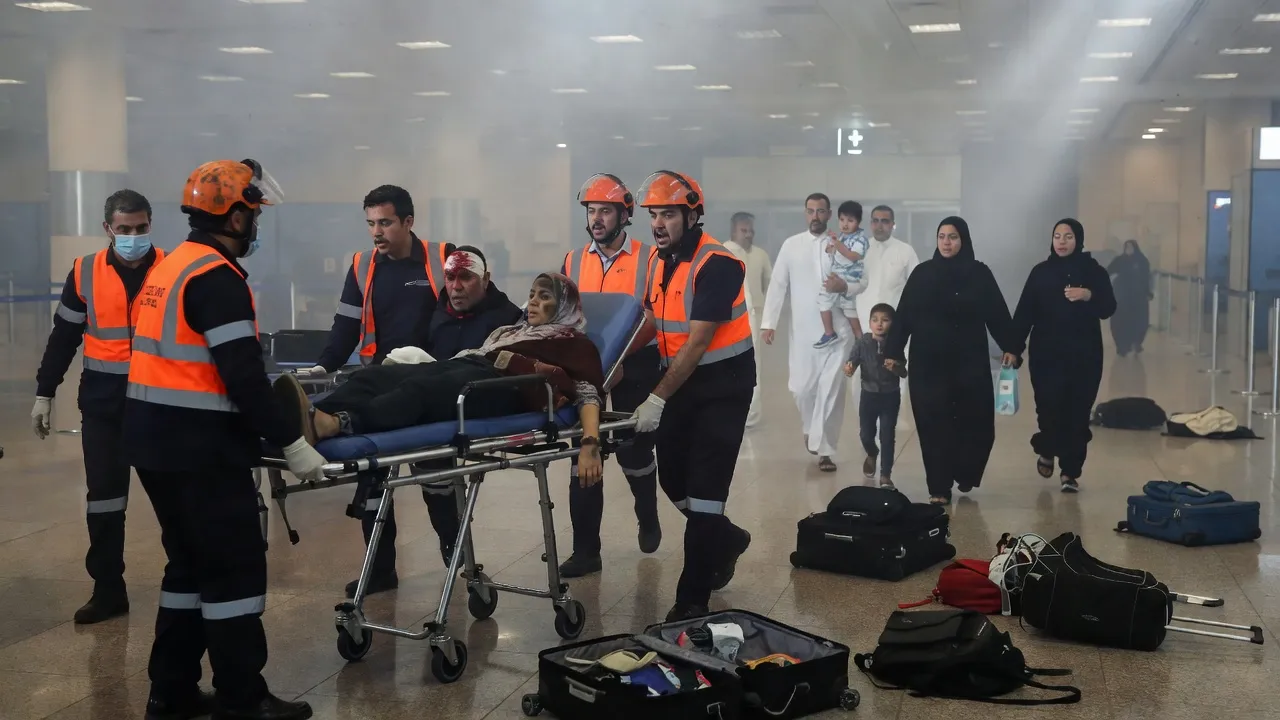
The Saudi Civil Aviation Authority reports twelve dead, including one American citizen, and 309 injured in the strike on King Khalid Airport (CBS News).
- 02
Donald Trump says he is considering American involvement in Saudi strikes against the Houthis: "We may. We're going to look at it" (NPR/AP, ABC).
- 03
The Houthis had not claimed responsibility for Saturday's strike, but those earlier in the week, which killed three Saudis including a pilot (CBS News, Time).
ANALYSIS
Washington, October 11, 2026. In the US press, the attack on Riyadh's King Khalid International Airport is first seen as a possible turning point for the United States. NPR, which picks up the AP, and CBS News report the toll from the Saudi Civil Aviation Authority: twelve dead, including four Saudis, two Bangladeshis, and one person from each of the following nationalities: American, Egyptian, Jordanian, Syrian, Palestinian, and Sudanese. CBS puts the number of injured at 309, several in critical condition.
The details of the location are provided by an anonymous regional official: a missile struck the complex of terminals 3 and 4, reserved for domestic flights. Time specifies that it is the second airport in the kingdom in terms of traffic and that the attack resulted in a near-complete halt to public air traffic in the capital.
The heart of the story is Donald Trump's reaction. Asked on Saturday, the president said he was evaluating American participation in Saudi strikes against the Houthis: "We may. We're going to look at it. (...) We move very quickly." Marco Rubio condemned the "terrorist Houthis" and confirmed that an American citizen was among the victims; the State Department told CBS it remains in close contact with its "Saudi partners". NPR estimates that the attack should increase the pressure from Riyadh on its allies, the United States first, to obtain military support.
US media put the facts into a sequence: the offensive announced on October 4 by the Yemeni government backed by Riyadh, then the wave of strikes on Saudi airports, military sites, and oil infrastructure. Time lists the victims of the week, mostly Saudi but also Algerian, Moroccan, Filipino, or Pakistani, and quotes the coalition's spokesman, who says the attacks "will not go unpunished".
On attribution, the articles are more cautious than the coalition: the AP notes that the Saudi statement did not attribute responsibility, and CBS and Time indicate that the Houthis had not claimed responsibility for Saturday's attack, whereas they had claimed those at the beginning of the week. ABC reports the Houthi accusation that Saudi Arabia had struck Sanaa airport. All place the episode on a new front in the war with Iran, which makes it, for the AP, the deadliest attack in a Gulf Arab country since the start of this conflict.