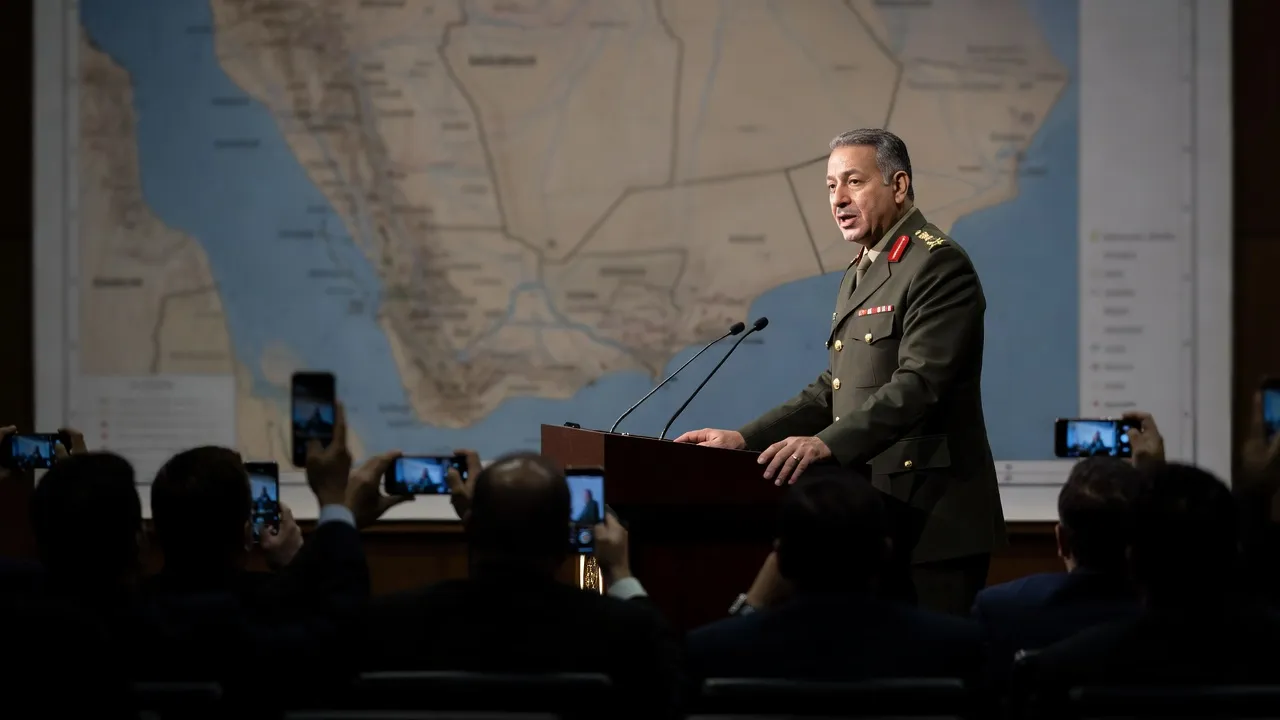
Common ground and differences in coverage across the media analysed.
What the media report in common
1
Between September 14 and 16, 2026, maritime traffic collapses in the Strait of Hormuz and oil and fuel prices reach unprecedented levels since the start of the conflict, with a barrel exceeding $100 and record prices at the pump in several countries.
2
During the same week, Houthi forces intensify their military actions: ballistic missile and drone strikes against Saudi territory, and new positions taken on the Yemeni Red Sea coast, near the Bab-el-Mandeb Strait.
Where media coverage diverges
Damage to the Algaya/El Gaia oil tanker
The Iranian Revolutionary Guard's navy attributes the damage to the supertanker to naval mines hit south of the Strait of Hormuz, while the American CENTCOM, whose version is taken up by the Saudi and British press, attributes it to an Iranian missile followed by a drone.
The Arab coalition claims to have intercepted a Houthi drone targeting Mecca on Tuesday, a second attempt of this kind since 2017 according to its spokesperson, while the Houthi political office denies any such attempt the next day.
Some regional media describe the Houthi strikes as terrorist acts and condemn them as an aggression against Saudi Arabia, while the Iranian press presents the Strait of Hormuz crisis as the consequence of American-Israeli aggression, without mentioning any Houthi role.
Canberra is gauging this Gulf escalation by the barrel price: the Houthi strikes against Saudi cities are pushing oil above $100 American, a surge that Australian media immediately convert into a cost for the national motorist.
KEY POINTS
The barrel has exceeded $100 US (around $140 Australian) after Houthi attacks on Saudi oil infrastructure, reports SBS News.
Thirteen civilians were injured by Houthi ballistic missile and drone fire on Khamis Mushait, Abha, and Taif, confirmed Tuesday by the Arab coalition.
The coalition intercepted a drone targeting Mecca on Tuesday before it entered the restricted airspace, the first emergency alert for the site since the start of the war, according to ABC News.
ANALYSIS
Canberra, September 16, 2026. Australia is first measuring this new episode of the Middle East conflict by its impact on fuel prices: SBS News notes that the Houthi attacks on Saudi oil infrastructure have driven the barrel above the $100 threshold, or about 140 Australian dollars. For an economy that imports most of its refined fuel, this shift is not a distant detail.
On the ground, the Arab coalition led by Riyadh promised on Tuesday to react "firmly" after a series of ballistic missile and drone strikes that injured thirteen civilians in the south of the kingdom. The Houthis claimed a "large-scale" attack, carried out with "dozens of ballistic missiles and drones", against King Khaled Air Base in Khamis Mushait; the coalition confirmed strikes the day before on Khamis Mushait, Abha, and Taif. A resident of Khamis Mushait told AFP that he heard "intense explosions" that caused fires "for a long time": "Honestly, we couldn't sleep at all."
ABC News reports that the coalition intercepted a drone targeting Mecca on Tuesday before it entered the restricted airspace surrounding the holy sites — the first emergency alert for the site since the start of the regional war. Spokesman Turki al-Malki described the security of the two holy cities as a "red line" on Wednesday and promised deterrent measures. Security alerts were triggered on Tuesday in Mecca, Jeddah, and Taif.
The Australian narrative links these strikes to the capture, last week, of the Yemeni Red Sea coast and the Bab el-Mandeb Strait by the Houthis, described as a severe blow to already weakened government forces, even as the Strait of Hormuz further north is choking under the broader war between Washington and Tehran. A Houthi raid on Monday in western Yemen killed eight government soldiers, according to two military sources. Riyadh is also seeking continued support from Egypt in the face of the escalation in the Red Sea.
For Canberra, dependent on maritime routes and global crude prices, the convergence between the Houthi offensive, the Saudi response, and the oil surge directly affects household budgets, long before any diplomatic calculations about Hormuz.
Bangladesh
DOMINANT ANGLE
Dhaka is alarmed by the growing risk to Mecca and the major maritime routes of the Gulf, two vital arteries for Bangladeshi pilgrims and expatriate workers.
KEY POINTS
A Houthi drone was intercepted Tuesday at 18:50 Saudi time south of Mecca, the second attempt of its kind after a ballistic missile launch in 2017, according to General Turki Al-Malki.
Thirteen civilians were injured Monday by ballistic missile and drone strikes on Khamis Mushait, Abha, and Taif, according to the Arab coalition led by Riyadh.
The UN migration agency has recorded 93,864 displaced people in Yemen since the resumption of fighting in July, after the Houthis took control of the port of Mokha and Mayyoun Island.
ANALYSIS
Dhaka, September 16, 2026. For the Bangladeshi press, the dominant news is not only the collapse of traffic in the Strait of Ormuz, but the direct threat now looming over Mecca, the holy city to which millions of Bangladeshi pilgrims travel every year. TBS Top News and the Daily Star report that Saudi air defenses intercepted a Houthi drone south of the city on Tuesday evening at 6:50 pm local time, before it entered the restricted airspace. The coalition's spokesman, General Turki Al-Malki, described the attempt as a "red line", specifying that it was the second attempt of this type targeting Mecca since a ballistic missile strike in 2017. The Houthis denied targeting the city, with a representative of their political office, Mohammed al-Farah, calling it a "pure lie" relayed by the SABA agency.
This statement comes after a week of attacks that injured thirteen civilians on Monday in Khamis Mushait, Abha, and Taif, and more than seventy people in total over the previous week, including women and children. Riyadh warned that it would react "firmly" to protect its sovereignty.
At sea, the capture of the port of Mokha and the island of Mayyoun by the Houthis, who now control the entire Red Sea coast of Yemen, is shifting Saudi oil exports to Bab al-Mandeb at a time when the Strait of Ormuz is almost paralyzed by the war between Washington and Tehran. The UN migration agency reports 93,864 displaced people since the resumption of fighting in July. Crown Prince Mohammed bin Salman, received in Cairo by President Abdel Fattah al-Sissi, called for "guaranteeing the freedom and security of navigation" in the two straits; the Egyptian presidency recalls that the Suez Canal, on which Cairo's revenues depend, is also suffering from the crisis. According to the American press cited by the Daily Star, Riyadh had requested a direct intervention from President Donald Trump in vain.
Brazil
DOMINANT ANGLE
Brasília is first measuring the oil bill: the postponement of the Gulf meeting and the Houthi escalation are driving up American crude and diesel, a direct signal for a country that depends on maritime freight for its agricultural trade.
KEY POINTS
Oil climbed more than 3% on Monday, September 14, 2026, when markets reopened, according to Agência Brasil, and US retail diesel reached a record high of over $6.23 per gallon.
The scheduled Iran-GCC meeting in Salalah, Oman, was postponed "in the name of consensus" according to Omani Minister Badr Albusaidi; Tehran claims the postponement was requested by Riyadh, and Bahrain had announced on Saturday, September 12, that it would not participate.
Houthi attacks on Monday and Tuesday (September 14-15) against a military base in Khamis Mushait and the cities of Abha and Taif injured 13 civilians, according to G1; the Houthi rebels had already taken an island at the entrance to the Red Sea on Friday, September 11, and damaged the Saudi east-west oil pipeline.
ANALYSIS
Brasília, September 16, 2026. For the Brazilian press, the most readable indicator of the Gulf crisis remains the price of a barrel. According to Agência Brasil, crude oil jumped more than 3% on Monday, September 14, 2026, when markets reopened after the weekend, while in the United States, retail diesel reached a record high, exceeding $6.23 per gallon.
This surge follows the announcement of the postponement of the meeting that was to bring together Iran and the six countries of the Gulf Cooperation Council in Salalah, Oman, to discuss temporary navigation management in the Strait of Hormuz. The head of Omani diplomacy, Badr Albusaidi, explained that the meeting had been "postponed in the name of consensus," according to Folha. Tehran claims that this postponement was requested by Riyadh. Bahrain, which currently chairs the GCC and is one of the Gulf states most affected by Iranian retaliation, had announced on Saturday, September 12, 2026, that it would not participate; Iraq was also expected to be present.
Switzerland
DOMINANT ANGLE
Bern measures the Strait crisis by its own benchmarks: Swiss experts cited by the local press translate the Ormuz oil spill into familiar units — the surface of Lake Geneva — and document a Saudi Arabia caught in a vice between three military fronts.
KEY POINTS
Greenpeace mentions five oil slicks in the Strait of Hormuz and off the coast of Oman, including one as vast as Lake Geneva
Cornelia Kienle (Eawag) lists the species threatened by the slicks: green turtles, Arabian humpback whales, dugongs, dolphins, whale sharks
The Houthists now control the entire Yemeni coast of the Red Sea and the Bab-el-Mandeb Strait, placing Saudi Arabia in an "increasingly uncomfortable triangle" between Hormuz to the east and the Red Sea to the west
ANALYSIS
Berne, September 16, 2026. The Swiss press is addressing the crisis in the Strait of Ormuz from two distinct but complementary angles: the ecological cost of the oil war and the strategic stranglehold closing in on Saudi Arabia.
SRF News reports that several oil tankers damaged by sea mines or rocket fire have leaked oil into the Strait of Ormuz and off the southern coast of Oman. Greenpeace mentions five distinct oil slicks, one of which would cover at least the surface of Lake Geneva — a Swiss comparison to make the extent of the disaster tangible. Cornelia Kienle, from the ecotoxicology center of the water research institute Eawag, warns that it is difficult to assess the current situation due to a lack of data on the quantities spilled, adding that the oil is leaking in an active war zone with no end in sight, and that this could still worsen significantly. She details the threatened species: green turtles, hawksbill turtles, Arabian humpback whales in danger of extinction, dugongs, dolphins, whale sharks, and migratory birds, as well as the mangroves that protect the coastline. The oil reaching the coast can engulf the plumage of seabirds and the fur of mammals, causing drowning or hypothermia; it can also cover corals, leaves, and roots, block photosynthesis, and obstruct the gills of fish.
China
DOMINANT ANGLE
Beijing measures the Gulf crisis in barrels and tonnes of grain, highlighting the collapse of traffic at Hormuz and its impact on fertilizers and global food rather than diplomatic maneuvers.
KEY POINTS
Daily traffic in the Strait of Hormuz dropped to a single digit over the weekend of September 12-13, compared to an average of 14 ships per day over the previous ten days (Jiemian).
According to Oleg Kobiakov (FAO), the disruption to traffic at Hormuz will reduce global food production and supply in 2026-2027, through delays in fertilizer deliveries.
The scheduled Iran-Gulf meeting on Monday was postponed at the request of "certain countries in the region", according to the Iranian agency IRNA, while Riyadh kept its damaged drone strike pipeline closed.
ANALYSIS
Beijing, September 16, 2026. The Chinese press is focusing on maritime traffic figures in its coverage of the Gulf crisis, rather than diplomatic negotiations. According to ship tracking data cited by Jiemian, which is close to CCTV, the number of vessels passing through the Strait of Hormuz daily dropped to "single digits" over the weekend of September 12-13, compared to an average of 14 vessels per day over the previous ten days. Only four vessels, including energy tankers, left the strait, while ten cargo ships entered - a count that, Jiemian notes, excludes vessels that turned off their automatic identification system. The UK Maritime Trade Operations reported that a vessel was hit by an "unidentified object" on September 13 while crossing the strait. On September 15, according to Iranian sources cited by Jiemian, a third US MQ-1 drone was shot down over Hormuz by the Revolutionary Guards' air defense.
Beyond energy, Jiemian is relaying a warning from the FAO: according to Oleg Kobiakov, head of the organization's liaison office in Russia, the disruption to traffic in Hormuz will reduce global food production and supply in the second half of 2026 and in 2027, by delaying fertilizer deliveries - the strait being a key route for urea.
Germany
DOMINANT ANGLE
Berlin is gauging the Gulf crisis in terms of cents at the pump: tensions in the Strait of Hormuz and Bab-el-Mandeb are driving gasoline prices to historic records, forcing Chancellor Merz to promise a response to motorists.
KEY POINTS
The liter of Super E10 reached a record of 2,273 euros on Sunday and diesel 2,404 euros, according to the FAZ, with a barrel of Brent at 108,65 dollars, up nearly 80 % since January.
Chancellor Friedrich Merz announced a proposal to support motorists 'very soon', referring suspicions of abusive profits to the Federal Cartel Office.
The Houthists took the port of Moka and then the island of Mayyoun, which makes shipowners fear, according to the FAZ, a second strait blocked after Hormuz.
ANALYSIS
Berlin, September 16, 2026. In Germany, the Gulf crisis is first and foremost measured at the pump. The postponement of the meeting scheduled for Monday between Iran and the Gulf States, which Oman had been counting on to regulate navigation in the Strait of Hormuz, and the advance of the Houthi rebels to the Bab el-Mandeb Strait, have resulted in record prices. According to the FAZ, the liter of Super E10 reached 2.273 euros on Sunday, a record, with diesel rising to 2.404 euros; the barrel of Brent reached 108.65 dollars on Monday, up nearly 80% since the beginning of the year, and domestic fuel has never been more expensive since 2022, at 167.18 euros per 100 liters. The Saudi East-West pipeline, shut down as a precaution after drone attacks, is adding to the pressure on supply.
In the face of motorists' anger, Chancellor Friedrich Merz (CDU) has promised to take action: "For many people who need their car every day, the limit has been reached," he said in Berlin during an event organized by the BGA foreign trade association, assuring that a proposal would be presented "very soon" after consultation with the 16 states. He referred the question of abusive profits to the Federal Cartel Office, "equipped with the necessary powers" to monitor abuses. The FAZ notes that more than 120 political interventions have already been recorded in 22 European countries, and that high prices could be exploited by populist parties like the AfD.
France
DOMINANT ANGLE
Paris is gauging the double failure of the oil corridors: the closure of the Strait of Hormuz is now compounded by that of the Bab el-Mandeb, with a barrel already above $100 and the threat of a peak at $130 or $140.
KEY POINTS
According to Kpler data cited by BFM Business, 21 ships passed through Bab el-Mandeb on Monday, compared to 28 the day before.
The Arab coalition reports 13 civilians were injured in Monday's Houthi strikes on Khamis Mushait, Abha, and Taïf, according to BFMTV.
According to L'Express, nearly 8% of global LNG and around 12% of global oil pass through Bab el-Mandeb, and a barrel at $130-140 is not ruled out.
ANALYSIS
Paris, September 16, 2026. The French press is tallying signs of an energy crisis at two straits. Since the Houthis took control of the Bab el-Mandeb strait on September 11, and then the island of Mayyoun (Perim), maritime traffic has collapsed: according to Kpler data cited by BFM Business, 21 ships passed through Bab el-Mandeb on Monday, compared to 28 the day before. The Qatari Ministry of Foreign Affairs spokesperson, Ibrahim Al-Hashmi, believes a closure would be "catastrophic": "The world is already suffering enough from the closure of the Ormuz strait (...), so we cannot afford to add Bab Al-Mandab to this equation."
L'Express quantifies the stakes: nearly 8% of global liquefied natural gas exports and around 12% of global oil pass through Bab el-Mandeb, compared to 20.9 million barrels per day for Ormuz. Analyst Cyril Widdershoven anticipates "prolonged delays in maritime transport, a shortage of available ships, and higher oil prices," without ruling out a barrel at $130 or $140. Crude oil has already exceeded $100, according to Le Monde. France 24 notes that several countries are turning to coal to bypass Ormuz, with global demand expected to reach a record 8.94 billion tons this year, according to the International Energy Agency.
On the ground, the Houthis claimed on Monday to have launched an attack of "dozens of ballistic missiles and drones" against the Saudi King Khalid airbase in Khamis Mushait; the Arab coalition reported 13 civilians injured in Khamis Mushait, Abha, and Taif. On Tuesday, Riyadh accused the rebels of targeting Mecca with an intercepted drone, an accusation the Houthis describe as a "worn-out lie." At Ormuz, two sailors from the Elgaia oil tanker remain missing after an attack, with 23 others evacuated. Crown Prince Mohammed Ben Salman received US Admiral Brad Cooper in Jeddah before meeting with Abdel Fattah Al-Sissi in Cairo; the two leaders call for "guaranteeing the freedom and security of maritime navigation." Ursula von der Leyen condemned the attacks, saying the EU is "in solidarity" with the Gulf against "Iran's relays."
Indonesia
DOMINANT ANGLE
Jakarta is deciphering a front that is closing in on two seas at once: the Houthists are locking down Bab el-Mandeb while Hormuz remains closed, and the war is spreading to the outskirts of Mecca.
KEY POINTS
The Houthists captured the Hanish Islands (Grand and Little) in the Red Sea on Monday, September 14, after having already taken the port of Mokha and Mayyoun Island the previous week, closing the alternative to Hormuz.
The Houthists claimed, on September 14, a missile and drone strike on the Saudi King Khalid airbase in Khamis Mushait; Riyadh has not confirmed the alleged damage.
The coalition claims to have intercepted a drone targeting Mecca on September 15, which the Houthist political office denied on September 16 as a "worn-out lie".
ANALYSIS
Jakarta, September 16, 2026. Indonesia's CNN and Tempo describe a front that is closing in on two seas at once. According to Tempo, the Houthi rebels, backed by Iran, announced on Monday, September 14, that they had captured the Hanish Islands, Grande and Petite, in the southern Red Sea — a seizure that adds to their capture of the port of Mokha and Mayyoun Island in the Bab el-Mandeb Strait the previous week. This route had served as a fallback for Saudi Arabia since the Strait of Hormuz, through which a fifth of the world's oil passes, has been closed by Iran since the United States began bombing the Islamic Republic on February 28. Riyadh finds itself caught in a vice on its two maritime outlets.
On Saudi territory, CNN Indonesia reports that the Houthi rebels claimed on Monday, September 14, to have launched a strike of dozens of ballistic missiles and drones against the King Khalid airbase in Khamis Mushait, targeting hangars, radars, runways, and ammunition depots. Houthi military spokesman Yahya Saree claims that Riyadh suffered "significant losses," an assertion that Saudi Arabia has not confirmed. The Saudi civil defense had issued an alert before announcing that "the danger had passed." The previous week, Saudi authorities had reported 73 civilians injured in strikes targeting Abha, Khamis Mushait, Jazan, and Najran.
Israel
DOMINANT ANGLE
Israel is gauging the risk of a US-Iranian compromise that would leave Riyadh exposed to the Houthis, and is already passing on military intelligence to the Saudis through Washington.
KEY POINTS
Israel and Saudi Arabia have held US CENTCOM-mediated talks for Israeli intelligence assistance against the Houthis (Jerusalem Post).
According to Arutz Sheva, Israel is now transmitting military intelligence to Riyadh via Washington, based on the idea that the Houthi threat is a regional problem.
The Houthis have seized several strategic islands in the Red Sea and blocked the passage of Saudi ships through the Bab al-Mandeb Strait, in addition to a drone strike that partially halted a Saudi oil pipeline.
ANALYSIS
Jérusalem, September 16, 2026. As the Strait of Hormuz becomes congested and the Houthists step up their strikes on Saudi territory, Israel is taking a discreet approach. According to the Jerusalem Post, talks have been held between Israel and Saudi Arabia, mediated by the US Central Command (CENTCOM), to help Riyadh defend itself against the Houthist threat through intelligence assistance. These exchanges, reported by "diplomatic sources in the Middle East", come as the Houthists intensified their attacks on the kingdom last week, including a drone strike on pipelines and oil pumping facilities, causing a partial shutdown of activity on the main oil pipeline, as well as an attack on civilians near a mosque close to the Yemeni border.
The Arutz Sheva website specifies that this channel remains indirect: Israel is now transmitting intelligence to Riyadh via Washington, based on the idea that the Houthist threat is a regional problem and no longer just a Yemeni one. The Jerusalem Post notes that the Israeli army "has already demonstrated its intelligence and operational capabilities in the maritime space around the Strait of Hormuz", by helping the Americans build layers of intelligence on the positions of Iranian forces — expertise that Riyadh is now seeking to benefit from.
Iran
DOMINANT ANGLE
Tehran denounces the postponement of the Gulf meeting as American pressure, claims its bilateral agreement with Oman on navigation, and prepares talks with Beijing, while ruling out its own responsibility in the collapse of traffic in the Strait of Hormuz.
KEY POINTS
Spokesman Esmaeil Baghaei claims the meeting of regional foreign ministers "did not take place due to Saudi Arabia's request", while an agreement on navigation routes has been "finalized" with Oman.
Preliminary data from Kepler cited in the press indicates that only 4 cargo ships crossed the Strait of Hormuz in one day, compared to 10 on Sunday.
The Revolutionary Guard's navy confirms the explosion of the supertanker "Algaya" after hitting mines in a restricted area south of Hormuz, and claims to have destroyed an MQ-1 drone west of the strait.
ANALYSIS
Tehran, Wednesday, September 16, 2026. The postponement, on Monday, of the regional meeting on the Strait of Hormuz is presented by Riyadh as its own request, but read in Tehran as a gesture under American pressure. The spokesman for the Ministry of Foreign Affairs, Esmaeil Baghaei, explained that "the meeting of the foreign ministers of the countries in the region did not take place due to the request of Saudi Arabia", while ensuring that Tehran and Muscat have "finalized their agreement on navigation routes" and will decide together on its announcement. Baghaei insisted: foreign policy and national security decisions "are not made based on a single factor", nor does a rise in oil prices dictate Iran's conduct.
On the maritime front, preliminary data from Kepler cited by the Iranian press shows a plummeting traffic: only four cargo ships crossed the strait the day before, compared to ten on Sunday. The Revolutionary Guard's navy confirmed the explosion of the supertanker "Algaya", which hit mines while trying to cross a prohibited zone south of the strait, and claims "intelligent" control over a Hormuz it says is closed. It also announced that it shot down an MQ-1 drone west of the strait. In the waters of Hormozgan, a drone attack on two fishing boats near Larak Island has left fishermen missing, according to provincial authorities.
Nigeria
DOMINANT ANGLE
Abuja is particularly focused on the religious dimension of the escalation: as a heavyweight member of the Organisation of Islamic Cooperation (OIC), Nigeria sees the drone attack on Mecca as a turning point condemned by the pan-Islamic organization, while the local press simultaneously details the cross-strikes in Yemen.
KEY POINTS
The OIC describes the Houthi drone attack targeting Mecca as "heinous" and affirms its "total solidarity" with Saudi Arabia.
The Houthists claim that Saudi Arabia carried out 54 strikes in 24 hours in western Yemen, in response to Houthi drone and missile fire against Saudi bases (alerts in Khamis Mushait, Abha, Najran).
The Houthists took the Yemeni Red Sea coast and the Bab el-Mandeb Strait last week, with the release of 210 prisoners.
ANALYSIS
Abuja, September 16, 2026. A key member of the Organisation of Islamic Cooperation (OIC), Nigeria reports the escalation in the Middle East first through the voice of the pan-Islamic institution. Daily Post relays the OIC's formal condemnation after the drone attack targeting Mecca, described as "heinous": the organisation accuses the Houthis of seeking to "instil fear among civilians, desecrate the sacred nature of holy sites... and inflame the sentiments of Muslims worldwide". The statement goes further, asserting that targeting "holy sites, religious establishments and civilian infrastructure" constitutes "acts of terrorism" contrary to Islamic doctrine. The OIC affirms its "total solidarity" with the Kingdom of Saudi Arabia and endorses the protective measures taken by Riyadh.
On the ground, Riyadh claims to have intercepted and neutralised, on Tuesday evening, the drone headed towards Mecca before it entered the restricted airspace. The coalition's spokesman, General Turki Al-Malki, denounces an attempt to "put the faithful in danger".
Vanguard details, in parallel, the military escalation itself: the Houthis claim that Riyadh carried out 54 strikes in 24 hours in western Yemen, in response to Houthi drone and missile fire against Saudi bases, which triggered civil defence alerts in Khamis Mushait, Abha, and briefly in Najran. A resident of Khamis Mushait testifies to AFP that he heard "intense explosions" that caused fires "for a long time": "Honestly, we didn't sleep at all." Houthi missile fire in western Yemen also killed eight government forces soldiers, according to two military sources from the Aden-based administration cited by AFP.
Nepal
DOMINANT ANGLE
Kathmandu is measuring the Gulf crisis almost exclusively in terms of the barrel: the Nepalese press, which reprints Reuters dispatches, first retains the threat to 4% of the world's oil supply, more than the battle for the Bab el-Mandeb islands or diplomatic negotiations.
KEY POINTS
Thirteen civilians were injured Monday in Houthi strikes on the Khamis Mushait airbase, according to the Arab coalition led by Riyadh
A prolonged shutdown of the east-west Saudi oil pipeline, damaged Thursday by a strike attributed to pro-Iraqi militias, could cut up to 4% of the global oil supply, according to traders cited by Reuters
The Houthis have captured the Hanish islands, 160 kilometres north of Bab el-Mandeb, after already taking the port of Mokha and Mayyoun island
ANALYSIS
Katmandou, 16 September 2026. In the Nepalese press, which has no correspondent in the Gulf, the crisis is first read through the prism of the barrel. The Kathmandu Post, like The Rising Nepal, largely reprints Reuters dispatches, but the choice of headlines is revealing: "Houthis strike Saudi targets anew as talks over Strait of Hormuz stall" puts the threat to the global oil supply before the count of victims.
The reported facts are precise. On Monday, the Houthis fired "dozens of missiles and drones" at the Khamis Mushait airbase in southern Saudi Arabia, targeting hangars, radars, runways, and ammunition depots, in retaliation for Saudi strikes in Yemen. Riyadh has placed this city and three others in the south on alert, and the Arab coalition reports thirteen civilians injured. Nepalese newspapers note that these attacks come after an airstrike on Thursday put the 1,200-kilometer Saudi east-west oil pipeline, built in the 1980s to bypass the Ormuz Strait, out of service. Riyadh attributes it to pro-Iraqi militias supported by Iran. According to traders cited by Reuters, a prolonged shutdown of this pipeline could cut up to 4% of the global oil supply, while the Ormuz Strait remains largely blocked.
Pakistan
DOMINANT ANGLE
Islamabad is questioning the exact scope of the Makkah defence pact signed with Riyadh and Ankara, as the Houthi advance towards the Bab-el-Mandeb Strait raises the question of a potential Pakistani intervention obligation under Article 51.
KEY POINTS
The joint defense pact of Makkah, signed on August 7, 2026, by Pakistan, Saudi Arabia, and Turkey, stipulates that an armed attack against one of the signatories will be regarded as an attack against all, with reference to Article 51 of the United Nations Charter.
The DG of ISPR, Lieutenant General Ahmed Sharif Chaudhry, told Al-Arabiya English that the pact is "defensive" and has "no regional ambition", and that its operational modalities remain classified.
Pakistan's Ambassador to the UN, Asim Iftikhar Ahmad, condemned the Houthi attacks on Tuesday before the Security Council, and Prime Minister Shahbaz Sharif expressed the same condemnation during a call with Crown Prince Mohammed bin Salman.
ANALYSIS
Islamabad, September 16, 2026. In Islamabad as in Karachi, the press is focusing less on the origins of the new Houthi salvo against Saudi Arabia than on its implications for Pakistan itself. The Makkah joint defense pact, signed on August 7 by Islamabad, Riyadh, and Ankara, provides that an armed attack against one of the three countries will be regarded as an attack against all, in explicit echo of Article 51 of the United Nations Charter on legitimate defense.
The chief spokesperson for the army, Lieutenant General Ahmed Sharif Chaudhry, director general of inter-services public relations (ISPR), sought to circumscribe the scope of the text in an interview granted Wednesday to Al-Arabiya English. "It's defensive, as the word indicates. There's nothing aggressive. There's no regional ambition. It's collective deterrence," he stated, adding that the operational modalities remain classified and are never made public.
The question arises as the Houthi rebels, after seizing the port of Moka and then the island of Mayyoun in the Bab-el-Mandeb strait, announced their intention to keep the route open to international traffic, except for Saudi ships. A Pakistani newspaper wonders: if this selective blockade is equivalent to an armed attack against the kingdom, what would be expected of Islamabad as a signatory to the Makkah pact?
Qatar
DOMINANT ANGLE
Doha is defending a strictly diplomatic reading of the crisis: saving the dialogue on the Strait of Hormuz before Bab-el-Mandeb also tips over, while recalling that Saudi security directly affects that of the Gulf.
KEY POINTS
The Qatari Ministry of Foreign Affairs spokesperson, Ibrahim bin Sultan al-Hashmi, stated on Tuesday, September 15, that the world "cannot bear the cost of the closure of the Bab-el-Mandeb Strait" after that of Hormuz
According to maritime tracking data relayed by Al Jazeera, only three ships crossed the Strait of Hormuz on Tuesday, September 15, 2026, compared to five the day before
The Qatari Ministry of Foreign Affairs condemned on Tuesday the Houthi strikes on Khamis Mushait, Abha, and Taif as "despicable acts of aggression", affirming that Saudi security is an integral part of Qatar's and the GCC's security
ANALYSIS
Doha, September 16, 2026. For Qatar, the priority remains diplomatic: saving what remains of the dialogue on the Strait of Ormuz before the crisis spreads to the neighboring Bab-el-Mandeb Strait. During the weekly press briefing of the Ministry of Foreign Affairs on Tuesday, September 15, 2026, its spokesperson Ibrahim bin Sultan al-Hashmi reaffirmed Doha's support for "diplomatic efforts to preserve maritime navigation freedom and reach a comprehensive agreement guaranteeing lasting peace in the region". He emphasized the urgency of bringing positions closer, judging that "the immediate priority for all parties is to reach a consensus on a solution to the current crisis".
On the same day, the ministry warned against any normalization of the closure of maritime routes, warning that the world "has already suffered enough from the closure of the Strait of Ormuz and cannot bear the cost of the closure of the Bab-el-Mandeb Strait". A phrase that reflects Qatar's concern over the measured collapse of traffic: according to maritime tracking data relayed by Al Jazeera, only three ships crossed Ormuz on Tuesday, September 15, compared to five the day before, while a ship was hit by an unidentified projectile on Monday evening, with no reported damage.
Russia
DOMINANT ANGLE
Moscow interprets the escalation as the formation of a unique pressure lever on Iran, where the blockade of the Strait of Hormuz and the Houthi advance towards Bab el-Mandeb converge under American supervision, rather than as two separate crises.
KEY POINTS
On Tuesday, September 15, only two ships entered and two exited the Strait of Hormuz, compared to around 125 per day before the war, according to Kpler cited by TASS.
The supertanker Algaya hit naval mines on Monday, September 14, in a restricted area of the southern strait, according to the IRGC navy, which described it as being entirely in flames.
The Houthis took the port of Mokha and then the island of Mayyoun (Perim) in the Bab el-Mandeb Strait, forcing the withdrawal of Yemeni government forces on Monday, September 14.
ANALYSIS
Moscow, Wednesday, September 16, 2026. For Russian agencies, the essence of the Gulf and Red Sea crisis is being played out on the military terrain, not in diplomatic salons. TASS reports that on Tuesday, September 15, only two ships entered and two left the Strait of Hormuz, compared to around 125 vessels per day before the war triggered by the United States and Israel against Iran on February 28, according to the analysis company Kpler cited by Reuters. This artery had until now ensured nearly 20% of the world's daily oil and liquefied natural gas exports.
The agency also notes that the giant oil tanker Algaya hit naval mines on Monday, September 14, while attempting to cross a prohibited zone in the south of the strait, according to the navy of the Islamic Revolutionary Guard Corps (IRGC), which claims to have previously warned the crews of the danger of this unauthorized route: "the entire tanker is on fire," the statement specifies. The next day, Sputnik, citing Press TV, indicates that the IRGC shot down an MQ-1 drone over the western part of the strait with a new air defense system.
On the Yemeni front, TASS notes that Houthi forces took the port of Mokha and then the island of Mayyoun (Perim) in the Bab el-Mandeb Strait, pushing government forces to retreat on Monday, September 14. US Vice President JD Vance confirmed at Andrews Base that Washington remained "in constant contact" with the Emiratis, Saudis, and the Houthis themselves to follow a situation he deemed "very fluid." On Tuesday, the same agency reported seven airstrikes by the Saudi air force on the Houthi province of Saada, where spokesman Yahya Saree claims that his forces responded with domestically manufactured surface-to-air missiles against Typhoon and F-15 aircraft.
Saudi Arabia
DOMINANT ANGLE
Riyadhh is escalating tensions and invoking Article 51 of the United Nations Charter to justify deterrent measures against the Houthists, following strikes on three cities and a foiled attempt to target Mecca.
KEY POINTS
13 civilians injured and 7 houses damaged by Houthi ballistic missiles and drones on Khamis Mushait, Abha and Taif, according to the Arab coalition (announced Tuesday).
Saudi air defenses intercepted a Houthi drone at 6:50 pm before it entered the restricted airspace of Mecca, the second attempt of this type after July 2017, according to General Al-Malki.
US CENTCOM denied on Monday the Iranian claim of an oil tanker explosion due to a mine in the Strait of Hormuz, recalling that an Iranian missile had already hit the same ship the previous month.
ANALYSIS
Riyadh, September 16, 2026. The Arab coalition led by Saudi Arabia announced on Tuesday that thirteen civilians were injured and seven houses, as well as two vehicles, were damaged by Houthi ballistic missile and drone strikes on Monday, in three cities of the kingdom: Khamis Mushait, Abha, and Taif. The coalition's spokesperson, General Turki Al-Malki, denounced "deliberate and repeated" attacks that demonstrate, in his view, the "terrorist approach and extremist ideology" of the Houthis. He invoked Article 51 of the United Nations Charter, the right to legitimate defense, and international humanitarian law to justify "necessary operational measures" of deterrence against the militia.
The following day, on Tuesday evening, Saudi air defenses intercepted a Houthi drone at 6:50 pm south of Mecca, before it entered the city's restricted airspace. Al-Malki sees this as the second attempt of its kind after a ballistic missile strike in July 2017, and describes the incident as an "heinous act" aimed at "terrorizing" Umrah pilgrims. "The security of the two Holy Sites is a red line," he emphasized, promising that the coalition "will not hesitate" to take necessary measures.
Riyadh is receiving strong regional support: the Arab Parliament condemned the strikes as a "flagrant violation" of international law and the UN Charter, calling on the Security Council to "assume its responsibilities"; the Muslim World League reaffirmed its "full solidarity" with the kingdom.
Singapore
DOMINANT ANGLE
Singapore notes the oil shift towards Asia, as Aramco redirects cargoes meant for Asian refiners to the Omani port of Sohar after the strikes on its east-west pipeline.
KEY POINTS
Saudi Aramco is offering its Arab Light, Arab Medium, and Arab Heavy grades to Asian buyers for a ship-to-ship transfer loading off Sohar, Oman, outside the Strait of Hormuz.
Saudi loadings at Ras Tanura and Juaymah have doubled to around two very large crude carriers per day (4 million barrels) according to Energy Aspects; Kpler tracked four supertankers (8 million barrels) loading on September 16.
Riyadh shut its east-west pipeline on September 11 after drone strikes, cancelled cargoes to Europe, and European physical Brent has exceeded $122 a barrel.
ANALYSIS
Singapour, 16 September 2026. As the Strait of Ormuz becomes congested and the Houthists step up strikes on Saudi soil, the Singaporean press first notes the shift in oil flows towards Asian refiners. According to Channel News Asia, Saudi Arabia is now offering more cargoes to its Asian clients through ship-to-ship transfers off the Omani port of Sohar, located outside the Strait of Ormuz. State-owned company Saudi Aramco is offering its three flagship grades, Arab Light, Arab Medium, and Arab Heavy, to contract buyers in Asia, for loading in Sohar. This shift comes after drone attacks damaged the east-west pipeline connecting the Gulf to the Red Sea, forcing Riyadh to shut down the infrastructure on 11 September and cancel some cargoes to Europe.
Satellite tracking data cited by Channel News Asia shows that Saudi loadings at Ras Tanura and Juaymah have doubled, reaching around two very large crude carriers per day, or 4 million barrels, according to Energy Aspects. Kpler, a provider, has spotted four supertankers capable of transporting 8 million barrels loading at Ras Tanura on 16 September. The buyers concerned, who were not identified, were not authorized to speak publicly, the article notes.
The Straits Times, for its part, places these movements in the broader context of a six-month war between the United States and Iran, which has reduced traffic in the Strait of Ormuz "to a trickle". The newspaper reports that Saudi Arabia warned on Tuesday that it would react "firmly" to Houthist attacks, after missile and drone strikes injured thirteen civilians in the south of the kingdom. A drone targeting Mecca was also destroyed on Tuesday evening before entering the city's restricted airspace, said coalition spokesman General Turki Al-Malki, for whom the security of Mecca is "a red line". The Houthists denied targeting the city.
United Kingdom
DOMINANT ANGLE
London is deciphering the escalation off the coast of Ormuz through its own maritime surveillance centre, the UK Maritime Trade Operations, more attentive to the count of tankers hit than to the diplomatic negotiations in the Gulf.
KEY POINTS
The tanker El Gaia, flying a Panamanian flag, was hit by an Iranian missile and then by a drone off the coast of Oman; two sailors remain missing, twenty-three were rescued (Oman Maritime Security Centre, via the BBC)
The International Maritime Organization reports at least 22 sailors killed in 79 confirmed incidents in the Strait of Hormuz and the Middle East since late February
A report by the Pentagon inspector estimates the cost of US ammunition at $22.3 billion for the first four months of the war against Iran
ANALYSIS
London, 16 September 2026. The United Kingdom views the escalation off Ormuz through the prism of its own surveillance centre, the UK Maritime Trade Operations (UKMTO), which reported a fire on board a ship hit by "an unidentified projectile" as it transited the strait on Sunday at dawn, according to the BBC. This technical report adds to a series of incidents documented by Oman: the tanker El Gaia, flying the Panamanian flag, was taken in charge by the Omani Maritime Security Centre after a fire broke out in its engine room, 1.3 nautical miles north of the Musandam Peninsula. Two sailors remain missing, twenty-three others were rescued; the ship was being towed on Tuesday towards an Omani port.
The versions diverge on the cause. The Iranian Revolutionary Guards mention naval mines on "a restricted and dangerous route"; the US military, on the other hand, insists: the tanker was hit by an Iranian missile last month, rendering it "inoperable", and then again by an Iranian drone this weekend off Oman, before being towed by a regional partner. A similar precedent, at the beginning of September, had cost the lives of two Filipino sailors on the Saudi supertanker Sidr: Tehran saw it as a mine, Riyadh as a strike. The International Maritime Organization counts at least 22 sailors killed in 79 confirmed incidents in the strait and the Middle East since the outbreak of the American-Israeli war against Iran, at the end of February — a strait through which until now a fifth of the world's oil and gas transited.
United States
DOMINANT ANGLE
The United States is factoring in the cost at the pump of its own campaign against Iran, between record diesel and a Saudi pipeline out of service.
KEY POINTS
Diesel has reached a record national average of $6.23 per gallon on Monday and gasoline $4.32, according to AAA cited by Fox News
The East-West Saudi pipeline, which carried 2.6 to 4 million barrels/day, was damaged by a drone and could remain out of service for three to five weeks (Fox News)
The meeting scheduled in Oman between Iran and the Gulf States on the reopening of the Strait of Hormuz has been postponed at the request of Saudi Arabia, Bahrain having already announced its absence (NPR)
ANALYSIS
The United States, September 16, 2026. The American press is measuring the crisis in the Strait of Ormuz less in diplomatic terms than in terms of the national energy bill. According to the AAA, cited by Fox News, diesel reached a record national average of $6.23 per gallon on Monday, while regular gasoline was at $4.32. Brent crude rose to around $110 per barrel on Monday, before falling back to $107.03 on Tuesday, according to CNBC, which also reported WTI at $102.91.
The immediate cause: a drone fired from Iraq damaged the Saudi East-West pipeline, a bypass route for the strait that carried between 2.6 and 4 million barrels per day to the Red Sea. Riyadh has shut it down; repairs could immobilize it for three to five weeks, according to Fox News. Meanwhile, Houthi rebels, supported by Iran, have taken the port of Mokha and then the islands of Grande and Petite Hanish, tightening their grip on Bab el-Mandeb, the alternative Saudi route, reports ABC News.
The coalition led by Riyadh says it has counted 13 civilians injured on Monday after a wave of Houthi ballistic missiles and drones, according to Al Jazeera cited by CNBC. A Houthi official claims that Saudi strikes killed three people, including two children, in the province of Taiz - a toll that AP says it cannot verify independently. Human Rights Watch also accuses the Houthis of possible war crimes for their attacks on commercial ships.
Explore every perspective on this subject across 19 countries.
Traffic collapses in the Strait of Hormuz as the Houthis strike three Saudi cities and the Gulf meeting is postponed
published on
September 16, 2026
19
countries
60
sources
83
articles
56%
gap
The Arab coalition led by Saudi Arabia announced on Tuesday, September 15, 2026, that thirteen civilians were injured and seven houses were damaged by Houthi missile and drone strikes on Monday, in three cities in the kingdom: Khamis Mushait, Abha, and Taif. Its spokesperson, General Turki Al-Malki, cited Article 51 of the United Nations Charter and announced deterrent measures. Maritime traffic has collapsed in the Strait of Hormuz, and a meeting scheduled for Monday between Iran and several Gulf states on navigation modalities in the strait has been postponed at Riyadh's request. In Yemen, the Houthi rebels have taken the port of Mokha and then the island of Mayyoun, in the Bab el-Mandeb Strait, facing divided government forces.
Regional mediation on Hormuz remains suspended without a new date announced, while Tehran opens a separate channel with Beijing on navigation modalities.
The Saudi East-West pipeline
Damaged by a drone, it transported up to 4 million barrels/day; closure estimated at three to five weeks.
The Makkah defense pact
Signed on August 7, 2026, by Riyadh, Islamabad, and Ankara, it also invokes Article 51 of the UN Charter.
Israeli Intelligence
Israel is transmitting military intelligence to Riyadh via Washington in the face of the Houthi threat.
Displaced in Yemen
The UN migration agency reports 93,864 displaced people since the resumption of fighting in July.
Understand the context
SEP 11, 2026
The Houthi rebels take the Bab el-Mandeb Strait, the port of Mokha, and then the island of Mayyoun
SEP 14, 2026
The Houthi rebels take the Hanish Islands, in the southern Red Sea
SEP 15, 2026
The Arab coalition says it intercepted a Houthi drone targeting Mecca
Key figures
13
Civilians injured on Monday by Houthi strikes on Khamis Mushait, Abha, and Taif
The meeting scheduled between Iran and the Gulf States on navigation in Ormuz, postponed at Riyadh's request, adds to the uncertainty as crude oil prices have exceeded $100 a barrel after the attack that put the Saudi east-west oil pipeline out of service, which can handle 4% of the world's supply.
On the ground, G1 reports that the Houthis carried out new attacks against Saudi Arabia between Monday, September 14, and Tuesday, September 15, 2026, injuring 13 people. The group claims to have targeted a military base in Khamis Mushait as well as the cities of Abha and Taif, in retaliation for Saudi bombings in Yemen. The Saudi civil defense issued, then withdrew a few minutes later, a danger alert for Mecca — a first since the beginning of the escalation. According to Agência Brasil, the Houthis had already taken an island at the entrance to the Red Sea on Friday, September 11, 2026, and damaged the Saudi east-west oil pipeline, the main oil route that bypasses Hormuz.
For Brasília, a major energy importer and agricultural exporter dependent on maritime freight, the combination of a strategic strait paralyzed and a bypass oil pipeline damaged illustrates the risk of a lasting oil shock, with direct repercussions on global logistical costs.
Le Temps, citing the Lebanese daily L'Orient-Le Jour, describes a Saudi Arabia "short of options" after the defeat of the internationally recognized Yemeni government, an ally of Riyadh, at the hands of the Houthi rebels, who now control the entire Yemeni coast of the Red Sea and the Bab el-Mandeb Strait. The kingdom, a regional heavyweight and major oil exporter, finds itself caught in an "increasingly uncomfortable triangle": Ormuz disrupted to the east by the Iranian-American confrontation, the Red Sea locked to the west by the Houthi rebels, and in the center, drones fired from Iraq by pro-Iranian groups that have shown that even the east-west oil pipeline, Riyadh's main bypass route around Ormuz, remains vulnerable.
On the diplomatic front, CGTN is reporting the postponement of a meeting scheduled for Monday between Iran and Gulf countries, announced by Omani Minister Sayyid Badr bin Hamad Al Busaidi "in the interest of consensus". Tehran, via the IRNA agency, attributes the postponement to a request from "certain countries in the region" and a joint decision with Oman. CGTN notes that Riyadh kept its 1,200 km east-west pipeline closed all weekend, after it was damaged by drone strikes on Friday, while oil prices rose at the reopening of markets on Monday.
On the Yemeni front, CGTN quotes Houthi spokesman Yahya Sarea claiming missile and drone strikes against the King Khaled airbase in Khamis Mushait, in retaliation for over 300 recent Saudi strikes. The South China Morning Post notes that the Saudi coalition accuses the Houthi rebels of targeting Mecca, an accusation the rebels describe as a "worn-out lie".
On the diplomatic and security front, the Handelsblatt reports that the Salalah meeting was cancelled "at the request of Saudi Arabia", according to Tehran, due to the escalation in Yemen, where the Houthi rebels have taken the port of Moka and the island of Mayyoun. The Strait of Hormuz remains blocked by Iran since the US-Israeli attack at the end of February, and the US counter-blockade is preventing any reopening, while the route transported a fifth of the world's energy exports before the war. The FAZ notes that shipowners now fear a second closed strait after Bab el-Mandeb, where Mayyoun is located just three kilometers from the Yemeni coast. The Tagesschau quotes Martin Kröger, from the German shipowners' association, who says that the Red Sea has been under tension "for about three years"; Hapag-Lloyd has been diverting its ships since the end of 2023.
On Tuesday, September 15, the coalition claimed to have intercepted a drone targeting the outskirts of Mecca, the debris of which fell south of the city — which would be, according to spokesman Turki Al Maliki, the second Houthi attempt to target the holy city since 2017. Riyadh issued an emergency alert for Jeddah, Mecca, and Taif. But the Houthi political office, through the voice of Hezam Al Asad, denied on Wednesday, September 16, any strike against Mecca, calling the Saudi accusation a "worn-out and outdated lie that no one believes anymore."
In the background, Tempo relays a note from the FAO stating that Russian food supplies would remain unaffected by the blockade of Hormuz, which has been closed since February 28, and has brought the global trade in oil and liquefied gas to a near standstill, causing fuel prices to soar worldwide.
The regional situation is darkening as the Houthists seize strategically located islands in the Red Sea and block the passage of Saudi ships through the Bab al-Mandeb Strait, imposing what sources describe as an economic and diplomatic blockade on the kingdom. This situation is fueling, according to the Jerusalem Post, a shared concern among other countries in the region: that of a scenario where Washington reaches agreements with Iran and the Houthists, leaving Saudi Arabia and its neighbors exposed to unresolved threats.
On the military front, Haaretz reports that six Saudi cities, including Yanbu, the kingdom's main oil port on the Red Sea, received emergency alerts before the civil defense confirmed a return to calm in Jeddah, Abha, Jazan, AlUla, and Taif. Around the Strait of Hormuz, the Jerusalem Post also reports the explosion of an oil tanker after a collision with mines claimed by Iran, denied by the US CENTCOM, which instead suggests an Iranian missile and drone strike on the ship.
On the economic front, an Iranian diplomat stated before UNCTAD in Geneva that the crisis in the strait is "the direct result of American-Israeli aggression" and the naval blockade, and that Iran should not be blamed for its global repercussions on trade, energy, and food. The conservative daily Kayhan goes further, calling for Tehran to target "all tankers in the Persian Gulf and the Gulf of Oman" for every Iranian ship hit. An analysis relayed by Khabar Online also judges that no Gulf country will accept Iranian dominance over Hormuz, and that the absence of Bahrain undermines the regional consensus sought by Tehran.
The postponement of the meeting also leaves the field open to Beijing: Tehran is preparing discussions with China on navigation modalities, in parallel with its channels with Oman and the United States.
These two aspects of the same conflict are linked to the Houthis' capture, last week, of the Yemeni Red Sea coast and the Bab el-Mandeb Strait, backed by Iran — a vital lock for Saudi oil exports as the Strait of Hormuz remains closed due to the war between the United States and Iran. Two hundred and ten prisoners were released at the end of this week-long offensive.
Katmandou also relays the Houthi advance on the Yemeni coast of the Red Sea: after taking the port of Mokha and the island of Mayyoun in the Bab el-Mandeb Strait, the rebels have taken the Hanish Islands, 160 kilometers to the north, strengthening their grip on a route that has become, according to Reuters, "even more crucial" since the partial blockade of Ormuz. On Tuesday, Saudi Arabia issued expanded security alerts as far as Mecca and Jeddah, a first for the holy city since the start of the conflict; the authorities have not reported any projectiles hitting the ground.
The postponement, at Riyadh's request, of the meeting scheduled with Iran on navigation in the strait occupies only one line in the Nepalese accounts, almost all of which are focused on the consequences for oil markets and global freight rather than regional diplomacy or the fate of Yemeni civilians, themes that the local press leaves to international agencies.
On the diplomatic level, Pakistan condemned on Tuesday, through the voice of its ambassador to the UN, Asim Iftikhar Ahmad, before the Security Council, "in the strongest terms, all Houthi attacks against the Kingdom of Saudi Arabia". Prime Minister Shahbaz Sharif himself expressed his condemnation during a telephone exchange with Crown Prince Mohammed bin Salman, emphasizing that these attacks threaten regional stability and global energy security.
The three Saudi cities targeted on Monday, Khamis Mushait, Abha, and Taif, resulted in thirteen civilian casualties and seven damaged houses, according to the coalition led by Riyadh, whose spokesperson Turki Al-Malki promised deterrent measures. Islamabad finally emphasizes the complementary nature of the Makkah pact with its other alliances, notably its historical relationship with Beijing, dismissing any idea of competition between partners.
On the Yemeni front, Doha condemned, in a separate statement dated the same Tuesday, the ballistic missile and drone strikes by Houthi rebels on Khamis Mushait, Abha, and Taif, described as "dishonorable acts of aggression" and "flagrant violations of Saudi sovereignty". The text states that "the security of the Kingdom of Saudi Arabia is an integral part of the security of the State of Qatar and the collective security system" of the Gulf Cooperation Council - a way of framing the attack in a logic of alliance rather than a simple bilateral confrontation between Riyadh and the Houthi rebels.
This double emphasis, on mediation on the one hand and Gulf solidarity on the other, explains the relative silence of the Qatari press on the postponement of the Iran-Gulf meeting, presented as a technical setback rather than a sign of rupture. For Qatar, whose economy directly depends on the stability of regional maritime routes, each day of blockade in Ormuz reminds that Gulf diplomacy remains, in its eyes, the only barrier to a generalized escalation.
RT links these two fronts to a single system: the Houthi advance towards Bab el-Mandeb, the media writes, transforms a local sector of the Yemeni war into a second lever of pressure on Iran, alongside the blockade of Hormuz, in a context of direct confrontation with the United States. However, the Ansar Allah movement assures, through the voice of its spokesman Mohammed Abdulsalam, that trade in the Red Sea remains safe, with restrictions only applying to ships linked to Riyadh.
On the maritime front, the US Central Command denied on Monday the claims by the Iranian Revolutionary Guards that a Panamanian-flagged oil tanker had exploded after hitting a mine in the Strait of Hormuz, seeing this as another Iranian lie aimed at disrupting commercial traffic. CENTCOM specified that the same ship, the "El Gaia", had already been hit by an Iranian missile the previous month.
On the Yemeni side, the Houthi advance towards Moka and then the island of Mayyoun, in the Bab-el-Mandeb Strait, has displaced over 100,000 people according to the UN refugee agency, including thousands who fled by sea to Djibouti.
For the Singapore financial and oil hub, the signal retained is less military than energy-related: crude is heading to Asia via bypass routes, at high prices - European physical Brent has exceeded $122 a barrel - while the balance of power on the Yemeni ground, where the Houthists now control Mokha and the island of Mayyoun, remains a distant backdrop.
The United Kingdom also notes the cost of this war for Washington: a report by the Pentagon inspector puts the amount of ammunition consumed in four months at $22.3 billion, revealing fragilities in the American defence industrial base. Donald Trump said he is "open" to negotiation, specifying that the final decision is his. On the markets, crude oil rose by 1.82% to $103.24, Brent by 1.6% to $107.37, after the new wave of Houthi attacks against Saudi Arabia on Monday and the postponement of the Gulf talks with Iran.
On the diplomatic front, the meeting scheduled in Oman between Iran and the Gulf States on the reopening of the strait has been postponed at the request of Saudi Arabia, NPR reports; Bahrain had already announced its absence. The Gulf, notes NPR, sees itself as an economic collateral victim of the conflict, while Washington does not appear to have a plan to end it.
On the military front, Iran claims to have destroyed an advanced American drone over Ormuz. The US Central Command denies the Iranian version that the tanker El Gaia hit a mine, stating that it was hit by an Iranian missile last month. Donald Trump said on Sunday that Washington could pursue its campaign and take control of Iranian oil.
SEP 16, 2026
The Houthi political office denies any strike targeting Mecca