Ukraine — news through its media
Stories followed in this country, with their framing set against the rest of the world.
161 subjects found
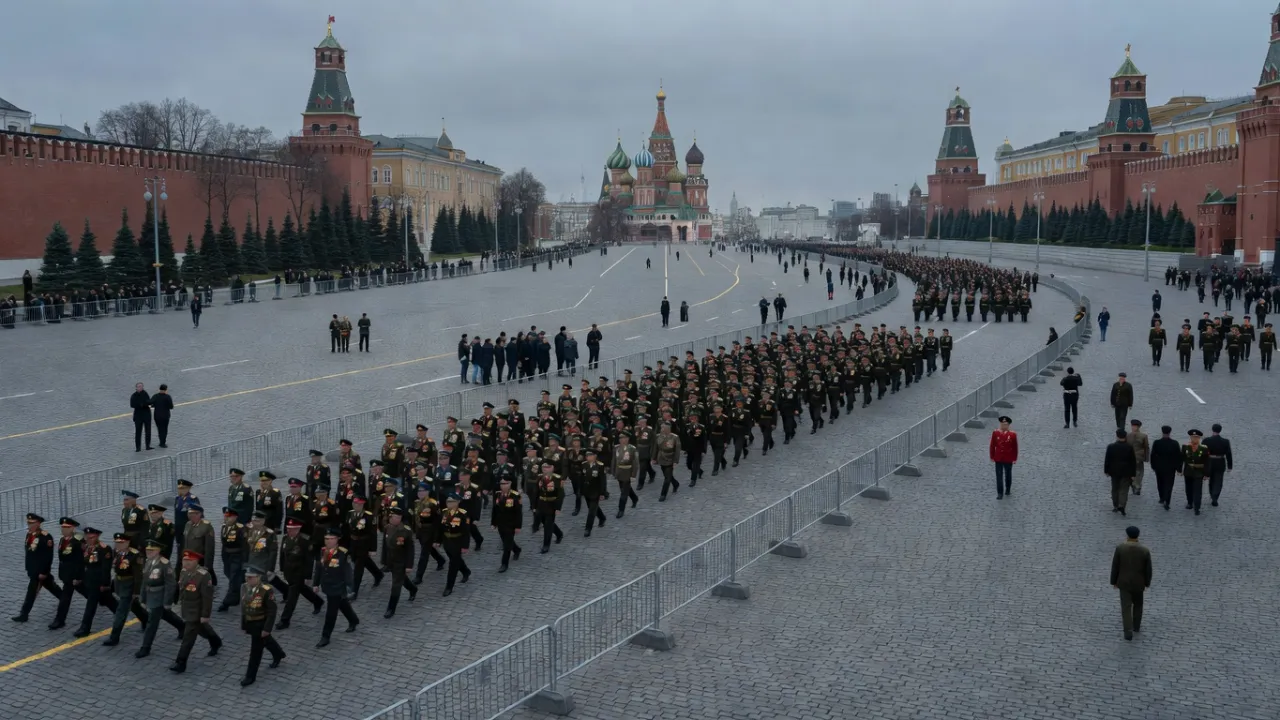
Moscow celebrates May 9 without tanks or planes: Putin's reduced parade reveals a Russia at war
For the 81st anniversary of Soviet victory, Moscow organized its May 9 parade without heavy equipment, internet cut in the city center, and for the first time with North Korean soldiers in the ranks. Putin denounced NATO and presented the Ukraine war as a continuation of the antifascist struggle.


 +7

Russia Orders Embassy Evacuations from Kyiv and Threatens Massive Strikes Before May 9
Russia issued a formal warning to foreign diplomatic missions in Kyiv to evacuate staff ahead of threatened retaliatory strikes if Ukraine disrupts the Victory Day parade on May 9. Both sides accuse each other of violating the unilateral truces they each declared, amid a dual military and rhetorical escalation.

 +3

Zelensky's ceasefire sabotaged: 1,820 Russian violations and a kindergarten in Sumy
Zelensky declares a unilateral ceasefire for Victory Day on May 9. Russia violates it 1,820 times, strikes a kindergarten in Sumy killing two, and Kyiv threatens a mirror response during Moscow's parade.
+7
Trump Pulls 5,000 US Troops from Germany — and Threatens 'A Lot Further': The NATO Fracture Deepens
After Merz accused Iran of 'humiliating' Washington in peace talks, Trump retaliated by announcing the withdrawal of 5,000 US soldiers from Germany — then escalated, threatening to go 'a lot further.' The cancellation of long-range Tomahawk missile deployment, promised by Biden, is also confirmed. NATO says it is 'working to understand' the decision. Republican committee chairs are 'very concerned.'
 +8

Cuba: Trump Tightens Sanctions and Threatens Military Intervention — Havana Warns of "Dangerous and Unprecedented" Escalation
On May 1, 2026, Donald Trump signed an executive order massively expanding US sanctions against Cuba, targeting foreign banks that cooperate with Havana and Cuban officials in the energy, defense and finance sectors. The next day, Trump declared at a private Florida dinner that the US could take control of Cuba 'almost immediately,' citing the Abraham Lincoln aircraft carrier 'on the way back from Iran.' Cuba's president denounces a 'dangerous and unprecedented level' of US military threats.

 +6

Trump Hikes EU Auto Tariffs to 25%: Brussels Fires Back, Seoul Takes Note
On May 1, 2026, Donald Trump announced he would raise US tariffs on European Union cars and trucks to 25%, up from the current 15%, accusing the EU of failing to comply with their summer 2025 trade deal. The measure was set to take effect the following week. The EU denounced the move as 'unacceptable' from an 'unreliable' trading partner. The announcement came the same day the EU-Mercosur deal entered into force, revealing the multi-front trade war Trump is waging against his allies.

 +4

EU-Mercosur Free Trade Deal Takes Effect: Brussels Wins, Paris Loses
On May 1, 2026, the long-awaited EU-Mercosur free trade agreement provisionally entered into force, creating one of the world's largest trading blocs covering 720 million consumers. The deal, 25 years in the making, eliminates tariffs on over 90% of trade. But it remains deeply contested: France decries it as a betrayal of European farmers, a legal challenge is pending before the EU Court of Justice, and the European Parliament has yet to ratify the text.

 +5

Trump Threatens to Pull US Troops from Germany: The Transatlantic Fracture Deepens
On April 30, Donald Trump posted on Truth Social that Washington is 'studying and reviewing the possible reduction of troops in Germany,' with a decision expected 'over the next short period of time.' The threat came directly after Chancellor Merz said Iran was 'humiliating' the US at the negotiating table — a comment Trump flatly rejected, calling Merz someone who 'doesn't know what he's talking about.' Berlin says it's 'prepared.' The next day, Trump extended the threat to Italy and Spain. South Korea, with 28,500 US troops of its own, is watching anxiously.
+5
Trump-Putin: The Call and the May 9 Ceasefire
Trump says he asked Putin for 'a little bit of a ceasefire' on Victory Day — an offer that Kyiv receives with suspicion and that Europe reads as a Russian communications maneuver.
+8
Iran proposes reopening Hormuz strait in exchange for end to US naval blockade
Iran has submitted a formal proposal: reopen the Strait of Hormuz if Washington lifts its naval blockade — while Trump declares Iran in 'state of collapse' and Merz accuses it of waging war without strategy.
 +13

Kim Jong-un inaugurates a museum for North Korean soldiers killed in Ukraine
Pyongyang officially acknowledges the military engagement of its soldiers in Ukraine with a national museum and state funerals — Kim Jong-un calls their deaths a "sacred war" and reaffirms the Moscow-Pyongyang axis as an anti-Western bulwark.
+2Understand global stakes from every perspective.
718 subjects · 75 countries · 8174 perspectives