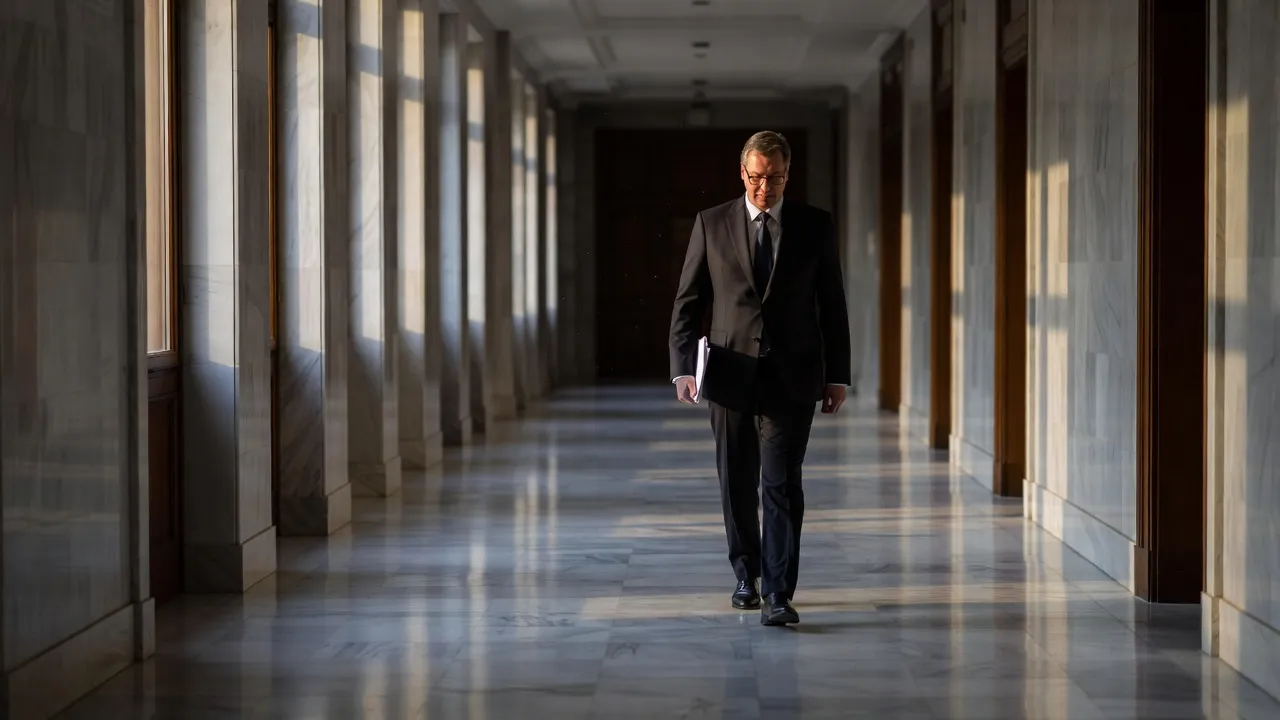

DOMINANT ANGLE
Brussels is deciphering the move: a president who is trading in his seat for a more powerful position, on the eve of an anticipated legislative election marked by student protests.
Dominant angle identified — does not reflect unanimity of this country’s media
KEY POINTS
- 01
Aleksandar Vučić, 56, announced his resignation on Sunday, September 27, in front of the presidential palace: "I resign from my duties as president".
- 02
Ana Brnabić, Speaker of the Parliament, takes over as interim starting this Monday; a new presidential election must be held within a maximum of three months.
- 03
Just before his departure, Vučić pardoned 49 people, including 23 students and supporters of his party prosecuted for actions related to the protests.
ANALYSIS
Brussels, 28 September 2026. The resignation of Aleksandar Vučić, announced on Sunday, 27 September, in front of the presidential palace in Belgrade, is seen in Brussels as a power move rather than a withdrawal. "I resign from my duties as president," the Serbian head of state declared to his supporters, before adding: "Tomorrow morning, I will hand over my mandate to the president of the National Assembly." At 56, and after two presidential terms that the Serbian Constitution prohibited him from renewing, Vučić is not leaving the scene: he is taking the lead of the list of his Serbian Progressive Party (SNS) for the early legislative elections on 25 October, with the stated goal of becoming Prime Minister again, a position considered formally more powerful than the presidency.
The interim will fall to Ana Brnabić, President of the Parliament and close ally of Vučić, as of this Monday, pending the organisation of a presidential election within a maximum period of three months. A few minutes before announcing his departure, the outgoing president again used his constitutional prerogatives to pardon 49 people, including 23 students and sympathisers of his party prosecuted for facts related to the demonstrations that have been shaking the country for nearly two years.
The 25 October election is taking place in a climate of unprecedented protest for Vučić, president and now candidate for Prime Minister, who has been in a dominant position since 2014. The movement, mainly carried by students, was born after the collapse of a canopy at the Novi Sad train station in 2024, which had killed 16 people and since then has fueled accusations of corruption and mismanagement of institutions. The SNS will face two distinct blocks: a movement directly born from the student mobilisations against corruption, and a coalition of pro-European opposition parties that hopes to benefit from the wear and tear of the current power.
For the Belgian press, the issue is less about the institutional form of power than its continuity: by changing chairs, Vučić is seeking to preserve his political influence without facing the constitutional limit of the two presidential terms he has already exhausted. The European candidacy of Serbia, mentioned at the end of the article but not developed by Belgian sources, remains in the background of a narrative focused primarily on the internal electoral mechanism and the showdown with the street.