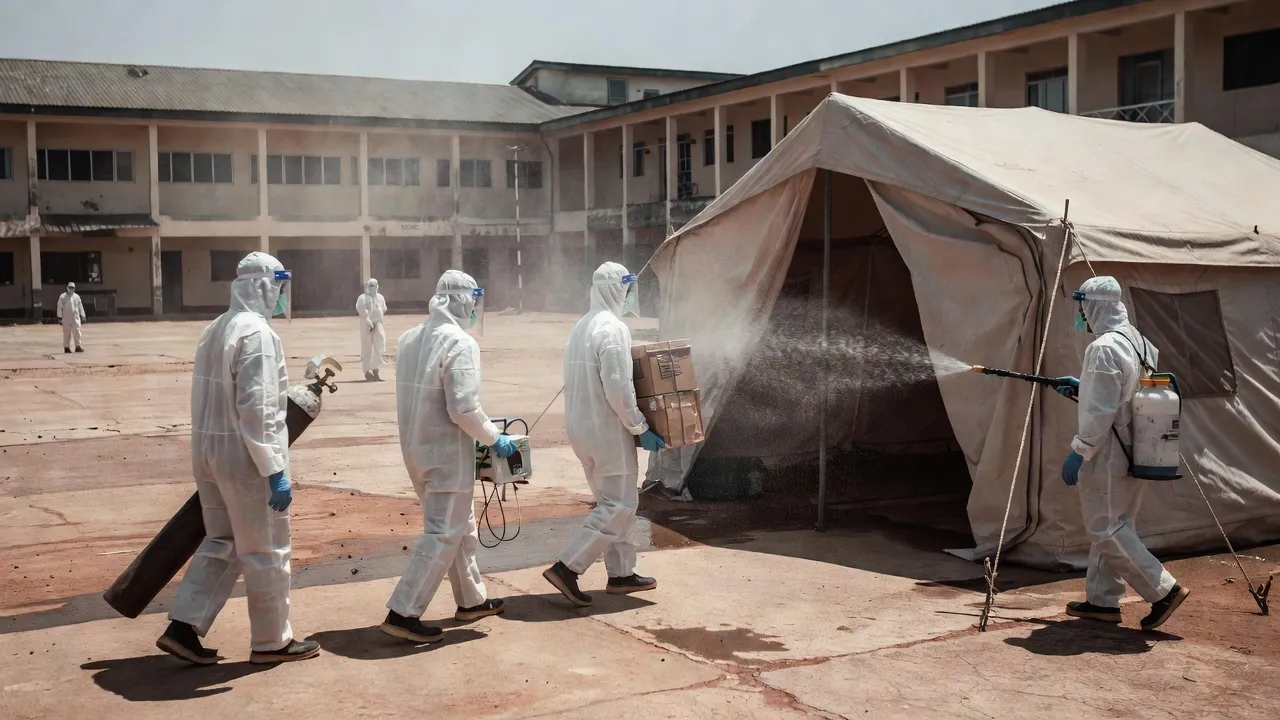
Common ground and differences in coverage across the media analysed.
What the media report in common
1
Nigerian Health Minister Muhammad Ali Pate announced on Tuesday, October 20, 2026, the confirmation of an Ebola case in Abuja, the first case of this type in the capital.
2
Nigerian authorities have identified 44 contacts (healthcare workers, patients, relatives, travelers), whose tracing is at the center of the coverage in ten out of eleven perspectives.
3
The case is part of the regional extension of the Bundibugyo epidemic born in the DRC, which also affects Uganda and Kenya.
Where media coverage diverges
Location of patient exposure
Question: is the patient's infection linked to Uganda? German, Danish, French, Ghanaian, and American media report a patient from Uganda; Kampala claims to have no active cases and says transit does not prove infection on its soil, which is relayed by Kenyan, British, South African, and Nigerian media.
Question: how many cases does Kenya have? Nine according to Kenyan, French, Swedish, and British media; eight according to Politiken, which cites Patrick Amoth via Reuters after a new case.
Question: is the species responsible established? The NCDC, as reported by French media, confirms Bundibugyo; Premium Times indicates it cannot independently confirm the responsible species.
Abuja is gauging its response to the test: between maximum alert from the States, health funds claimed by lawmakers and divergence with Kampala over the origin of the imported case.
Stockholm is gauging the risk of regional spread: for Dagens Nyheter, a single case in Abuja is more concerning than nine cases in Kenya, and contact tracing has become the central issue.
Kinshasa takes away from this Nigerian case the urgency of funding: the Congolese press relays the call from Africa CDC and places the DRC, with a lethality rate close to 50%, at the center of a continental threat.
Abuja is gauging its response to the test: between maximum alert from the States, health funds claimed by lawmakers and divergence with Kampala over the origin of the imported case.
KEY POINTS
Minister Muhammad Ali Pate announced on Tuesday, October 20, an imported Ebola case in Abuja, with 44 contacts identified (healthcare workers, patients, companions, travelers).
The House of Representatives asked the executive to release the funds already allocated to health agencies to strengthen the response.
Uganda claims to have no active cases and that "the place of exposure is still under study", the patient being a Nigerian in transit after a trip to the DRC.
ANALYSIS
Abuja, October 21, 2026. The Minister of Health, Muhammad Ali Pate, announced on Tuesday, October 20, the confirmation of an Ebola case in the Federal Capital Territory. The patient, who arrived from Uganda by international flight, was treated for several days in a private hospital before the diagnosis, according to a government statement cited by Nairametrics. She is in isolation. Forty-four contacts, including healthcare workers, patients, companions, and travelers, are being monitored. Punch reports that Pate called on the flight passengers to cooperate with contact tracing.
On Wednesday, October 21, according to Nigerian Eye, the NCDC identified the Bundibugyo strain after three series of molecular tests, with no specific vaccine or treatment, and reported a multi-organ failure. Premium Times, more cautious, writes that it cannot independently confirm the species involved. The newspaper recalls that Nigeria had controlled an outbreak in 2014 that killed eight people.
The Nigerian press emphasizes the domestic response. The House of Representatives, on a motion by Amobi Ogah, asked the executive to release the already voted funds for health agencies. The states are following suit: Niger has activated its emergency operations center, citing travel to Abuja and Minna Airport; Kano is calling on healthcare workers to maintain a "high index of suspicion"; Ogun claims to have monitored 111 at-risk travelers. The airport authority FAAN is strengthening surveillance at all airports.
The point of friction comes from Kampala. The Ugandan Ministry of Health claims that the patient is a Nigerian who traveled to the eastern Democratic Republic of Congo for business, simply in transit, and that "the place of exposure is still being studied". It says it has no confirmed active cases and is demanding the patient's itinerary and medical records from Nigeria. Punch notes that these divergent accounts require clarification.
External support is being widely reported. The Director-General of the Africa CDC, Jean Kaseya, praises Pate's transparency and calls for "immediate and flexible" funding: "Every day of delay costs lives." The WHO promises support for contact tracing and protective equipment. The US Embassy advises its citizens to monitor their health for 21 days after traveling to an affected area.
Sweden
DOMINANT ANGLE
Stockholm is gauging the risk of regional spread: for Dagens Nyheter, a single case in Abuja is more concerning than nine cases in Kenya, and contact tracing has become the central issue.
KEY POINTS
According to Aftonbladet, Minister Muhammad Pate says 44 people in contact with the patient have been identified; she was admitted on October 11 to a private hospital in Abuja.
Dagens Nyheter puts the epidemic in the Congo at around 9,500 sick and over 4,500 dead.
Kenya has nine cases, eight new ones linked to the first case that arrived in Nairobi on October 3, all diagnosed in quarantine according to DN.
ANALYSIS
Stockholm, October 21, 2026. The Swedish press is treating the Nigerian announcement as a regional health alert rather than a strictly national issue. In Dagens Nyheter, correspondent Erik Esbjörnsson, reporting from Johannesburg, says that a case of Ebola in Nigeria "can be worse than nine in Kenya". He finds Tuesday evening's news from the largest country in Africa "far more disturbing": it is the first confirmed case in 12 years.
Aftonbladet provides factual information and contact tracing. The patient showed symptoms on October 7, was admitted on October 11 to a private hospital in Abuja, where Ebola was diagnosed. Health Minister Muhammad Pate indicates that the authorities have found and identified 44 people who were in contact with her. The newspaper recalls that Uganda had already reported cases before being declared virus-free, and that Kenya, which announced a confirmed death at the beginning of October, now has nine cases.
Dagens Nyheter puts the episode into the context of the chain of contamination that started in eastern Congo, where around 9,500 people have fallen ill and more than 4,500 have died. Kenya serves as a point of comparison: on October 3, a seriously ill man arrived in Nairobi and was taken by relatives to a large hospital, where Ebola was confirmed; he died two days later. Eight new cases have been recorded in recent days, all linked to the first, including family members and caregivers. All are said to have been diagnosed while already in quarantine, which, according to Dagens Nyheter, indicates that the Kenyan authorities have the situation under control.
DR Congo
DOMINANT ANGLE
Kinshasa takes away from this Nigerian case the urgency of funding: the Congolese press relays the call from Africa CDC and places the DRC, with a lethality rate close to 50%, at the center of a continental threat.
KEY POINTS
On Tuesday, October 20, 2026, Professor Muhammad Ali Pate informed Jean Kaseya of the confirmation of an Ebola Bundibugyo case in Nigeria (Radio Okapi, Actualité.cd).
Jean Kaseya is calling for "immediate and flexible funding, medical supplies, diagnostics, trained responders, and enhanced community surveillance".
Africa CDC, which declared the epidemic on May 15, 2026, mentions a fatality rate close to 50% and the largest geographical spread in history for this strain.
ANALYSIS
Kinshasa, October 21, 2026. Congolese media are covering the confirmation of a case of Ebola of the Bundibugyo strain in Nigeria almost exclusively through the words of Africa CDC. Actualité.cd and Radio Okapi are reporting the statement published on Tuesday, October 20, 2026, on the X account of its Director General, Jean Kaseya, after an interview with the Nigerian Minister of Health and Social Welfare, Professor Muhammad Ali Pate. The latter announced the confirmation of the case to him.
The tone is one of regional alert. Jean Kaseya "praises his transparency and leadership" and states that "early notification of cases saves lives." He recalls that when Africa CDC declared the epidemic on May 15, 2026, the organization had already warned of its regional dimension and the risks of cross-border spread. According to him, this Bundibugyo epidemic has become the most geographically widespread in history, with affected countries in three regions of Africa.
The DRC appears in these articles as the reference hub. The two media outlets note that the lethality is approaching 50% in the country, a figure that Jean Kaseya invokes to speak of an "extremely serious" threat to Africa. Radio Okapi specifies that Africa CDC is intensifying its response activities in the DRC and Kenya, while maintaining increased vigilance in Uganda, and that it has begun to mobilize support for Nigeria.
Germany
DOMINANT ANGLE
Berlin notes from the Nigerian announcement the contact tracing effort: 44 people identified around a patient carrying the Bundibugyo variant, fourth African country affected.
KEY POINTS
44 contacts identified around the patient, including medical staff, other patients, caregivers, and travel contacts (Tagesschau)
Nigeria, the fourth African country affected by the Bundibugyo variant, after the DRC, Uganda, and Kenya (Tagesschau)
DRC: 9,552 cases and 4,602 deaths recorded according to Tagesschau; the epidemic began in mid-May
ANALYSIS
Berlin, October 21, 2026. For the Tagesschau as for the Deutsche Welle, the news first concerns a geography: Nigeria, "Afrika's bevölkerungsreichstes Land" with some 220 million inhabitants, records its first case of Ebola in the current epidemic. The Tagesschau headlines "Nigeria bestätigt ersten Ebola-Fall" and specifies that it is the Bundibugyo variant.
The facts are presented in a sober manner. According to the Ministry of Health cited by the Tagesschau, the patient recently arrived from Uganda by plane and was treated for several days in a private clinic in the Abuja region before laboratory results confirmed the infection. She is in isolation and receiving care. The DW, which dates the announcement to Tuesday, cites Minister Muhammad Ali Pate: the woman arrived "on an international flight from Uganda". The channel indicates that the first symptoms appeared on October 7 and that hospitalization in a private establishment in Abuja dates back to October 11.
Contact tracing is at the center of both texts. Forty-four contacts have been identified, including medical staff, other patients, caregivers, and people met during travel. Pate assures: "We are doing everything possible to contain this case by tracing all contacts the individual may have had". The government has called on all public and private establishments to be on "höchster Wachsamkeit".
The DW recalls that the Nigerian Center for Disease Control had strengthened surveillance two weeks earlier after the first cases in Kenya, and that the country created an Ebola crisis cell in June. It cites the desire not to repeat the episode of the previous epidemic, where a carrier had entered the country and where everyone had to improvise.
Denmark
DOMINANT ANGLE
Copenhagen is quietly relaying Abuja's alert and is particularly focused on contact tracing, following a Congolese epidemic that is crossing borders.
KEY POINTS
Nigeria's Health Minister, Muhammad Ali Pate, confirmed on Tuesday a case of Ebola in Abuja in a woman from Uganda, who was initially treated for several days in a private hospital.
44 close contacts of the patient have been identified; authorities will monitor healthcare workers, patients, relatives, and others she encountered during her trip.
In Kenya, a new case (a 49-year-old hospital cleaner) brings the total to eight, according to Patrick Amoth, cited by Reuters via Politiken.
ANALYSIS
Copenhagen, October 21, 2026. The Danish press treats the Nigerian announcement as a news agency dispatch, without editorializing or dramatization. Berlingske and Politiken headline almost identically: "Nigeria confirms its first case of Ebola," and both rely on AFP.
The Nigerian Minister of Health, Muhammad Ali Pate, confirmed a case in Abuja, the capital, on Tuesday. It involves a woman who had traveled from Uganda to Nigeria. According to the official statement reported by AFP, she was admitted to a private hospital after her arrival, where she received care for several days before the diagnosis was definitively confirmed. She has since been isolated and is continuing treatment, the minister specifies.
The focus is on contact tracing. A significant search effort has been launched, and 44 close contacts have been identified so far. Berlingske notes, however, that it is not specified whether these individuals are considered particularly exposed. The Nigerian Ministry of Health indicates that the authorities will monitor people who may have been exposed: healthcare workers, patients, relatives, and others encountered during the patient's journey.
The two daily newspapers place the case in the regional dynamic. The epidemic that started in the Democratic Republic of Congo, declared in May but which, according to Berlingske, was probably already circulating beforehand, has spread to several neighboring countries. Politiken associates the information with Kenya, which has confirmed a new case, bringing the total to eight. Patrick Amoth, Director-General at the Kenyan Ministry of Health, told Citizen TV: "Today, 38 people were tested, and one tested positive for Ebola." The patient, a 49-year-old man, was cleaning instruments and laundry in a hospital; he is believed to have been contaminated by the first Kenyan case, a traveler from the DRC who died in Nairobi on October 5.
France
DOMINANT ANGLE
Paris is assessing the health risk of an Ebola Bundibugyo outbreak that has arrived in Abuja: a strain with no approved vaccine, 44 contacts to monitor, and an epidemic that is spreading to a fourth country on the continent.
KEY POINTS
Nigerian Health Minister Muhammad Ali Pate announced on Tuesday, October 20, the first case of Ebola in Abuja, in a patient who arrived from Uganda, with 44 close contacts identified.
The NCDC confirmed on Wednesday, October 21, after three levels of molecular testing, that the strain was Bundibugyo, the same as the outbreak in the DRC; the patient, a diplomat, is in multi-organ failure.
The outbreak declared in May in the DRC has surpassed 9,000 cases and 4,381 deaths according to Le Monde and France 24, and Kenya has reported nine cases, including one death.
ANALYSIS
Paris, October 21, 2026. France is closely following the Nigerian announcement as a further step in the spread of an epidemic born in the Democratic Republic of Congo, and primarily gives it a health-related interpretation.
On Tuesday, October 20, Nigerian Health Minister Muhammad Ali Pate announced the first case of Ebola on the territory, in Abuja, "the capital of the most populous country in Africa". The patient, "a woman who recently arrived in Nigeria on an international flight from Uganda", was admitted to a private hospital "where she was treated for several days before the diagnosis was confirmed". The government called on "all public and private health facilities" to be on "maximum alert".
On Wednesday, October 21, Le Monde reported the precision of the Nigerian Center for Disease Control and Prevention (NCDC): after three levels of molecular tests, "the strain was Bundibugyo", the one that is prevalent in the DRC. An official described a diplomat who arrived on October 3, whose condition worsened to "multivisceral failure". The 44 close contacts, including healthcare workers, patients, caregivers, and travelers, are being closely monitored.
Ghana
DOMINANT ANGLE
Accra is watching the arrival of Ebola in Abuja as a regional tracing test: an imported case from Uganda, 44 contacts, and a strain without an approved vaccine.
KEY POINTS
Nigerian Health Minister Muhammad Ali Pate confirmed on Tuesday a case of Ebola in Abuja in a traveler from Uganda, with 44 contacts identified.
The outbreak that began in May in the DRC has caused at least 4,600 deaths out of more than 9,500 cases according to the ECDC, cited by Graphic Online.
The Bundibugyo strain has no approved vaccine or treatment, with trials underway.
ANALYSIS
Accra, October 21, 2026. The Ghanaian press reported on Tuesday the confirmation of an Ebola case in Abuja. According to GBC Ghana Online, Nigerian Health Minister Muhammad Ali Pate announced that a traveler from Uganda had tested positive, marking the first appearance of the disease in the capital during the recent regional outbreak. Graphic Online adds that Nigeria is the first West African state to report a case related to the current crisis in East Africa, and recalls that it had managed to contain a previous epidemic in 2014.
The chronology is detailed by GBC: symptoms appeared on October 7, the patient was admitted on October 11 to a private hospital in Abuja, and the infection was then verified in a laboratory. She is in isolation and receiving specialized care, while the authorities have launched containment procedures to prevent local transmission.
Contact tracing is at the center of the story. Epidemiologists have identified 44 people who came into contact with the patient before her isolation. "We are doing everything possible to contain this case by tracing all the contacts this person may have had," said Mr. Pate. On public television NTA, he assured that she "is receiving quality care" and that contact tracing "is underway".
Graphic Online puts the case into the context of the epidemic that began in May in the Democratic Republic of Congo: at least 4,600 deaths and more than 9,500 cases, according to the European Centre for Disease Prevention and Control. It is caused by the relatively rare Bundibugyo species, for which there is no approved vaccine or treatment, although trials are ongoing. Uganda, where at least two people have died, had declared itself free of the disease in August; Kenya has at least nine infections, and the United States raised its travel alert level for the country on Monday.
Kenya
DOMINANT ANGLE
Nairobi is assessing the Abuja case based on its own record, with nine cases and 134 contacts out of 135 in quarantine, and is echoing Kampala's deflection of responsibility.
KEY POINTS
The Nigerian Health Minister, Muhammad Ali Pate, announced the case on Tuesday, October 20, and reported 44 people identified as contacts.
Nine Ebola cases have been confirmed, including one death, with 134 of the 135 identified contacts placed in quarantine.
Uganda claims to have no confirmed active cases and says the patient's transit does not prove an infection on its soil.
ANALYSIS
Nairobi, October 21, 2026. The Kenyan press is covering the first confirmed Ebola case in Abuja from the angle of regional health response, immediately linking it to the situation in Kenya. Tuko reports on the "44 identified contacts" and recalls that Kenya has confirmed nine Ebola cases, including one death, with 134 out of 135 identified contacts found and quarantined.
The Nigerian Minister of Health, Muhammad Ali Pate, announced the case on Tuesday, October 20, on the public channel NTA. It involves a woman who recently traveled to Uganda, initially admitted to a private hospital in Abuja where she was treated before laboratory tests confirmed the infection. "She is in isolation and receiving quality care," the minister said, specifying that contact tracing is ongoing. The authorities are trying to determine if others have been exposed, including healthcare workers and others who came into contact with the patient.
Capital FM, which picked up a Xinhua dispatch dated October 21 from Kampala, provides the Ugandan version. The Ugandan Ministry of Health indicated in a statement released late Tuesday that it had not recorded any active confirmed cases. According to the ministry, the Nigerian woman had traveled to eastern Democratic Republic of Congo for business before transiting through Uganda in early October. She had not shown any symptoms in Uganda, with signs appearing after her arrival in Nigeria. "Travel through Uganda does not establish that infection occurred here," the ministry wrote: transiting through Uganda does not prove that the infection occurred there. The location of exposure remains under investigation.
United Kingdom
DOMINANT ANGLE
London is gauging the geographical spread of Ebola through the Abuja case, emphasizing the tracing of 44 contacts and the regional scope of the Bundibugyo strain.
KEY POINTS
Nigeria has confirmed an Ebola case in Abuja in a woman from Uganda; 44 close contacts have been identified for tracing (BBC).
Symptoms appeared on October 7 according to the WHO; Uganda claims the patient only transited and asserts it has no confirmed active cases (BBC, Guardian).
The epidemic in the DRC has killed at least 4,600 people with over 9,500 cases; Kenya has nine infections (BBC, Guardian).
ANALYSIS
London, 21 October 2026. The British press is treating the Abuja case as a stage in an epidemic that is changing scale. The BBC reports that Nigeria has recorded an Ebola case in a woman who traveled from Uganda to the capital, "Abuja, capital of the West African state". The Minister of Health, Muhammad Ali Pate, specifies that the diagnosis was confirmed by laboratory tests. According to health sources cited by the channel, the patient is not Nigerian and is the wife of a diplomat; she is isolated and being treated in a hospital in Abuja.
The medical calendar is given with precision. According to the WHO, as reported by the BBC, the symptoms appeared on 7 October, four days after the patient arrived in the country. The Guardian indicates that she was admitted to the hospital four days later, then diagnosed, while noting that it is unknown when she arrived in Nigeria. The authorities have begun contact tracing: 44 people have been identified. "We are doing everything possible to contain this case," Pate tells the daily.
The two titles recall that Nigeria, the first state in West Africa to report a case related to the current crisis, had managed to halt a previous epidemic in 2014. The Guardian makes this case the latest in a series: Kenya confirmed its first case this month and now has nine infections.
A point of friction appears with Kampala. The Ugandan Ministry of Health claims that the patient only transited through Uganda and that she is a Nigerian on a business trip in eastern Democratic Republic of Congo. "Travel through Uganda does not establish that infection occurred here," it writes, adding that the place of exposure remains under study and that there are "no confirmed active Ebola cases" in the country. The Nigerian authorities have not published the patient's nationality, which The Guardian notes.
United States
DOMINANT ANGLE
The United States is analyzing the Abuja case as another link in a regional Bundibugyo epidemic, where everything hinges on tracing the 44 contacts.
KEY POINTS
Nigeria confirmed an Ebola case on Tuesday in Abuja in a woman who arrived from Uganda; symptoms on October 7, admission on October 11 to a private hospital.
Minister Muhammad Pate indicates that 44 contacts have been identified and their tracing has begun.
Jean Kaseya, from Africa CDC, mentions an "extremely serious threat", a fatality rate close to 50%, and the most geographically extensive Bundibugyo epidemic in history.
ANALYSIS
Washington, October 21, 2026. US media outlets are reporting an Associated Press dispatch from Lagos, stating that Nigeria confirmed a case of Ebola in its capital, Abuja, on Tuesday, October 20, in a woman who arrived from Uganda and tested positive, according to the Ministry of Health.
The account focuses first on the clinical timeline. The patient presented symptoms on October 7 and was then admitted to a private hospital in Abuja on October 11, where the Ebola diagnosis was made. The text does not detail what happened between these two dates, but the reader can measure the interval.
The Minister of Health, Muhammad Pate, is the central voice. He indicates that the authorities have begun to track down 44 people identified as contacts of the patient: "We are doing everything possible to contain this case by tracking down all the contacts this person may have had." The Nigerian Centre for Disease Control (NCDC) is cited for having strengthened surveillance two weeks ago, after the virus was detected in Kenya, with an emphasis on early detection, isolation, laboratory diagnosis, infection prevention, contact tracing, and protection of healthcare workers.
The case is placed in a regional dynamic. Uganda had reported cases before declaring itself free of the disease; Kenya confirmed its first case earlier in October and has since recorded nine infections. Nigeria is presented as "the last country" to be affected by the outbreak.
South Africa
DOMINANT ANGLE
Pretoria is tracing the continental spread of the Bundibugyo strain: the Abuja case is presented as a new link, after the Congo, Uganda and Kenya, with the tracing of 44 contacts at the center of the story.
KEY POINTS
Minister Muhammad Ali Pate confirmed an Ebola case in Abuja and reported 44 contacts already identified.
Ugandan spokesman Alan Kasujja stated: "There is no Ebola in Uganda", while the WHO had declared the country Ebola-free in August.
The Bundibugyo epidemic has reached an eighth Congolese province, Nord-Ubangi, and Kenya reported cases this month.
ANALYSIS
Pretoria, October 21, 2026. Nigeria's Minister of Health, Muhammad Ali Pate, confirmed on Tuesday, October 20, 2026, a case of Ebola in Abuja, after laboratory confirmation. Daily Maverick, which reprints a Reuters dispatch, and SABC News, the South African public broadcaster, report the same statement made to the public channel NTA: the patient, a woman who traveled to Uganda, "is in isolation and receiving quality care".
Contact tracing is "underway" and 44 contacts have already been identified, Pate said. Daily Maverick specifies that the patient had been admitted to a private hospital in Abuja, where she received care for several days before the diagnosis was confirmed. The minister recalls that "Nigeria successfully contained Ebola in 2014" and has the experience and public health systems to respond to this case.
The Ugandan aspect is being treated with caution. When asked, the Ugandan government spokesperson, Alan Kasujja, replied: "There is no Ebola in Uganda." Daily Maverick recalls that Uganda reported 20 cases in May and June, mostly imported from the Congo, before being declared virus-free by the WHO in August.
The regional context occupies the other half of the texts. The epidemic, declared in the Democratic Republic of Congo in mid-May, has become the second most important ever recorded, caused by the rare Bundibugyo strain. SABC News adds that it has reached an eighth Congolese province, Nord-Ubangi, bordering the Central African Republic, where the National Institute of Biomedical Research confirmed two cases, including one death. The channel sees this as a "new challenge" for authorities struggling to contain the outbreak, the worst in Congolese history.
Explore every perspective on this subject across 11 countries.
Nigeria: first Ebola case in Abuja, a strain with no approved vaccine, 44 contacts isolated
published on
October 21, 2026
11
countries
26
sources
27
articles
35/100
gap
Beyond Abuja's announcement, the coverage focuses on three points: Nigeria's domestic response, the disagreement with Kampala over the patient's route, and how each press outlet frames this case within the regional epidemic.
The patient is in isolation, the 44 contacts are being monitored, and Uganda contests that the exposure occurred on its territory, the place of infection remaining to be established.
A national response is being organized
The Nigerian press emphasizes the domestic response. According to Premium Times, the House of Representatives, on a motion by Amobi Ogah, asked the executive to release the funds already voted for health agencies.
The states are aligning, reports the same press. Daily Post writes that Niger is activating its emergency operations center, citing displacements towards Abuja and Minna airport. Kano calls on healthcare workers to maintain a "high index of suspicion", and Ogun says it has tracked 111 at-risk travelers.
Nairametrics relays the decision of the airport authority FAAN to strengthen surveillance in all airports. In its statement, the FAAN presents the early detection of the case as an illustration of the coordination between public agencies. Also according to the Nigerian press, the WHO promises support for contact tracing and protective equipment, and the US Embassy advises its citizens to monitor their health for 21 days after traveling to an affected area.
The journey of the patient in question
The accounts of the patient's arrival do not coincide in all details. The BBC cites health sources according to which she is not Nigerian and is the wife of a diplomat. The Guardian notes that the Nigerian authorities have not published her nationality and that the date of her arrival is unknown. According to the WHO, cited by the BBC, the symptoms appeared four days after her arrival in the country.
« Travel through Uganda does not establish that infection occurred here »
Ugandan Ministry of Health, statement reprinted by Capital FM Kenya, 21 October 2026
On nationality, the Ugandan version is different. In a statement reproduced by Capital FM Kenya from a Xinhua dispatch, the Ugandan Ministry of Health describes a Nigerian woman who traveled for business in eastern DRC, then passed through Uganda in early October. It indicates that she did not present any symptoms and is requesting her itinerary and medical file from Abuja.
The Ugandan government spokesperson, Alan Kasujja, responded to Daily Maverick: "There is no Ebola in Uganda." The newspaper recalls that Uganda had reported 20 cases in May and June, mostly imported from Congo, before being declared virus-free by the WHO in August. Punch writes that these divergent accounts call for clarification.
Five out of eleven perspectives (DRC, Germany, France, United States, Denmark) do not mention this dispute. This count measures what the coverage of the corpus retains, not the degree of credit given to one version or the other.
Death tolls that vary depending on the headlines
For the DRC, the cited figures are not identical. Tagesschau reports 9,552 cases and 4,602 deaths according to the health authority. France 24 and Le Monde cite more than 9,000 cases and 4,381 deaths. RFI mentions more than 4,500 deaths for approximately 9,500 cases, and the BBC and Graphic Online report "at least 4,600" deaths, according to the European Centre for Disease Prevention and Control. The articles do not specify the cutoff date for each count.
Kenya experiences the same discrepancy. Tuko, the Guardian, and Dagens Nyheter report nine cases; Tagesschau and Politiken, eight; SABC News, seven. Tuko adds that 134 of the 135 identified contacts have been found and quarantined. Politiken, citing Patrick Amoth via Reuters, describes a 49-year-old man who cleaned instruments and laundry in a hospital and was allegedly contaminated by Kenya's first case, who died in Nairobi on October 5.
Regarding the species in question, Le Monde reports the NCDC's clarification: Bundibugyo, after three levels of molecular tests. Premium Times, on the other hand, writes that it cannot independently confirm the responsible virus.
Eight perspectives repeat the same figure of 44 contacts. This count measures the repetition of the same official announcement in the corpus, not an independent verification.
Interpretations of the regional alert
Jean Kaseya, director general of the Africa CDC, is the most quoted voice on the scale of the epidemic. In The Guardian and on NPR, he mentions a lethality close to 50% and a Bundibugyo epidemic "the most geographically extensive in history", with affected countries in three regions of Africa. Radio Okapi attributes this lethality figure to him alone.
« we are facing an extremely serious threat »
Jean Kaseya, Director-General of Africa CDC, quoted by The Guardian, 21 October 2026
The Congolese press, Actualité.cd and Radio Okapi, reads the Nigerian case almost entirely through this statement. It does not detail either the patient or the isolated contacts. Radio Okapi specifies that the Africa CDC is intensifying its response in the DRC and Kenya, maintaining its vigilance in Uganda, and has begun to mobilize support for Nigeria.
The angles vary according to the editorial offices. Tagesschau describes Nigeria as "Afrikas bevölkerungsreichstes Land", with some 220 million inhabitants, and the fourth African country affected. In Dagens Nyheter, correspondent Erik Esbjörnsson judges the news from Abuja "much more worrying" than the nine cases in Kenya, as it is the first confirmed case in Nigeria in 12 years. SABC News notes for its part that the epidemic has reached an eighth Congolese province, Nord-Ubangi.
Ten perspectives out of eleven place contact tracing at the center of their story. This count measures the convergence of the coverage of the corpus on this theme, and not the level of health risk.
Bundibugyo strain
No approved vaccine or treatment exists for this species, with trials underway.
Clinical timeline
Symptoms appeared on October 7 according to the WHO, admission on October 11 to a private hospital in Abuja.
Position of Uganda
Kampala claims to have no active cases and says the location of the exposure is still under study.
Call from Africa CDC
Jean Kaseya demands immediate and flexible funding, diagnostics, and enhanced community surveillance.
The newspaper recalls that the incubation period usually lasts one to three weeks, with some cases being faster, and that two weeks have passed since the death in Nairobi. The fear is that other countries will be affected in the same proportions. Aftonbladet, for its part, describes the transmission through direct contact with bodily fluids and the symptoms: fever, vomiting, diarrhea, and, in severe cases, skin and internal bleeding.
The two Swedish newspapers thus focus on the scope of the epidemic, the geography of its spread, and the ability of states to isolate contacts, rather than on Nigerian domestic politics or international aid.
The essence of the message lies in a request for resources. The Director General is calling for "immediate and flexible funding, medical supplies, diagnostics, trained responders, and enhanced community surveillance." Actualité.cd headlines with an "urgent mobilization of the international community" and the financial, logistical, and medical support that partners must reinforce without delay.
The articles do not detail the patient, isolated contacts, or hospital management in Abuja: the Nigerian case serves as a signal of the extension of an epidemic that the DRC has been bearing the weight of for five months. The narrative emphasizes cooperation between countries and the speed of notification as levers to contain the spread, rather than Nigeria's health policy.
The regional context is detailed with figures. The epidemic began in mid-May in the Democratic Republic of Congo, where the Tagesschau reports 9,552 cases and 4,602 deaths according to the health authority. Kenya has eight cases, including one death, according to the Tagesschau, nine cases according to the DW; Uganda, which borders Congo and Kenya, has a total of 20 confirmed cases. The DW emphasizes that the vast majority of cases remain concentrated in the DRC, especially in the eastern provinces.
The two media outlets remain in the register of service information: no criticism of the Nigerian authorities, no debate on late management, little room for funding appeals. The emphasis is on the transmission chain and health surveillance.
The Danish account remains factual and focused on the health care system: isolation, contact tracing, and the delay before diagnosis. It does not address the issue of vaccination, the funding of the response, or the human toll in the DRC, and does not quote any Danish voices, whether from the government or experts, on the potential risk to Europe.
The French press is placing this case in a geography of contagion. RFI notes that West Africa had so far been spared from this strain, and recalls the 2014 Nigerian epidemic: eight deaths for about twenty cases. Le Monde counts Nigeria as the fourth country affected, after the DRC, Uganda, and Kenya, where nine cases including one death have been recorded since early October. On the Congolese side, the reported tolls are over 9,000 cases and 4,381 deaths according to France 24 and Le Monde, and over 4,500 deaths for about 9,500 cases according to RFI.
The head of the Africa CDC, Jean Kaseya, warned of "an extremely serious threat". France 24 also refers to the visit of the French Foreign Minister to the DRC, who came to plead for increased aid, which links the file to Paris' commitment to the response.
The tone remains factual: the articles reproduce the official Nigerian statements, detail contact tracing and the patient's isolation, without comment on the management of the private hospital that treated her for several days before the diagnosis.
The two media outlets finally highlight the cross-border dimension: GBC notes that regional travel continues to complicate surveillance between neighboring countries. Nigeria, according to Graphic, had already strengthened its health surveillance since the start of the epidemic. Neither of the two articles directly addresses Ghana's preparation.
Kampala adds that the Nigerian authorities have not yet provided details of the patient's itinerary and medical history, necessary for potential investigations and additional tracing. This point of friction between the two capitals is relayed as is by the Kenyan media.
For the Kenyan reader, the narrative thus links three elements: an imported case in a West African metropolis, a travel chain passing through East Africa, and a national balance presented as controlled, with almost all contacts monitored. The articles do not detail the strain involved, the patient's condition, or the funding needs for the response.
The regional context dominates. The Guardian quotes the Director-General of the Africa CDC, Jean Kaseya: "we are facing an extremely serious threat", with a fatality rate close to 50%, and a Bundibugyo epidemic that has become "the most geographically extensive in history", affecting several countries in three regions of Africa. The BBC situates the Congolese outbreak, declared in May, at over 4,600 deaths and more than 9,500 cases according to the European Centre for Disease Prevention and Control, and recalls the modes of transmission through contact with bodily fluids.
The alert comes from the Africa CDC. Its Director-General, Jean Kaseya, writes on X: "We are facing an extremely serious threat," with a fatality rate close to 50% of cases. He adds that the Bundibugyo epidemic "has already become the most geographically widespread in history," affecting several countries across three regions of Africa.
The coverage remains factual and sober, without editorial commentary or an angle on American politics in the available excerpts. The two media outlets in the corpus, ABC News and NPR, publish the same agency text, which limits the diversity of voices: only Nigerian and continental officials are heard, not independent experts or witnesses.
Kenya reported nine cases this month, according to Daily Maverick, seven according to SABC News, all linked to a person from the Congo. The head of the Africa CDC, Jean Kaseya, indicated that the agency is starting to mobilize support for Nigeria and that this epidemic is already "the most geographically extensive in history", affecting countries across three regions of Africa.
In these two texts, South Africa is not mentioned: the Nigerian case is seen as a link in a continental chain, from Kinshasa to Nairobi and Abuja, where the challenge is contact tracing and the movement of travelers.
More divergent than 23% of recent comparable stories (reference: 94 recent stories measured with the same method).